CBSE Class 12 Chemistry Electrochemistry Notes Set F

Download the latest CBSE Class 12 Chemistry Electrochemistry Notes Set F in PDF format. These Class 12 Chemistry revision notes are carefully designed by expert teachers to align with the 2025-26 syllabus. These notes are great daily learning and last minute exam preparation and they simplify complex topics and highlight important definitions for Class 12 students.

Chapter-wise Revision Notes for Class 12 Chemistry Unit 2 Electrochemistry

To secure a higher rank, students should use these Class 12 Chemistry Unit 2 Electrochemistry notes for quick learning of important concepts. These exam-oriented summaries focus on difficult topics and high-weightage sections helpful in school tests and final examinations.

Unit 2 Electrochemistry Revision Notes for Class 12 Chemistry


ELECTROCHEMISTRY

VSA QUESTIONS (1 - MARK QUESTIONS)

1. What is a galvanic cell?

2. Give the cell representation for Daniell Cell.

3. Mention the purpose of salt-bridge placed between two half-cells of a galvanic cell?

4. Give the condition for Daniell Cell in which there is no flow of electrons or current.

5. How is electrode potential different from cell potential?

6. Can you store zinc sulphate solution in a copper container? Give suitable reason. (EqZn2+/Zn = – 01.76V, EqCu2+/Cu = 0.34v)

7. How does electrochemical series help us in predicting whether a redox reaction is feasible or not?

8. Write Nernst equation for the electrode reaction. Mn+(aq) + ne– ® M(s) at 298 K and 1 bar pressure.

10. List the two factors that influence the value of cell potential of a galvanic cell

11. How is equilibrium constant of a reaction related to standard cell potential?

12. Write the relation between Eqcell and equilibrium constant (K) of cell reaction.

13. Define cell constant. Write the SI unit of cell constant.

14 How does specific conductance or conductivity of electrolytic solution vary with temperature?

15. What is the SI unit of (i) Conductance; (ii) Conductivity.

16. Represent a concentration cell with a suitable example. 

17. State one difference between a primary battery and secondary battery.

*18. Galvanized iron does not corrode even if the coating of zinc is broken. Explain why?

(Given : (EθFe2+/Fe=– 0.44V;EθZn2+/Zn=– 0.76V)

19. Write the unit of Faraday constant.

*20. Write the name of a chemical substance which is used to prevent corrosion.

[Ans. : Bisphenol]

21. Show is the direction of flow of electrons in the following cell :

Zn (s) | Zn2+ (aq) || Ag+ (aq) | Ag (s)

22. Rusting of iron becomes quicker in saline water?

*23. Two metals A and B have reduction potential values of – 0.25V and 0.80V respectively. Which of these will liberate hydrogen gas from dilute H2SO4?

24. Express the relation between conductivity and molar conductivity.

25. Name the cell which was used in Apollo space programme.

26. How many faradays are required to oxidise 1 mole of H2O to O2.

[Ans. : 2F]


SA (I) TYPE QUESTIONS (2 - MARK QUESTIONS)

1. List two points of difference between metallic conductance and electrolytic conductance.

2. List two points of difference between electrochemical cell and electrolytic cell.

3. List two factors which affect the conductivity of ionic solutions.

4. A conventional method of representing a Daniel cell is :

Zn (s) | Zn2+ (1M) || Cu2+ (1M) | Cu (s).

(i) Draw a diagram of the cell and mark anode and cathode as current is drawn from the cell.

(ii) Write the reactions taking place at the cathode and the anode during the operation of Daniel cell.

*5. Suggest a method to determine the L°m value of water.

6. Write the cell reaction which occur in the lead storage battery (a) when the battery is in use (b) when the battery is on charging.
 
7. Why absolute value of electrode potential cannot be determined?
 
8. Account for the fact that when chlorine is passed through a fluoride solution,no reaction takes place. ( – )
CBSE Class 12 Chemistry notes and questions for ElectroChemistry Part C 1
 
9. Copper does not dissolve in HCl (aq) but dissolves in HNO3 (aq) producing Cu2+ ions. Explain the difference in behaviour.
CBSE Class 12 Chemistry notes and questions for ElectroChemistry Part C 2
 
10. Explain the following observations :
(a) The product of electrolysis of molten NaCl are sodium metal and chlorine gas.
(b) The product of electrolysis of aqueous sodium chloride solution are NaOH, Cl2 and H2.
 
11. What are fuel cells? Describe the principle and overall reaction involved in the working of hydrogen–oxygen fuel cell or CH3OH – O2 fuel cell.
 
12. Explain the meaning of the terms
(a) Ionic mobility. (b) Overvoltage.
 
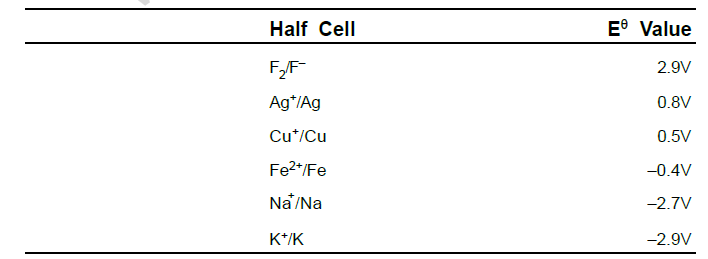
13. Some standard reduction potential are as given below :

 CBSE Class 12 Chemistry notes and questions for ElectroChemistry Part C 3

(a) Arrange oxidising agents in order of increasing strength.
(b) Which of these oxidising agents will oxidise Cu to Cu+ under standard conditions? 
 
14. Account for the following observations : 
(a) In a dry cell, the build up of ammonia around the carbon cathode should disrupt the electric current, but in practice this does not happen. 
(b) Ordinary dry cells are not rechargeable. 
 
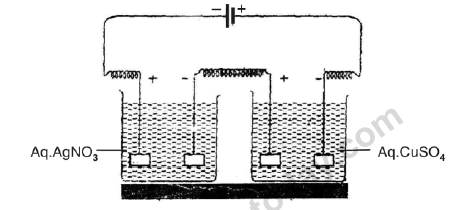
15. The following figure shows two electrolytic cells connected in series.
CBSE Class 12 Chemistry notes and questions for ElectroChemistry Part C 4


(a) How much electricity is required for the reduction of 1 mole of Ag+ ions to Ag? 
(b) If three faradays of electricity is passed through these cells, what is  the ratio of cations Ag+ and Cu2+ deposited on cathodes? 
 
[Ans. : (a) 1F, (b) 2:1] 
 
16. You are aquainted with the construction and working of a lead storage battery. Give the plausible reasons for these facts. 
(a) There is only a single compartment unlike other electrochemical cells which have two compartments 
(b) Addition of water is necessary from time to time for maintenance
 

Please click the link below to download pdf file for CBSE Class 12 Chemistry notes and questions for ElectroChemistry Part C.

z More Study Material for Class 12 Chemistry
Class 12 Chemistry Full Study Material For Boards Revision
~ Class 12 Chemistry (Old Chapters)
CBSE Class 12 Chemistry Ammonia And Phosphine Notes
CBSE Class 12 Chemistry Chemistry In Everyday Life Board Exam Notes
CBSE Class 12 Chemistry Chemistry In Everyday Life Chapter Notes
CBSE Class 12 Chemistry Chemistry In Everyday Life Notes Set A
CBSE Class 12 Chemistry Chemistry In Everyday Life Notes Set B
CBSE Class 12 Chemistry Chemistry In Everyday Life Notes Set C
CBSE Class 12 Chemistry Chemistry In Everyday Life Notes Set D
CBSE Class 12 Chemistry Chemistry In Everyday Life Notes Set E
CBSE Class 12 Chemistry Chemistry In Everyday Life Notes Set F
CBSE Class 12 Chemistry General Principles Notes
CBSE Class 12 Chemistry General Principles And Process Of Isolation Of Elements Board Exam Notes
CBSE Class 12 Chemistry General Principles Process Of Isolation Of Elements Chapter Notes
CBSE Class 12 Chemistry General Principles Process Of Isolation Of Elements Notes
CBSE Class 12 Chemistry P Block Elements Board Exam Notes
CBSE Class 12 Chemistry P Block Elements Notes Set A
CBSE Class 12 Chemistry P Block Elements Notes Set B
CBSE Class 12 Chemistry Polymers Board Exam Notes
CBSE Class 12 Chemistry Polymers Chapter Notes
CBSE Class 12 Chemistry Polymers Notes Set A
CBSE Class 12 Chemistry Polymers Notes Set B
CBSE Class 12 Chemistry Polymers Notes Set C
CBSE Class 12 Chemistry Polymers Notes Set D
CBSE Class 12 Chemistry Polymers Notes Set E
CBSE Class 12 Chemistry Polymers Notes Set F
CBSE Class 12 Chemistry Processes Of Isolation Of Elements Notes Set A
CBSE Class 12 Chemistry Processes Of Isolation Of Elements Notes Set B
CBSE Class 12 Chemistry Processes Of Isolation Of Elements Notes Set C
CBSE Class 12 Chemistry Solid State Chapter Notes
CBSE Class 12 Chemistry Solid State Notes Set A
CBSE Class 12 Chemistry Solid State Notes Set B
CBSE Class 12 Chemistry Solid State Notes Set C
CBSE Class 12 Chemistry Surface Chemistry Board Exam Notes
CBSE Class 12 Chemistry Surface Chemistry Chapter Notes
CBSE Class 12 Chemistry Surface Chemistry Notes Set A
CBSE Class 12 Chemistry Surface Chemistry Notes Set B
CBSE Class 12 Chemistry Surface Chemistry Notes Set C
CBSE Class 12 Chemistry Surface Chemistry Notes Set D
CBSE Class 12 Chemistry Surface Chemistry Notes Set E
CBSE Class 12 Chemistry Surface Chemistry Notes Set F
CBSE Class 12 Chemistry The P Block Elements Chapter Notes
CBSE Class 12 Chemistry The P Block Elements Notes
CBSE Class 12 Chemistry The P Block Elements Notes Set A
CBSE Class 12 Chemistry The P Block Elements Notes Set B
CBSE Class 12 Chemistry The P Block Elements Notes Set C
CBSE Class 12 Chemistry The Solid State Notes Set A
CBSE Class 12 Chemistry The Solid State Notes Set B
CBSE Class 12 Chemistry The Solid State Notes Set C
CBSE Class 12 Chemistry Unit Cell Notes

CBSE Class 12 Chemistry Unit 2 Electrochemistry Notes

Students can use these Revision Notes for Unit 2 Electrochemistry to quickly understand all the main concepts. This study material has been prepared as per the latest CBSE syllabus for Class 12. Our teachers always suggest that Class 12 students read these notes regularly as they are focused on the most important topics that usually appear in school tests and final exams.

NCERT Based Unit 2 Electrochemistry Summary

Our expert team has used the official NCERT book for Class 12 Chemistry to design these notes. These are the notes that definitely you for your current academic year. After reading the chapter summary, you should also refer to our NCERT solutions for Class 12. Always compare your understanding with our teacher prepared answers as they will help you build a very strong base in Chemistry.

Unit 2 Electrochemistry Complete Revision and Practice

To prepare very well for y our exams, students should also solve the MCQ questions and practice worksheets provided on this page. These extra solved questions will help you to check if you have understood all the concepts of Unit 2 Electrochemistry. All study material on studiestoday.com is free and updated according to the latest Chemistry exam patterns. Using these revision notes daily will help you feel more confident and get better marks in your exams.

Where can I download latest CBSE Class 12 Chemistry Unit 2 Electrochemistry notes

You can download notes for Class 12 Chemistry Unit 2 Electrochemistry for latest academic session from StudiesToday.com

Are the revision notes available for Unit 2 Electrochemistry Class 12 Chemistry for the latest CBSE academic session

Yes, the notes issued for Class 12 Chemistry Unit 2 Electrochemistry have been made available here for latest CBSE session

Is there any charge for the Class 12 Chemistry Unit 2 Electrochemistry notes

There is no charge for the notes for CBSE Class 12 Chemistry Unit 2 Electrochemistry, you can download everything free of charge

Which is the best online platform to find notes for Unit 2 Electrochemistry Class 12 Chemistry

www.studiestoday.com is the best website from which you can download latest notes for Unit 2 Electrochemistry Chemistry Class 12

Where can I find topic-wise notes for Class 12 Chemistry Unit 2 Electrochemistry

Come to StudiesToday.com to get best quality topic wise notes for Class 12 Chemistry Unit 2 Electrochemistry