

Revision Notes for Class 12 Chemistry: Unit 06 General Principles and Processes of Isolation of Elements
Explore reliable concept summaries and revision materials through the CBSE Class 12 Chemistry General Principles And Process Of Isolation Of Elements Board Exam Notes. Tailored for Class 12 learners, utilizing these notes for Chemistry Unit 06 General Principles and Processes of Isolation of Elements ensures thorough preparation and strengthens core academic definitions before final evaluations.
Review Unit 06 General Principles and Processes of Isolation of Elements for Class 12 Chemistry
View or download the dedicated Unit 06 General Principles and Processes of Isolation of Elements revision resource below. Engaging with these structured concept notes daily ensures continuous academic progress and mastery of the 2026-27 curriculum for Chemistry.
(1 mark)
A.1. It is easily fusible material, which is formed when gangue still present in roasted ore combines with the flux. e.g. CaO (flux) + SiO2 (gangue) → CaSiO3 (slag)
Q.2.Name the metals which can be refined by zone refining.
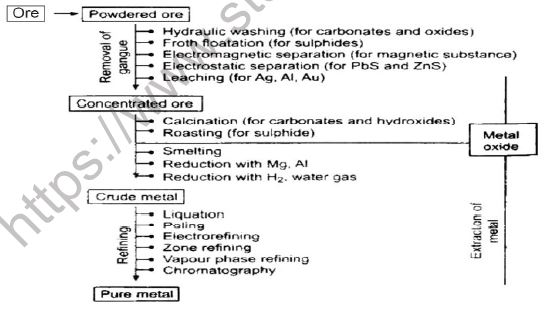
A3.Silicon, Germanium, Gallium.
Q.3.What is the principle of chromatography?
A3. It is based on adsorption
Q.4. What is the role of graphite rods in electrometallurgy of aluminium?
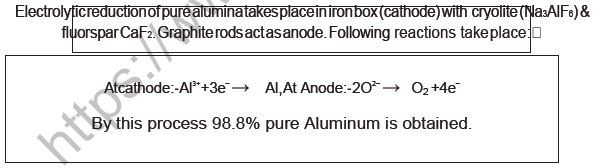
A.4. Graphite rods act as anode, are attacked by oxygen to form CO2 and sois replaced from time to time.
Q.5. What is the role of cryolite in electrometallurgy of aluminium?
A.5. Alumina cannot be fused easily because of high melting point. Dissolving of alumina in cryolite furnishes Al3+ ions, which can be electrolyzed easily.
Q.6. What are depressants?
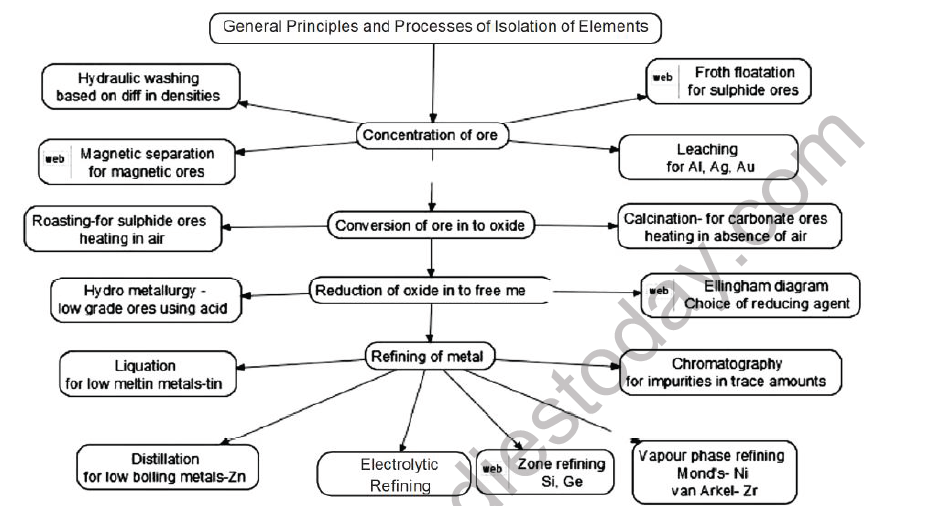
A.6. It is possible to separate two sulphide ore by adjusting proportion of oil to water in froth flotation process by using a substance known as depressant.e.g. NaCN is used to separate ZnS and PbS.
Q.7. Copper can be extracted by hydrometallurgy but not Zn. Why?
A.7. The E0 of Zn is lower than that of Cu thus Zn can displace Cu2+ion from its solution. On the other hand, to displace Zn from Zn2+ion, we need a more reactive metal than it.
Q.8. Give name and formula of important ore of iron .
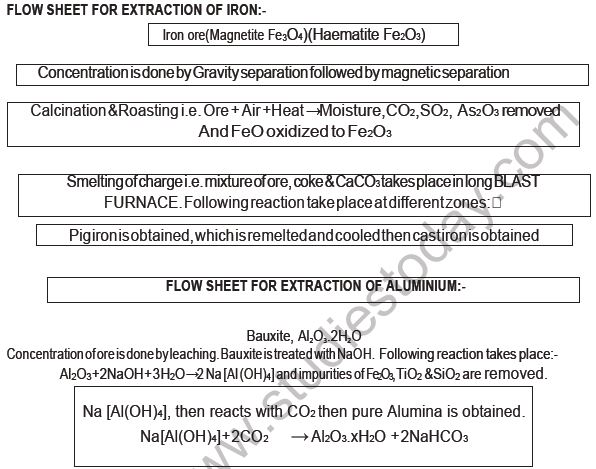
A.8. Haematite – Fe2O3, Magnetite –Fe3O4, Iron pyrites FeS2.
Q.9. Give name and formula of important ore of copper .
A.9. Copper pyrites CuFeS2, Malachite CuCO3 . Cu (OH)2, Cuprite Cu2O.
Q.10. Give name and formula of important ore of Zinc .
A.10. Zinc blende ‐ ZnS, Calamine‐ ZnCO3, Zincite – ZnO
Free study material for Chemistry
Study Material and Revision Notes for Class 12 Chemistry Unit 06 General Principles and Processes of Isolation of Elements
About Unit 06 General Principles and Processes of Isolation of Elements Revision Notes
Review targeted chapter notes for Class 12 Chemistry Unit 06 General Principles and Processes of Isolation of Elements. Built according to official CBSE guidelines, these summaries highlight high-yield topics frequently tested in school evaluations.
How to Use These Revision Notes
Built using the official NCERT book for Class 12 Chemistry, these notes provide reliable academic guidance. Pair your summary review with our recommended NCERT solutions to master optimal problem-solving approaches.
Enhance Practice with MCQs and Worksheets
Follow up your revision by attempting the interactive online Chemistry MCQ test and practice worksheets for this chapter to verify your mastery. All platform resources are free to access.
FAQs
You can download the teacher prepared revision notes for CBSE Class 12 Chemistry General Principles And Process Of Isolation Of Elements Board Exam Notes from StudiesToday.com. These notes are designed as per 2026-27 academic session to help Class 12 students get the best study material for Chemistry.
Yes, our CBSE Class 12 Chemistry General Principles And Process Of Isolation Of Elements Board Exam Notes include 50% competency-based questions with focus on core logic, keyword definitions, and the practical application of Chemistry principles which is important for getting more marks in 2026 CBSE exams.
Yes, our CBSE Class 12 Chemistry General Principles And Process Of Isolation Of Elements Board Exam Notes provide a detailed, topic wise breakdown of the chapter. Fundamental definitions, complex numerical formulas and all topics of CBSE syllabus in Class 12 is covered.
These notes for Chemistry are organized into bullet points and easy-to-read charts. By using CBSE Class 12 Chemistry General Principles And Process Of Isolation Of Elements Board Exam Notes, Class 12 students fast revise formulas, key definitions before the exams.
No, all study resources on StudiesToday, including CBSE Class 12 Chemistry General Principles And Process Of Isolation Of Elements Board Exam Notes, are available for immediate free download. Class 12 Chemistry study material is available in PDF and can be downloaded on mobile.