

Download Class 12 Chemistry Concept Summaries: CBSE Class 12 Chemistry Surface Chemistry Notes Set 05
Access comprehensive revision notes for Unit 05 Surface Chemistry using the CBSE Class 12 Chemistry Surface Chemistry Notes Set 05. Designed to align with the 2026-27 academic syllabus for Class 12 Chemistry, these concept summaries help students streamline their exam preparation and review complex topics efficiently.
Access Unit 05 Surface Chemistry Notes and Study Material
Access the complete concept summary PDF for Unit 05 Surface Chemistry below. Regular review of these targeted notes builds familiarity with complex Class 12 Chemistry themes and helps secure higher marks in final school evaluations.
Chapter-5 SURFACE CHEMISTRY
The branch of the Chemistry wich deals with the study of surface phenomena is called surface Chemistry.
POINTS TO BE REMEMBERED: ---
1. Adsorption: - The accumulation of molecules species at the surface rather in the bulk of a solid or liquid is termed adsorption.
2. Desorption:-Removal of adsorbate from the surface of adsorbent is known as Desorption.
3. Sorption:-When adsorption and absorption both takes place simultaneously.
4. Type of adsorption: - On the basis of interaction between adsorption and absorption, adsorbate are of two types:
(i)Physical adsorption/physisorption: - When weak vander waal interaction involve between adsorbate and adsorbent.
(ii) Chemical adsorption/chemisortion:-When chemical bonds form between adsorbate and adsorbent.
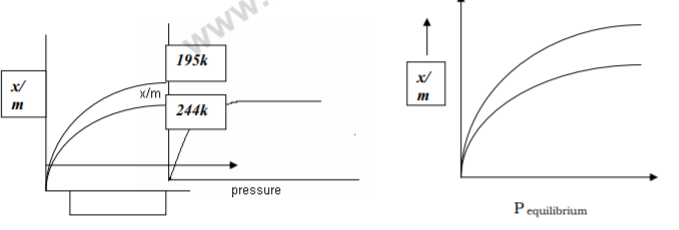
5. Adsorption isotherm:-The variation in the amount of gas adsorbed by the adsorbent with pressure at constant temperature can be expressed by means of a curve termed as adsorption isotherm.
6. Application of adsorption:-
(a) Removal of colouring matter from solution using animal charcoal.
(b)Chromatographic analysis is based on adsorption.
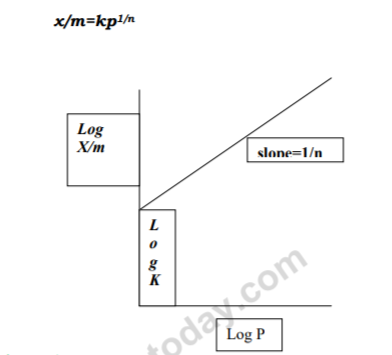
7. Freundlich adsorption isotherm:-It is a graph which shows relationship between the quality of gas adsorbed by unit mass of solid adsorbent and pressure at a particular temperature.
8 .Factors affecting adsorption:-
(i)Surface area: - Adsorption increases with increases of surface area of adsorbent.
(ii)Nature of adsorbate:- Easily liquefiable gases are readily adsorbed.
(iii)Temperature:-Low temperature is favorable for physical adsorption and High temperature for chemisortion.
(iv)Pressure: - Pressure increases, adsorption increases.
9. CATALYSIS:- Substances which alter the rate of chemical reaction and themselves remain chemically and quantitatively unchanged after the reaction are known as catalyst and the phenomenon is known as catalysis.
10. PROMOTERS AND POISONS
Promoters are substance that enhance the activity of catalyst while poisons decrease the activity of catalyst.
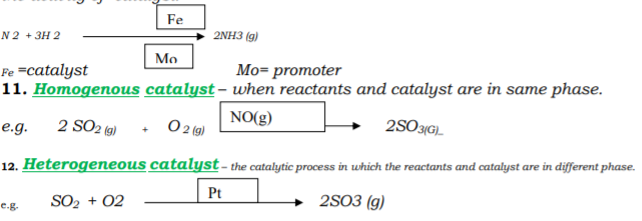
13. Adsorption theory of Heterogeneous catalysis – It explains the mechanism of heterogeneous catalyst.
The mechanism involves 5 steps:-
a. Diffusion of reactants to the surface of catalyst.
b. Adsorption of reactant molecules on the surface of catalyst.
c. Chemical reaction on the catalyst surface through formation of an intermediate.
d. Desorption of reaction product from the catalyst surface.
e. Diffusion of reaction product away from the catalyst surface.
14. IMPORTANT FEATURES OF SOLID CATALYST
Activity - The activity of a catalyst depend on the strength of chemisorption.
Catalytic activity increases from group 5 to group 11 elements of the periodic table.
Pt
2H2 + O2 → 2H2O
Selectivity – The selectivity of a catalyst is its ability to direct a reaction to yield a particular product.

15. SHAPE SELECTIVE CATALYSIS
The catalytic reaction that depends upon the pure substance of the catalyst and the size of reactant and product molecules is called shape selective catalysis.
e.g. Zeolites are good shape selective catalyst.
16. ENZYME CATALYSIS
Enzymes are protein molecules of high molecular mass which catalyse the biochemical reaction.
e.g. Inversion of cane sugar by invertase enzyme.
17. Characteristic of enzyme catalysis –
a. Enzymes are specific to substrate.
b. Enzymes are highly active under optimum temperature.
c. Enzymes are specific to pH. e.g. Pepsin act in acidic medium
d. Enzymes are inhabited by the presence of certain substance.
Mechanism of enzyme catalysis –
1. Binding of enzyme to substrate to form an activated complex.
18. Colloid-a colloid is a heterogeneous system in which one substance is dispersed(dispersed phase)in another substance called dispersion medium and size of dispersed phase is from 1nm-1000 nm.
19. TYPES OF COLLOIDS
(1) On the basis of nature of interaction between dispersed phase and dispersion medium.
(a) Lyophobic colloid-solvent , hating colloid, these colloids can not be prepared by simply mixing of dispersed phase into dispersion medium.
e.g. metallic sols.
(b) Lyophobic colloid-solvent loving these colloids can be prepared by simply mixing of dispersion phase into dispersion medium.
e.g. Starch sol.
(2) On the basis of types of particles of the dispersed phase
(a) Multimolecular colloid-on dissolution, a large number of atoms or smaller molecules of a substance aggregate together to form species having size in colloidal range. The species thus formed are called Multimolecular colloids.
e.g. Sulphur sol.
(b) Macromolecular colloids -macromolecules are suitable solvent from solution in which size of the particles are in range of colloidal range.
e.g. starch sol.
(c) Associated colloids (micelles)-some substances in law concentration behaves as normal strong electrolyte but at higher concentration exhibit colloidal behavior due to formation of aggregates. The aggregated particles are called micelles and also known as associated colloids.
(3) Kraft temperature- Temp. above which formation of micelles takes places.
(4) Critical micelle concentration (cmc) - concentration above which micelle formation takes place is known as cmc.
(5) PREPERATION OF COLLOIDS
(a) Chemical methods- By double decomposition, oxidation reaction or hydrolysis
Please click the link below to download pdf file for CBSE Class 12 Chemistry notes and questions for Surface Chemistry Part B.
Free study material for Chemistry
Revision Notes and Key Concepts for Class 12 Chemistry Unit 05 Surface Chemistry
Key Concepts and Summary for Class 12 Chemistry Unit 05 Surface Chemistry
Explore reliable chapter overviews for Unit 05 Surface Chemistry tailored for Class 12 learners. Use these structured points to grasp difficult themes and ensure solid preparation for upcoming assessments.
NCERT-Aligned Chapter Summary and Notes
Built using the official NCERT book for Class 12 Chemistry, these notes provide reliable academic guidance. Pair your summary review with our recommended NCERT solutions to master optimal problem-solving approaches.
Next Steps in Your Exam Preparation
Follow up your revision by attempting the interactive online Chemistry MCQ test and practice worksheets for this chapter to verify your mastery. All platform resources are free to access.
FAQs
You can download the teacher prepared revision notes for CBSE Class 12 Chemistry Surface Chemistry Notes Set 05 from StudiesToday.com. These notes are designed as per 2026-27 academic session to help Class 12 students get the best study material for Chemistry.
Yes, our CBSE Class 12 Chemistry Surface Chemistry Notes Set 05 include 50% competency-based questions with focus on core logic, keyword definitions, and the practical application of Chemistry principles which is important for getting more marks in 2026 CBSE exams.
Yes, our CBSE Class 12 Chemistry Surface Chemistry Notes Set 05 provide a detailed, topic wise breakdown of the chapter. Fundamental definitions, complex numerical formulas and all topics of CBSE syllabus in Class 12 is covered.
These notes for Chemistry are organized into bullet points and easy-to-read charts. By using CBSE Class 12 Chemistry Surface Chemistry Notes Set 05, Class 12 students fast revise formulas, key definitions before the exams.
No, all study resources on StudiesToday, including CBSE Class 12 Chemistry Surface Chemistry Notes Set 05, are available for immediate free download. Class 12 Chemistry study material is available in PDF and can be downloaded on mobile.