

Official Class 12 Chemistry Revision Material: CBSE Class 12 Chemistry The P Block Elements Notes Set 02
Review targeted revision notes for Class 12 Chemistry with the CBSE Class 12 Chemistry The P Block Elements Notes Set 02. Built according to official educational guidelines for the 2026-27 academic year, these downloadable summaries for Unit 07 The p-Block Elements support daily study and last-minute exam readiness.
Chapter-wise Concept Summaries: Unit 07 The p-Block Elements
Navigate directly to the revision notes for Unit 07 The p-Block Elements using the digital viewer below. Each summary is structured to highlight high-weightage sections, allowing students to instantly access critical definitions and focus on core exam topics.
ISOMERISM IN COORDINATION COMPOUNDS
Two or more substances having the same molecular formula but different spatial arrangements are called isomers and the phenomenon is called isomerism. Coordination compounds show
two main types of isomerism-
A) Structural Isomerism B) Stereoisomerism
STRUCTURAL ISOMERISM:- It arises due to the difference in structures of coordination compounds. It is further subdivided into the following types-
1) Ionisation isomerism : This form of isomerism arises when the counter ion in a complex salt is itself a potential ligand and can displace a ligand which can then become the counter ion. An example is provided by the ionization isomers [Co(NH3)5SO4]Br and [Co(NH3)5Br]SO4.
2) Hydrate or solvate isomerism: This form of isomerism is known as ‗hydrate isomerism‘ in case where water is involved as a solvent. This is similar to ionisation isomerism. Solvate isomers differ by whether or not a solvent molecule is directly bonded to the metal ion or merely present as free solvent molecules in the crystal lattice. An example is provided by the aqua complex [Cr(H2O)6]Cl3 (violet) and its solvate isomer [Cr(H2O)5Cl]Cl2.H2O (grey-green).
3) Linkage Isomerism: Linkage isomerism arises in a coordination compound containing ambidentate ligand. A simple example is provided by complexes containing the thiocyanate ligand, NCS–, which may bind through the nitrogen to give M–NCS or through sulphur to give M–SCN.
4) Coordination isomerism: It arises from the interchange of ligands between cationic and anionic entities of different metal ions present in a complex .
Example [Co(NH3)6][Cr(CN)6] & [Cr(NH3)6][Co(CN)6]
STEREOISOMERISM: Stereo isomers have the same chemical formula and chemical bonds but they have different spatial arrangement. They are of two kinds
A. Geometrical isomerism
B. Optical isomerism
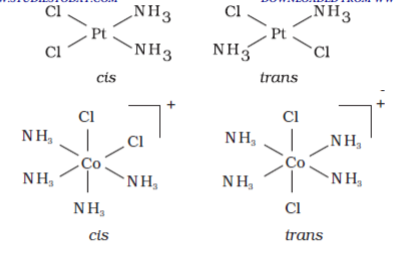
GEOMETRICAL ISOMERISM- This type of isomerism arises in heteroleptic complexes due to different possible geometric arrangements of the ligands. Important examples of this behaviour are found with coordination numbers 4 and 6. In a square planar complex of formula [MX2L2] (X and L are unidentate), the two ligands X may be arranged adjacent to each other in a cis isomer, or opposite to each other in a trans isomer [MABXL]-Where A,B,X,L are unidentates Two cis- and one trans- isomers are possible.
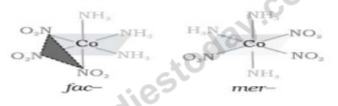
Another type of geometrical isomerism occurs in octahedral coordination entities of the type [Ma3b3] like [Co(NH3)3(NO2)3]. If three donor atoms of the same ligands occupy adjacent positions at the corners of an octahedral face, we have the facial (fac) isomer. When the positions are around the meridian of the octahedron, we get the meridional (mer) isomer.
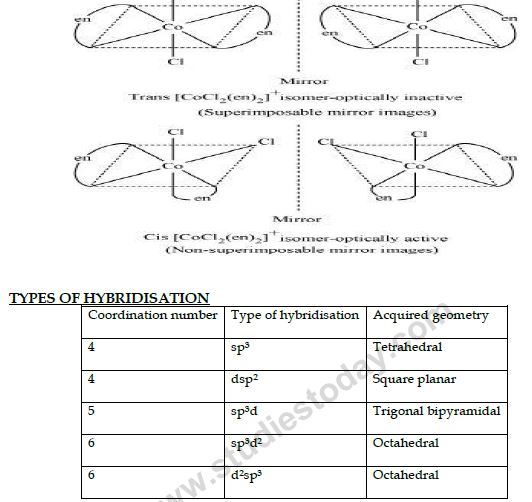
b) OPTICAL ISOMERISM: Optical isomers are mirror images that cannot be superimposed on one another. These are called as enantiomers. The molecules or ions that cannot be superimposed are called chiral. The two forms are called dextro (d) and laevo (l) depending upon the direction they rotate the plane of polarised light in a polarimeter (d rotates to the right, l to the left). Optical isomerism is common in octahedral complexes involving didentate ligands. In a coordination entity of the type [CoCl2(en)2]2+, only the cis-isomer shows optical activity
8.CRYSTAL FIELD THEORY:
1. The metal-ligand bond is ionic arising purely from electrostatic interactions between the metal ion and the ligand.
2. Ligands are treated as point charges or dipoles in case of anions and neutral molecules.
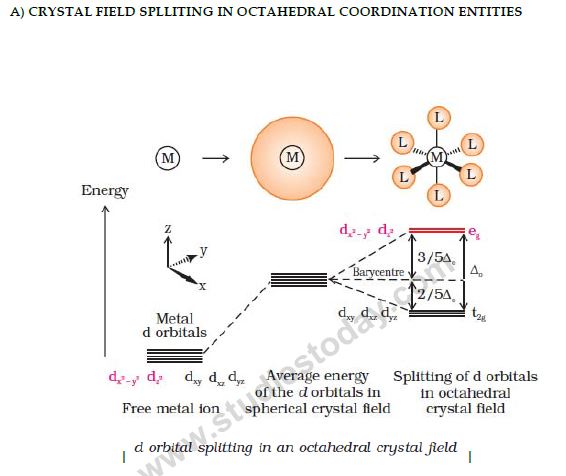
3. In an isolated gaseous metal atom or ion the five d-orbitals are degenerate.
4. Degeneracy is maintained if a spherically symmetrical field of negative charges surrounds the metal /ion.
5. In a complex the negative field becomes asymmetrical and results in splitting of the
1. For d4 ions, two possible patterns of electron distribution arise:
(i) If Δo < P, the fourth electron enters one of the eg orbitals giving the configuration t3 2g e1g . Ligands for which Δo < P are known as weak field ligands and form high spin complexes.
(ii) If Δo > P, it becomes more energetically favourable for the fourth electron to occupy a t2g orbital with configuration t42g e0g. Ligands which produce this effect are known as strong field ligands and form low spin complexes.
B) CRYSTAL FIELD SPLLITING IN TETRAHEDRAL COORDINATION ENTITIES
2. The t2g orbitals are raised in energy (2/5) t .
1. The four surrounding ligands approach the central metal atom/ion along the planes between the axes.
3. The two eg orbitals are lowered in energy (3/5) t
4. The splitting is smaller as compared to octahedral field splitting, t=(4/9) 0.
Please click the link below to download pdf file for CBSE Class 12 Chemistry notes and questions for The p block Elements Part B.
Free study material for Chemistry
Study Material and Revision Notes for Class 12 Chemistry Unit 07 The p-Block Elements
Key Concepts and Summary for Class 12 Chemistry Unit 07 The p-Block Elements
Access structured revision notes for Unit 07 The p-Block Elements designed in alignment with the latest CBSE curriculum for Class 12 Chemistry. These summaries help clarify core themes and support effective daily study.
NCERT-Aligned Chapter Summary and Notes
Each chapter summary is structured around standard CBSE textbooks, allowing students to check their understanding and clarify complex ideas early in their revision.
Next Steps in Your Exam Preparation
Explore our broader library of printable assignments, chapter notes, and mock tests designed to support continuous revision and secure higher marks in CBSE assessments.
FAQs
You can download the teacher prepared revision notes for CBSE Class 12 Chemistry The P Block Elements Notes Set 02 from StudiesToday.com. These notes are designed as per 2026-27 academic session to help Class 12 students get the best study material for Chemistry.
Yes, our CBSE Class 12 Chemistry The P Block Elements Notes Set 02 include 50% competency-based questions with focus on core logic, keyword definitions, and the practical application of Chemistry principles which is important for getting more marks in 2026 CBSE exams.
Yes, our CBSE Class 12 Chemistry The P Block Elements Notes Set 02 provide a detailed, topic wise breakdown of the chapter. Fundamental definitions, complex numerical formulas and all topics of CBSE syllabus in Class 12 is covered.
These notes for Chemistry are organized into bullet points and easy-to-read charts. By using CBSE Class 12 Chemistry The P Block Elements Notes Set 02, Class 12 students fast revise formulas, key definitions before the exams.
No, all study resources on StudiesToday, including CBSE Class 12 Chemistry The P Block Elements Notes Set 02, are available for immediate free download. Class 12 Chemistry study material is available in PDF and can be downloaded on mobile.