

Download Class 12 Chemistry Concept Summaries: CBSE Class 12 Chemistry The D And F Block Elements Notes Set 03
Access comprehensive revision notes for Unit 4 The d- and f-Block Elements using the CBSE Class 12 Chemistry The D And F Block Elements Notes Set 03. Designed to align with the 2026-27 academic syllabus for Class 12 Chemistry, these concept summaries help students streamline their exam preparation and review complex topics efficiently.
Access Unit 4 The d- and f-Block Elements Notes and Study Material
View or download the dedicated Unit 4 The d- and f-Block Elements revision resource below. Engaging with these structured concept notes daily ensures continuous academic progress and mastery of the 2026-27 curriculum for Chemistry.
CBSE Class 12 Chemistry notes and questions for The d and f Block Elements Part C. Learning the important concepts is very important for every student to get better marks in examinations. The concepts should be clear which will help in faster learning. The attached concepts made as per NCERT and CBSE pattern will help the student to understand the chapter and score better marks in the examinations.
d – AND f – BLOCK ELEMENTS
Electronic Configuration of Transition Metal/Ions
The d-block element is called transition metal if it has partly filled d-orbitals in the ground state as well as in its oxidised state.
The general electronic configuration of transition metal is (n–1) d1–10ns1–2. Exceptions in electronic configuration are due to (a) very little engery difference between (n–1) d and ns orbitals and (b) extra stability of half filled and completely filled orbitals in case of Cr and Cu in 3d series.
Cr : Is2 2s2 2p6, 3s2 3p6 4s1 3d5
Cu : Is2 2s2 2p6, 3s2 3p6 4s1 3d10
To write the electronic configuration of Mn+, the electrons are first removed from ns orbital and then from (n - 1) d orbitals of neutral, atom (if required). For example, the electronic configuration of Cu+, Cu2+ and Cr3+ are respectively
3d10 4s°, 3d9 4s° and 3d3 4s°.
The following questions can be answered with the help of above.
(i) Scandium (Z = 21) is a transition element but zinc (Z = 30) is not.
(ii) Copper (Z = 29) and silver (Z = 47) both have fully filled d-orbitals i.e., (n - 1) d10. why are these elements are regarded as transition elements?
(iii) Which of the d-block elements are not regarded as transition elements?
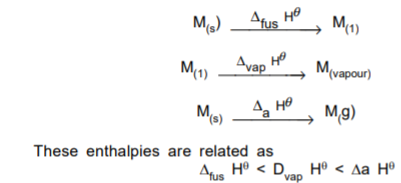
UNDERSTANDING Δfus H Θ,vap HΘAND Δa HΘ
In transition metals unpaired (n - l)d electrons as well as ns electrons take part in interatomic bonding. Larger the number of unpaired (n - 1) d electrons, the stronger is the interatomic bonding and large amount of energy is required to overcome the interatomic interaction.
The following questions can be explained using the above reasoning.
(i) Which has higher m.p.? V (Z = 23) or Cr (Z = 24) ?
(ii) Explain why Fe (Z = 26) has higher m.p. than cobalt (Z = 27).
Metals of second (4d) and third (5d) transition series have greater enthalpies of atomisation than corresponding elements of first transition series on account of more frequent metal metal bonding due to greater spatial extension of 4d and 5d orbitals than 3d orbitals.
LANTHANOID CONTRACTION AND ITS CONSEQUENCE
The 4f orbitals screen the nuclear .charge less effectively because they are large and diffused. The filling of 4f orbitals before 5d orbitals results in the gradual increase in effective nuclear charge resulting in a regular decrease in atomic and ionic radii. This phenomenon is called lanthanoid contraction. The corresponding members of second and third transition series have similar radii because the normal size increase down the group of d-block elements almost exactly balanced by the lanthanoid contraction.
This reasoning is applied in answering the following questions.
(i) Elements in the’following pairs have identical (similar) radii : Zr/Hf, Nb/Ta and Mo/W. Explain why?
(ii) Why do Zr and Hf have very similar physical and chemical properties and occur together in the same mineral?
VARIATION IN IONISATION ENTHALPY
With the filling of (n - 1) d orbitals effective nuclear charge increases resulting in the increase in first ionisation enthalpy. There are some irregular variations.
The first ionisation enthalpy of chromium is lower because the removal of one electron produces extra stable d5 configuration and that of zinc is higher because the removal of electron takes place from fully filled 4s orbital. Second ionization enthalpy of Zn (Δi H2 = 1734 kj)/mol) is lower than second ionization enthalpy of Cu (1958 kj/mol). This is because removal of second electron in Zn produces stable d10 configuration while the removal of second electron in Cu disrupts the d10 configuration with a considerable loss in exchange energy to from less stable d9 configuration.
Cr = 3d5 4s1
Zn = 3d10 4s2; Zn2+ = 3d10
Cu = 3d10 4s1; Cu2+ = 3d9
Please click the link below to download pdf file for CBSE Class 12 Chemistry notes and questions for The d and f Block Elements Part C.
Free study material for Chemistry
Unit 4 The d- and f-Block Elements Concepts and Summary for Class 12 Chemistry
Key Concepts and Summary for Class 12 Chemistry Unit 4 The d- and f-Block Elements
Access structured revision notes for Unit 4 The d- and f-Block Elements designed in alignment with the latest CBSE curriculum for Class 12 Chemistry. These summaries help clarify core themes and support effective daily study.
NCERT-Aligned Chapter Summary and Notes
Cross-reference your comprehension with comprehensive NCERT solutions for Class 12 to ensure absolute clarity across all sub-topics in this chapter.
Next Steps in Your Exam Preparation
Explore our broader library of printable assignments, chapter notes, and mock tests designed to support continuous revision and secure higher marks in CBSE assessments.
FAQs
You can download the teacher prepared revision notes for CBSE Class 12 Chemistry The D And F Block Elements Notes Set 03 from StudiesToday.com. These notes are designed as per 2026-27 academic session to help Class 12 students get the best study material for Chemistry.
Yes, our CBSE Class 12 Chemistry The D And F Block Elements Notes Set 03 include 50% competency-based questions with focus on core logic, keyword definitions, and the practical application of Chemistry principles which is important for getting more marks in 2026 CBSE exams.
Yes, our CBSE Class 12 Chemistry The D And F Block Elements Notes Set 03 provide a detailed, topic wise breakdown of the chapter. Fundamental definitions, complex numerical formulas and all topics of CBSE syllabus in Class 12 is covered.
These notes for Chemistry are organized into bullet points and easy-to-read charts. By using CBSE Class 12 Chemistry The D And F Block Elements Notes Set 03, Class 12 students fast revise formulas, key definitions before the exams.
No, all study resources on StudiesToday, including CBSE Class 12 Chemistry The D And F Block Elements Notes Set 03, are available for immediate free download. Class 12 Chemistry study material is available in PDF and can be downloaded on mobile.