

Official Class 12 Chemistry Revision Material: CBSE Class 12 Chemistry Haloalkanes And Haloarenes Notes Set 07
Explore reliable concept summaries and revision materials through the CBSE Class 12 Chemistry Haloalkanes And Haloarenes Notes Set 07. Tailored for Class 12 learners, utilizing these notes for Chemistry Unit 6 Haloalkanes and Haloarenes ensures thorough preparation and strengthens core academic definitions before final evaluations.
Chapter-wise Concept Summaries: Unit 6 Haloalkanes and Haloarenes
View or download the dedicated Unit 6 Haloalkanes and Haloarenes revision resource below. Engaging with these structured concept notes daily ensures continuous academic progress and mastery of the 2026-27 curriculum for Chemistry.
Chapter 10: Haloalkanes and Haloarenes
Top Concepts
1. Nature of C-X bond in alkyl halides: X is more electronegative than carbon. So, the C-X bond is polarized with C having a partial positive charge and X having a partial negative charge
2. Common and IUPAC names:-
Chemical formula Common Name IUPAC Name
CH2Cl2 Methylene chloride Dichloro methane
CHCl3 Methylene chloride Trichloro methane
CCl4 Carbon tetrachloride Tetracholro methane
CH3CH(Cl)CH3 Isopropyl chloride 2-Chloro propane
CH3CH(Cl)CH2CH3 Chloride sec-butyl 2-Chloro butane
CH2=CHCl Vinyl chloride Chloroethene
C6H5Cl Benzyl chloride Chlorobenzene
3. Isomerism:-
a) Chain isomerism
b) Position isomerism
4. Preparation of haloalkanes:-
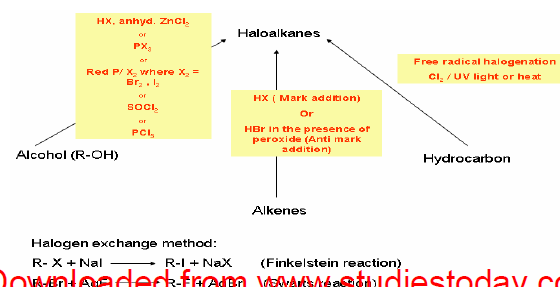
5. Preparation of haloarenes:
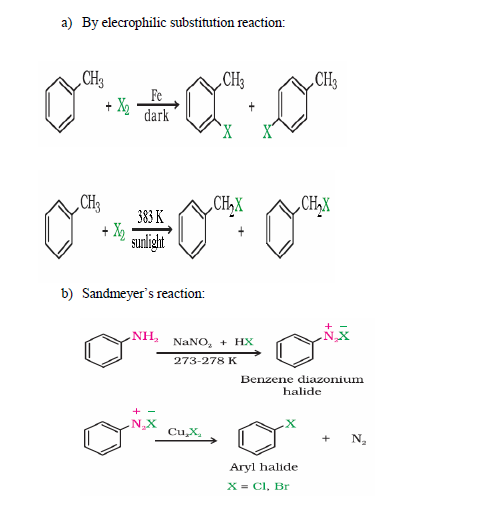
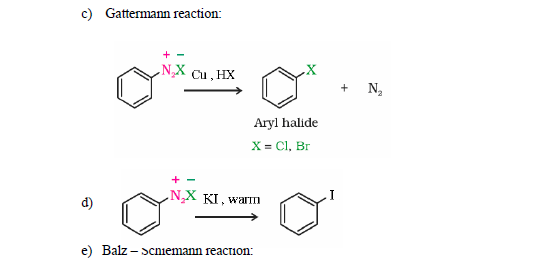
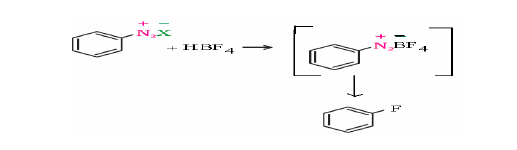
6. Physical properties of haloalkanes: a. Solubility. Although haloalkanes are polar in nature, yet they are practically very slightly soluble in water. In order for a haloalkane to dissolve in water, energy is required to overcome the attractions between the haloalkane molecules and break the hydrogen bonds between water molecules. However Haloalkanes are not able to form hydrogen bonds with water and therefore, less energy is released when new attractions are set up between the haloalkane and the water molecules because these are not as strong as the original hydrogen bonds in water molecules. As a result, solubility of haloalkanes in water is low.
b. Density:
1.Simple fluoro and chloroalkanes are lighter than water while bromides and polychloro devrivatives are heavier than water.
2.With the increase in number of carbon atoms, the densities go on increasing.
3.With the increase in number of halogen atoms, the densities go on increasing.
4.The densities increase in the order: Fluoride < chloride < bromide < iodide
5.The density also increases with increasing number and atomic mass of the halogen.
c. Method and Boiling points:
Molecules of organic halogen compounds are generally polar. Due to the polarity as well as higher molecular mass as compared to the parent hydrocarbon, the intermolecular forces of attraction (dipole – dipole and van der Waals) between the molecules are stronger in halogen derivatives of alkanes. As a result melting and boiling points of chlorides, bromides and iodides are considerably higher than those of the parent hydrocarbon of comparable molecular mass.
1. Amongst themselves, the following trends are observed:
2.For the same alkyl group the boiling points of alkyl chlorides, bromides and iodides follow the order RI > RBr > RCl > RF where R is an alkyl group. This is because with the increase in the size of the halogen, the magnitude of van der Waals force increase.
3.In general, the boiling points of chloro, bromo and iodo compounds increase with increase in the number of halogen atoms.
4.For the same halogen atom, the boiling points of haloalkanes increase with increase in the size of alkyl groups.
5. For isomeric alkyl halides, the boiling points decrease with branching. This is because branching of the chain makes the molecule more compact and, therefore,decrease the surface area. Due to decrease in surface area, the magnitude of van der Waals forces of attraction decreases and consequently, the boiling points of the branched chain compound is less than those of the straight chain compounds.
7. Physical Properties of Haloarenes:
a. These are generally colourless liquids or crystalline solids.
b. These are heavier than water.
c. Melting and boiling points of haloarenes:
• Melting and boiling points of haloarenes are nearly the same as those of alkyl halides containing the same number of carbon atoms.
• The boiling points of monohalogen derivatives of benzene are in the order: iodo > bromo > chloro > fluoro
• For the same halogen atom, the melting and boiling points increase as the size of the aryl group increases.
• The melting point of para isomer is quite higher than that of ortho or meta isomers.
This is due to the fast that is has symmetrical structure and there fore, its molecules can easily pack loosely in the crystal lattice. As a result intermolecular forces of attraction are stronger and therefore, greater energy is required to break its lattice and it melts at higher temperature.
Please click the link below to download CBSE Class 12 Chemistry Haloalkanes And Haloarenes Notes Set G
Free study material for Chemistry
Download CBSE Revision Notes: Class 12 Chemistry Unit 6 Haloalkanes and Haloarenes
About Unit 6 Haloalkanes and Haloarenes Revision Notes
Review targeted chapter notes for Class 12 Chemistry Unit 6 Haloalkanes and Haloarenes. Built according to official CBSE guidelines, these summaries highlight high-yield topics frequently tested in school evaluations.
How to Use These Revision Notes
Built using the official NCERT book for Class 12 Chemistry, these notes provide reliable academic guidance. Pair your summary review with our recommended NCERT solutions to master optimal problem-solving approaches.
Enhance Practice with MCQs and Worksheets
Wrap up your chapter revision by testing your knowledge against standard question formats. Everything on our platform is provided free of charge.
FAQs
You can download the teacher prepared revision notes for CBSE Class 12 Chemistry Haloalkanes And Haloarenes Notes Set 07 from StudiesToday.com. These notes are designed as per 2026-27 academic session to help Class 12 students get the best study material for Chemistry.
Yes, our CBSE Class 12 Chemistry Haloalkanes And Haloarenes Notes Set 07 include 50% competency-based questions with focus on core logic, keyword definitions, and the practical application of Chemistry principles which is important for getting more marks in 2026 CBSE exams.
Yes, our CBSE Class 12 Chemistry Haloalkanes And Haloarenes Notes Set 07 provide a detailed, topic wise breakdown of the chapter. Fundamental definitions, complex numerical formulas and all topics of CBSE syllabus in Class 12 is covered.
These notes for Chemistry are organized into bullet points and easy-to-read charts. By using CBSE Class 12 Chemistry Haloalkanes And Haloarenes Notes Set 07, Class 12 students fast revise formulas, key definitions before the exams.
No, all study resources on StudiesToday, including CBSE Class 12 Chemistry Haloalkanes And Haloarenes Notes Set 07, are available for immediate free download. Class 12 Chemistry study material is available in PDF and can be downloaded on mobile.