

Official Class 12 Chemistry Revision Material: Class 12 Chemistry Full Study Material For Boards Revision
Review targeted revision notes for Class 12 Chemistry with the Class 12 Chemistry Full Study Material For Boards Revision. Built according to official educational guidelines for the 2026-27 academic year, these downloadable summaries for All topics support daily study and last-minute exam readiness.
Chapter-wise Concept Summaries: All topics
Access the complete concept summary PDF for All topics below. Regular review of these targeted notes builds familiarity with complex Class 12 Chemistry themes and helps secure higher marks in final school evaluations.
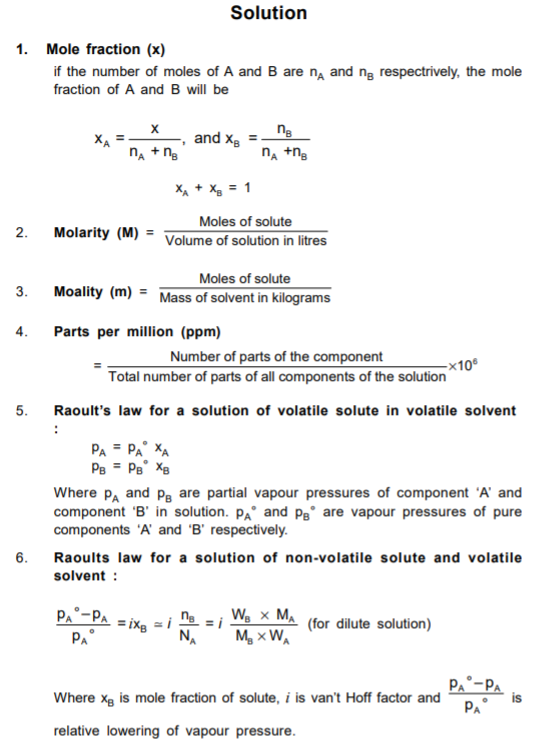
7. Elevation in boiling point (ΔTb)
ΔTb = i.Kb m
where ΔTb = Tb – Tb°
Kb = molal boiling point elevation constant
m = molality of solution.
8. Depression in freezing point (ΔTf)
ΔTf = i.Kf m
where ΔTf = Tf° – Tf
Kf = molal depression constant
m = molality of solution.
9. Osmotic pressure (π) of a solution
πV = inRT or π = i CRT
where π = osmotic pressure in bar or atm
V = volume in litres
i = Van't Hoff factor
c = molar concentration in moles per litres
n = number of moles
T = Temperature on Kelvin Scale
R = 0.083 L bar mol–1 K–1
R = 0.0821 L atm mol–1 K–1
10. Van't Hoff factor (i)
i = Observed colligative property / Theoretically calculated colligative property
i = Normal molar mass / Abnormal molar mass
{i > 1 For dissociation of molecules
{i < 1 For association of molecules
{i= 1 For ideal solution
11. Relationship between relative lowering in vapour prescure and elevation in b.p.
Δb/pA°=(ixΔTb/Kb)MAx1000
Here
Δp is lowering in vapour pressure, pA° is vapour pressure of pure solvent, i is van't Hoff factor, ΔTb is elevation in boiling point, Kb is molal elevation constant and MA is molar mass of solvent
Electrochemistry
1. Conductivity (k)
K = 1 /P= 1/R =l/A= G G*/A
Where R is resistance, l/A = cell constant (G*) and 1/P is resistivity.
2. Relationship between k and Am
Am = 1000 kxc
Where m L is molar conductance, k is conductivity and C is molar concentration.
Kohlrausch’s law
(a) In general if an electrolyte on dissociation gives ν+ cations and γ– anions then, its limiting molar conductivity is given by
Please click the link below to download pdf file for Class 12 Chemistry full Study Material for boards revision
Free study material for Chemistry
All topics Concepts and Summary for Class 12 Chemistry
Download Chapter Summary: Class 12 Chemistry All topics
Access structured revision notes for All topics designed in alignment with the latest CBSE curriculum for Class 12 Chemistry. These summaries help clarify core themes and support effective daily study.
Concept Clarification for All topics
Built using the official NCERT book for Class 12 Chemistry, these notes provide reliable academic guidance. Pair your summary review with our recommended NCERT solutions to master optimal problem-solving approaches.
Additional Study Resources for Class 12 Chemistry
Explore our broader library of printable assignments, chapter notes, and mock tests designed to support continuous revision and secure higher marks in CBSE assessments.
FAQs
You can download the teacher prepared revision notes for Class 12 Chemistry Full Study Material For Boards Revision from StudiesToday.com. These notes are designed as per 2026-27 academic session to help Class 12 students get the best study material for Chemistry.
Yes, our Class 12 Chemistry Full Study Material For Boards Revision include 50% competency-based questions with focus on core logic, keyword definitions, and the practical application of Chemistry principles which is important for getting more marks in 2026 CBSE exams.
Yes, our Class 12 Chemistry Full Study Material For Boards Revision provide a detailed, topic wise breakdown of the chapter. Fundamental definitions, complex numerical formulas and all topics of CBSE syllabus in Class 12 is covered.
These notes for Chemistry are organized into bullet points and easy-to-read charts. By using Class 12 Chemistry Full Study Material For Boards Revision, Class 12 students fast revise formulas, key definitions before the exams.
No, all study resources on StudiesToday, including Class 12 Chemistry Full Study Material For Boards Revision, are available for immediate free download. Class 12 Chemistry study material is available in PDF and can be downloaded on mobile.