

Chemistry Concept Notes for Class 12: All topics
Access comprehensive revision notes for All topics using the CBSE Class 12 Chemistry Important Formulae. Designed to align with the 2026-27 academic syllabus for Class 12 Chemistry, these concept summaries help students streamline their exam preparation and review complex topics efficiently.
Download All topics Revision Notes PDF
Navigate directly to the revision notes for All topics using the digital viewer below. Each summary is structured to highlight high-weightage sections, allowing students to instantly access critical definitions and focus on core exam topics.
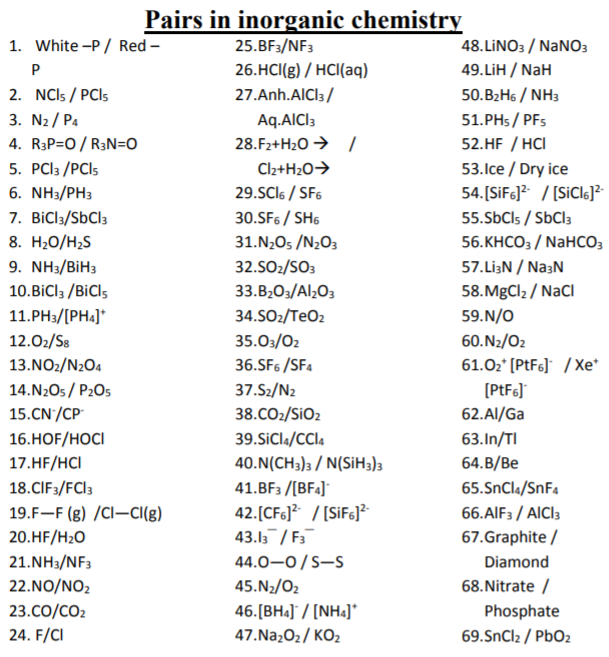
Concepts for anomalous properties / exceptions in chemistry
1) Ionisation Energy
2. Electronegativity
3. Electron gain enthalpy
4. Atomic / ionic radii
5. Oxidation Number
6. Bond dissociation enthalpy
7. Charge by Radius ratio
8. Lattice enthalpy
9. Hydration Enythalpy
10. Presence and absence of vacant d-orbital
11. Size – p-ᴨ - p-ᴨ and p-ᴨ - d-ᴨ overlapping
12. Fajan’s Rule (Covalent character)
13. Presence and absence Odd Electron
14. H-bond formation ability
15. Lewis – Base Character
16. Dipole moment / Polarity
17. Reducing and oxidizing ability - Electrode potential
18. Intermolecular force of attraction
19. Catenation property / ability to form allotrope
20. State of substance – solid / liquid / gas
21. Inert pair effect
22. Repulsive interaction
23. Exothermic and endothermic compound
24. 600 angular strain
26. Types of oxides – acidic, basic, amphoteric
27. Isostructural compounds
28. Monomeric / polymeric
29. State of hybridization.
30. Imperfect screening
31. Paramagnetic / diamagnetic
32. Multiple bond formation ability
33. Effective nuclear charge

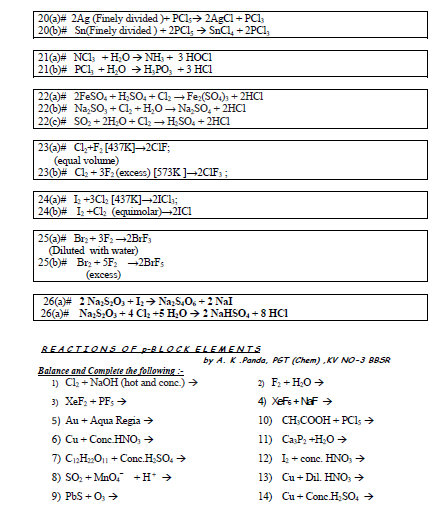
15) Ca(OH)2 +Cl2 →
16) NaCl + MnO2 + H2SO4 →
17) HgCl2 + PH3→
18) U + ClF3 →
19) XeF4 + H2O →
20) XeF6 + H2O →
21) KMnO4 + HCl →
22) KI (aq) + H2O(l) + O3 (g) →
23) CuSO4 + NH3 →
24) PCl5 + H2O(excess) →
25) (NH4)2Cr2O7 --(heat)→
26) P4 + NaOH +H2O →
27) Al2O3 + NaOH + H2O →
28) HCl + O2 + CuCl2(Catalyst)→
29) XeF2 (s) + H2O (l) →
30) NH3 + Cl2 (excess) →
31) Fe3+ + SO2+ 2H2O →
32) Br2 + KI →
33) Cl2 + H2O →
34) NaOH + SO2 →
35) SO2 + MnO4ˉ + H+ →
36) Fe + HCl →
37) Cl2(g) + NaI(aq) →
38) Na2S2O3 + I2 →
39) Na2S2O3 + Cl2 + H2O →
40) ClF + H2O →
41) XeF4 + O2F2 →
42) Cl2 + NaOH (cold and dil.) →
43) NH3 (excess) + Cl2 →
44) SO2+ V2O5 →
45) H3PO3 + Heat →
46) SF4 + H2O →
47) Al2O3 + HCl + H2O →
48) HNO3 + P4O10 →
49) NH4NO3 + Heat →
50) AgCl + NH3 →
51) NaN3 + Heat →
52) Ag + PCl5 →
53) PCl3 + H2O →
54) Zn + dil. HNO3 →
WORD ROOTS -prefix
1. Homo-- / Hetero :
2. Endo- / Exo-
3. Ultra-- / Infra –
4. Dextro- / Laevo –
5. Phobia- / Philic --- Lyophobic / lyophilic : Hydrohobic / hydrophilic
6. Pre- - Post –
7. Ante- / post : Penultimate / ante-penultimate
8. Mon- -/ bi- or di- / tri- / tetra- / penta -- Oligo - ………………… Poly- [ Monomer /polymer : monochromatic / polychromatic
9. Bis- tris- tetrakis
10.Inter- / Intra-
11.Hypo- / Hyper- : Hypotonic and hyper tonic solution
12.Primary- / secondary/ tertiary / Quaternary –
13.Super- / Sub : Supersonic , Subsonic
14.In- / Ex-
15. Singlet / duplet / triplet / quartet
16.Protic / aprotic solvent
17.Triads / Octaves
18.Entegegen - / Zusaman
19. Trans- / Cis –
20.Isomorphous / Polymorphous
21.Zeotrope / Azeotrope
22.Semi - / hemi- / demi –
23. Iso-- : Isotope / Isobar / Isoelectronic / Isotone / Isomer
24.Isotherm / Isobar / Isochore / Isotonic Solution / Isomorphous / isolobal
25.Isotropic / Anisotropic
26.Isomorphous / Polymorphous
27.Anomalous / Analogous
28.Intensive / Extensive : Intrinsic / Extrinsic
29.Dynamic / Static
30. Dehydration / Decarboxylation/Dehydrogenation
WORD ROOTS
Auto- self; tele- distance; Chroma – colour; Phone – sound; Algia = pain
Pyre- fire , heat
Photo- light Phobia – fearness, Phile – love towards, affinity towards
Metron-- measurement Stoichion - element Atomio – not divisible Oligo-fewPoly –many
Amphi , Ambi - both , on both side , around Halo- salt , Chalco-ore gene - born ,
form
1. Dent – tooth ,Chaeleo- crab Aroma - smell scribe – to write
2. Therm- Heat
3. Therapy – to cure
Antiseptic / Antibacterial / Anti allergic
Please click the link below to download pdf file for CBSE Class 12 Chemistry Important Formulae.
Free study material for Chemistry
All topics Concepts and Summary for Class 12 Chemistry
About All topics Revision Notes
Explore reliable chapter overviews for All topics tailored for Class 12 learners. Use these structured points to grasp difficult themes and ensure solid preparation for upcoming assessments.
How to Use These Revision Notes
Cross-reference your comprehension with comprehensive NCERT solutions for Class 12 to ensure absolute clarity across all sub-topics in this chapter.
Enhance Practice with MCQs and Worksheets
Follow up your revision by attempting the interactive online Chemistry MCQ test and practice worksheets for this chapter to verify your mastery. All platform resources are free to access.
FAQs
You can download the teacher prepared revision notes for CBSE Class 12 Chemistry Important Formulae from StudiesToday.com. These notes are designed as per 2026-27 academic session to help Class 12 students get the best study material for Chemistry.
Yes, our CBSE Class 12 Chemistry Important Formulae include 50% competency-based questions with focus on core logic, keyword definitions, and the practical application of Chemistry principles which is important for getting more marks in 2026 CBSE exams.
Yes, our CBSE Class 12 Chemistry Important Formulae provide a detailed, topic wise breakdown of the chapter. Fundamental definitions, complex numerical formulas and all topics of CBSE syllabus in Class 12 is covered.
These notes for Chemistry are organized into bullet points and easy-to-read charts. By using CBSE Class 12 Chemistry Important Formulae, Class 12 students fast revise formulas, key definitions before the exams.
No, all study resources on StudiesToday, including CBSE Class 12 Chemistry Important Formulae, are available for immediate free download. Class 12 Chemistry study material is available in PDF and can be downloaded on mobile.