
CBSE Class 12 Chemistry Polymers Notes Set E

Download the latest CBSE Class 12 Chemistry Polymers Notes Set E in PDF format. These Class 12 Chemistry revision notes are carefully designed by expert teachers to align with the 2025-26 syllabus. These notes are great daily learning and last minute exam preparation and they simplify complex topics and highlight important definitions for Class 12 students.

Chapter-wise Revision Notes for Class 12 Chemistry Unit 15 Polymers

To secure a higher rank, students should use these Class 12 Chemistry Unit 15 Polymers notes for quick learning of important concepts. These exam-oriented summaries focus on difficult topics and high-weightage sections helpful in school tests and final examinations.

Unit 15 Polymers Revision Notes for Class 12 Chemistry


POLYMERS

GIST

1. Polymer:

It is a very large molecule having molecular mass 103 - 107 g mol-1. They are formed by joining together repeating structural units.

2. Classification of Polymers:

(a) Based On Source:

(i) Natural: Found in plants and animals, e.g. Proteins, cellulose, natural rubber, silk, wool.

(ii) Synthetic: Man-made e.g. Nylon, polyster, neoprene, Bakelite, Teflon, PVC, polystyrene.

(b) Based On Structure:

(i) Linear Polymers: this consist of long and straight chain repeating units e.g. Polythene (HDPE), PVC, nylon, polyester.

(ii) Branched Polymers: This contain linear chains having some branches e.g. amylopectin, glycogen etc.

(iii) Cross Linked Polymers: Strong covalent bonds are present between various linear polymer chains. E.g. Bakelite, urea- formaldehyde polymer, melamine, formaldehyde polymer etc.

(c) Based On Mode Of Polymerization:

(i) Addition Polymers: These are formed by the repeated addition of monomer molecules possessing multiple bonds, e.g., polythene, polypropene, polystyrene, PMMA (polymethyl metha crylate)

(ii) Condensation Polymers: These are formed by the repeated condensation reaction of different bifunctional or trifunctional monomers, with the elimination of small molecules like water,HCL,NH3, alcohol etc. e.g. Bakelite,nylon,polyster,urea- formaldehyde resin.

(d) Based On Molecular Forces:

(i) Elastomers: Forces of interaction between polymer chains is weakest, e.g. natural rubber, neoprene, vulcanized rubber.

(ii) Fibers: Strong hydrogen bonds are present between the polymer chains. They have high tensile strength e.g., nylon.polyster, silk, wool, orlon, rayon etc.

(iii) Thermoplastics: They are linear/slightly branched chains molecules capable of repeated softening on heating and hardening on cooling,e.g., polythene,PVC, polystrene, polypropene.

(iv) Thermosetting Plastics: They are cross-linked or heavily branched molecules, which on heating undergo extensive cross-linkages and become infusible, e.g., bakelite,urea formaldehyde resin.

(e) Based On Growth Of Polymerization: Depending upon the mechanism of Polymerization, polymers are classified as

(i) Addition Polymers Or Chain Growth Polymers:

They follow mostly free radical mechanism.

(ii) Condensation Polymers or Step Growth Polymers

because they are formed in gradual steps.
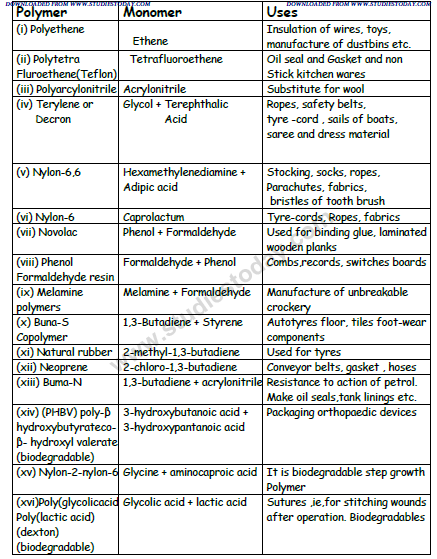
CBSE Class 12 Chemistry notes and questions for Polymers Part B 1

VSA (1 marks)
 
1.Name a natural elastomer.
Ans . Natural rubber.
 
2. Write name of a synthetic poly
Ans. Nylon 6 or Nylon 6,6.
 
3. Name of monomer of Nylon 6.
Ans. €‐ Aminocaproic acid
 
4. Write the monomer units of Bakelite.
Ans. Phenol and formaldehyde.
 
5. Define a copolymer.
Ans.The polymers made by addition polymerisation from two different
monomers are termed as copolymers, e.g., Buna‐S , Buna‐N, etc.
 
6. Write one use of PVC.
Ans: In manufacture of rain coats& vinyl flooring.
 
7. Define Polymer.
Ans: Polymer is defined as very large molecules having molecular mass (103‐107u). These are also referred to as macromolecules,
 
8. Give an example of thermoplastics.
Ans: Thermoplastics are polythene, polystyrene, polyvinyls, etc.
 
9. To which class of polymers does Nylon‐66 belong?
Ans: Polyamides
 
10. Name the type of monomers in terylene ?
Ans: Ethylene glycol and terephthalic acid.


Please click the link below to download pdf file for CBSE Class 12 Chemistry notes and questions for Polymers Part B.

z More Study Material for Class 12 Chemistry
Class 12 Chemistry Full Study Material For Boards Revision
~ Class 12 Chemistry (Old Chapters)
CBSE Class 12 Chemistry Ammonia And Phosphine Notes
CBSE Class 12 Chemistry Chemistry In Everyday Life Board Exam Notes
CBSE Class 12 Chemistry Chemistry In Everyday Life Chapter Notes
CBSE Class 12 Chemistry Chemistry In Everyday Life Notes Set A
CBSE Class 12 Chemistry Chemistry In Everyday Life Notes Set B
CBSE Class 12 Chemistry Chemistry In Everyday Life Notes Set C
CBSE Class 12 Chemistry Chemistry In Everyday Life Notes Set D
CBSE Class 12 Chemistry Chemistry In Everyday Life Notes Set E
CBSE Class 12 Chemistry Chemistry In Everyday Life Notes Set F
CBSE Class 12 Chemistry General Principles And Process Of Isolation Of Elements Board Exam Notes
CBSE Class 12 Chemistry General Principles Notes
CBSE Class 12 Chemistry General Principles Process Of Isolation Of Elements Chapter Notes
CBSE Class 12 Chemistry General Principles Process Of Isolation Of Elements Notes
CBSE Class 12 Chemistry P Block Elements Board Exam Notes
CBSE Class 12 Chemistry P Block Elements Notes Set A
CBSE Class 12 Chemistry P Block Elements Notes Set B
CBSE Class 12 Chemistry Polymers Board Exam Notes
CBSE Class 12 Chemistry Polymers Chapter Notes
CBSE Class 12 Chemistry Polymers Notes Set A
CBSE Class 12 Chemistry Polymers Notes Set B
CBSE Class 12 Chemistry Polymers Notes Set C
CBSE Class 12 Chemistry Polymers Notes Set D
CBSE Class 12 Chemistry Polymers Notes Set E
CBSE Class 12 Chemistry Polymers Notes Set F
CBSE Class 12 Chemistry Processes Of Isolation Of Elements Notes Set A
CBSE Class 12 Chemistry Processes Of Isolation Of Elements Notes Set B
CBSE Class 12 Chemistry Processes Of Isolation Of Elements Notes Set C
CBSE Class 12 Chemistry Solid State Chapter Notes
CBSE Class 12 Chemistry Solid State Notes Set A
CBSE Class 12 Chemistry Solid State Notes Set B
CBSE Class 12 Chemistry Solid State Notes Set C
CBSE Class 12 Chemistry Surface Chemistry Board Exam Notes
CBSE Class 12 Chemistry Surface Chemistry Chapter Notes
CBSE Class 12 Chemistry Surface Chemistry Notes Set A
CBSE Class 12 Chemistry Surface Chemistry Notes Set B
CBSE Class 12 Chemistry Surface Chemistry Notes Set C
CBSE Class 12 Chemistry Surface Chemistry Notes Set D
CBSE Class 12 Chemistry Surface Chemistry Notes Set E
CBSE Class 12 Chemistry Surface Chemistry Notes Set F
CBSE Class 12 Chemistry The P Block Elements Chapter Notes
CBSE Class 12 Chemistry The P Block Elements Notes
CBSE Class 12 Chemistry The P Block Elements Notes Set A
CBSE Class 12 Chemistry The P Block Elements Notes Set B
CBSE Class 12 Chemistry The P Block Elements Notes Set C
CBSE Class 12 Chemistry The Solid State Notes Set A
CBSE Class 12 Chemistry The Solid State Notes Set B
CBSE Class 12 Chemistry The Solid State Notes Set C
CBSE Class 12 Chemistry Unit Cell Notes

CBSE Class 12 Chemistry Unit 15 Polymers Notes

Students can use these Revision Notes for Unit 15 Polymers to quickly understand all the main concepts. This study material has been prepared as per the latest CBSE syllabus for Class 12. Our teachers always suggest that Class 12 students read these notes regularly as they are focused on the most important topics that usually appear in school tests and final exams.

NCERT Based Unit 15 Polymers Summary

Our expert team has used the official NCERT book for Class 12 Chemistry to design these notes. These are the notes that definitely you for your current academic year. After reading the chapter summary, you should also refer to our NCERT solutions for Class 12. Always compare your understanding with our teacher prepared answers as they will help you build a very strong base in Chemistry.

Unit 15 Polymers Complete Revision and Practice

To prepare very well for y our exams, students should also solve the MCQ questions and practice worksheets provided on this page. These extra solved questions will help you to check if you have understood all the concepts of Unit 15 Polymers. All study material on studiestoday.com is free and updated according to the latest Chemistry exam patterns. Using these revision notes daily will help you feel more confident and get better marks in your exams.

Where can I download the latest PDF for CBSE Class 12 Chemistry Polymers Notes Set E?

You can download the teacher prepared revision notes for CBSE Class 12 Chemistry Polymers Notes Set E from StudiesToday.com. These notes are designed as per 2025-26 academic session to help Class 12 students get the best study material for Chemistry.

Are these Chemistry notes for Class 12 based on the 2026 board exam pattern?

Yes, our CBSE Class 12 Chemistry Polymers Notes Set E include 50% competency-based questions with focus on core logic, keyword definitions, and the practical application of Chemistry principles which is important for getting more marks in 2026 CBSE exams.

Do these Class 12 notes cover all topic-wise concepts for Chemistry?

Yes, our CBSE Class 12 Chemistry Polymers Notes Set E provide a detailed, topic wise breakdown of the chapter. Fundamental definitions, complex numerical formulas and all topics of CBSE syllabus in Class 12 is covered.

How can I use CBSE Class 12 Chemistry Polymers Notes Set E for quick last-minute revision?

These notes for Chemistry are organized into bullet points and easy-to-read charts. By using CBSE Class 12 Chemistry Polymers Notes Set E, Class 12 students fast revise formulas, key definitions before the exams.

Is there any registration required to download Class 12 Chemistry notes?

No, all study resources on StudiesToday, including CBSE Class 12 Chemistry Polymers Notes Set E, are available for immediate free download. Class 12 Chemistry study material is available in PDF and can be downloaded on mobile.