

Advanced Study Material for Class 12 Biology: Chapter 09 Biotechnology Principles and Processes
Explore structured advanced study materials through the CBSE Class 12 Biology Biotechnology Principles and Processes diagrams based questions. Tailored for Class 12 learners, utilizing these Biology resources ensures thorough preparation and strengthens foundational knowledge before final CBSE evaluations.
Practice Class 12 Biology Resources: Chapter 09 Biotechnology Principles and Processes
Navigate directly to the advanced Biology study materials using the digital viewer below. Each resource pack includes detailed conceptual summaries and solved practice questions, allowing students to instantly reinforce their learning.
CBSE Class 12 Biology Biotechnology Principles and Processes diagrams based questions. Please refer to the examination notes which you can use for preparing and revising for exams. These notes will help you to revise the concepts quickly and get good marks.
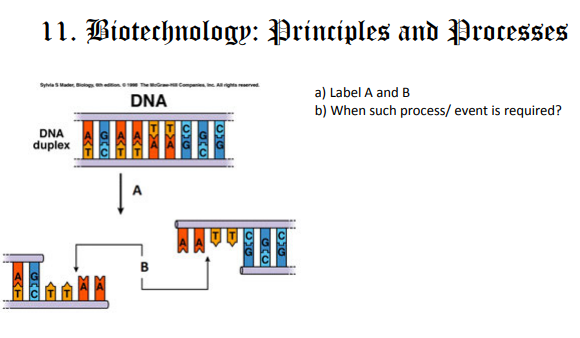
Important Questions for NCERT Class 12 Biology Biotechnology: Principles and Processes
Ques. Recombinant DNA is achieved by cleaving the pro-DNAs by
(a) ligase
(b) restriction endonuclease
(c) primase
(d) exonucleases.
Answer: B
Ques. Two bacteria found to be very useful in genetic engineering experiments are
(a) Nitrobacter and Azotobacter
(b) Rhizobium and Diplococcus
(c) Nitrosomonas and Klebsiella
(d) Escherichia and Agrobacterium.
Answer: D
Ques. Restriction endonucleases are
(a) used for in vitro DNA synthesis
(b) used in genetic engineering
(c) synthesized by bacteria
(d) present in mammalian cells for degradation of DNA.
Answer: B
Ques. The restriction enzymes are used in genetic engineering, because
(a) they can cut DNA at specific base sequence
(b) they are nucleases that cut DNA at variable sites
(c) they can degrade harmful proteins
(d) they can join different DNA fragments.
Answer: A
Ques. Match the organism with its use in biotechnology.
(A) Bacillus (i) Cloning vector thuringiensis
(B) Thermus (ii) Construction of first aquaticus rDNA molecule
(C) Agrobacterium (iii) DNA polymerase tumefaciens
(D) Salmonella (iv) Cry proteins typhimurium
Select the correct option from the following.
(A) (B) (C) (D)
(a) (ii) (iv) (iii) (i)
(b) (iv) (iii) (i) (ii)
(c) (iii) (ii) (iv) (i)
(d) (iii) (iv) (i) (ii)
Answer: B
Ques. DNA precipitation out of a mixture of biomolecules can be achieved by treatment with
(a) chilled chloroform
(b) isopropanol
(c) chilled ethanol
(d) methanol at room temperature.
Answer: C
Ques. Which one of the following equipments is essentially required for growing microbes on a large scale, for industrial production of enzymes?
(a) Bioreactor (b) BOD incubator
(c) Sludge digester (d) Industrial oven
Answer: A
Ques. The correct order of steps in Polymerase Chain Reaction (PCR) is
(a) extension, denaturation, annealing
(b) annealing, extension, denaturation
(c) denaturation, extension, annealing
(d) denaturation, annealing, extension.
Answer: D
Ques. The process of separation and purification of expressed protein before marketing is called
(a) downstream processing
(b) bioprocessing
(c) postproduction processing
(d) upstream processing.
Answer: A
Ques. Stirred-tank bioreactors have been designed for
(a) purification of product
(b) addition of preservatives to the product
(c) availability of oxygen throughout the process
(d) ensuring anaerobic conditions in the culture
Answer: C
Ques. Which of the following is not a component of downstream processing?
(a) Separation (b) Purification
(c) Preservation (d) Expression
Answer: D
Ques. The Taq polymerase enzyme is obtained from
(a) Bacillus subtilis
(b) Pseudomonas putida
(c) Thermus aquaticus
(d) Thiobacillus ferroxidans.
Answer: C
Ques. An analysis of chromosomal DNA using the Southern hybridization technique does not use
(a) electrophoresis (b) blotting
(c) autoradiography (d) PCR.
Answer: D
Ques. In vitro clonal propagation in plants is characterized by
(a) PCR and RAPD
(b) Northern blotting
(c) electrophoresis and HPLC
(d) microscopy.
Answer: A
Ques. Which of the following is not correctly matched for the organism and its cell wall degrading enzyme?
(a) Algae – Methylase
(b) Fungi – Chitinase
(c) Bacteria – Lysozyme
(d) Plant cells – Cellulase
Answer: A
Ques. During the process of isolation of DNA, chilled ethanol is added to
(a) precipitate DNA
(b) break open the cell to release DNA
(c) facilitate action of restriction enzymes
(d) remove proteins such as histones.
Answer: A
Ques. PCR and restriction fragment length polymorphism are the methods for
(a) study of enzymes
(b) genetic transformation
(c) DNA sequencing
(d) genetic fingerprinting.
Answer: D
Ques. Which one is a true statement regarding DNA polymerase used in PCR?
(a) It is used to ligate introduced DNA in recipient cells.
(b) It serves as a selectable marker.
(c) It is isolated from a virus.
(d) It remains active at high temperature.
Answer: D
Ques. Stirred-tank bioreactors have been designed for
(a) addition of preservatives to the product
(b) purification of the product
(c) ensuring anaerobic conditions in the culture vessel
(d) availability of oxygen throughout the process.
Answer: D
Please click the link below to download pdf file of CBSE Class 12 Biology Biotechnology Principles and Processes diagrams based questions.
Free study material for Biology
Biology Class 12 Exam Resources: Chapter 09 Biotechnology Principles and Processes
Comprehensive Study Resources for Chapter 09 Biotechnology Principles and Processes
Review targeted study resources for Chapter 09 Biotechnology Principles and Processes tailored for Class 12 learners. Utilizing these structured notes and quick-revision tools ensures complete alignment with current CBSE evaluation standards.
Understanding Marking Schemes
Designed around the official curriculum, these study guides guarantee standard compliance. Reviewing step-by-step solutions clarifies complex sub-topics within Chapter 09 Biotechnology Principles and Processes and demystifies standard marking schemes for Biology evaluations.
Complete Revision for Biology
Wrap up your chapter revision by testing your knowledge against standard objective question formats. Explore our full library of free, up-to-date sample papers and online assessments to secure top grades in your CBSE examinations.
FAQs
Our advanced study package for Chapter 09 Biotechnology Principles and Processes includes detailed concepts, diagrams, Mind Maps, and explanation of complex topics to ensure Class 12 students learn as per syllabus for 2026 exams.
The Mind Maps provided for Chapter 09 Biotechnology Principles and Processes act as visual anchors which will help faster recall during high-pressure exams.
Yes, teachers use our Class 12 Biology resources for lesson planning as they are in simple language and have lot of solved examples.
Yes, You can download the complete, mobile-friendly PDF of the Biology Chapter 09 Biotechnology Principles and Processes advanced resources for free.
Yes, our subject matter experts have updated the Chapter 09 Biotechnology Principles and Processes material to align with the rationalized NCERT textbooks and have removed deleted topics and added new competency-based questions.