

Class 12 Biology Study Guide: CBSE Class 12 Biology Bio Technology Principles and Processes Diagrams
Explore structured advanced study materials through the CBSE Class 12 Biology Bio Technology Principles and Processes Diagrams. Tailored for Class 12 learners, utilizing these Biology resources ensures thorough preparation and strengthens foundational knowledge before final CBSE evaluations.
Download Chapter 09 Biotechnology Principles and Processes Study Material PDF
View or download the dedicated CBSE Class 12 Biology Bio Technology Principles and Processes Diagrams resource below. Engaging with these advanced study guides under focused conditions ensures continuous academic progress and mastery of the 2026-27 curriculum for Chapter 09 Biotechnology Principles and Processes.
CBSE Class 12 Biology Bio Technology Principles and Processes Diagrams. Please refer to the examination notes which you can use for preparing and revising for exams. These notes will help you to revise the concepts quickly and get good marks.
BIOLOGY
CHAPTER - 11 BIOTECHNOLOGY - PRINCIPLES & PROCESSES
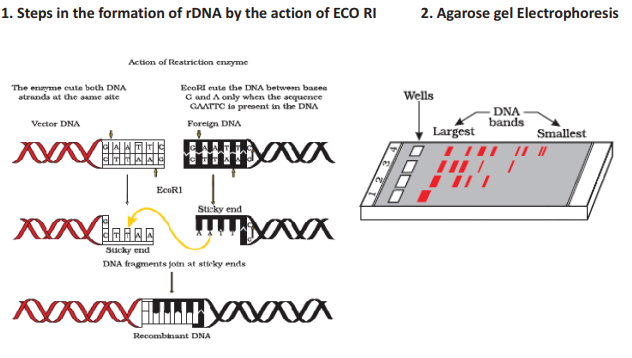
1. Steps in the formation of rDNA by the action of ECO RI [3 Marks]
[Figure: Diagram showing action of restriction enzyme EcoRI. Vector DNA and foreign DNA strands cut by EcoRI at specific recognition sequence (GAATTC) generating sticky ends, which are then joined by DNA ligase to form recombinant DNA.]
Answer:
1. EcoRI recognizes and cuts the palindromic nucleotide sequence GAATTC on both vector DNA and foreign DNA.
2. The enzyme cuts between bases G and A, producing single-stranded overhangs known as sticky ends.
3. DNA ligase joins the foreign DNA fragment and vector DNA at these complementary sticky ends to form recombinant DNA.
Teacher's Note:
a) EcoRI specifically targets the hexanucleotide sequence 5'-GAATTC-3'.
b) Sticky ends form hydrogen bonds with complementary counterparts, facilitating ligation.
c) Always ensure the same restriction enzyme is used for both vector and foreign DNA to generate compatible ends.
2. Agarose gel Electrophoresis [3 Marks]
[Figure: Diagram of agarose gel electrophoresis setup showing wells, DNA bands moving towards the positive electrode, with largest fragments near wells and smallest fragments moving farthest.]
Answer:
1. Negatively charged DNA fragments are forced to move towards the anode (positive electrode) through an agarose gel matrix under an electric field.
2. The sieving effect of the porous agarose gel separates DNA fragments according to their size.
3. Smaller fragments move faster and travel farther through the gel compared to larger fragments.
Teacher's Note:
a) Agarose is a natural polymer extracted from sea weeds used as the matrix.
b) DNA fragments are visualized by staining with ethidium bromide and exposure to UV radiation.
c) The migration velocity of DNA is inversely proportional to the logarithm of their molecular size.
3. Diagrammatic representation of rDNA formation (Recombinant of DNA technology) [3 Marks]
[Figure: Diagrammatic representation showing foreign DNA and plasmid vector cut by the same restriction enzyme, joined by ligases to form recombinant DNA, followed by transformation into E. coli host cells and cell division.]
Answer:
1. Both foreign DNA and vector DNA (plasmid) are cut using the same restriction enzyme at specific points.
2. DNA ligase enzyme is used to join the foreign DNA insert into the plasmid vector to create recombinant DNA.
3. The recombinant plasmid vector is introduced into a host organism like E. coli via transformation, and the cells are allowed to divide.
Teacher's Note:
a) Plasmids serve as extrachromosomal self-replicating circular DNA molecules.
b) Transformation is the process by which host bacteria take up foreign genetic material.
c) Cloned copies multiply rapidly as the host cells undergo regular cell division.
4. Cloning Vector pBR322 [3 Marks]
[Figure: Detailed diagram of E. coli cloning vector pBR322 showing restriction sites for HindIII, EcoRI, BamHI, SalI, PvuII, PstI, ClaI, ori site, and antibiotic resistance genes ampR and tetR, along with rop codes for protein replication.]
Answer:
1. pBR322 is a widely used artificial plasmid cloning vector in E. coli containing unique restriction sites.
2. It possesses two distinct antibiotic resistance genes, ampR and tetR, used as selectable markers.
3. It contains the origin of replication (ori) site and the rop region which controls the copy number of the linked DNA.
Teacher's Note:
a) The letters pBR stand for plasmid, Bolivar, and Rodriguez who constructed it.
b) Selectable markers help in distinguishing transformants from non-transformants.
c) Insertion of foreign DNA at a restriction site within an antibiotic gene leads to insertional inactivation.
BIOLOGY
5. POLYMERASE CHAIN REACTION (PCR) [3 Marks]
[Figure: Diagram of Polymerase Chain Reaction showing three main steps: Denaturation at high temperature separating dsDNA strands, Annealing where synthetic oligonucleotide primers hybridize to the complementary regions, and Extension where Taq DNA polymerase synthesizes new DNA strands using deoxynucleotides, resulting in exponential amplification over multiple cycles.]
Answer:
1. Denaturation: The double-stranded DNA is heated to a high temperature (around 94°C) to separate the two strands, each acting as a template.
2. Annealing: Two sets of oligonucleotide primers hybridize to the separated single strands at a lower temperature.
3. Extension: Thermostable DNA polymerase (Taq polymerase) extends the primers using deoxynucleotides in the reaction mixture, synthesizing complementary strands at around 72°C.
4. Amplification: Repeated cycling of these three steps yields approximately 1 billion copies after 30 cycles.
Teacher's Note:
a) Taq polymerase is isolated from the bacterium Thermus aquaticus, which allows it to remain active during the high temperatures of denaturation.
b) Ensure all three sequential temperature phases are explicitly mentioned in correct order.
c) Primers are chemically synthesized small oligonucleotides complementary to the regions of DNA.
d) This technique is routinely used in gene cloning, DNA fingerprinting, and disease diagnostics.
6. SIMPLE STIRRED TANK BIOREACTOR [2 Marks]
[Figure: Diagram of a simple stirred tank bioreactor showing a cylindrical vessel with a motor at the top driving a central shaft with flat bladed impeller, foam breaker, acid/base inlet for pH control, steam inlet for sterilisation, sterile air sparger at the base, and culture broth.]
Answer:
1. A simple stirred tank bioreactor usually consists of a cylindrical vessel designed to facilitate the mixing of reactor contents.
2. The stirrer facilitates even mixing and oxygen availability throughout the culture broth.
3. It includes a foam breaker, temperature and pH control systems, and ports for adding sterile air and nutrients.
Teacher's Note:
a) Bioreactors are vessels in which raw materials are biologically converted into specific products using microbial plant, animal, or human cells.
b) The flat bladed impeller specifically helps in thorough mixing and oxygen transfer throughout the vessel.
7. SPARGED STIR TANK BIOREACTOR [2 Marks]
[Figure: Diagram of a sparged stirred tank bioreactor showing sterile air being bubbled through a sparger at the bottom, creating gas entrainment where bubbles dramatically increase the surface area for oxygen transfer across the culture medium.]
Answer:
1. In a sparged stirred tank bioreactor, sterile air is bubbled through the bottom of the vessel via a sparger.
2. The rising air bubbles mix the contents and dramatically increase the surface area for oxygen mass transfer into the culture broth.
3. It prevents dead zones and ensures proper aeration for aerobic cultures.
Teacher's Note:
a) Sparging distinguishes this reactor from simple surface aeration setups, enhancing oxygen transfer efficiency.
b) High density cell cultures require high rates of oxygen transfer provided by sparging.
Free study material for Biology
Useful Resources and Notes for Class 12 Biology Chapter 09 Biotechnology Principles and Processes
Essential Notes for Class 12 Biology
Explore essential learning tools for Class 12 Biology Chapter 09 Biotechnology Principles and Processes. This curated collection features in-depth notes and targeted practice questions built around the active 2026 curriculum to streamline your daily revision.
Verified Solutions for Class 12 Biology
Built using official NCERT guidelines for Class 12 Biology, these materials provide reliable academic support. Integrating past examination questions and step-by-step solutions helps students understand official CBSE grading criteria.
Enhance Accuracy with Online Tests
For peak performance in upcoming evaluations, integrate official Biology sample papers directly into your study schedule. Follow up your revision by attempting online MCQ tests for Chapter 09 Biotechnology Principles and Processes to refine calculation speed and precision.
FAQs
Our advanced study package for Chapter 09 Biotechnology Principles and Processes includes detailed concepts, diagrams, Mind Maps, and explanation of complex topics to ensure Class 12 students learn as per syllabus for 2026 exams.
The Mind Maps provided for Chapter 09 Biotechnology Principles and Processes act as visual anchors which will help faster recall during high-pressure exams.
Yes, teachers use our Class 12 Biology resources for lesson planning as they are in simple language and have lot of solved examples.
Yes, You can download the complete, mobile-friendly PDF of the Biology Chapter 09 Biotechnology Principles and Processes advanced resources for free.
Yes, our subject matter experts have updated the Chapter 09 Biotechnology Principles and Processes material to align with the rationalized NCERT textbooks and have removed deleted topics and added new competency-based questions.