

Official CBSE Study Materials for Class 12 Biology
Access comprehensive study materials and useful resources for Chapter 09 Biotechnology Principles and Processes using the CBSE Class 12 Biology Bio Technology Principles and Processes Flow Chart. Designed to align with the 2026-27 CBSE academic guidelines, these advanced resources help Class 12 Biology students reinforce core concepts beyond standard textbooks.
Advanced Resources for Biology
Access the complete useful resource PDF for Class 12 Biology below. Regular practice with these targeted academic notes builds familiarity with complex topics and helps secure higher marks in final school evaluations.
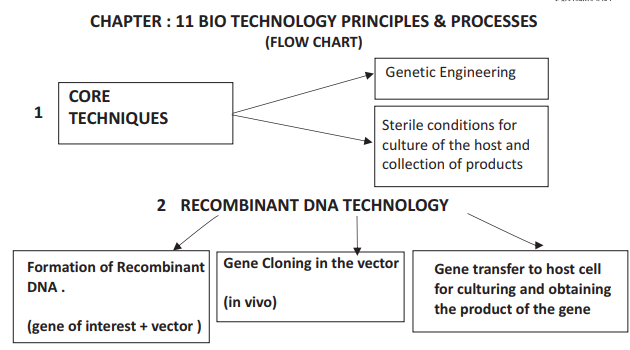
This Class 12 Biology flow chart notes page on Bio-Technology Principles and Processes covers the core techniques of genetic engineering, the steps in creating recombinant DNA, the isolation of the gene of interest with enzymes, restriction enzymes, gel electrophoresis, PCR, methods of gene transfer into host cells, the characteristics of cloning vectors, and bioreactors with downstream processing and quality control.
Topics Covered
1. Core Techniques of Genetic Engineering
2. Recombinant DNA Technology
3. Steps in Creation of rDNA
4. Isolation of Gene (DNA) of Interest using Enzymes
5. Characteristics of Restriction Enzymes
6. Gel Electrophoresis
7. Polymerase Chain Reaction (PCR)
8. Methods of Gene Transfer into Host Cells
9. Characteristics of Cloning Vectors
10. Bioreactors and Downstream Processing
1. Core Techniques
Genetic engineering uses two core techniques. The first is the culture of the host under sterile conditions, and the second is the collection of products from the host.
2. Recombinant DNA Technology
Recombinant DNA (rDNA) is formed by joining a gene of interest with a vector. The steps are: (i) formation of recombinant DNA from the gene of interest and the vector; (ii) gene cloning in the vector, in vivo; and (iii) gene transfer into the host cell for culturing and obtaining the product of the gene.
3. Steps in Creation of rDNA and Recombinant Protein
1. Isolation of DNA from the organism, using enzymes such as lysozyme, chitinase, protease and RNase, and precipitation with chilled ethanol.
2. Cutting of DNA at recognition sites by restriction enzymes. The same enzyme cuts the cloning vector at a similar recognition site, producing sticky ends.
3. Separation of the cut fragments by gel electrophoresis, and amplification of the gene using PCR.
4. Joining of the gene (DNA fragment) with the cloning vector DNA using DNA ligase.
5. Transfer of the recombinant DNA into the host cell, using methods such as biolistics, microinjection, or pathogens such as bacteria and retroviruses whose pathogenic properties have been removed.
6. Culturing of the host cell containing the rDNA in bioreactors to produce the product.
7. Separation and purification of the product (downstream processing), formulation with preservatives, followed by quality control testing.
4. Isolation of Gene (DNA) of Interest using Enzymes
Lysozyme breaks the bacterial cell wall. Chitinase breaks the fungal cell wall. Cellulase breaks the plant cell wall. Protease digests proteins. RNase digests RNA, so that only DNA is left.
5. Characteristics of Restriction Enzymes
1. They are endonucleases, which cut DNA within the molecule.
2. They have specific recognition sites, which are palindromic.
3. They are named after the genus, species and strain of the organism from which they are isolated.
6. Gel Electrophoresis
1. Negatively charged DNA fragments are forced to move through a gel towards the anode, in an electric field.
2. The smaller fragments sieve through the gel faster and move faster towards the anode.
3. The larger fragments remain near the wells at the cathode end, as they sieve slowly.
4. The separated fragments are stained with ethidium bromide and visualised under UV light.
5. The DNA fragments are cut out from the gel, a process known as elution.
7. Polymerase Chain Reaction (PCR)
1. Denaturation: The DNA is separated into single strands by applying a high temperature of up to 95°C.
2. Annealing: Two sets of primers (short stretches of nucleic acid) attach to the single-stranded DNA at complementary sites.
3. Extension: The primers are extended by the addition of nucleotides, in the presence of a thermostable DNA polymerase (Taq polymerase), complementary to the DNA strand. The primers are then removed.
4. Repeat: This cycle is repeated about 30 times, and the DNA fragment is amplified about a billion times.
[Figure: Three-stage PCR cycle showing denaturation at high temperature, annealing of primers, and extension by Taq polymerase]
8. Methods of Gene Transfer into Host Cells
1. Biolistics (gene gun) for plant cells.
2. Microinjection for animal cells.
3. Disarmed pathogens, such as bacteria and retroviruses, for animal cells.
4. Treatment with Ca2+ and heat shock (ice shock) to make bacterial cells porous, so that they take up DNA from the surroundings.
9. Characteristics of Cloning Vectors
1. Ori (origin of replication): The sequence on the DNA where replication starts. It should be capable of supporting several replications, to make as many copies as needed.
2. Recognition sites: Sites for the action of different restriction enzymes, where the gene of interest can be inserted.
3. Marker genes: Their presence in the host helps in selecting the host cells that have the gene, separating them from cells that do not carry it. The cells carrying rDNA, called transformants, can be selected and separated from non-transformants.
10. Bioreactors
Bioreactors produce recombinant proteins using raw materials and living cells or enzymes.
Sparged Stirred Tank
Sterile air is passed into the tank as bubbles, so that the medium is sparged (aerated).
Simple Stirred Tank
1. Curved base for better mixing.
2. Stirrer.
3. Oxygen delivery system.
4. Foam control.
5. Temperature control.
6. pH control.
7. Sampling ports.
[Figure: Sparged stirred tank with sterile air bubbles entering the tank, and a simple stirred tank with its labelled parts, including the stirrer, oxygen delivery, foam control, temperature control, pH control and sampling ports]
Downstream Processing and Quality Control
Downstream processing and quality control testing are carried out before the product is made commercially available.
Free study material for Biology
Useful Resources and Notes for Class 12 Biology Chapter 09 Biotechnology Principles and Processes
Comprehensive Study Resources for Chapter 09 Biotechnology Principles and Processes
Review targeted study resources for Chapter 09 Biotechnology Principles and Processes tailored for Class 12 learners. Utilizing these structured notes and quick-revision tools ensures complete alignment with current CBSE evaluation standards.
Understanding Marking Schemes
Each resource draws directly from authorized textbooks to maintain academic accuracy. Evaluating solved examples allows Class 12 students to master the formal presentation and answer-writing standards expected in upcoming school exams.
Complete Revision for Biology
Maximize your grade potential by utilizing Class 12 Biology practice papers in tandem with these structured notes. All printable assignments and interactive mock tests on our platform are updated for the 2026 session and available free of charge.
FAQs
Our advanced study package for Chapter 09 Biotechnology Principles and Processes includes detailed concepts, diagrams, Mind Maps, and explanation of complex topics to ensure Class 12 students learn as per syllabus for 2026 exams.
The Mind Maps provided for Chapter 09 Biotechnology Principles and Processes act as visual anchors which will help faster recall during high-pressure exams.
Yes, teachers use our Class 12 Biology resources for lesson planning as they are in simple language and have lot of solved examples.
Yes, You can download the complete, mobile-friendly PDF of the Biology Chapter 09 Biotechnology Principles and Processes advanced resources for free.
Yes, our subject matter experts have updated the Chapter 09 Biotechnology Principles and Processes material to align with the rationalized NCERT textbooks and have removed deleted topics and added new competency-based questions.