

Download CBSE Class 12 Biology Useful Resources
Review targeted academic resources with the CBSE Class 12 Biology Ecosystem Key Points. Built according to official CBSE standards for the 2026-27 term, these downloadable Class 12 Biology study materials support effective daily practice and deeper conceptual understanding for Chapter 12 Ecosystem.
Access CBSE Study Guides and Summaries
Navigate directly to the advanced Biology study materials using the digital viewer below. Each resource pack includes detailed conceptual summaries and solved practice questions, allowing students to instantly reinforce their learning.
CBSE Class 12 Biology Ecosystem Key Points. There are many more useful educational material which the students can download in pdf format and use them for studies. Study material like concept maps, important and sure shot question banks, quick to learn flash cards, flow charts, mind maps, teacher notes, important formulas, past examinations question bank, important concepts taught by teachers. Students can download these useful educational material free and use them to get better marks in examinations. Also refer to other worksheets for the same chapter and other subjects too. Use them for better understanding of the subjects.
This Class 12 Biology Chapter 14 Ecosystem key points page gives short, exam-ready definitions of ecosystem terms, including productivity, decomposition, energy flow, food chains and food webs, ecological pyramids, Lindeman's 10 percent law, succession, biomes, carrying capacity and environmental issues such as desertification and extinction.
CHAPTER 14: ECOSYSTEM (KEY POINTS)
| S.N | Term | Explanation |
|---|---|---|
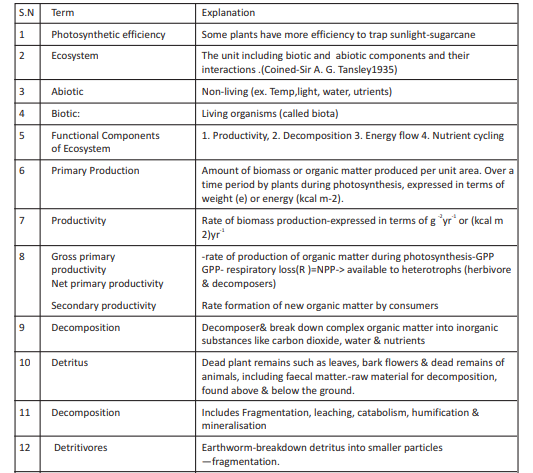
| 1 | Photosynthetic efficiency | Some plants have more efficiency to trap sunlight, e.g., sugarcane. |
| 2 | Ecosystem | The unit including biotic and abiotic components and their interactions. (Coined by Sir A. G. Tansley, 1935) |
| 3 | Abiotic | Non-living components, e.g., temperature, light, water, nutrients. |
| 4 | Biotic | Living organisms (called biota). |
| 5 | Functional components of ecosystem | 1. Productivity 2. Decomposition 3. Energy flow 4. Nutrient cycling |
| 6 | Primary production | Amount of biomass or organic matter produced per unit area over a time period by plants during photosynthesis, expressed in terms of weight or energy (kcal m-2). |
| 7 | Productivity | Rate of biomass production, expressed in terms of g m-2 yr-1 or (kcal m-2) yr-1. |
| 8 | Gross primary productivity; Net primary productivity; Secondary productivity | Gross primary productivity (GPP): rate of production of organic matter during photosynthesis. Net primary productivity (NPP): GPP minus respiratory loss (R), i.e., NPP = GPP - R, which is available to heterotrophs (herbivores and decomposers). Secondary productivity: rate of formation of new organic matter by consumers. |
| 9 | Decomposition | Decomposers break down complex organic matter into inorganic substances like carbon dioxide, water and nutrients. |
| 10 | Detritus | Dead plant remains such as leaves, bark, flowers and dead remains of animals, including faecal matter. It is the raw material for decomposition and is found above and below the ground. |
| 11 | Decomposition (process) | Includes fragmentation, leaching, catabolism, humification and mineralisation. |
| 12 | Detritivores | Earthworms, which break down detritus into smaller particles (fragmentation). |
| 13 | Process of decomposition | Fragmentation: earthworms break detritus into smaller particles. Leaching: water-soluble inorganic nutrients go down into the soil horizon and get precipitated as unavailable salts. Catabolism: bacterial and fungal enzymes convert degraded detritus into simpler inorganic substances. Humification: occurs during decomposition in the soil and leads to the accumulation of a dark coloured amorphous substance, humus, which is resistant to microbial action and decomposes at an extremely slow rate. Mineralisation: humus is degraded by microbes and releases inorganic nutrients. |
| 14 | PAR | Photosynthetically Active Radiation. |
| 15 | Producers | Autotrophs, which produce organic matter from inorganic matter (producing chemical energy in the form of organic matter). |
| 16 | Consumers | Heterotrophs, such as herbivores and carnivores, that depend on producers or other consumers for food. |
| 17 | Decomposers | Fungi and bacteria, heterotrophic organisms that break down (decompose) detritus. |
| 18 | Saprotrophs | "Sapro" means decompose. Decomposers secrete digestive enzymes that break down dead and waste materials into simple inorganic material, which is then absorbed by them. |
| 19 | Food chain | Transfer of energy from producers to top consumers through a series of organisms. One organism holds only one position in the chain, thereby transferring matter and energy from one level to the next. |
| 20 | Food web | Number of food chains interconnected with each other like a web. One organism holds more than one position, and there are branching lines and competition among members of different trophic levels. It is a complex network of many interconnected food chains and feeding relationships. |
| 21 | Standing crop | The mass of living material present in each trophic level at a particular time. |
| 22 | Seral community | An individual transitional community, called a seral stage. |
| 23 | Climax community | A community that is in near equilibrium with the environment. |
| 24 | Pioneer community | Species that invade a bare area. |
| 25 | Primary succession | Establishment of a biotic community in a newly cooled lava, bare rock, or a newly created pond or reservoir. It is a slow process. In water, primary succession goes: phytoplankton → free floating angiosperms → rooted hydrophytes → sedges and grasses → trees → forest (climax). |
| 26 | Secondary succession | Begins in areas where natural biotic communities have been destroyed, e.g., abandoned farm land, or buried or cut forests. Since soil is available, it is a faster process. |
| 27 | Hydrarch succession | Takes place in wetter areas (water bodies), and the series progresses from hydric to mesic conditions. |
| 28 | Xerarch succession | Takes place in dry areas (rocks), and the series progresses from xeric to mesic conditions. |
| 29 | Gaseous cycle | Reservoir is the atmosphere; nutrients are in gas or vapour form; cycling is quick or faster, e.g., carbon and nitrogen cycles. |
| 30 | Sedimentary cycle | Reservoir is the earth's crust; nutrients are non-gaseous; cycling is slow, e.g., phosphorus and sulphur cycles. |
| 31 | Phosphorus | Makes shell, bone, teeth, biological membranes, nucleic acids and the cellular energy transfer system. |
| 32 | Ecosystem services | Robert Costanza gave an 18 trillion US dollar price tag to nature's life support services: 1. purify air, 2. cycle nutrients, 3. mitigate droughts and floods, 4. generate fertile soil, 5. provide wildlife habitat, 6. pollinate crops, 7. maintain biodiversity, 8. provide storage site for carbon, 9. provide aesthetic, cultural and spiritual values. |
| 33 | Energy flow | Solar energy 100% → plants 2-10% → consumers. Energy is transferred in an ecosystem, and at each step food is degraded and a major portion is lost as heat energy. |
| 34 | Lindeman's 10% law | At each step of a food chain, only 10% of the energy is passed on from one trophic level to the next (1942). |
| 35 | Ecological pyramid | The relation between producers and consumers in an ecosystem, represented graphically in the form of a pyramid. |
| 36 | Pyramid of numbers | Relationship between producers and consumers in terms of number. It is upright (except in a tree ecosystem, where it is inverted). |
| 37 | Pyramid of biomass | Relationship between producers and consumers in terms of biomass. It is inverted in the sea, e.g., fish and plankton. |
| 38 | Pyramid of energy | Relationship between producers and consumers in terms of the flow of energy. It is always upright and never inverted. |
| 39 | Ecological succession | Sequential, gradual and predictable changes in the species composition of an area. |
| 40 | Sere | The entire sequence of communities that successively change in a given area. |
| 41 | Biome | Any of the world's major ecosystems, classified according to the predominant vegetation and characterised by adaptations of organisms to that environment. Terrestrial regions inhabited by certain types of life, especially vegetation, e.g., deserts, grasslands and forests. |
| 42 | Carrying capacity (K) | The maximum population of a particular species that a given habitat can support over a given period of time. |
| 43 | Competition | Two or more individual organisms of a single species (intraspecific competition), or two or more individuals of different species (interspecific competition), trying to use the same scarce resources in the same ecosystem. |
| 44 | Consumer | An organism that cannot synthesise the organic nutrients it needs and gets them by feeding on the tissues of producers or of other consumers. Generally divided into primary consumers (herbivores), secondary consumers (carnivores), tertiary (higher level) consumers, omnivores and detritivores (decomposers and detritus feeders). |
| 45 | Deforestation | Removal of trees from a forested area without adequate replanting. |
| 46 | Desert | A biome where evaporation exceeds precipitation and the average precipitation is less than 25 cm (10 inches) a year. Such areas have little vegetation or widely spaced, mostly low vegetation. |
| 47 | Desertification | Conversion of rangeland, rain-fed cropland or irrigated cropland into desert-like land, with a drop in agricultural productivity of 10% or more. It is usually caused by a combination of overgrazing, soil erosion, prolonged drought and climate change. |
| 48 | Ecological niche | The total way of life or role of a species in an ecosystem. It includes all the physical, chemical and biological conditions a species needs to live and reproduce. |
| 49 | Environmental degradation | Depletion or destruction of a potentially renewable resource, such as soil, grassland, forest or wildlife, by using it faster than it is naturally replenished. If such use continues, the resource can become non-renewable on a human time scale or non-existent (extinct). |
| 50 | Extinction | Complete disappearance of a species from the earth. This happens when a species cannot adapt and successfully reproduce under new environmental conditions, or when it evolves into one or more new species (speciation). |
| 51 | Forest | A biome with enough average annual precipitation (at least 76 cm, or 30 inches) to support the growth of various species of trees and smaller forms of vegetation. |
| 52 | Grassland | A biome found in regions where moderate annual average precipitation (25 to 76 cm, or 10 to 30 inches) is enough to support the growth of grass and small plants, but not enough to support large stands of trees. |
| 53 | Habitat | The place, or type of place, where an organism or a population of organisms lives. |
| 54 | Keystone species | Species that play roles affecting many other organisms in an ecosystem. |
| 55 | Limiting factor | A single factor that limits the growth, abundance or distribution of the population of a species in an ecosystem. |
| 56 | Native species | Species that normally live and thrive in a particular ecosystem. |
| 57 | Pioneer community | The first integrated set of plants, animals and decomposers found in an area undergoing primary ecological succession. |
| 58 | Pioneer species | The first hardy species of microbes, mosses and lichens that begin colonising a site as the first stage of ecological succession. |
| 59 | Primary succession | Sequential development of communities in a bare area that has never been occupied by a community of organisms. |
| 60 | Secondary succession | Sequential development of communities in an area where natural vegetation has been removed or destroyed, but the soil is not destroyed and has remnants of vegetation. |
| 61 | Stratification | In an ecosystem, stratification refers to the vertical distribution of different species occupying different levels. |
Free study material for Biology
Free CBSE Study Guides: Class 12 Biology Chapter 12 Ecosystem
Quick Revision Material for Chapter 12 Ecosystem
Access comprehensive study material for Chapter 12 Ecosystem, including revision notes, concept maps, and high-probability questions. These resources are designed in alignment with the latest 2026 CBSE syllabus for Class 12 Biology to support effective exam preparation.
Expert Notes and Solved Exam Questions
Designed around the official curriculum, these study guides guarantee standard compliance. Reviewing step-by-step solutions clarifies complex sub-topics within Chapter 12 Ecosystem and demystifies standard marking schemes for Biology evaluations.
Additional Study Resources for Class 12
For peak performance in upcoming evaluations, integrate official Biology sample papers directly into your study schedule. Follow up your revision by attempting online MCQ tests for Chapter 12 Ecosystem to refine calculation speed and precision.
FAQs
Our advanced study package for Chapter 12 Ecosystem includes detailed concepts, diagrams, Mind Maps, and explanation of complex topics to ensure Class 12 students learn as per syllabus for 2026 exams.
The Mind Maps provided for Chapter 12 Ecosystem act as visual anchors which will help faster recall during high-pressure exams.
Yes, teachers use our Class 12 Biology resources for lesson planning as they are in simple language and have lot of solved examples.
Yes, You can download the complete, mobile-friendly PDF of the Biology Chapter 12 Ecosystem advanced resources for free.
Yes, our subject matter experts have updated the Chapter 12 Ecosystem material to align with the rationalized NCERT textbooks and have removed deleted topics and added new competency-based questions.