

Official CBSE Study Materials for Class 12 Biology
Access comprehensive study materials and useful resources for Chapter 13 Biodiversity and Conservation using the CBSE Class 12 Biology Biodiversity and Conservation Key Points. Designed to align with the 2026-27 CBSE academic guidelines, these advanced resources help Class 12 Biology students reinforce core concepts beyond standard textbooks.
Advanced Resources for Biology
View or download the dedicated CBSE Class 12 Biology Biodiversity and Conservation Key Points resource below. Engaging with these advanced study guides under focused conditions ensures continuous academic progress and mastery of the 2026-27 curriculum for Chapter 13 Biodiversity and Conservation.
CBSE Class 12 Biology Biodiversity and Conservation Key Points. There are many more useful educational material which the students can download in pdf format and use them for studies. Study material like concept maps, important and sure shot question banks, quick to learn flash cards, flow charts, mind maps, teacher notes, important formulas, past examinations question bank, important concepts taught by teachers. Students can download these useful educational material free and use them to get better marks in examinations. Also refer to other worksheets for the same chapter and other subjects too. Use them for better understanding of the subjects.
CHAPTER: 15 BIODIVERSITY AND CONSERVATION (KEY POINTS)
Review the key terms and explanations related to biodiversity and conservation as presented below. [5 Marks]
Answer:
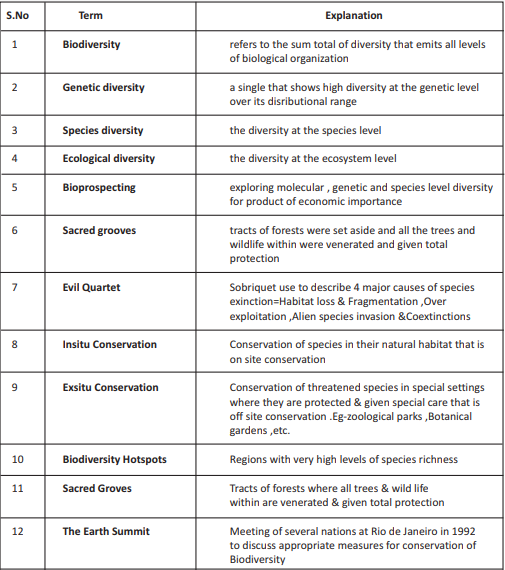
The important terms and their explanations from the chapter are tabulated below:
| S.No | Term | Explanation |
|---|---|---|
| 1 | Biodiversity | Refers to the sum total of diversity that emits all levels of biological organization. |
| 2 | Genetic diversity | A single species that shows high diversity at the genetic level over its distributional range. |
| 3 | Species diversity | The diversity at the species level. |
| 4 | Ecological diversity | The diversity at the ecosystem level. |
| 5 | Bioprospecting | Exploring molecular, genetic and species level diversity for products of economic importance. |
| 6 | Sacred Groves | Tracts of forests were set aside and all the trees and wildlife within were venerated and given total protection. |
| 7 | Evil Quartet | Sobriquet used to describe 4 major causes of species extinction: Habitat loss and fragmentation, Over-exploitation, Alien species invasion, and Co-extinctions. |
| 8 | In-situ Conservation | Conservation of species in their natural habitat, that is on-site conservation. |
| 9 | Ex-situ Conservation | Conservation of threatened species in special settings where they are protected and given special care, that is off-site conservation, e.g., zoological parks, botanical gardens, etc. |
| 10 | Biodiversity Hotspots | Regions with very high levels of species richness. |
| 12 | The Earth Summit | Meeting of several nations at Rio de Janeiro in 1992 to discuss appropriate measures for conservation of biodiversity. |
| 13 | World Summit on Sustainable Development | Meeting of several nations in Johannesburg, South Africa in 2002 to reduce the rate of biodiversity loss. |
| 14 | Endemism | Species confined to a region and not found elsewhere. |
Teacher's Note:
a) These key terms form the foundational vocabulary for understanding ecology and conservation principles.
b) Students often confuse in-situ and ex-situ conservation; emphasize that natural habitat protection is in-situ while captive/botanical protection is ex-situ.
c) The term 'Evil Quartet' groups the four major drivers of biodiversity loss popularized by Paul Ehrlich.
d) Knowing the specific years and locations of the Earth Summit (Rio de Janeiro, 1992) and World Summit (Johannesburg, 2002) is essential for objective questions.
Free study material for Biology
CBSE Class 12 Biology Study Material: Chapter 13 Biodiversity and Conservation
Essential Notes for Class 12 Biology
Access comprehensive study material for Chapter 13 Biodiversity and Conservation, including revision notes, concept maps, and high-probability questions. These resources are designed in alignment with the latest 2026 CBSE syllabus for Class 12 Biology to support effective exam preparation.
Verified Solutions for Class 12 Biology
Designed around the official curriculum, these study guides guarantee standard compliance. Reviewing step-by-step solutions clarifies complex sub-topics within Chapter 13 Biodiversity and Conservation and demystifies standard marking schemes for Biology evaluations.
Enhance Accuracy with Online Tests
Maximize your grade potential by utilizing Class 12 Biology practice papers in tandem with these structured notes. All printable assignments and interactive mock tests on our platform are updated for the 2026 session and available free of charge.
FAQs
Our advanced study package for Chapter 13 Biodiversity and Conservation includes detailed concepts, diagrams, Mind Maps, and explanation of complex topics to ensure Class 12 students learn as per syllabus for 2026 exams.
The Mind Maps provided for Chapter 13 Biodiversity and Conservation act as visual anchors which will help faster recall during high-pressure exams.
Yes, teachers use our Class 12 Biology resources for lesson planning as they are in simple language and have lot of solved examples.
Yes, You can download the complete, mobile-friendly PDF of the Biology Chapter 13 Biodiversity and Conservation advanced resources for free.
Yes, our subject matter experts have updated the Chapter 13 Biodiversity and Conservation material to align with the rationalized NCERT textbooks and have removed deleted topics and added new competency-based questions.