

Advanced Study Material for Class 12 Biology: Chapter 05 Molecular Basis of Inheritance
Access comprehensive study materials and useful resources for Chapter 05 Molecular Basis of Inheritance using the CBSE Class 12 Biology Molecular Basis of Inheritance Cross Word. Designed to align with the 2026-27 CBSE academic guidelines, these advanced resources help Class 12 Biology students reinforce core concepts beyond standard textbooks.
Practice Class 12 Biology Resources: Chapter 05 Molecular Basis of Inheritance
Access the complete useful resource PDF for Class 12 Biology below. Regular practice with these targeted academic notes builds familiarity with complex topics and helps secure higher marks in final school evaluations.
CBSE Class 12 Biology Molecular Basis of Inheritance Cross Word. Please refer to the examination notes which you can use for preparing and revising for exams. These notes will help you to revise the concepts quickly and get good marks.
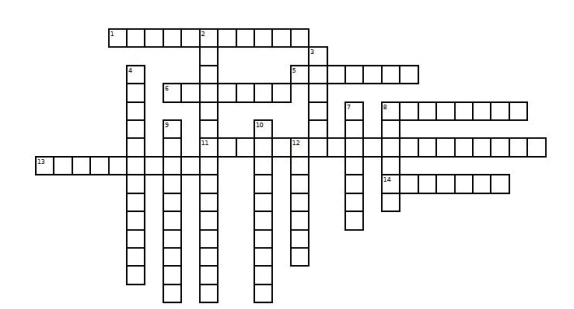
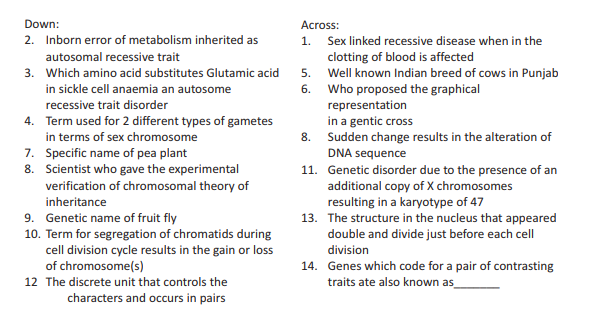
[Figure: A crossword puzzle grid numbered 1 to 14 containing across and down blank rows and columns for answers related to Molecular Basis of Inheritance]
ACROSS: [1 Mark each]
5. Causative organism of pneumonia [1 Mark]
Answer:
1. Pneumococcus (Streptococcus pneumoniae)
Teacher's Note:
a) Streptococcus pneumoniae is the primary bacterial pathogen causing pneumonia.
b) Ensure correct spelling of the genus and species names.
6. An acidic substance present in nucleus [1 Mark]
Answer:
1. Nucleic acid (DNA or RNA)
Teacher's Note:
a) Friedrich Miescher initially identified this substance as nuclein.
b) The acidic nature is due to the presence of phosphate groups.
8. Chromatin densely packed and inactive [1 Mark]
Answer:
1. Heterochromatin
Teacher's Note:
a) Heterochromatin stains darkly with basic dyes.
b) It is transcriptionally inactive.
9. Helps in joining the fragments [1 Mark]
Answer:
1. DNA ligase
Teacher's Note:
a) Seals nicks in the sugar-phosphate backbone.
b) Crucial during lagging strand DNA replication.
12. A set of positively charged base proteins [1 Mark]
Answer:
1. Histones
Teacher's Note:
a) Rich in basic amino acids lysine and arginine.
b) Core octamer packages DNA into nucleosomes.
13. Chromatin loosely packed and active [1 Mark]
Answer:
1. Euchromatin
Teacher's Note:
a) Stains light with basic dyes.
b) Transcriptionally active region of chromatin.
14. Process of removing introns from processed RNA [1 Mark]
Answer:
1. Splicing
Teacher's Note:
a) Removes non-coding introns and joins exons.
b) Performed by the spliceosome machinery in eukaryotes.
DOWN: [1 Mark each]
1. Formed by N-glyccosidic linkage [1 Mark]
Answer:
1. Nucleoside
Teacher's Note:
a) Formed by attachment of a nitrogenous base to a pentose sugar.
b) Contrast with nucleotide which also includes a phosphate group.
2. largest known human gene at 2.4 billon bases [1 Mark]
Answer:
1. Dystrophin
Teacher's Note:
a) Mutations in this gene cause Duchenne muscular dystrophy.
b) Note that the transcript contains 2.4 million bases (typo in source paper stating billion).
3. Substrate of lac-operon [1 Mark]
Answer:
1. Lactose
Teacher's Note:
a) Acts as an inducer in the lac operon system.
b) Binds to the repressor protein to allow transcription.
4. Process of protein synthesis from RNA [1 Mark]
Answer:
1. Translation
Teacher's Note:
a) Occurs on ribosomes in the cytoplasm.
b) Translates mRNA codon sequence into amino acid sequence.
5. Variation at genetic level [1 Mark]
Answer:
1. Mutation
Teacher's Note:
a) Source of all new alleles and genetic diversity.
b) Can be point mutations or chromosomal aberrations.
7. Bacteria infected with viruses [1 Mark]
Answer:
1. Bacteriophage
Teacher's Note:
a) Viruses that specifically parasitize bacteria.
b) Used in the Hershey and Chase radioactive labeling experiments.
10. A segment of DNA coding for polypeptide [1 Mark]
Answer:
1. Cistron
Teacher's Note:
a) Functional unit of inheritance analogous to a gene.
b) Can be monocistronic in eukaryotes or polycistronic in prokaryotes.
11. Present in RNA ay the place of Thymine [1 Mark]
Answer:
1. Uracil
Teacher's Note:
a) A pyrimidine base found exclusively in RNA.
b) Pairs with adenine during transcription.
Free study material for Biology
Biology Class 12 Exam Resources: Chapter 05 Molecular Basis of Inheritance
Core Study Kit: Class 12 Biology Chapter 05 Molecular Basis of Inheritance
Access comprehensive study material for Chapter 05 Molecular Basis of Inheritance, including revision notes, concept maps, and high-probability questions. These resources are designed in alignment with the latest 2026 CBSE syllabus for Class 12 Biology to support effective exam preparation.
NCERT-Aligned Solutions for Chapter 05 Molecular Basis of Inheritance
Built using official NCERT guidelines for Class 12 Biology, these materials provide reliable academic support. Integrating past examination questions and step-by-step solutions helps students understand official CBSE grading criteria.
Next Steps in Your Exam Preparation
Maximize your grade potential by utilizing Class 12 Biology practice papers in tandem with these structured notes. All printable assignments and interactive mock tests on our platform are updated for the 2026 session and available free of charge.
FAQs
Our advanced study package for Chapter 05 Molecular Basis of Inheritance includes detailed concepts, diagrams, Mind Maps, and explanation of complex topics to ensure Class 12 students learn as per syllabus for 2026 exams.
The Mind Maps provided for Chapter 05 Molecular Basis of Inheritance act as visual anchors which will help faster recall during high-pressure exams.
Yes, teachers use our Class 12 Biology resources for lesson planning as they are in simple language and have lot of solved examples.
Yes, You can download the complete, mobile-friendly PDF of the Biology Chapter 05 Molecular Basis of Inheritance advanced resources for free.
Yes, our subject matter experts have updated the Chapter 05 Molecular Basis of Inheritance material to align with the rationalized NCERT textbooks and have removed deleted topics and added new competency-based questions.