

Advanced Study Material for Class 12 Biology: Chapter 01 Sexual Reproduction In Flowering Plants
Explore structured advanced study materials through the CBSE Class 12 Biology Sexual Reproduction in Flowering Plants Question Bank. Tailored for Class 12 learners, utilizing these Biology resources ensures thorough preparation and strengthens foundational knowledge before final CBSE evaluations.
Practice Class 12 Biology Resources: Chapter 01 Sexual Reproduction In Flowering Plants
Access the complete useful resource PDF for Class 12 Biology below. Regular practice with these targeted academic notes builds familiarity with complex topics and helps secure higher marks in final school evaluations.
CBSE Class 12 Biology Sexual Reproduction in Flowering Plants Question Bank. There are many more useful educational material which the students can download in pdf format and use them for studies. Study material like concept maps, important and sure shot question banks, quick to learn flash cards, flow charts, mind maps, teacher notes, important formulas, past examinations question bank, important concepts taught by teachers. Students can download these useful educational material free and use them to get better marks in examinations. Also refer to other worksheets for the same chapter and other subjects too. Use them for better understanding of the subjects.
SEXUAL REPRODUCTION IN FLOWERING PLANTS
ONE MARK
1. Why are pollen grains produced in enormous quantity in maize?
2. What is the ploidy of the cells in the microspore tetrad?
3. What is the ploidy of PEN?
4. How many eggs are present in an embryo sac?
5. Even though each pollen grain has two male gametes, why are atleast 10 pollen grains and not 5 pollen grains required to fertilize 10 ovules present in a particular carpel?
6. What are parthenocarpic fruits?
7. What is scutellum?
8. What is a pollen bank?
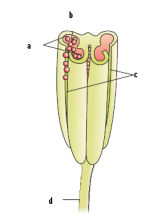
9. identify the given figure and lable the parts.
TWO MARKS
10. Of the eight nuclei of the embryo sac in flowering plants three are at the micropylar end. How many are there at the chalazal end and how many nuclei located in the central cell?
11. How could pollen grains be well preserved as fossils?
12. What are the effects of pollen in some people and how are the pollen grains are being used as food supplements?
13. How many haploid nuclei and haploid cells are present in the female gametophyte of angiosperm?
14. Why is the process of fertilization in flowering plant referred to as double fertilization? Explain.
15. How does geitonogamy differ from xenogamy in plants?
16. What are the stages of embryogeny in a Dicotyledonous embryo?
17. How long do the seeds remain alive after they are dispersed?
THREE MARKS
18. Draw a diagram of the following and label any six / three parts. (i) T.S. of a mature anther. (ii) Mature pollen grain. (iii) A diagrammatic view of a typical anatropous ovule. (iv) A diagrammatic representation of the mature embryo sac . (v) Fertilized embryo sac (vi) Stages in embryo development in a dicot. (vii) Dicot embryo. (viii) L.S. of an embryo of grass(ix) a longitudinal section of a flower showing growth of pollen tube.
19. Explain the structure of microsporangium.
20. Explain the structure of pollen grain.
21. Explain artificial hybridization technique.
22. Explain double fertilization schematically.
23. What is pollination and explain its types?
24. Endosperm development precedes embryo development .Why?
25. Explain free nuclear endosperm development.
26. What are advantages of seeds to Angiosperms?
27. What do you mean by seed dormancy?What is its significance?
FIVE MARKS
28. Continued self-pollination result in inbreeding depression.What are the out breeding devices developed in flowering plants to discourage self- ollination ?Which type of pollination seen in Papaya ?
29. What are the characteristics of wind ,water and insect pollinated flowers ?
30. Explain the pollen pistil interaction with a sketch showing entry of pollen tube into a synergid.
31. Define triple fusion. What is the product of this process? What does the product develop into?
32. Trace the development of a mature female gametophyte from a megaspore mother cell.
33. Describe the development of male gametophyte in angiosperms.
34. Explain the following terms : Non-albuminous, Albuminous, Perisperm, Pericarp, seed dormancy.
35. Explain the following terms : False fruit ,True fruit, Parthenocarpic fruit, Apomixis, Polyembryony,.
VALUE BASED QUESTION ( 4 MARKS )
36. Mr. Y, a farmer has kept heaps of seeds to be packed for future use in a room. His children while playing poured water on to the seeds.
A) As a student of biology suggest the measures to be taken before storage and why?
B) What is the significance of seeds for a farmer?
Please click the link below to download CBSE Class 12 Biology Sexual Reproduction in Flowering Plants Question Bank.
Free study material for Biology
CBSE Class 12 Biology Study Material: Chapter 01 Sexual Reproduction In Flowering Plants
Quick Revision Material for Chapter 01 Sexual Reproduction In Flowering Plants
Review targeted study resources for Chapter 01 Sexual Reproduction In Flowering Plants tailored for Class 12 learners. Utilizing these structured notes and quick-revision tools ensures complete alignment with current CBSE evaluation standards.
Expert Notes and Solved Exam Questions
Each resource draws directly from authorized textbooks to maintain academic accuracy. Evaluating solved examples allows Class 12 students to master the formal presentation and answer-writing standards expected in upcoming school exams.
Additional Study Resources for Class 12
Wrap up your chapter revision by testing your knowledge against standard objective question formats. Explore our full library of free, up-to-date sample papers and online assessments to secure top grades in your CBSE examinations.
FAQs
Our advanced study package for Chapter 01 Sexual Reproduction In Flowering Plants includes detailed concepts, diagrams, Mind Maps, and explanation of complex topics to ensure Class 12 students learn as per syllabus for 2026 exams.
The Mind Maps provided for Chapter 01 Sexual Reproduction In Flowering Plants act as visual anchors which will help faster recall during high-pressure exams.
Yes, teachers use our Class 12 Biology resources for lesson planning as they are in simple language and have lot of solved examples.
Yes, You can download the complete, mobile-friendly PDF of the Biology Chapter 01 Sexual Reproduction In Flowering Plants advanced resources for free.
Yes, our subject matter experts have updated the Chapter 01 Sexual Reproduction In Flowering Plants material to align with the rationalized NCERT textbooks and have removed deleted topics and added new competency-based questions.