

Download CBSE Class 12 Biology Useful Resources
Explore structured advanced study materials through the CBSE Class 12 Biology Bio Technology and Its Application Flow Chart. Tailored for Class 12 learners, utilizing these Biology resources ensures thorough preparation and strengthens foundational knowledge before final CBSE evaluations.
Access CBSE Study Guides and Summaries
View or download the dedicated CBSE Class 12 Biology Bio Technology and Its Application Flow Chart resource below. Engaging with these advanced study guides under focused conditions ensures continuous academic progress and mastery of the 2026-27 curriculum for Chapter 10 Biotechnology and Its Application.
CBSE Class 12 Biology Bio Technology and Its Application Flow Chart. There are many more useful educational material which the students can download in pdf format and use them for studies. Study material like concept maps, important and sure shot question banks, quick to learn flash cards, flow charts, mind maps, teacher notes, important formulas, past examinations question bank, important concepts taught by teachers. Students can download these useful educational material free and use them to get better marks in examinations. Also refer to other worksheets for the same chapter and other subjects too. Use them for better understanding of the subjects.
BIO TECHNOLOGY AND ITS APPLICATION
CHAPTER : 12 BIO TECHNOLOGY & ITS APPLICATION (FLOW CHART)
1. AGRICULTURE : APPLICATIONS [1 Mark]
Answer:
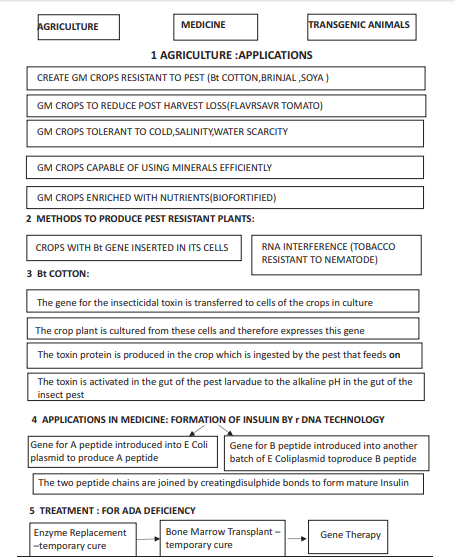
1. CREATE GM CROPS RESISTANT TO PEST (Bt COTTON, BRINJAL, SOYA)
2. GM CROPS TO REDUCE POST HARVEST LOSS (FLAVRSAVR TOMATO)
3. GM CROPS TOLERANT TO COLD, SALINITY, WATER SCARCITY
4. GM CROPS CAPABLE OF USING MINERALS EFFICIENTLY
5. GM CROPS ENRICHED WITH NUTRIENTS (BIOFORTIFIED)
Teacher's Note:
a) This flow chart outlines major agricultural applications of biotechnology.
b) Genetic modification helps develop crops with desired agronomic traits.
2. METHODS TO PRODUCE PEST RESISTANT PLANTS: [1 Mark]
Answer:
1. CROPS WITH Bt GENE INSERTED IN ITS CELLS
2. RNA INTERFERENCE (TOBACCO RESISTANT TO NEMATODE)
Teacher's Note:
a) Pest resistance can be achieved via genetic engineering using bacterial genes or gene silencing.
b) RNA interference silences specific mRNA in the pest to prevent infection.
3. Bt COTTON: [1 Mark]
Answer:
1. The gene for the insecticidal toxin is transferred to cells of the crops in culture.
2. The crop plant is cultured from these cells and therefore expresses this gene.
3. The toxin protein is produced in the crop which is ingested by the pest that feeds on it.
4. The toxin is activated in the gut of the pest larva due to the alkaline pH in the gut of the insect pest.
Teacher's Note:
a) Bt toxin exists as an inactive protoxin in the bacterium.
b) Alkaline pH solubilizes the crystals and activates the toxin, killing the insect pest.
4. APPLICATIONS IN MEDICINE: FORMATION OF INSULIN BY r DNA TECHNOLOGY [1 Mark]
Answer:
1. Gene for A peptide introduced into E. Coli plasmid to produce A peptide.
2. Gene for B peptide introduced into another batch of E. Coli plasmid to produce B peptide.
3. The two peptide chains are joined by creating disulphide bonds to form mature Insulin.
Teacher's Note:
a) Recombinant DNA technology overcame the limitation of extracting insulin from animal sources.
b) Chains A and B are synthesized separately in bacterial cultures and combined chemically.
5. TREATMENT : FOR ADA DEFICIENCY [1 Mark]
Answer:
1. Enzyme Replacement - temporary cure
2. Bone Marrow Transplant - temporary cure
3. Gene Therapy
Teacher's Note:
a) Adenosine deaminase (ADA) deficiency causes severe combined immunodeficiency (SCID).
b) Gene therapy introduces functional ADA cDNA into patients' cells for a permanent solution.
6. GENE THERAPY: [3 Marks]
(c) Lymphocytes cultured outside the body
(d) The gene for ADA introduced into the lymphocytes using retrovirus
(e) The lymphocytes with the functional gene is returned to the patients body .
(f) The lymphocytes produce ADA enzyme as long as they last in the body .
(g) If the gene is introduced into cells in the embryonic stages ,the cure could be permanent.
Answer:
1. Gene therapy is a collection of methods that allows correction of a gene defect that has been diagnosed in a child or embryo.
2. In this method, lymphocytes from the patient's blood are grown in culture outside the body.
3. A functional ADA cDNA is then introduced using a retroviral vector into these lymphocytes, which are subsequently returned to the patient.
Teacher's Note:
a) Gene therapy aims to replace faulty genes with normal working copies.
b) Since lymphocytes are not immortal, the patient requires periodic infusion of genetically engineered lymphocytes.
c) Permanent cure is possible if the gene is isolated and introduced into cells at early embryonic stages.
7. TECHNIQUES FOR MOLECULAR DIAGNOSIS: [3 Marks]
[Figure: Flow chart showing three techniques for molecular diagnosis: PCR-for early diagnosis, ELISA based on Antigen-Antibody Reaction, and Radioactive DNA probes to identify mutated gene in cells]
Answer:
1. PCR (Polymerase Chain Reaction) detects very low concentration of bacteria or viruses by amplification of their nucleic acid for early diagnosis.
2. ELISA is based on the principle of antigen-antibody interaction, where infection can be detected by the presence of antigens or antibodies.
3. Radioactive DNA or RNA probes are hybridised to mutated genes in cloned cells to detect genetic disorders.
Teacher's Note:
a) Conventional methods of diagnosis like serum and urine analysis do not serve early diagnosis.
b) Molecular diagnosis allows early detection, which is crucial for effective treatment.
c) ELISA utilises enzyme-linked antibodies to produce a colorimetric or fluorescent signal for detection.
8. USES IN ANIMALS: [3 Marks]
To study normal functions of the body .When an altered gene is introduced the altered effects can be studied.
Animals are made as models of human diseases to study their effects.
To produce Medicines, proteins required for treatment of disease,human milk- protein etc
Animals modified to test safety of vaccines like Polio.
Animals with genes sensitive to the chemical, is exposed to the chemical to test the safety of the chemical
Answer:
1. Transgenic animals are specifically designed to allow study of how genes are regulated and how they affect normal functions of the body.
2. They serve as models for human diseases such as cancer, cystic fibrosis, and rheumatoid arthritis to investigate new treatments.
3. Transgenic mice are used to test the safety of vaccines before they are used on humans, such as the polio vaccine.
Teacher's Note:
a) Transgenic animals carry foreign genes introduced using recombinant DNA technology.
b) They are also used for the production of biological products like human alpha-lactalbumin in milk.
c) Toxicity testing on transgenic animals provides results much faster than conventional methods.
Free study material for Biology
Free CBSE Study Guides: Class 12 Biology Chapter 10 Biotechnology and Its Application
Comprehensive Study Resources for Chapter 10 Biotechnology and Its Application
Access comprehensive study material for Chapter 10 Biotechnology and Its Application, including revision notes, concept maps, and high-probability questions. These resources are designed in alignment with the latest 2026 CBSE syllabus for Class 12 Biology to support effective exam preparation.
Understanding Marking Schemes
Designed around the official curriculum, these study guides guarantee standard compliance. Reviewing step-by-step solutions clarifies complex sub-topics within Chapter 10 Biotechnology and Its Application and demystifies standard marking schemes for Biology evaluations.
Complete Revision for Biology
For peak performance in upcoming evaluations, integrate official Biology sample papers directly into your study schedule. Follow up your revision by attempting online MCQ tests for Chapter 10 Biotechnology and Its Application to refine calculation speed and precision.
FAQs
Our advanced study package for Chapter 10 Biotechnology and Its Application includes detailed concepts, diagrams, Mind Maps, and explanation of complex topics to ensure Class 12 students learn as per syllabus for 2026 exams.
The Mind Maps provided for Chapter 10 Biotechnology and Its Application act as visual anchors which will help faster recall during high-pressure exams.
Yes, teachers use our Class 12 Biology resources for lesson planning as they are in simple language and have lot of solved examples.
Yes, You can download the complete, mobile-friendly PDF of the Biology Chapter 10 Biotechnology and Its Application advanced resources for free.
Yes, our subject matter experts have updated the Chapter 10 Biotechnology and Its Application material to align with the rationalized NCERT textbooks and have removed deleted topics and added new competency-based questions.