

Official CBSE Study Materials for Class 12 Biology
Access comprehensive study materials and useful resources for Chapter 16 Environmental Issues using the CBSE Class 12 Biology Environmental Issues Flow Chart. Designed to align with the 2026-27 CBSE academic guidelines, these advanced resources help Class 12 Biology students reinforce core concepts beyond standard textbooks.
Advanced Resources for Biology
View or download the dedicated CBSE Class 12 Biology Environmental Issues Flow Chart resource below. Engaging with these advanced study guides under focused conditions ensures continuous academic progress and mastery of the 2026-27 curriculum for Chapter 16 Environmental Issues.
This Class 12 Biology flow chart for Chapter 16 Environmental Issues summarises nine environmental problems - air pollution, noise pollution, water pollution, solid wastes, radioactive wastes, greenhouse effect and global warming, ozone depletion, soil erosion and deforestation - with the source or cause, effect and control measures for each.
CHAPTER 16 - ENVIRONMENTAL ISSUES (FLOW CHART)
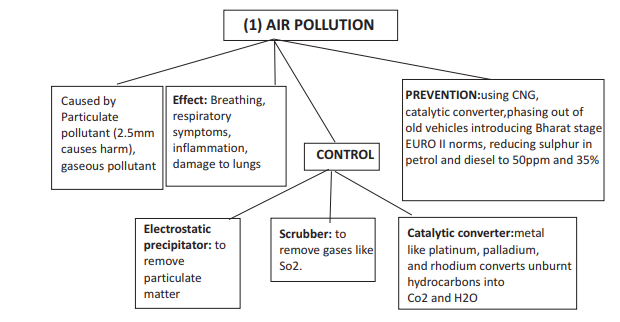
(1) AIR POLLUTION
Caused by: Particulate pollutant (2.5 mm causes harm), gaseous pollutant
Effect: Breathing, respiratory symptoms, inflammation, damage to lungs
PREVENTION: using CNG, catalytic converter, phasing out of old vehicles introducing Bharat stage EURO II norms, reducing sulphur in petrol and diesel to 50 ppm and 35%
CONTROL:
- Electrostatic precipitator: to remove particulate matter
- Scrubber: to remove gases like SO2.
- Catalytic converter: metal like platinum, palladium, and rhodium converts unburnt hydrocarbons into CO2 and H2O
(2) NOISE POLLUTION
SOURCE: Automobiles, Loudspeaker, crackers, industry (150 db or more sound causes pollution)
EFFECT: Hearing impairment, sleeplessness, increased heartbeat, alters breathing
CONTROL: Using sound absorbent materials, delimiting horn free zones, permissible sound level of crackers and loudspeakers
(3) WATER POLLUTION
SOURCE: sewage and industrial effluent
Diseases like typhoid, jaundice, cholera, dysentery. Eutrophication, Bio magnification
CONTROL: Integrated waste water treatment (FOAM)
(4) SOLID WASTES
SOURCE: Municipal wastes, hospital wastes, electronic wastes, pesticides, weedicides, human excreta
EFFECT: causes diseases, soil pollution, kills beneficial insects and microbes
CONTROL: recycling, reuse, incineration, used for land filling, preparing
(5) RADIOACTIVE WASTES
SOURCE: Nuclear energy used for generating electricity
Radiation emitted cause mutations, genetic disorders in organisms
CONTROL: Storing in a shielded container after sufficient treatment and buried within the sea bottom or rocks about 500 m deep below the earth surface.
(6) GREEN HOUSE EFFECT AND GLOBAL WARMING
CAUSE: Gases like CO2, methane, CFC, N2O. Absorbs solar radiation and increase the atmospheric
El Nino effect - melting of polar ice caps, results in rise in sea level and submerges of coastal areas.
EFFECT: Reducing the emission of greenhouse gases, planting more trees, increasing efficiency of energy usage.
(7) OZONE DEPLETION
SOURCE: CFC released from refrigerator, AC, jet aeroplane degrades the ozone
Effect: UV rays act on CFCs and release Cl atoms which act as a catalyst and degrade ozone. Causes cataract, damage to DNA, aging of skin, skin cancer. UV-B causes snow blindness and inflammation of cornea.
CONTROL: preventing emission of CFC
(8) SOIL EROSION
CAUSE: Over cultivation, unrestricted grazing, Deforestation, Irrigation without proper drainage of
EFFECT: decreases soil fertility. water logging affect crops and draws salt to the surface of soil.
CONTROL: Planting more trees
(9) DEFORESTATION
CAUSE: Cutting trees for timber, fire wood. Convertion of forest to agricultural land. Slash and burn agriculture/jhum
EFFECT: global warming due to excess carbon-dioxide. Loss of biodiversity. Damage to hydrological cycle. Leads to soil erosion. Desertification of land
CONTROL: Reforestation.
Free study material for Biology
CBSE Class 12 Biology Study Material: Chapter 16 Environmental Issues
Quick Revision Material for Chapter 16 Environmental Issues
Review targeted study resources for Chapter 16 Environmental Issues tailored for Class 12 learners. Utilizing these structured notes and quick-revision tools ensures complete alignment with current CBSE evaluation standards.
Expert Notes and Solved Exam Questions
Designed around the official curriculum, these study guides guarantee standard compliance. Reviewing step-by-step solutions clarifies complex sub-topics within Chapter 16 Environmental Issues and demystifies standard marking schemes for Biology evaluations.
Additional Study Resources for Class 12
Wrap up your chapter revision by testing your knowledge against standard objective question formats. Explore our full library of free, up-to-date sample papers and online assessments to secure top grades in your CBSE examinations.
FAQs
Our advanced study package for Chapter 16 Environmental Issues includes detailed concepts, diagrams, Mind Maps, and explanation of complex topics to ensure Class 12 students learn as per syllabus for 2026 exams.
The Mind Maps provided for Chapter 16 Environmental Issues act as visual anchors which will help faster recall during high-pressure exams.
Yes, teachers use our Class 12 Biology resources for lesson planning as they are in simple language and have lot of solved examples.
Yes, You can download the complete, mobile-friendly PDF of the Biology Chapter 16 Environmental Issues advanced resources for free.
Yes, our subject matter experts have updated the Chapter 16 Environmental Issues material to align with the rationalized NCERT textbooks and have removed deleted topics and added new competency-based questions.