

Download CBSE Class 12 Biology Useful Resources
Explore structured advanced study materials through the CBSE Class 12 Biology Sexual Reproduction in Flowering Plants Key Points. Tailored for Class 12 learners, utilizing these Biology resources ensures thorough preparation and strengthens foundational knowledge before final CBSE evaluations.
Access CBSE Study Guides and Summaries
Navigate directly to the advanced Biology study materials using the digital viewer below. Each resource pack includes detailed conceptual summaries and solved practice questions, allowing students to instantly reinforce their learning.
CBSE Class 12 Biology Sexual Reproduction in Flowering Plants Key Points. Please refer to the examination notes which you can use for preparing and revising for exams. These notes will help you to revise the concepts quickly and get good marks.
SEXUAL REPRODUTION IN FLOWERING PLANTS
(KREY POINTS)
CHAPTER : 2 SEXUAL REPRODUCTION IN FLOWERING PLANTS (KEY POINTS)
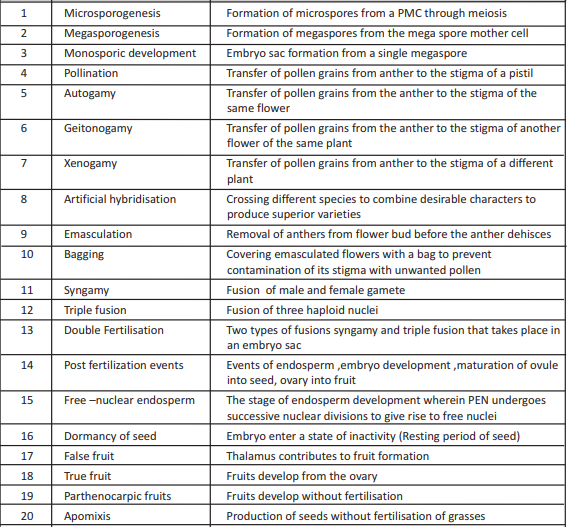
1. Review and study the key terms and explanations related to Sexual Reproduction in Flowering Plants as presented in the summary table below. [1 Mark]
| S.No | Term | Explanation |
|---|---|---|
| 1 | Microsporogenesis | Formation of microspores from a PMC through meiosis |
| 2 | Megasporogenesis | Formation of megaspores from the mega spore mother cell |
| 3 | Monosporic development | Embryo sac formation from a single megaspore |
| 4 | Pollination | Transfer of pollen grains from anther to the stigma of a pistil |
| 5 | Autogamy | Transfer of pollen grains from the anther to the stigma of the same flower |
| 6 | Geitonogamy | Transfer of pollen grains from the anther to the stigma of another flower of the same plant |
| 7 | Xenogamy | Transfer of pollen grains from anther to the stigma of a different plant |
| 8 | Artificial hybridisation | Crossing different species to combine desirable characters to produce superior varieties |
| 9 | Emasculation | Removal of anthers from flower bud before the anther dehisces |
| 10 | Bagging | Covering emasculated flowers with a bag to prevent contamination of its stigma with unwanted pollen |
| 11 | Syngamy | Fusion of male and female gamete |
| 12 | Triple fusion | Fusion of three haploid nuclei |
| 13 | Double Fertilisation | Two types of fusions syngamy and triple fusion that takes place in an embryo sac |
| 14 | Post fertilization events | Events of endosperm, embryo development, maturation of ovule into seed, ovary into fruit |
| 15 | Free -nuclear endosperm | The stage of endosperm development wherein PEN undergoes successive nuclear divisions to give rise to free nuclei |
| 16 | Dormancy of seed | Embryo enter a state of inactivity (Resting period of seed) |
| 17 | False fruit | Thalamus contributes to fruit formation |
| 18 | True fruit | Fruits develop from the ovary |
| 19 | Parthenocarpic fruits | Fruits develop without fertilisation |
| 20 | Apomixis | Production of seeds without fertilisation of grasses |
| 21 | Polyembryony | More than one embryo in a seed |
| 22 | Filament | Long slender stalk of stamen |
| 23 | Anther | Bilobed structure of stamen |
| 24 | Dithecous | Two theca in each lobe |
| 25 | Tapetum | Innermost wall layer of microsporangia |
| 26 | Sporogenous tissue | Compactly arranged homogenous cells in the centre of microsporangia |
| 27 | Microspore tetrad | Cluster of four microspores |
| 28 | Pollen grains | Male gametophyte |
Answer:
1. The table outlines essential biological definitions and processes related to sexual reproduction in flowering plants.
2. Key processes include microsporogenesis, megasporogenesis, pollination types, double fertilisation, and post-fertilization events.
3. Structural terminology covers floral parts such as anther, filament, tapetum, and ovule derivatives like true and false fruits.
Teacher's Note:
a) These key points serve as a rapid revision guide for NCERT Class 12 Biology Chapter 2.
b) Pay special attention to precise definitions of double fertilisation and artificial hybridisation steps.
BIOLOGY - Key Terms and Definitions (Part 2)
The following table contains important biological terms and their definitions related to sexual reproduction in flowering plants, numbered from 29 to 62.
| S.No. | Term | Definition / Description |
|---|---|---|
| 29 | Exine | Hard outer layer of pollen grain |
| 30 | Sporopollenin | Most resistant organic material of exine |
| 31 | Germ pore | Apertures in pollen grain |
| 32 | Intine | Inner wall of the pollen grain |
| 33 | Generative cell | Cell floats in the cytoplasm of vegetative cell |
| 34 | Monocarpellary | Single pistil |
| 35 | Multicarpellary | More than one pistil |
| 36 | Syncarpous | Fused pistils |
| 37 | Apocarpous | Free pistils |
| 38 | Stigma | Landing platform of pollen grains |
| 39 | Style | Elongated slender part beneath the stigma |
| 40 | Ovary | Basal bulged part of pistil |
| 41 | Ovule | Megasporangia |
| 42 | Funicle | Stalk of ovule |
| 43 | Hilum | Region, the body of the ovule fuses with funicle |
| 44 | Integuments | Protective envelopes of ovule |
| 45 | Micropyle | Small opening in the ovule |
| 46 | Chalaza | Basal part of the ovule |
| 47 | Embryo sac | Female gametophyte |
| 48 | Egg apparatus | Three cells at the micropylar end with two synergids and one egg cell |
| 49 | Antipodals | Three cells at the chalazal end |
| 50 | Cleistogamous flower | Flowers which do not open at all |
| 51 | Zygote | Diploid cell resulting out of fertilisation |
| 52 | Primary endosperm cell | Central cell after triple fusion becomes PEC |
| 53 | Embryogeny | Embryo development |
| 54 | Epicotyl | Portion of embryonal axis above the level of cotyledons |
| 55 | Hypocotyl | Portion below the level of cotyledons |
| 56 | Scutellum | Cotyledon of grass family situated towards one side of embryonal axis |
| 57 | Coleorrhiza | Undifferentiated sheath that encloses radical and root cap |
| 58 | Coleoptile | Hollow foliar structure that encloses a shoot apex and a few leaf primordia |
| 59 | Non-albuminous seed or ex-albuminous | No residual endosperm as it is completely consumed during embryo development |
| 60 | Albuminous | Retain a part of endosperm as it is not completely used up during embryo development |
| 61 | Perisperm | Residual persistent nucellus |
| 62 | Pericarp | Wall of the fruit |
Answer:
The table lists key anatomical and developmental terms from angiosperm reproduction for revision and memorisation.
Teacher's Note:
a) These definitions form the foundational vocabulary for board exam questions on plant reproduction.
b) Pay special attention to structural pairs like syncarpous versus apocarpous and albumnious versus non-albuminous seeds.
c) Terms like sporopollenin and scutellum are frequently tested in one-mark and assertion-reason questions.
Free study material for Biology
Biology Class 12 Exam Resources: Chapter 01 Sexual Reproduction In Flowering Plants
Core Study Kit: Class 12 Biology Chapter 01 Sexual Reproduction In Flowering Plants
Access comprehensive study material for Chapter 01 Sexual Reproduction In Flowering Plants, including revision notes, concept maps, and high-probability questions. These resources are designed in alignment with the latest 2026 CBSE syllabus for Class 12 Biology to support effective exam preparation.
NCERT-Aligned Solutions for Chapter 01 Sexual Reproduction In Flowering Plants
Designed around the official curriculum, these study guides guarantee standard compliance. Reviewing step-by-step solutions clarifies complex sub-topics within Chapter 01 Sexual Reproduction In Flowering Plants and demystifies standard marking schemes for Biology evaluations.
Next Steps in Your Exam Preparation
For peak performance in upcoming evaluations, integrate official Biology sample papers directly into your study schedule. Follow up your revision by attempting online MCQ tests for Chapter 01 Sexual Reproduction In Flowering Plants to refine calculation speed and precision.
FAQs
Our advanced study package for Chapter 01 Sexual Reproduction In Flowering Plants includes detailed concepts, diagrams, Mind Maps, and explanation of complex topics to ensure Class 12 students learn as per syllabus for 2026 exams.
The Mind Maps provided for Chapter 01 Sexual Reproduction In Flowering Plants act as visual anchors which will help faster recall during high-pressure exams.
Yes, teachers use our Class 12 Biology resources for lesson planning as they are in simple language and have lot of solved examples.
Yes, You can download the complete, mobile-friendly PDF of the Biology Chapter 01 Sexual Reproduction In Flowering Plants advanced resources for free.
Yes, our subject matter experts have updated the Chapter 01 Sexual Reproduction In Flowering Plants material to align with the rationalized NCERT textbooks and have removed deleted topics and added new competency-based questions.