

Advanced Study Material for Class 12 Biology: Chapter 08 Microbes In Human Welfare
Access comprehensive study materials and useful resources for Chapter 08 Microbes In Human Welfare using the CBSE Class 12 Biology Microbes in Human Welfare Flow Chart. Designed to align with the 2026-27 CBSE academic guidelines, these advanced resources help Class 12 Biology students reinforce core concepts beyond standard textbooks.
Practice Class 12 Biology Resources: Chapter 08 Microbes In Human Welfare
Access the complete useful resource PDF for Class 12 Biology below. Regular practice with these targeted academic notes builds familiarity with complex topics and helps secure higher marks in final school evaluations.
This Class 12 Biology flow chart notes page on Microbes in Human Welfare covers the microbes used in households, fermented beverages, the production of chemicals and antibiotics, microbes used to control pests and diseases, biogas production, biofertilisers, and sewage treatment.
Topics Covered
1. Microbes in Household Products
2. Fermented Beverages
3. Microbial Chemicals
4. Antibiotics
5. Microbes to Control Pests and Diseases
6. Production of Biogas
7. Microbes as Biofertilisers
8. Microbes in Sewage Treatment
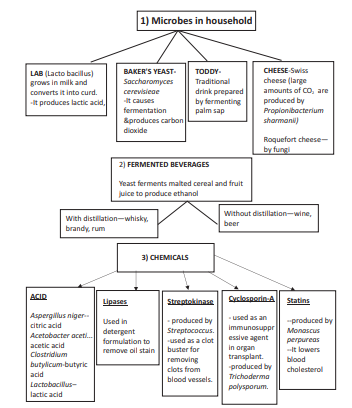
1. Microbes in Household Products
1. Lactobacillus (LAB) grows in milk and converts it into curd. It produces lactic acid.
2. Baker's yeast (Saccharomyces cerevisiae) causes fermentation and produces carbon dioxide, which makes dough rise.
3. Toddy is a traditional drink prepared by fermenting palm sap.
4. Swiss cheese has holes made by the large amounts of carbon dioxide produced by Propionibacterium sharmanii.
5. Roquefort cheese is made with the help of fungi.
2. Fermented Beverages
Yeast ferments malted cereals and fruit juices to produce ethanol.
(i) With distillation: whisky, brandy and rum.
(ii) Without distillation: wine and beer.
3. Microbial Chemicals
1. Citric acid is produced by Aspergillus niger.
2. Acetic acid is produced by Acetobacter aceti.
3. Butyric acid is produced by Clostridium butyricum.
4. Lactic acid is produced by Lactobacillus.
5. Lipases are used in detergent formulations to remove oil stains.
6. Streptokinase is produced by Streptococcus. It is used as a clot buster, for removing clots from blood vessels.
7. Cyclosporin A is an immunosuppressive agent, used in organ transplants. It is produced by Trichoderma polysporum.
8. Statins are produced by Monascus purpureus. They lower blood cholesterol.
4. Antibiotics
Penicillin is an antibiotic produced by Penicillium notatum.
5. Microbes to Control Pests and Diseases
1. Bacillus thuringiensis produces a protein which kills caterpillars. It is used as a biopesticide.
2. Trichoderma, a fungus, kills root-borne pathogens.
3. Baculovirus (Nucleopolyhedrovirus) attacks specific insects and other arthropods.
4. Biological control uses natural predators. For example, the lady bird beetle is used to get rid of aphids, and dragonflies are used to eradicate mosquitoes.
6. Production of Biogas
Methanogens, such as Methanobacterium, act on cellular material to produce methane. They are found in anaerobic sludge digesters, in the rumen of cattle, in flooded rice fields and in cattle dung.
7. Microbes as Biofertilisers
Bacteria
(i) Symbiotic bacteria: Rhizobium.
(ii) Free living bacteria: Azospirillum and Azotobacter. Both fix atmospheric nitrogen and enrich the soil with nutrients.
Cyanobacteria
Anabaena, Nostoc and Oscillatoria enrich the organic matter of the soil through photosynthesis.
Fungi
Glomus fungi form associations with the roots of higher plants. They absorb phosphorus and give it to the plant. They also give the plant resistance to root-borne pathogens.
8. Microbes in Sewage Treatment
Primary Treatment
1. Filtration
2. Sedimentation
Secondary Treatment
1. Aerobic digestion
2. Anaerobic digestion, in which the sludge digesters produce biogas
Free study material for Biology
CBSE Class 12 Biology Study Material: Chapter 08 Microbes In Human Welfare
Core Study Kit: Class 12 Biology Chapter 08 Microbes In Human Welfare
Explore essential learning tools for Class 12 Biology Chapter 08 Microbes In Human Welfare. This curated collection features in-depth notes and targeted practice questions built around the active 2026 curriculum to streamline your daily revision.
NCERT-Aligned Solutions for Chapter 08 Microbes In Human Welfare
Each resource draws directly from authorized textbooks to maintain academic accuracy. Evaluating solved examples allows Class 12 students to master the formal presentation and answer-writing standards expected in upcoming school exams.
Next Steps in Your Exam Preparation
For peak performance in upcoming evaluations, integrate official Biology sample papers directly into your study schedule. Follow up your revision by attempting online MCQ tests for Chapter 08 Microbes In Human Welfare to refine calculation speed and precision.
FAQs
Our advanced study package for Chapter 08 Microbes In Human Welfare includes detailed concepts, diagrams, Mind Maps, and explanation of complex topics to ensure Class 12 students learn as per syllabus for 2026 exams.
The Mind Maps provided for Chapter 08 Microbes In Human Welfare act as visual anchors which will help faster recall during high-pressure exams.
Yes, teachers use our Class 12 Biology resources for lesson planning as they are in simple language and have lot of solved examples.
Yes, You can download the complete, mobile-friendly PDF of the Biology Chapter 08 Microbes In Human Welfare advanced resources for free.
Yes, our subject matter experts have updated the Chapter 08 Microbes In Human Welfare material to align with the rationalized NCERT textbooks and have removed deleted topics and added new competency-based questions.