

Official CBSE Study Materials for Class 12 Biology
Explore structured advanced study materials through the CBSE Class 12 Biology Microbes in Human Welfare diagrams based questions. Tailored for Class 12 learners, utilizing these Biology resources ensures thorough preparation and strengthens foundational knowledge before final CBSE evaluations.
Advanced Resources for Biology
View or download the dedicated CBSE Class 12 Biology Microbes in Human Welfare diagrams based questions resource below. Engaging with these advanced study guides under focused conditions ensures continuous academic progress and mastery of the 2026-27 curriculum for Chapter 08 Microbes In Human Welfare.
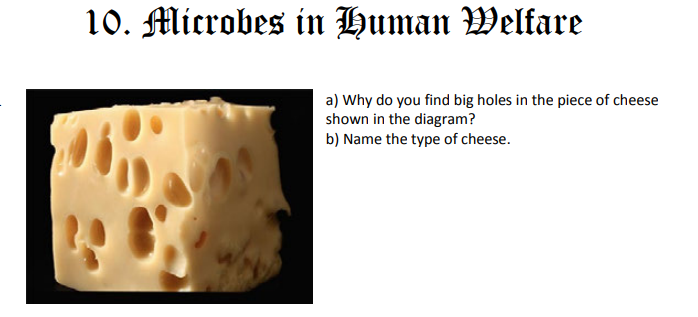
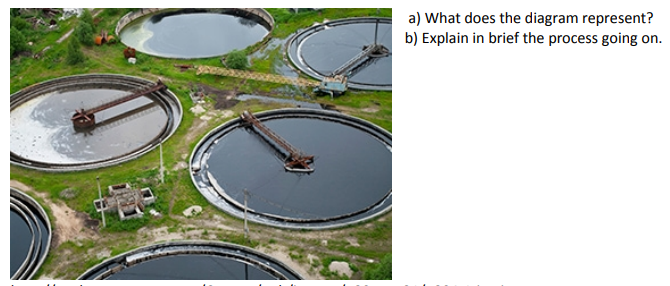
This Class 12 Biology page gives diagram based questions with answers on Chapter 10 Microbes in Human Welfare, covering a piece of Swiss cheese with holes, a sewage treatment plant and a gobar gas (biogas) plant.
10. Microbes in Human Welfare
10.1 a) Why do you find big holes in the piece of cheese shown in the diagram?
[Figure: Photograph of a block of yellow cheese with many large round holes]
Answer: The big holes are due to the production of a large amount of carbon dioxide (CO2) by the bacterium Propionibacterium shermanii during ripening of the cheese.
Teacher's Note:
a) Propionibacterium shermanii releases CO2 gas, which gets trapped and forms the holes.
b) Do not say the holes are caused by yeast or by air bubbles.
b) Name the type of cheese.
Answer: The cheese is Swiss cheese.
Teacher's Note:
a) Swiss cheese is the large-holed cheese; Roquefort is ripened by a fungus instead.
10.2 a) What does the diagram represent?
[Figure: Aerial photograph of several large circular tanks with bridges across them (sewage settling tanks) surrounded by green land]
Answer: The diagram represents a sewage treatment plant (aerial view of the circular settling tanks used in the primary and secondary treatment of sewage).
Teacher's Note:
a) Sewage treatment plants are used to make sewage less polluting before it is released into natural water bodies.
b) Name the plant clearly as 'sewage treatment plant' for the mark.
b) Explain in brief the process going on.
Answer:
1. Primary treatment: physical removal of large and small particles from sewage by sequential filtration and sedimentation; floating debris is removed by filtration and grit by sedimentation, and the settled solids form the primary sludge.
2. The effluent from the primary settling tank is passed into large aeration tanks, where it is agitated and air is pumped in; this is the secondary or biological treatment.
3. Useful aerobic microbes grow into flocs (masses of bacteria associated with fungal filaments) and consume the organic matter, so the BOD (biochemical oxygen demand) of the effluent is greatly reduced.
4. The effluent is passed into a settling tank where the flocs sediment as activated sludge; a small part is used as inoculum and the rest goes to anaerobic sludge digesters, where bacteria produce biogas.
5. The clear effluent is then released into rivers or streams.
Teacher's Note:
a) Primary treatment is physical, secondary treatment is biological; do not mix them up.
b) BOD falls because aerobic microbes consume the organic matter, so mention BOD as the examiner looks for it.
c) The sludge digesters give biogas (a mixture of methane, hydrogen sulphide and CO2), a useful by-product.
d) Write the steps in order from sedimentation to release of the effluent.
10.3 This is a diagram of a Gobar gas plant. Label A to D.
[Figure: Gobar gas plant. A marks the inlet with an arrow for Water and a tank holding Feed slurry on the left. B marks the large underground digester. A Gas-holder above it is labelled with D and CO2. A pipe at the top carries Gas to combustion or other uses. C marks the outlet pit on the right]
Answer:
A - Inlet (mixing tank for Water and Feed slurry, the dung)
B - Digester
C - Sludge (outlet for the spent slurry)
D - Methane (CH4)
Teacher's Note:
a) The digester is the large underground tank where methanogens act on the slurry anaerobically.
b) The gas-holder collects the gas, which is mainly methane (CH4) along with CO2.
c) The spent slurry (sludge) is taken out and used as manure.
diagrams based questions.
Free study material for Biology
Biology Class 12 Exam Resources: Chapter 08 Microbes In Human Welfare
Essential Notes for Class 12 Biology
Review targeted study resources for Chapter 08 Microbes In Human Welfare tailored for Class 12 learners. Utilizing these structured notes and quick-revision tools ensures complete alignment with current CBSE evaluation standards.
Verified Solutions for Class 12 Biology
Designed around the official curriculum, these study guides guarantee standard compliance. Reviewing step-by-step solutions clarifies complex sub-topics within Chapter 08 Microbes In Human Welfare and demystifies standard marking schemes for Biology evaluations.
Enhance Accuracy with Online Tests
Wrap up your chapter revision by testing your knowledge against standard objective question formats. Explore our full library of free, up-to-date sample papers and online assessments to secure top grades in your CBSE examinations.
FAQs
Our advanced study package for Chapter 08 Microbes In Human Welfare includes detailed concepts, diagrams, Mind Maps, and explanation of complex topics to ensure Class 12 students learn as per syllabus for 2026 exams.
The Mind Maps provided for Chapter 08 Microbes In Human Welfare act as visual anchors which will help faster recall during high-pressure exams.
Yes, teachers use our Class 12 Biology resources for lesson planning as they are in simple language and have lot of solved examples.
Yes, You can download the complete, mobile-friendly PDF of the Biology Chapter 08 Microbes In Human Welfare advanced resources for free.
Yes, our subject matter experts have updated the Chapter 08 Microbes In Human Welfare material to align with the rationalized NCERT textbooks and have removed deleted topics and added new competency-based questions.