

Class 12 Biology Study Guide: CBSE Class 12 Biology Molecular Basis of Inheritance Flow Chart
Access comprehensive study materials and useful resources for Chapter 05 Molecular Basis of Inheritance using the CBSE Class 12 Biology Molecular Basis of Inheritance Flow Chart. Designed to align with the 2026-27 CBSE academic guidelines, these advanced resources help Class 12 Biology students reinforce core concepts beyond standard textbooks.
Download Chapter 05 Molecular Basis of Inheritance Study Material PDF
Navigate directly to the advanced Biology study materials using the digital viewer below. Each resource pack includes detailed conceptual summaries and solved practice questions, allowing students to instantly reinforce their learning.
CBSE Class 12 Biology Molecular Basis of Inheritance Flow Chart. Please refer to the examination notes which you can use for preparing and revising for exams. These notes will help you to revise the concepts quickly and get good marks.
Class 12 Biology Chapter 6 Molecular Basis of Inheritance flow chart covers the structure of DNA, transcription, the search for genetic material, the genetic code, DNA replication, the Human Genome Project, DNA fingerprinting, the lac operon, eukaryotic transcription and protein synthesis, in a simple step-by-step format for revision.
BIOLOGY
CHAPTER 6: MOLECULAR BASIS OF INHERITANCE (FLOW CHART)
1. Structure of DNA
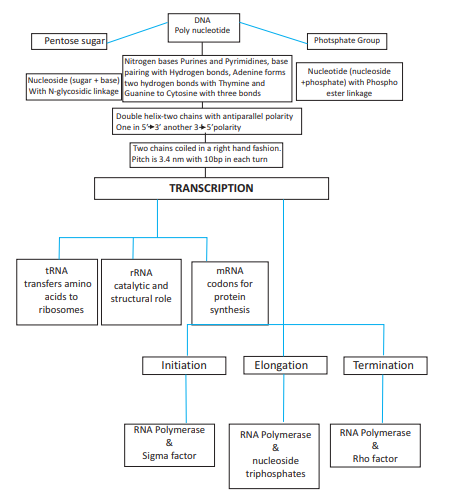
DNA is a polynucleotide.
Nucleoside = pentose sugar + nitrogenous base, joined by an N-glycosidic linkage.
Nucleotide = nucleoside + phosphate group, joined by a phosphoester linkage.
Nitrogen bases are purines and pyrimidines. Base pairing uses hydrogen bonds: adenine forms two hydrogen bonds with thymine, and guanine forms three hydrogen bonds with cytosine.
DNA is a double helix of two chains with antiparallel polarity. One chain runs 5' to 3' and the other runs 3' to 5'.
The two chains are coiled in a right-hand fashion. The pitch is 3.4 nm, with 10 base pairs in each turn.
Transcription
tRNA transfers amino acids to ribosomes.
rRNA has a catalytic and structural role.
mRNA carries codons for protein synthesis.
Initiation: RNA polymerase and sigma factor.
Elongation: RNA polymerase and nucleoside triphosphates.
Termination: RNA polymerase and rho factor.
2. Search for Genetic Material
Experiments:
(i) Transformation experiment by Frederick Griffith (1928), using Streptococcus pneumoniae (bacteria).
(ii) DNA is the genetic material: proof by Alfred Hershey and Martha Chase (1952).
Griffith's transformation experiment
Smooth shiny colonies are virulent and pathogenic. Rough colonies are non-virulent and non-pathogenic.
S strain injected into mice: mice died.
R strain injected into mice: mice lived.
S strain (heat killed) injected into mice: mice lived.
S strain (heat killed) + R strain (live) injected into mice: mice died.
Conclusion: the transforming principle passed from the heat-killed S strain to the R strain, enabling the R strain to synthesise a smooth polysaccharide coat and become virulent.
The biochemical nature of the transforming principle was proved to be DNA by Oswald Avery, Colin MacLeod and Maclyn McCarty.
Hershey and Chase experiment (1952)
Bacteriophages are viruses that infect bacteria.
Radioactive phages were allowed to attach to E. coli.
As the infection proceeded, the viral coats were removed from the bacteria by agitating them in a blender.
The virus particles were separated from the bacteria by spinning them in a centrifuge.
Bacteria infected with viruses that had radioactive DNA were radioactive. This shows that DNA was the material passed from the virus to the bacteria.
Bacteria infected with viruses that had radioactive proteins were not radioactive. This proves that protein is not the genetic material, and DNA is.
3. Salient Features of Genetic Code
1. Triplet: each codon has three nucleotides.
2. Unambiguous and specific: each codon codes for only one amino acid.
3. Degenerate: more than one codon can code for the same amino acid.
4. Contiguous: codons are read continuously, without gaps.
5. No punctuations: there are no punctuation signals within the coding sequence.
6. Universal: the same code is used by almost all organisms.
7. AUG has dual functions: it is the initiator codon and also codes for methionine.
4. DNA Replication
Method: Semi-conservative replication. One strand is parental (conserved), and the other strand is newly synthesised.
Proof (Meselson and Stahl experiment):
Escherichia coli was grown in a medium containing 15NH4Cl for several generations. As a result, 15N was incorporated into the newly synthesised DNA.
These cells were then transferred to normal 14NH4Cl containing medium.
First generation, collected after 20 minutes: hybrid DNA (one heavy and one normal strand).
Second generation, collected after 40 minutes: equal amounts of hybrid DNA and light DNA.
This proves that DNA replication is semi-conservative.
5. Goals of Human Genome Project (HGP)
1. Identify genes in human DNA.
2. Determine the sequences of the 3 billion chemical base pairs.
3. Store the information in databases.
4. Improve tools for data analysis.
5. Transfer related technologies to other sectors, such as industries.
6. Address the ethical, legal and social issues (ELSI).
6. DNA Fingerprinting
DNA fingerprinting was developed by Alec Jeffreys.
Steps (IDETHA):
I. Isolation of DNA.
D. Digestion of DNA.
E. Separation of DNA by electrophoresis.
T. Transferring the separated DNA fragments to synthetic membranes.
H. Hybridisation using labelled VNTR probes.
A. Detection of hybridised DNA fragments by autoradiography.
7. Gene Regulation: Lac Operon
Lac operon consists of:
Regulatory gene (i): codes for the repressor protein.
Promoter: RNA polymerase binds here.
Operator: the repressor binds here.
Structural genes (z, y and a):
z gene codes for beta-galactosidase, which hydrolyses lactose into glucose and galactose.
y gene codes for permease, which transports lactose into the cell.
a gene codes for transacetylase, which transacetylates lactose in its active form.
8. Transcription in Eukaryotes
Enzyme: Three RNA polymerases are involved in transcription.
RNA polymerase I transcribes rRNA.
RNA polymerase II transcribes precursor mRNA (hnRNA).
RNA polymerase III transcribes tRNA, 5S rRNA and snRNAs.
Steps:
Initiation → Elongation → Termination → Precursor of mRNA → Splicing → Capping and tailing → Processed hnRNA (mRNA)
9. Protein Synthesis (Translation)
Charging of tRNA (aminoacylation of tRNA).
Initiation: the ribosome binds to mRNA at the start codon.
Elongation: the ribosome moves codon to codon, amino acids are joined, and the polypeptide is formed.
Termination: the translation complex enters the terminator codon, the release factor binds, translation is terminated, and the polypeptide is released.
Free study material for Biology
Free CBSE Study Guides: Class 12 Biology Chapter 05 Molecular Basis of Inheritance
Core Study Kit: Class 12 Biology Chapter 05 Molecular Basis of Inheritance
Access comprehensive study material for Chapter 05 Molecular Basis of Inheritance, including revision notes, concept maps, and high-probability questions. These resources are designed in alignment with the latest 2026 CBSE syllabus for Class 12 Biology to support effective exam preparation.
NCERT-Aligned Solutions for Chapter 05 Molecular Basis of Inheritance
Designed around the official curriculum, these study guides guarantee standard compliance. Reviewing step-by-step solutions clarifies complex sub-topics within Chapter 05 Molecular Basis of Inheritance and demystifies standard marking schemes for Biology evaluations.
Next Steps in Your Exam Preparation
Maximize your grade potential by utilizing Class 12 Biology practice papers in tandem with these structured notes. All printable assignments and interactive mock tests on our platform are updated for the 2026 session and available free of charge.
FAQs
Our advanced study package for Chapter 05 Molecular Basis of Inheritance includes detailed concepts, diagrams, Mind Maps, and explanation of complex topics to ensure Class 12 students learn as per syllabus for 2026 exams.
The Mind Maps provided for Chapter 05 Molecular Basis of Inheritance act as visual anchors which will help faster recall during high-pressure exams.
Yes, teachers use our Class 12 Biology resources for lesson planning as they are in simple language and have lot of solved examples.
Yes, You can download the complete, mobile-friendly PDF of the Biology Chapter 05 Molecular Basis of Inheritance advanced resources for free.
Yes, our subject matter experts have updated the Chapter 05 Molecular Basis of Inheritance material to align with the rationalized NCERT textbooks and have removed deleted topics and added new competency-based questions.