

Class 12 Biology Study Guide: CBSE Class 12 Biology Principles of Inheritance and Variation Flow Chart
Explore structured advanced study materials through the CBSE Class 12 Biology Principles of Inheritance and Variation Flow Chart. Tailored for Class 12 learners, utilizing these Biology resources ensures thorough preparation and strengthens foundational knowledge before final CBSE evaluations.
Download Chapter 04 Principles of Inheritance and Variation Study Material PDF
Access the complete useful resource PDF for Class 12 Biology below. Regular practice with these targeted academic notes builds familiarity with complex topics and helps secure higher marks in final school evaluations.
CBSE Class 12 Biology Principles of Inheritance and Variation Flow Chart. Please refer to the examination notes which you can use for preparing and revising for exams. These notes will help you to revise the concepts quickly and get good marks.
PRINCIPLE OF INHERITANCE AND VARIATION
BIOLOGY
CHAPTER - 5 : PRINCIPLES OF INHERITANCE AND VARIATION
(FLOW CHART) [5 Marks]
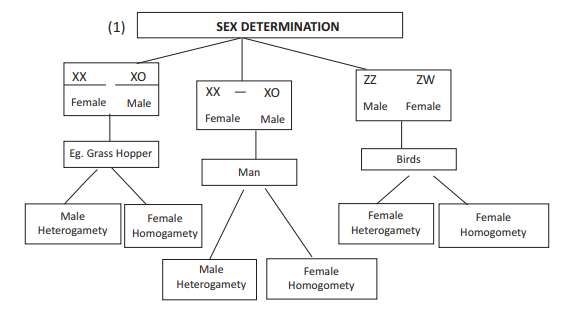
[Figure: Comprehensive flow chart representing Sex Determination and Genetic Disorders. Part 1 shows Sex Determination divided into XX-XO (Female-Male, eg. Grasshopper, Male Heterogamety, Female Homogamety), XX-XY (Man, Male Heterogamety, Female Homogamety), and ZZ-ZW (Male-Female, Birds, Female Heterogamety, Female Homogomety). Part 2 shows Genetic Disorders divided into Mendelian Disorders (Sex linked recessive: Haemophilia, Colour blindness; Autosome linked recessive: Sickle cell anemia, Phenylketonuria; Thalassaemia caused by defects in the synthesis of globin polypeptide: Alpha, Beta, Delta; Autosomal dominant recessive: Myotonic dystrophy) and Chromosomal Disorders (Aneuploidy: The gain or loss of a chromosome(s), Monosomy: Turners syndrome, 45 chromosome with X0; Trisomy: Down Syndrome, Trisomy 21; Polyploidy: An increase in whole set of chromosome).]
Answer:
1. The given flow chart summarizes the core concepts of Sex Determination and Genetic Disorders from Chapter 5 of Class 12 Biology.
2. Sex determination is categorized based on chromosomal mechanisms into XX-XO type (seen in insects like grasshoppers where males are heterogametic), XX-XY type (seen in humans where males are heterogametic), and ZZ-ZW type (seen in birds where females are heterogametic).
3. Genetic disorders are broadly classified into Mendelian disorders and Chromosomal disorders.
4. Mendelian disorders result from alterations in a single gene and include sex-linked recessive disorders (haemophilia, colour blindness), autosome-linked recessive disorders (sickle cell anaemia, phenylketonuria, thalassaemia), and autosomal dominant disorders (myotonic dystrophy).
5. Chromosomal disorders are caused due to absence or excess or abnormal arrangement of one or more chromosomes, further divided into Aneuploidy (monosomy like Turner's syndrome, trisomy like Down syndrome) and Polyploidy (increase in whole set of chromosomes).
Teacher's Note:
a) This flow chart is an essential revision tool highlighting the clear distinction between single-gene Mendelian defects and large-scale chromosomal aberrations.
b) A common student mistake is confusing monosomy (loss of a single chromosome, e.g., 45 with XO) with nullisomy or general aneuploidy.
c) Examiners frequently test numerical chromosome counts in Turner's syndrome (45 with XO) and Down's syndrome (Trisomy 21).
d) Ensure correct spelling of key scientific terms such as Phenylketonuria, Thalassaemia, and Heterogamety as depicted in the diagram.
Free study material for Biology
CBSE Class 12 Biology Study Material: Chapter 04 Principles of Inheritance and Variation
Core Study Kit: Class 12 Biology Chapter 04 Principles of Inheritance and Variation
Explore essential learning tools for Class 12 Biology Chapter 04 Principles of Inheritance and Variation. This curated collection features in-depth notes and targeted practice questions built around the active 2026 curriculum to streamline your daily revision.
NCERT-Aligned Solutions for Chapter 04 Principles of Inheritance and Variation
Each resource draws directly from authorized textbooks to maintain academic accuracy. Evaluating solved examples allows Class 12 students to master the formal presentation and answer-writing standards expected in upcoming school exams.
Next Steps in Your Exam Preparation
For peak performance in upcoming evaluations, integrate official Biology sample papers directly into your study schedule. Follow up your revision by attempting online MCQ tests for Chapter 04 Principles of Inheritance and Variation to refine calculation speed and precision.
FAQs
Our advanced study package for Chapter 04 Principles of Inheritance and Variation includes detailed concepts, diagrams, Mind Maps, and explanation of complex topics to ensure Class 12 students learn as per syllabus for 2026 exams.
The Mind Maps provided for Chapter 04 Principles of Inheritance and Variation act as visual anchors which will help faster recall during high-pressure exams.
Yes, teachers use our Class 12 Biology resources for lesson planning as they are in simple language and have lot of solved examples.
Yes, You can download the complete, mobile-friendly PDF of the Biology Chapter 04 Principles of Inheritance and Variation advanced resources for free.
Yes, our subject matter experts have updated the Chapter 04 Principles of Inheritance and Variation material to align with the rationalized NCERT textbooks and have removed deleted topics and added new competency-based questions.