

Official CBSE Study Materials for Class 12 Biology
Access comprehensive study materials and useful resources for Chapter 12 Ecosystem using the CBSE Class 12 Biology Ecosystem diagrams based questions. Designed to align with the 2026-27 CBSE academic guidelines, these advanced resources help Class 12 Biology students reinforce core concepts beyond standard textbooks.
Advanced Resources for Biology
Access the complete useful resource PDF for Class 12 Biology below. Regular practice with these targeted academic notes builds familiarity with complex topics and helps secure higher marks in final school evaluations.
CBSE Class 12 Biology Ecosystem diagrams based questions. Please refer to the examination notes which you can use for preparing and revising for exams. These notes will help you to revise the concepts quickly and get good marks.
ECOSYSTEM
These CBSE Class 12 Biology diagram based questions on the chapter Ecosystem cover energy flow and the ecological pyramid, ecological succession in a pond and on land, the decomposition cycle, man-made ecosystems and the functioning of a pond as a unit. Each question includes the figure from the paper with a full answer and a Teacher's Note to help students revise for the board exam.
14. Ecosystem
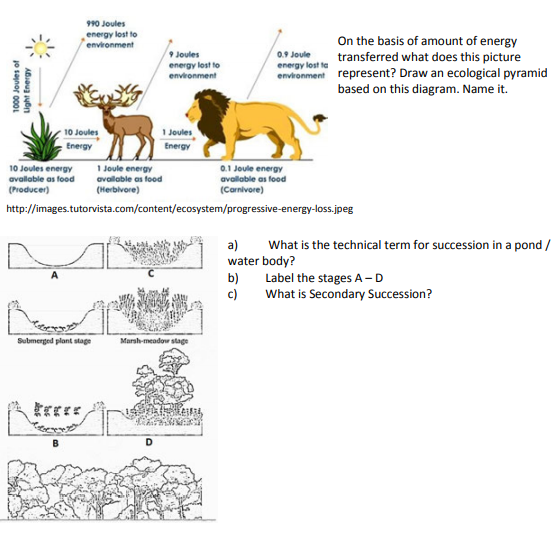
14.1 On the basis of amount of energy transferred what does this picture represent? Draw an ecological pyramid based on this diagram. Name it.
[Figure: Energy flow diagram with light energy of 1000 Joules falling on a green plant (Producer), which has 10 Joules energy available as food, and 990 Joules energy is lost to environment. The arrow from the plant to the deer is labelled 10 Joules Energy, and the deer (Herbivore) has 1 Joule energy available as food, with 9 Joules energy lost to environment. The arrow from the deer to the lion is labelled 1 Joule Energy, and the lion (Carnivore) has 0.1 Joule energy available as food, with 0.9 Joule energy lost to environment.]
Answer:
1. The picture shows the flow of energy through the trophic levels of a food chain, from producers to herbivores to carnivores.
2. Energy available at each level: Producers 10 Joules, Herbivores 1 Joule, Carnivores 0.1 Joule.
3. The pyramid drawn on this basis is the pyramid of energy.
4. Draw a pyramid with the producers at the base (largest), herbivores in the second tier and carnivores at the top (smallest), with the energy value written in each tier.
Teacher's Note:
a) Energy is lost at every trophic level as heat and in metabolic activities, so only about 10 percent passes on.
b) The pyramid of energy is always upright because energy can never be created at a higher level.
c) Do not confuse this with the pyramid of numbers, which can be inverted in some ecosystems.
14.2
[Figure: Stages of succession in a pond shown in five panels. Panel A shows an empty pond basin with open water. Panel B shows a floating plant stage with floating plants on the water surface. Panel C shows a reed swamp stage with reeds growing at the edges of the pond. Panel D shows a scrub stage with shrubs around the pond. Below the four pond panels, the labelled stages are: Submerged plant stage (rooted plants growing under the water), Marsh-meadow stage (grasses and herbs in the wet soil), and a final forest stage with tall trees.]
a) What is the technical term for succession in a pond / water body?
Answer: The technical term is hydrarch succession.
Teacher's Note:
a) Succession that starts in water is called hydrarch succession.
b) Succession that starts on dry land is called xerarch succession.
b) Label the stages A - D
Answer:
1. A: Open water stage (phytoplankton stage).
2. B: Floating plant stage.
3. C: Reed swamp stage.
4. D: Scrub stage.
Teacher's Note:
a) The sequence in a pond is open water, submerged plants, floating plants, reed swamp, marsh-meadow, scrub and then forest.
b) Sediment builds up slowly, so the pond becomes shallower at every stage.
c) Stage B comes after the submerged plant stage, not before it.
c) What is Secondary Succession?
Answer: Secondary succession is the sequence of community changes that takes place in an area where a community existed earlier but was destroyed by natural events such as fire, flood or storm, or by human activities such as deforestation, while the soil and some propagules remain.
Teacher's Note:
a) Secondary succession is faster than primary succession because soil is already present.
b) Primary succession starts on bare rock or sand where no soil exists, so it is much slower.
14.3
[Figure: Photograph of a glass aquarium with a black metal stand and cover, containing green aquatic plants, gravel at the bottom and several colourful fish swimming in the water.]
a) Name any other man made ecosystem.
Answer: A crop field (agroecosystem) is another man made ecosystem.
Teacher's Note:
a) Crop fields, gardens, fish ponds and aquariums are all man made ecosystems.
b) Man made ecosystems depend on human inputs such as water, fertilisers or food.
b) What are the aspects you should consider to term any ecosystem to be self-sustainable?
Answer:
1. A continuous source of energy, such as sunlight, for the producers.
2. A balance of producers, consumers and decomposers so that food chains work.
3. Recycling of nutrients and wastes by decomposers.
4. Clean water and enough oxygen for all the organisms.
5. Stable populations of each species, without any one species growing out of control.
Teacher's Note:
a) An aquarium needs regular feeding and cleaning, so it is not truly self-sustainable.
b) Nutrient recycling is the key link between dead matter and new growth.
c) Balance among the trophic levels decides whether the system stays stable over time.
14.4
[Figure: Cycle diagram of decomposition. A green leaf grows on a tree and a dead leaf falls to the ground. Arrow A goes from the fallen leaf to a caterpillar. Arrow B goes from the caterpillar to a mushroom (fungi). Arrow C is a curved arrow from the caterpillar stage back to the organic rich soil, labelled Decomposition. Arrow D goes from the mushroom stage to the organic rich soil. The organic rich soil at the bottom returns nutrients to the tree.]
Study the diagram and describe in brief the process with special reference to points marked a-d.
Answer:
1. Point A: Fragmentation. Detritivores such as caterpillars break the fallen leaf into smaller pieces.
2. Point B: Leaching. Water-soluble nutrients move down into the soil from the broken pieces of litter.
3. Point C: Catabolism. Decomposers such as bacteria and fungi break down complex organic compounds into simple inorganic substances.
4. Point D: Humification and mineralisation. Humus is formed and nutrients are released into the soil, making the organic rich soil that supports new plant growth.
Teacher's Note:
a) Decomposition is a series of steps, not a single event.
b) Fungi and bacteria do most of the chemical breakdown of dead matter.
c) Mineralisation returns nutrients to the soil, where the tree can absorb them again.
14.5
[Figure: Diagram showing seven stages of succession from left to right: Sand, Bacteria, fungi, mosses, lichens, Soil, Annual grasses, Perennial grasses, Shrubs, and Trees. Sand is shown as a bare heap with no plants, then bacteria, fungi, mosses and lichens grow on it, followed by soil, annual grasses, perennial grasses, shrubs and finally tall trees.]
What is shown in this diagram? Explain in brief.
Answer:
1. The diagram shows primary succession, which is the development of a plant community on bare sand or rock where no soil existed earlier.
2. Bacteria, fungi, mosses and lichens are the pioneer species. They break down the rock or sand and add organic matter, which slowly forms soil.
3. Once soil is formed, annual grasses and then perennial grasses grow.
4. Shrubs and then trees follow, and the final stable community is called the climax community.
Teacher's Note:
a) Lichens are the first colonisers of bare rock, so they are called pioneer species.
b) Primary succession takes hundreds of years because soil must form first.
c) The climax community stays stable until a disturbance such as fire or flood starts a new succession.
14.6
[Figure: Cross section of a lake showing a sloping bank on the left and open water on the right. Nutrients (nitrogen and phosphorus) flow into the lake from the land, leading to excessive plant and algae growth. New plant and algae growth is shown on the surface of the water. Plants and algae die and sink to the bottom. Plants and algae decompose and release nutrients back into the water. Arrows show the cycle of nutrients moving from the bottom back into the water.]
The diagram shows a section of a pond where certain events are shown to occur. How can you say that this ecosystem can function as a unit?
Answer:
1. Nutrients enter the pond from the land and support the growth of plants and algae.
2. Dead plants and algae sink to the bottom and are decomposed by bacteria and fungi.
3. Decomposition releases nutrients back into the water, which are used again for new growth.
4. Energy flows in from sunlight through producers to consumers, and matter is recycled within the pond, so the living and non-living components work together as one unit.
Teacher's Note:
a) An ecosystem functions as a unit because energy flows one way while nutrients cycle.
b) Too many nutrients from fertilisers cause excessive algae growth, which can harm the pond.
c) Recycling of nutrients by decomposers is what keeps the pond productive over time.
Free study material for Biology
Free CBSE Study Guides: Class 12 Biology Chapter 12 Ecosystem
Essential Notes for Class 12 Biology
Review targeted study resources for Chapter 12 Ecosystem tailored for Class 12 learners. Utilizing these structured notes and quick-revision tools ensures complete alignment with current CBSE evaluation standards.
Verified Solutions for Class 12 Biology
Each resource draws directly from authorized textbooks to maintain academic accuracy. Evaluating solved examples allows Class 12 students to master the formal presentation and answer-writing standards expected in upcoming school exams.
Enhance Accuracy with Online Tests
Wrap up your chapter revision by testing your knowledge against standard objective question formats. Explore our full library of free, up-to-date sample papers and online assessments to secure top grades in your CBSE examinations.
FAQs
Our advanced study package for Chapter 12 Ecosystem includes detailed concepts, diagrams, Mind Maps, and explanation of complex topics to ensure Class 12 students learn as per syllabus for 2026 exams.
The Mind Maps provided for Chapter 12 Ecosystem act as visual anchors which will help faster recall during high-pressure exams.
Yes, teachers use our Class 12 Biology resources for lesson planning as they are in simple language and have lot of solved examples.
Yes, You can download the complete, mobile-friendly PDF of the Biology Chapter 12 Ecosystem advanced resources for free.
Yes, our subject matter experts have updated the Chapter 12 Ecosystem material to align with the rationalized NCERT textbooks and have removed deleted topics and added new competency-based questions.