

Class 12 Biology Study Guide: CBSE Class 12 Biology Ecosystem Cross Word
Explore structured advanced study materials through the CBSE Class 12 Biology Ecosystem Cross Word. Tailored for Class 12 learners, utilizing these Biology resources ensures thorough preparation and strengthens foundational knowledge before final CBSE evaluations.
Download Chapter 12 Ecosystem Study Material PDF
Access the complete useful resource PDF for Class 12 Biology below. Regular practice with these targeted academic notes builds familiarity with complex topics and helps secure higher marks in final school evaluations.
CBSE Class 12 Biology Ecosystem Cross Word. Please refer to the examination notes which you can use for preparing and revising for exams. These notes will help you to revise the concepts quickly and get good marks.
BIOLOGY
CHAPTER : 14 ECOSYSTEM (CROSS WORD)
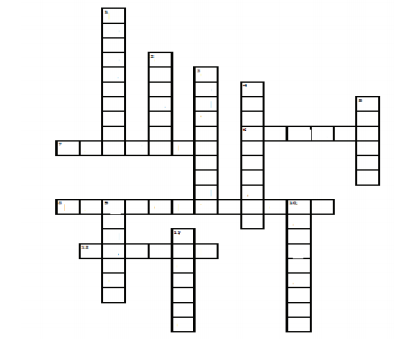
[Figure: Crossword puzzle grid numbered 1 to 22 with ACROSS and DOWN clues for the chapter Ecosystem]
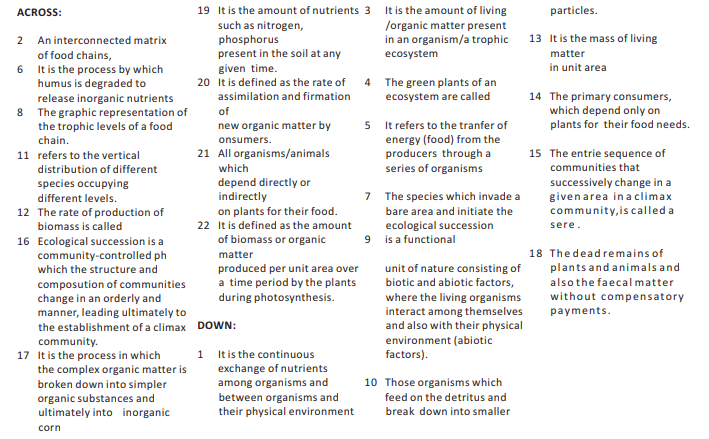
ACROSS CLUES:
2. An interconnected matrix of food chains, [1 Mark]
Answer:
Food web
Teacher's Note:
a) A food web consists of multiple intersecting food chains.
b) It demonstrates the complex feeding relationships in an ecosystem.
6. It is the process by which humus is degraded to release inorganic nutrients [1 Mark]
Answer:
Mineralisation
Teacher's Note:
a) Mineralisation is a key step in decomposition.
b) It releases inorganic nutrients previously locked in organic matter.
8. The graphic representation of the trophic levels of a food chain. [1 Mark]
Answer:
Ecological pyramid
Teacher's Note:
a) Ecological pyramids can be of number, biomass, or energy.
b) Producers form the base of these pyramids.
11. refers to the vertical distribution of different species occupying different levels. [1 Mark]
Answer:
Stratification
Teacher's Note:
a) Stratification is well-observed in forest ecosystems.
b) Trees occupy top vertical strata, shrubs and herbs occupy lower levels.
12. The rate of production of biomass is called [1 Mark]
Answer:
Productivity
Teacher's Note:
a) Productivity is expressed in terms of weight or energy.
b) It is divided into primary and secondary productivity.
16. Ecological succession is a community-controlled ph which the structure and composition of communities change in an orderly and manner, leading ultimately to the establishment of a climax community. [1 Mark]
Answer:
Ecological succession
Teacher's Note:
a) It is a gradual and predictable process.
b) It leads from a barren area to a stable climax community.
17. It is the process in which the complex organic matter is broken down into simpler organic substances and ultimately into inorganic corn [1 Mark]
Answer:
Decomposition
Teacher's Note:
a) Decomposition involves fragmentation, leaching, catabolism, humification, and mineralisation.
b) Earthworms and detritivores play a vital role here.
19. It is the amount of nutrients such as nitrogen, phosphorus present in the soil at any given time. [1 Mark]
Answer:
Standing state
Teacher's Note:
a) It represents nutrient availability in a given ecosystem at any time.
b) It varies across different ecosystem types.
20. It is defined as the rate of assimilation and firmation of new organic matter by onsumers. [1 Mark]
Answer:
Secondary productivity
Teacher's Note:
a) It is achieved by consumers.
b) It depends on consumption of primary production.
21. All organisms/animals which depend directly or indirectly on plants for their food. [1 Mark]
Answer:
Consumers
Teacher's Note:
a) Consumers are also known as heterotrophs.
b) They include herbivores, carnivores, and omnivores.
22. It is defined as the amount of biomass or organic matter produced per unit area over a time period by the plants during photosynthesis. [1 Mark]
Answer:
Gross primary productivity
Teacher's Note:
a) It is the total rate of photosynthesis.
b) A part of it is utilized by plants for respiration.
DOWN CLUES:
1. It is the continuous exchange of nutrients among organisms and between organisms and their physical environment [1 Mark]
Answer:
Nutrient cycling
Teacher's Note:
a) Also known as biogeochemical cycles.
b) It ensures no permanent depletion of nutrients occurs.
3. It is the amount of living / organic matter present in an organism/a trophic ecosystem [1 Mark]
Answer:
Biomass
Teacher's Note:
a) Biomass represents stored chemical energy.
b) It is measured as fresh or dry weight.
4. The green plants of an ecosystem are called [1 Mark]
Answer:
Producers
Teacher's Note:
a) Producers are autotrophs.
b) They trap solar energy to manufacture food.
5. It refers to the tranfer of energy (food) from the producers through a series of organisms [1 Mark]
Answer:
Food chain
Teacher's Note:
a) Energy flow in a food chain is unidirectional.
b) It follows the ten percent law of energy transfer.
7. The species which invade a bare area and initiate the ecological succession [1 Mark]
Answer:
Pioneer species
Teacher's Note:
a) Lichens are typical pioneer species on bare rocks.
b) Phytoplankton act as pioneers in aquatic succession.
9. is a functional unit of nature consisting of biotic and abiotic factors, where the living organisms interact among themselves and also with their physical environment (abiotic factors). [1 Mark]
Answer:
Ecosystem
Teacher's Note:
a) An ecosystem can be natural or artificial.
b) It integrates living communities with non-living surroundings.
10. Those organisms which feed on the detritus and break down into smaller particles. [1 Mark]
Answer:
Detritivores
Teacher's Note:
a) Earthworms are classic examples of detritivores.
b) They help in the fragmentation of detritus.
13. It is the mass of living matter in unit area [1 Mark]
Answer:
Standing crop
Teacher's Note:
a) Standing crop is measured as the mass of living organisms.
b) It can be expressed as number or biomass per unit area.
14. The primary consumers, which depend only on plants for their food needs. [1 Mark]
Answer:
Herbivores
Teacher's Note:
a) Herbivores occupy the second trophic level.
b) Examples include cows, rabbits, and grasshoppers.
15. The entrie sequence of communities that successively change in a given area in a climax community, is called a sere. [1 Mark]
Answer:
Sere
Teacher's Note:
a) Individual transitional communities are seral stages.
b) Hydrarch and xerarch are types of seres.
18. The dead remains of plants and animals and also the faecal matter without compensatory payments. [1 Mark]
Answer:
Detritus
Teacher's Note:
a) Detritus forms the raw material for decomposition.
b) It drives the detritus food chain.
Free study material for Biology
Free CBSE Study Guides: Class 12 Biology Chapter 12 Ecosystem
Comprehensive Study Resources for Chapter 12 Ecosystem
Access comprehensive study material for Chapter 12 Ecosystem, including revision notes, concept maps, and high-probability questions. These resources are designed in alignment with the latest 2026 CBSE syllabus for Class 12 Biology to support effective exam preparation.
Understanding Marking Schemes
Built using official NCERT guidelines for Class 12 Biology, these materials provide reliable academic support. Integrating past examination questions and step-by-step solutions helps students understand official CBSE grading criteria.
Complete Revision for Biology
Wrap up your chapter revision by testing your knowledge against standard objective question formats. Explore our full library of free, up-to-date sample papers and online assessments to secure top grades in your CBSE examinations.
FAQs
Our advanced study package for Chapter 12 Ecosystem includes detailed concepts, diagrams, Mind Maps, and explanation of complex topics to ensure Class 12 students learn as per syllabus for 2026 exams.
The Mind Maps provided for Chapter 12 Ecosystem act as visual anchors which will help faster recall during high-pressure exams.
Yes, teachers use our Class 12 Biology resources for lesson planning as they are in simple language and have lot of solved examples.
Yes, You can download the complete, mobile-friendly PDF of the Biology Chapter 12 Ecosystem advanced resources for free.
Yes, our subject matter experts have updated the Chapter 12 Ecosystem material to align with the rationalized NCERT textbooks and have removed deleted topics and added new competency-based questions.