

Download CBSE Class 12 Biology Useful Resources
Review targeted academic resources with the CBSE Class 12 Biology Strategies For Enhancement In Food Production Flow Chart. Built according to official CBSE standards for the 2026-27 term, these downloadable Class 12 Biology study materials support effective daily practice and deeper conceptual understanding for Chapter 09 Strategies for Enhancement In Food Production.
Access CBSE Study Guides and Summaries
Access the complete useful resource PDF for Class 12 Biology below. Regular practice with these targeted academic notes builds familiarity with complex topics and helps secure higher marks in final school evaluations.
This CBSE Class 12 Biology flow chart for Chapter 9, Strategies for Enhancement in Food Production, covers animal husbandry (dairy, poultry, bee-keeping and fisheries), animal breeding methods, controlled animal breeding, plant breeding for disease and pest resistance, and other plant breeding methods such as biofortification, single cell protein, tissue culture and somatic hybridisation.
Chapter 9: Strategies for Enhancement in Food Production (Flow Chart)
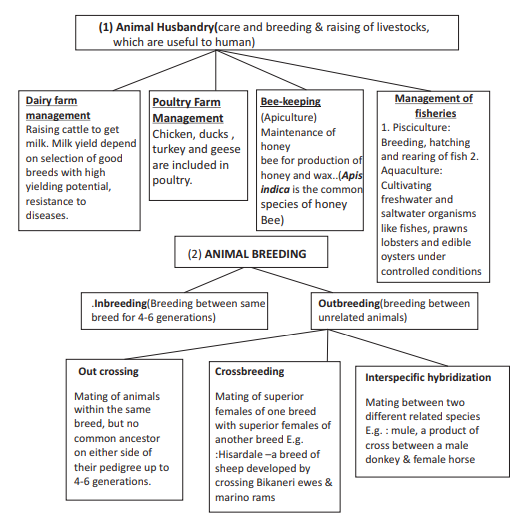
1. Animal Husbandry
Animal husbandry means the care, breeding and raising of livestock, which are useful to human beings.
Dairy Farm Management:
Raising cattle to get milk. Milk yield depends on the selection of good breeds with high yielding potential and resistance to diseases.
Poultry Farm Management:
Chicken, ducks, turkey and geese are included in poultry.
Bee-keeping (Apiculture):
Maintenance of honey bees for the production of honey and wax. Apis indica is the common species of honey bee.
Management of Fisheries:
1. Pisciculture - breeding, hatching and rearing of fish
2. Aquaculture - cultivating freshwater and saltwater organisms like fishes, prawns, lobsters and edible oysters under controlled conditions
2. Animal Breeding
Inbreeding: breeding between animals of the same breed for 4 to 6 generations.
Out crossing: mating of animals within the same breed, but with no common ancestor on either side of their pedigree up to 4 to 6 generations.
Outbreeding: breeding between unrelated animals.
Crossbreeding: mating of superior females of one breed with superior males of another breed. Example: Hisardale, a breed of sheep developed by crossing Bikaneri ewes and Marino rams.
Interspecific hybridisation: mating between two different related species. Example: mule, a product of a cross between a male donkey and a female horse.
3. Controlled Animal Breeding
Artificial Insemination: semen of a superior male is collected and injected into the reproductive tract of a selected female by the breeder.
MOET (Multiple Ovulation Embryo Transfer): a technique for herd improvement by successful production of hybrids. It is done in cattle, sheep, rabbits, buffalo, mare and others.
4. Plant Breeding
Plant breeding for disease resistance:
1. Viral - tobacco mosaic, turnip mosaic
2. Bacterial - black rot of crucifers, blight of rice
3. Fungal - rust of wheat, red rot of sugarcane, late blight of potato
Conventional breeding:
Screening germplasm for resistance sources. Example: Parbhani Kranti (bhindi) is resistant to yellow mosaic virus.
Mutational breeding:
Inducing mutation artificially through chemicals or radiations. Example: mung bean resistant to yellow mosaic virus and powdery mildew.
Plant breeding for resistance to insect pests:
Hairy leaves, solid stem, smooth leaved and nectarless varieties. High aspartic acid, low nitrogen and sugar content also form part of this breeding.
5. Other Plant Breeding Methods
Biofortification: breeding crops with higher levels of proteins, vitamins and minerals.
1. Vitamin C rich bitter gourd and tomato
2. Atlas 66 maize with high protein content
3. Iron fortified rice
4. Vitamin A enriched carrots, spinach and pumpkin
5. Iron and calcium rich spinach
6. Protein enriched beans and peas
SCP (Single Cell Protein):
1. Spirulina (algae)
2. Methylophilus methylotrophus (bacterium)
Tissue culture (Micropropagation): regeneration of a whole plant from an explant in culture medium. The medium contains sucrose as the carbon source, inorganic salts, vitamins, amino acids, auxin and cytokinin.
Somatic hybridisation: fusion of protoplasts of somatic cells of two different species. Example: Pomato is obtained by somatic hybridisation of potato and tomato.
Free study material for Biology
Free CBSE Study Guides: Class 12 Biology Chapter 09 Strategies for Enhancement In Food Production
Quick Revision Material for Chapter 09 Strategies for Enhancement In Food Production
Review targeted study resources for Chapter 09 Strategies for Enhancement In Food Production tailored for Class 12 learners. Utilizing these structured notes and quick-revision tools ensures complete alignment with current CBSE evaluation standards.
Expert Notes and Solved Exam Questions
Each resource draws directly from authorized textbooks to maintain academic accuracy. Evaluating solved examples allows Class 12 students to master the formal presentation and answer-writing standards expected in upcoming school exams.
Additional Study Resources for Class 12
Wrap up your chapter revision by testing your knowledge against standard objective question formats. Explore our full library of free, up-to-date sample papers and online assessments to secure top grades in your CBSE examinations.
FAQs
Our advanced study package for Chapter 09 Strategies for Enhancement In Food Production includes detailed concepts, diagrams, Mind Maps, and explanation of complex topics to ensure Class 12 students learn as per syllabus for 2026 exams.
The Mind Maps provided for Chapter 09 Strategies for Enhancement In Food Production act as visual anchors which will help faster recall during high-pressure exams.
Yes, teachers use our Class 12 Biology resources for lesson planning as they are in simple language and have lot of solved examples.
Yes, You can download the complete, mobile-friendly PDF of the Biology Chapter 09 Strategies for Enhancement In Food Production advanced resources for free.
Yes, our subject matter experts have updated the Chapter 09 Strategies for Enhancement In Food Production material to align with the rationalized NCERT textbooks and have removed deleted topics and added new competency-based questions.