

Class 12 Biology Study Guide: CBSE Class 12 Biology Human Health and Disease diagrams based questions
Explore structured advanced study materials through the CBSE Class 12 Biology Human Health and Disease diagrams based questions. Tailored for Class 12 learners, utilizing these Biology resources ensures thorough preparation and strengthens foundational knowledge before final CBSE evaluations.
Download Chapter 07 Human Health and Diseases Study Material PDF
Access the complete useful resource PDF for Class 12 Biology below. Regular practice with these targeted academic notes builds familiarity with complex topics and helps secure higher marks in final school evaluations.
CBSE Class 12 Biology Human Health and Disease diagrams based questions. Please refer to the examination notes which you can use for preparing and revising for exams. These notes will help you to revise the concepts quickly and get good marks.
Biology: Chapter 8 – Human Health and Disease (Diagram Based Questions)
7.10 What is shown in the picture? Write technical term for this event.
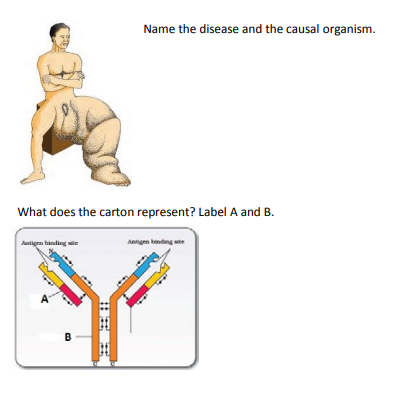
Name the disease and the causal organism. (The figure shows a person with grossly swollen legs.)
Answer: The disease is elephantiasis (filariasis). The causal organism is the filarial worm Wuchereria bancrofti (W. malayi also causes it). The worms live in the lymphatic vessels of the lower limbs and cause chronic inflammation and swelling of the organs. The disease spreads by the bite of the female Culex mosquito.
What does the cartoon represent? Label A and B.
Answer: The diagram shows the structure of an antibody molecule (an immunoglobulin, such as IgG). It is made of four polypeptide chains: two light chains and two heavy chains, written H2L2, joined by disulphide bonds. Each arm has an antigen-binding site at its tip.
A: light chain (the short chain).
B: heavy chain (the long chain that runs down the stem).
(a) Identify the plant. (b) Name the drug obtained from the seeds of this flower. What is it commonly called? (c) How is it obtained?
Answer: (a) The opium poppy, Papaver somniferum.
(b) The drug is morphine. It is a strong painkiller and sedative; its chemical derivative, diacetylmorphine, is commonly called smack (heroin).
(c) Morphine is obtained from the latex of the unripe fruits (the seed capsules) of the poppy, which is dried. Diacetylmorphine is then made from it by acetylation. It is not obtained from the ripe seeds themselves.
This is a common garden flower and is also found growing wild. This plant is associated with drug-related matters. What is it?
Answer: It is Datura (thorn apple, Datura stramonium or D. metel), a plant with large white trumpet-shaped flowers. Its seeds and leaves contain alkaloids (atropine, hyoscyamine and scopolamine) that act on the nervous system and cause hallucinations. It is a hallucinogen and is highly poisonous.
The diagram shows the life cycle of the pathogen causing a human disease. (a) Name the pathogen, the disease and the vector. (b) Label the stages 1 to 9.
Answer: (a) The pathogen is Plasmodium (P. vivax, P. malariae or P. falciparum), the disease is malaria, and the vector is the female Anopheles mosquito.
(b) The stages are:
- The female Anopheles mosquito bites a human and injects the infective stage (sporozoites) into the blood.
- The sporozoites go to the liver and enter the liver cells.
- They multiply asexually in the liver cells, and the liver cells burst to release merozoites into the blood.
- The merozoites attack the red blood cells (RBCs).
- They multiply asexually inside the RBCs. The RBCs burst and release more merozoites, along with a toxin called haemozoin, which causes the chill and high fever every 3 to 4 days.
- Some merozoites develop into the sexual stages, the male and female gametocytes, inside the RBCs.
- The gametocytes are present in the human blood.
- Another female Anopheles bites the infected person and takes up the gametocytes with the blood.
- In the mosquito's gut the gametes fuse (fertilisation) and develop into zygotes, then into oocysts in the gut wall, where the sporozoites are formed. The sporozoites move to the salivary glands of the mosquito, and the cycle begins again (stage 1).
(a) This is a photograph of a common plant abused for drugs. Name the plant. (b) Which part of this plant is used as drugs? (c) What are the different forms of drugs obtained from this plant?
Answer: (a) Hemp, Cannabis sativa.
(b) The flower tops, the leaves and the resin of the female plant (the inflorescences).
(c) Marijuana, hashish, charas and ganja. They are obtained from different parts of the plant: marijuana from the leaves and flower tops, ganja from the flowering tops of the female plant, and charas and hashish from the resin. The active chemicals are cannabinoids, which affect the cardiovascular system of the body.
Free study material for Biology
Free CBSE Study Guides: Class 12 Biology Chapter 07 Human Health and Diseases
Core Study Kit: Class 12 Biology Chapter 07 Human Health and Diseases
Access comprehensive study material for Chapter 07 Human Health and Diseases, including revision notes, concept maps, and high-probability questions. These resources are designed in alignment with the latest 2026 CBSE syllabus for Class 12 Biology to support effective exam preparation.
NCERT-Aligned Solutions for Chapter 07 Human Health and Diseases
Each resource draws directly from authorized textbooks to maintain academic accuracy. Evaluating solved examples allows Class 12 students to master the formal presentation and answer-writing standards expected in upcoming school exams.
Next Steps in Your Exam Preparation
Wrap up your chapter revision by testing your knowledge against standard objective question formats. Explore our full library of free, up-to-date sample papers and online assessments to secure top grades in your CBSE examinations.
FAQs
Our advanced study package for Chapter 07 Human Health and Diseases includes detailed concepts, diagrams, Mind Maps, and explanation of complex topics to ensure Class 12 students learn as per syllabus for 2026 exams.
The Mind Maps provided for Chapter 07 Human Health and Diseases act as visual anchors which will help faster recall during high-pressure exams.
Yes, teachers use our Class 12 Biology resources for lesson planning as they are in simple language and have lot of solved examples.
Yes, You can download the complete, mobile-friendly PDF of the Biology Chapter 07 Human Health and Diseases advanced resources for free.
Yes, our subject matter experts have updated the Chapter 07 Human Health and Diseases material to align with the rationalized NCERT textbooks and have removed deleted topics and added new competency-based questions.