

Download CBSE Class 12 Biology Useful Resources
Review targeted academic resources with the CBSE Class 12 Biology The Human Genome Project. Built according to official CBSE standards for the 2026-27 term, these downloadable Class 12 Biology study materials support effective daily practice and deeper conceptual understanding for The Human Genome Project.
Access CBSE Study Guides and Summaries
Access the complete useful resource PDF for Class 12 Biology below. Regular practice with these targeted academic notes builds familiarity with complex topics and helps secure higher marks in final school evaluations.
This CBSE Class 12 Biology notes page covers The Human Genome Project. It explains the genome as the genetic blueprint, the chromosomes and DNA that carry it, the aims and milestones of the project from 1990 to 2003, what the draft sequence revealed about genes, junk DNA, SNPs and mutations, how the human genome compares with other organisms, and the next steps of annotation, proteomics and comparative genomics.
The Human Genome Project
The Human Genome Project Began in 1990
The mission of the HGP is the quest to understand the human genome and the role it plays in both health and disease.
"The true payoff from the HGP will be the ability to better diagnose, treat, and prevent disease."
Francis Collins, Director of the HGP and the National Human Genome Research Institute (NHGRI)
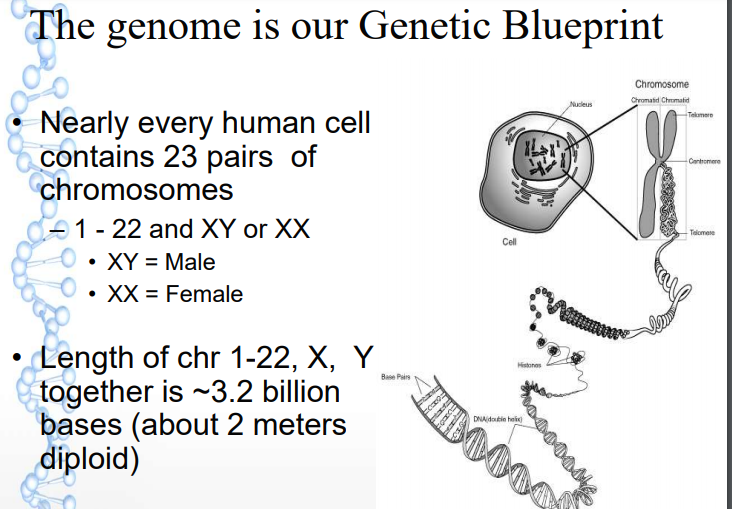
The Genome is Our Genetic Blueprint
Nearly every human cell contains 23 pairs of chromosomes.
Chromosomes 1 to 22 and XY or XX: XY = male, XX = female.
The length of chromosomes 1 to 22, X and Y together is about 3.2 billion bases (about 2 metres, diploid).
[Figure: Diagram of a cell with its nucleus, a chromosome with chromatids and centromere, and a DNA double helix]
Labels in the figure: Cell; Nucleus; Chromosome (two chromatids, with Telomere at each end and the Centromere in the middle); Histones; Base Pairs; DNA (double helix).
The Genome is Who We Are on the Inside
Chromosomes consist of DNA, which is a molecular string of the bases A, C, G and T.
Base pairs are A-T and C-G. The information is coded in DNA.
Genes are DNA sequences that encode proteins. Genes make up less than 3% of the human genome.
[Figure: Double helix of DNA labelled Backbone, Nucleotide, Base pair, with A, T, C and G bases shown in pairs]
Panel (a) DNA strand: a vertical Backbone carrying a series of Nucleotides, each with a Base (T, A, C, G, T). Panel (b) Double helix: two backbones joined by Base pairs, A pairs with T and C pairs with G. Heading of the figure: Information coded in DNA.
The Human Genome Project (DNA as a Molecule to Study)
Until the early 1970s, DNA was the most difficult cellular molecule for biochemists to analyse.
DNA is now the easiest molecule to analyse. We can now isolate a specific region of the genome, produce a virtually unlimited number of copies of it, and determine its nucleotide sequence overnight.
Source: Molecular Biology of the Cell, Alberts et al., pages 491-495.
The Beginning of the Project
Most of the first 10 years of the project were spent improving the technology to sequence and analyse DNA.
Scientists all around the world worked to make detailed maps of our chromosomes and to sequence model organisms, like the worm, fruit fly and mouse.
[Figure: Three photographs of model organisms, a worm, a fruit fly and a mouse]
The Human Genome Project (Speed of Sequencing)
At the height of the Human Genome Project, sequencing factories were generating DNA sequences at a rate of 1000 nucleotides per second, 24 hours a day and 7 days a week.
Technical breakthroughs that allowed the Human Genome Project to be completed have had an enormous impact on all of biology.
Source: Molecular Biology of the Cell, Alberts et al., pages 491-495.
The Challenges were Overwhelming
First there was the assembly. The DNA sequence is so long that no technology can read it all at once, so it was broken into pieces.
There were millions of clones (small sequence fragments).
The assembly process included finding where the pieces overlapped in order to put the draft together.
This was a 3,200,000 piece puzzle.
[Figure: Magnifying glass over green DNA sequence data]
The Human Genome Project (Goals and Milestones)
Goals:
1. Identify all the approximately 30,000 genes in human DNA.
2. Determine the sequences of the 3 billion chemical base pairs that make up human DNA.
3. Store this information in databases.
4. Improve tools for data analysis.
5. Transfer related technologies to the private sector.
6. Address the ethical, legal and social issues (ELSI) that may arise from the project.
Milestones:
1. 1990: Project initiated as a joint effort of the U.S. Department of Energy and the National Institutes of Health.
2. June 2000: Completion of a working draft of the entire human genome, covering more than 90% of the genome to a depth of 3-4x redundant sequence.
3. February 2001: Analyses of the working draft are published.
4. April 2003: HGP sequencing is completed, and the project is declared finished two years ahead of schedule.
Sources: doegenomes.org and sanger.ac.uk/HGP/overview.shtml (U.S. Department of Energy Genome Programs, 2003).
UCSC Puts the Genome Online
UCSC put the human genome sequence on the web on July 7, 2000. Cyber geeks searched for hidden messages, and for "GATTACA".
UCSC put the human genome sequence on CD in October 2000, with varying results.
[Figure: Graph of web traffic to the UCSC genome site, Bits per Second against time in weeks 23 to 28. Traffic is low (below about 20 M) in weeks 23-26, then rises sharply to about 75-80 M just after the start of week 27, when the sequence was put on the web, and falls back over weeks 27-28. A photograph shows a man holding up the CD labelled 'DNA Sequence of the Human Genome'.]
The Completion of the Human Genome Sequence
June 2000: White House announcement that the majority of the human genome (80%) had been sequenced (working draft).
July 2000: Working draft made available on the web at genome.ucsc.edu.
February 2001: Publication of 90 percent of the sequence in the journal Nature.
July 2003: Completion of 99.99% of the genome as finished sequence.
What Does the Draft Human Genome Sequence Tell Us? (By the Numbers)
The human genome contains 3 billion chemical nucleotide bases (A, C, T and G).
The average gene consists of 3000 bases, but sizes vary greatly. The largest known human gene is dystrophin, at 2.5 million bases. The smallest is the tRNA gene, at 76 bp.
The total number of genes is estimated at around 30,000, much lower than the previous estimates of 80,000 to 140,000.
Almost all (99.9%) nucleotide bases are exactly the same in all people.
The functions are unknown for over 50% of the discovered genes.
Source: U.S. Department of Energy Genome Programs, Genomics and Its Impact on Science and Society, 2003.
What Does the Draft Human Genome Sequence Tell Us? (How It's Arranged)
The human genome's gene-dense "urban centres" are predominantly composed of the DNA building blocks G and C.
In contrast, the gene-poor "deserts" are rich in the DNA building blocks A and T.
GC- and AT-rich regions can usually be seen through a microscope as light and dark bands on chromosomes.
Genes appear to be concentrated in random areas along the genome, with vast expanses of noncoding DNA between them.
Stretches of up to 30,000 C and G bases repeating over and over often occur adjacent to gene-rich areas, forming a barrier between the genes and the "junk DNA". These CpG islands are believed to help regulate gene activity.
Chromosome 1 has the most genes (2968), and the Y chromosome has the fewest (231).
The Human Genome (How It's Arranged, repeated slide)
The slide repeats the same points as above: gene-dense GC-rich "urban centres", gene-poor AT-rich "deserts", CpG islands with up to 30,000 C and G bases, and the gene counts of chromosome 1 (2968) and the Y chromosome (231).
The Wheat from the Chaff
Less than 2% of the genome codes for proteins.
Repeated sequences that do not code for proteins ("junk DNA") make up at least 50% of the human genome.
Repetitive sequences are thought to have no direct function, but they shed light on chromosome structure and dynamics. Over time, these repeats reshape the genome by rearranging it, creating entirely new genes, and modifying and reshuffling existing genes.
The human genome has a much greater portion (50%) of repeat sequences than the mustard weed (11%), the worm (7%) and the fly (3%).
How the Human Compares with Other Organisms
Unlike the human's seemingly random distribution of gene-rich areas, many other organisms' genomes are more uniform, with genes evenly spaced throughout.
Humans have on average three times as many kinds of proteins as the fly or worm, because of mRNA transcript "alternative splicing" and chemical modifications to the proteins. This process can yield different protein products from the same gene.
Humans share most of the same protein families with worms, flies and plants, but the number of gene family members has expanded in humans, especially in proteins involved in development and immunity.
Humans appear to have stopped accumulating repeated DNA over 50 million years ago, but there seems to be no such decline in rodents. This may account for some of the fundamental differences between hominids and rodents, although gene estimates are similar in these species.
Scientists have proposed many theories to explain evolutionary contrasts between humans and other organisms, including life span, litter sizes, inbreeding and genetic drift.
Variations and Mutations
Scientists have identified about 3 million locations where single-base DNA differences (SNPs) occur in humans. This information promises to revolutionise the process of finding chromosomal locations for disease-associated sequences and of tracing human history.
The ratio of germline (sperm or egg cell) mutations is 2:1 in males versus females. Researchers point to several reasons for the higher mutation rate in the male germline, including the greater number of cell divisions required for sperm formation than for egg formation.
What Does the Draft Human Genome Sequence Tell Us? (Discoveries)
The sequence led to the discovery of whole new classes of proteins and genes, while revealing that many proteins have been much more highly conserved in evolution than had been suspected.
It provided new tools for determining the functions of proteins and of individual domains within proteins, revealing a host of unexpected relationships between them.
Source: Molecular Biology of the Cell, Alberts et al., pages 491-495.
What Does the Draft Human Genome Sequence Tell Us? (Uses)
By making large amounts of protein available, it has yielded an efficient way to mass produce protein hormones and vaccines.
Dissection of regulatory genes has provided an important tool for unravelling the complex regulatory networks by which eukaryotic gene expression is controlled.
Source: Molecular Biology of the Cell, Alberts et al., pages 491-495.
The Project is Not Done
Next there is the annotation. The sequence is like a topographical map, and the annotation would include cities, towns, schools, libraries and coffee shops.
So, where are the genes? How do genes work? How do scientists use this information for scientific understanding and to benefit us?
[Figure: Photograph of a woman working at a computer]
What Do Genes Do Anyway?
We have only about 19,000 genes, so each gene has to do a lot.
Genes make proteins that make up nearly all we are (muscles, hair, eyes).
Almost everything that happens in our bodies happens because of proteins (walking, digestion, fighting disease).
[Figure: Two pairs of eyes labelled OR, and two hairstyles labelled OR, with the caption: Eye Color and Hair Color are determined by genes]
Of Mice and Men: It's All in the Genes
Humans and mice have about the same number of genes. But we are so different from each other, how is this possible?
One human gene can make many different proteins, while a mouse gene can only make a few.
[Figure: Cartoon with speech bubbles "Did you say cheese?" and "Mmm, Cheese!" next to a photograph of a mouse and a person, with the logo "ARE YOU A MAN... OR A MOUSE?"]
Genes are Important
By selecting different pieces of a gene, your body can make many kinds of proteins. This process is called alternative splicing.
If a gene is "expressed", that means it is turned on and it will make proteins.
[Figure: Diagram showing a chromosome with a gene, DNA transcribed to RNA transcript, then RNA splicing, leading to mRNA]
The UCSC Genome Browser
The browser takes you from early maps of the genome to a multi-resolution view, then to the gene cluster level, the single gene level, the single exon level, and finally to the single base level.
[Figure: Screenshot of the UCSC Genome Browser on the Human July 2003 Freeze, showing chromosome bands and gene tracks]
[Figure: Series of browser views. Early map of a chromosome with a band of the chromosome 4p region; a multi-resolution view of the chromosome; the gene cluster level, with the RefSeq genes and Chromosome Bands Localized by FISH Mapping Clones; the single gene level, with the gene HD and its neighbours; the single exon level, with Mouse Conservation and Single Nucleotide Polymorphisms (SNPs) tracks; and the single base level]
Labels in the browser figures (PDF pages 24-30):
- Page 24 (UCSC Genome Browser on Human July 2003 Freeze, position chr22:20000000-30000000, size 10,000,001, image width 610): tracks Base Position (25000000), Chromosome Band (22q11.22, 22q11.23, 22q12.1, 22q12.2), STS Markers, Gap, Known Genes (SWISS-PROT, TrEMBL, mRNA and RefSeq), Genscan Genes, Human mRNAs, Spliced ESTs, NonHuman mRNAs, Mouse Net (mm3-Feb 03 / Human Alignment Net) and RepeatMasker; Chromosome Color Key 1 to 22, X, Y.
- Page 25: early genetic map of chromosome 19 with markers (D19S476, D19S52, D19S62, D19S43, D19S40, D19S45, D19S46, D19S51, MBP, and others), distances (8.9, 30.9, 16.0, 9.7, 9.9, 13.6, 7.5, 14.6, 11.1, 21.9; total 149.6 cM) and bands 11.32 to 23.
- Page 26: chromosome 4 ideogram (bands 4p16.3 to 4q35.2); zoom to Base Position 5000000, 10000000, 15000000, Chromosome Bands 4p16.3, 4p16.2, 4p16.1, 4p15.33, 4p15.32, RefSeq Genes and Mouse Synteny (Human/Mouse Synteny using blastz single coverage, 100k window).
- Page 27: gene cluster level at Base Position 2500000, 3000000, 3500000, 4000000, band 4p16.3, RefSeq Genes: MXD4, RNF4, TNIP2, GPRK2L, RGS12, LRPAP1, RES4-22, ADD1 (three entries), SH3BP2, HD, HGFAC, LRPAP1, TETRAN.
- Page 28: single gene level at Base Position 3000000, 3050000, 3100000, 3150000, gene HD, Human/Mouse Evolutionary Conservation Score (Mouse Cons), Single Nucleotide Polymorphisms (SNPs) from Clone Overlaps (Overlap SNPs) and from Random Reads (Random SNPs).
- Page 29: single exon level at Base Position 3031000 to 3036000, gene HD, Mouse Cons, SNPs from Clone Overlaps with IDs 2301367, 363070, 363086, 363087, 3025855, 363085, 363084.
- Page 30: single base level; the two sequences differ at one base (g versus a): caggcggactcagtggatctggccagctgtgacttgacaag and caggcggactcagtggatctagccagctgtgacttgacaag.
[Figure: Single base level view showing the DNA sequence lines "caggcggactcagtggatctggccagctgtgacttgacaag" and "caggcggactcagtggatctagccagctgtgacttgacaag", which differ at one base]
The Continuing Project
Finding the complete set of genes and annotating the entire sequence. Annotation is like detailing. Scientists annotate a sequence by listing what has been learned experimentally and computationally about its function.
Proteomics is the study of the structure and function of groups of proteins. Proteins are really important, but we do not really understand how they work.
Comparative genomics is the process of comparing different genomes in order to better understand what they do and how they work. For example, humans, chimpanzees and mice are all mammals, but they are all very different.
Please click the link below to download pdf file of CBSE Class 12 Biology The Human Genome Project.
Free study material for Biology
Biology Class 12 Exam Resources: The Human Genome Project
Comprehensive Study Resources for The Human Genome Project
Review targeted study resources for The Human Genome Project tailored for Class 12 learners. Utilizing these structured notes and quick-revision tools ensures complete alignment with current CBSE evaluation standards.
Understanding Marking Schemes
Built using official NCERT guidelines for Class 12 Biology, these materials provide reliable academic support. Integrating past examination questions and step-by-step solutions helps students understand official CBSE grading criteria.
Complete Revision for Biology
Wrap up your chapter revision by testing your knowledge against standard objective question formats. Explore our full library of free, up-to-date sample papers and online assessments to secure top grades in your CBSE examinations.
FAQs
Our advanced study package for The Human Genome Project includes detailed concepts, diagrams, Mind Maps, and explanation of complex topics to ensure Class 12 students learn as per syllabus for 2026 exams.
The Mind Maps provided for The Human Genome Project act as visual anchors which will help faster recall during high-pressure exams.
Yes, teachers use our Class 12 Biology resources for lesson planning as they are in simple language and have lot of solved examples.
Yes, You can download the complete, mobile-friendly PDF of the Biology The Human Genome Project advanced resources for free.
Yes, our subject matter experts have updated the The Human Genome Project material to align with the rationalized NCERT textbooks and have removed deleted topics and added new competency-based questions.