

Official CBSE Study Materials for Class 12 Biology
Access comprehensive study materials and useful resources for Chapter 01 Reproduction in Organisms using the CBSE Class 12 Biology Reproduction in Organisms diagrams based questions. Designed to align with the 2026-27 CBSE academic guidelines, these advanced resources help Class 12 Biology students reinforce core concepts beyond standard textbooks.
Advanced Resources for Biology
Access the complete useful resource PDF for Class 12 Biology below. Regular practice with these targeted academic notes builds familiarity with complex topics and helps secure higher marks in final school evaluations.
CBSE Class 12 Biology Reproduction in Organisms diagrams based questions. Please refer to the examination notes which you can use for preparing and revising for exams. These notes will help you to revise the concepts quickly and get good marks.
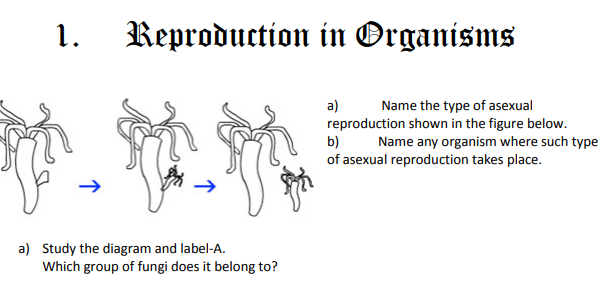
DIAGRAM BASED QUESTIONS IN BIOLOGY FOR CLASS XII
1. REPRODUCTION IN ORGANISMS
1.1 a) Name the type of asexual reproduction shown in the figure below.
b) Name any organism where such type of asexual reproduction takes place.
[Figure: Three-stage sequence of an animal with a tubular body and tentacles. In the first stage the body has a small bud on its side. In the second stage the bud has grown and developed its own tentacles. In the third stage the young bud has detached from the parent body. Blue arrows show the order of the stages]
Answer:
a) The type of asexual reproduction is budding (external budding).
b) Hydra reproduces by budding.
Teacher's Note:
a) In budding, a new individual grows out of the parent body as an outgrowth.
b) The bud develops its own tentacles before it breaks away from the parent.
1.2 a) Study the diagram and label-A.
Which group of fungi does it belong to?
1.3 a) Name the organism where it is found.
b) Label the part A
[Figure: Circular structure labelled Micropyle at the top, Outer Membrane, Inner Membrane, Monaxon spicules around the outside and gemmule at the lower left. A central dark granular region is marked A, and the arrow for A points to this central region inside the inner membrane]
Answer:
a) The structure is a gemmule, found in freshwater sponges such as Spongilla.
b) A is the internal mass of archaeocytes (the central cell mass of the gemmule).
Teacher's Note:
a) Gemmules are resistant buds that survive unfavourable conditions such as drying or cold.
b) The micropyle is the opening through which the cells come out during germination.
c) Monaxon spicules protect the gemmule from damage.
1.4 The diagram shows an event in Amoeba.
a) What is the event?
b) Are the two cell in stage 6 identical?
Name any other organism where such type of event occurs.
[Figure: Six stages of an amoeba. Stage 1 shows one nucleus. Stage 2 shows the nucleus beginning to divide. Stage 3 shows two nuclei. Stages 4 and 5 show the body constricting and elongating. Stage 6 shows two separate daughter amoebae, each with one nucleus]
Answer:
a) The event is binary fission, in which one amoeba divides into two daughter amoebae.
b) Yes, the two cells in stage 6 are identical, because the nucleus divides by mitosis and each daughter gets an equal share of the genetic material.
Paramecium also reproduces by binary fission.
Teacher's Note:
a) Binary fission is a form of asexual reproduction in unicellular organisms.
b) Nuclear division comes first and cytoplasmic division follows.
c) Bacteria such as E. coli also divide by binary fission.
1.5 Name the plant.
[Figure: Large green leaf with an adventitious bud marked along its margin. Several small plantlets with leaves are shown at the notches of the leaf edge]
Answer: The plant is Bryophyllum.
Teacher's Note:
a) Adventitious buds form on the leaf margin and grow into new plants.
b) Bryophyllum is a common example of vegetative propagation through leaves.
1.6 a) Name the type of propagule (marked X)
b) Name any other plant propagated by the same way.
[Figure: Water hyacinth plant labelled Eichhornia. Labels are Lamina, Swollen petiole, Spongy stem, Root pocket and X. X is marked on a horizontal runner that connects two plants. Roots hang from the swollen base of each plant]
Answer:
a) X is a stolon (runner), a horizontal stem that grows above the ground and forms new plants at its nodes.
b) Strawberry is also propagated by runners (stolons).
Teacher's Note:
a) A stolon grows horizontally above the soil.
b) Do not confuse a stolon with a rhizome, which grows horizontally below the soil.
c) Stolons help a plant spread quickly and reproduce vegetatively.
1.7 The image shows Chara with reproductive organs. Identify the organs marked A and B
[Figure: Photomicrograph of a Chara thallus. Organ B at the top is the upper, globular reproductive structure marked with an arrow. Organ A at the bottom is the lower, round structure with spiral markings marked with an arrow]
Answer:
A is the oogonium (female reproductive organ).
B is the antheridium (male reproductive organ).
Teacher's Note:
a) The antheridium produces male gametes called antherozoids.
b) The oogonium produces the egg cell.
c) Both organs are borne on the same thallus, which is what makes the organism monoecious in this case.
1.8 The photograph shows TS of a cucumber. Seeds are visible in the centre. Name the part of the fruit marked 'A'.
[Figure: Photograph of a transverse section of a cucumber fruit. Several flat, oval seeds are visible in the central cavity. An arrow labelled A points to the outer fleshy wall of the fruit]
Answer: A is the pericarp, the wall of the fruit.
Teacher's Note:
a) The pericarp develops from the wall of the ovary.
b) Seeds develop from the ovules inside the ovary.
1.9 The image shows potatoes with eyes.
a) What are the eyes?
b) What are the eyes used for?
c) Which part of the plant is the potato?
[Figure: Two potato tubers with small sprouting buds, called eyes, visible on their surface. Some eyes have small pale shoots growing from them]
Answer:
a) The eyes are axillary buds on the tuber.
b) The eyes are used for vegetative propagation, because each eye can grow into a new potato plant.
c) The potato is an underground stem (a tuber).
Teacher's Note:
a) A potato is a modified stem, not a root.
b) Each eye contains a bud that can sprout.
c) Cut pieces of tuber with at least one eye are used for planting.
1.10 See the photograph carefully and answer the questions.
a) Write the typical term given to the bud like structures.
b) Name the plant
[Figure: Photograph of a succulent plant with thick, pointed, grey-green leaves. Small, bud-like structures and clusters of yellow flowers are seen on the stems and at the tips]
Answer:
a) The bud-like structures are called bulbils.
b) The plant is Agave.
Teacher's Note:
a) Bulbils are small, fleshy buds that can grow into new plants.
b) Bulbils develop in the inflorescence, not in the roots.
1.11 Both the plants are ______ (chose any one). Define both the terms. Suggest any other terms meaning the same for them.
a) Monoecious
b) Dioecious
[Figure: Two photographs. The left photograph shows a papaya plant with green fruits clustered below its crown of large leaves. The right photograph shows a date palm with clusters of yellow-brown flowers and fruits hanging among its fronds]
Answer: (b) Dioecious
1. Dioecious plants bear male and female flowers on separate plants.
2. Monoecious plants bear male and female flowers on the same plant.
3. Another term for dioecious is diclinous (unisexual plants), and another term for monoecious is monoclinous.
4. Hence, both papaya and date palm are dioecious.
Teacher's Note:
a) Papaya plants are either male or female, so papaya is dioecious.
b) Date palm is also dioecious, which is why only female palms bear dates.
c) Maize and cucurbits are monoecious examples.
Revise with these diagram based questions for CBSE Class 12 Biology Reproduction in Organisms diagrams based questions.
Free study material for Biology
Free CBSE Study Guides: Class 12 Biology Chapter 01 Reproduction in Organisms
Quick Revision Material for Chapter 01 Reproduction in Organisms
Access comprehensive study material for Chapter 01 Reproduction in Organisms, including revision notes, concept maps, and high-probability questions. These resources are designed in alignment with the latest 2026 CBSE syllabus for Class 12 Biology to support effective exam preparation.
Expert Notes and Solved Exam Questions
Designed around the official curriculum, these study guides guarantee standard compliance. Reviewing step-by-step solutions clarifies complex sub-topics within Chapter 01 Reproduction in Organisms and demystifies standard marking schemes for Biology evaluations.
Additional Study Resources for Class 12
Maximize your grade potential by utilizing Class 12 Biology practice papers in tandem with these structured notes. All printable assignments and interactive mock tests on our platform are updated for the 2026 session and available free of charge.
FAQs
Our advanced study package for Chapter 01 Reproduction in Organisms includes detailed concepts, diagrams, Mind Maps, and explanation of complex topics to ensure Class 12 students learn as per syllabus for 2026 exams.
The Mind Maps provided for Chapter 01 Reproduction in Organisms act as visual anchors which will help faster recall during high-pressure exams.
Yes, teachers use our Class 12 Biology resources for lesson planning as they are in simple language and have lot of solved examples.
Yes, You can download the complete, mobile-friendly PDF of the Biology Chapter 01 Reproduction in Organisms advanced resources for free.
Yes, our subject matter experts have updated the Chapter 01 Reproduction in Organisms material to align with the rationalized NCERT textbooks and have removed deleted topics and added new competency-based questions.