

Download CBSE Class 12 Biology Useful Resources
Access comprehensive study materials and useful resources for Chapter 13 Biodiversity and Conservation using the CBSE Class 12 Biology Biodiversity and Conservation Diagrams. Designed to align with the 2026-27 CBSE academic guidelines, these advanced resources help Class 12 Biology students reinforce core concepts beyond standard textbooks.
Access CBSE Study Guides and Summaries
Navigate directly to the advanced Biology study materials using the digital viewer below. Each resource pack includes detailed conceptual summaries and solved practice questions, allowing students to instantly reinforce their learning.
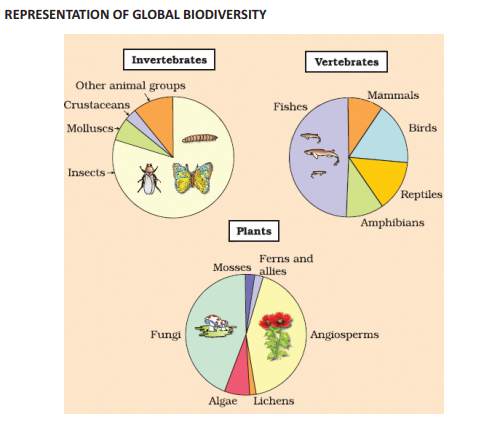
This Class 12 Biology page gives the two key diagrams of Chapter 15 Biodiversity and its Conservation: the pie-chart representation of global biodiversity (invertebrates, vertebrates and plants) and the species-area relationship graph with the equations S = CAZ and Log S = log C + Z log A, each described with all labels.
CHAPTER 15 - BIODIVERSITY AND ITS CONSERVATION
1. REPRESENTATION OF GLOBAL BIODIVERSITY
[Figure: Three pie charts. Invertebrates pie, divided into Insects (the largest part), Molluscs, Crustaceans and Other animal groups. Vertebrates pie, divided into Fishes (the largest part), Mammals, Birds, Reptiles and Amphibians. Plants pie, divided into Fungi, Angiosperms, Algae, Lichens, Mosses and Ferns and allies, with Fungi and Angiosperms the two largest parts]
2. SPECIES-AREA RELATIONSHIP
[Figure: Graph with Area on the horizontal axis and Species richness on the vertical axis. A blue curve rises steeply and then flattens, labelled S = CAZ. A straight red line on the log-log scale is labelled Log S = log C + Z log A]
Free study material for Biology
Useful Resources and Notes for Class 12 Biology Chapter 13 Biodiversity and Conservation
Essential Notes for Class 12 Biology
Explore essential learning tools for Class 12 Biology Chapter 13 Biodiversity and Conservation. This curated collection features in-depth notes and targeted practice questions built around the active 2026 curriculum to streamline your daily revision.
Verified Solutions for Class 12 Biology
Each resource draws directly from authorized textbooks to maintain academic accuracy. Evaluating solved examples allows Class 12 students to master the formal presentation and answer-writing standards expected in upcoming school exams.
Enhance Accuracy with Online Tests
Maximize your grade potential by utilizing Class 12 Biology practice papers in tandem with these structured notes. All printable assignments and interactive mock tests on our platform are updated for the 2026 session and available free of charge.
FAQs
Our advanced study package for Chapter 13 Biodiversity and Conservation includes detailed concepts, diagrams, Mind Maps, and explanation of complex topics to ensure Class 12 students learn as per syllabus for 2026 exams.
The Mind Maps provided for Chapter 13 Biodiversity and Conservation act as visual anchors which will help faster recall during high-pressure exams.
Yes, teachers use our Class 12 Biology resources for lesson planning as they are in simple language and have lot of solved examples.
Yes, You can download the complete, mobile-friendly PDF of the Biology Chapter 13 Biodiversity and Conservation advanced resources for free.
Yes, our subject matter experts have updated the Chapter 13 Biodiversity and Conservation material to align with the rationalized NCERT textbooks and have removed deleted topics and added new competency-based questions.