

Advanced Study Material for Class 12 Biology: Chapter 02 Human Reproduction
Access comprehensive study materials and useful resources for Chapter 02 Human Reproduction using the CBSE Class 12 Biology Human Reproduction Cross Word. Designed to align with the 2026-27 CBSE academic guidelines, these advanced resources help Class 12 Biology students reinforce core concepts beyond standard textbooks.
Practice Class 12 Biology Resources: Chapter 02 Human Reproduction
Navigate directly to the advanced Biology study materials using the digital viewer below. Each resource pack includes detailed conceptual summaries and solved practice questions, allowing students to instantly reinforce their learning.
CBSE Class 12 Biology Human Reproduction Cross Word. Please refer to the examination notes which you can use for preparing and revising for exams. These notes will help you to revise the concepts quickly and get good marks.
BIOLOGY
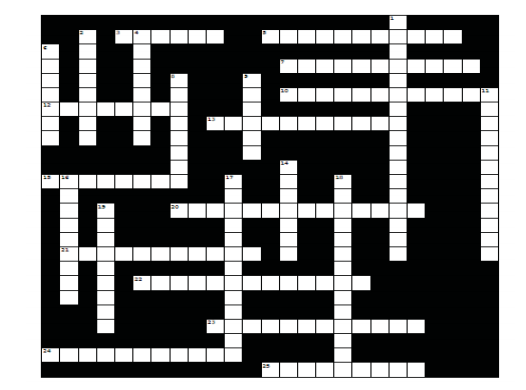
CHAPTER 3 : HUMAN REPRODUCTION (CROSS WORD)
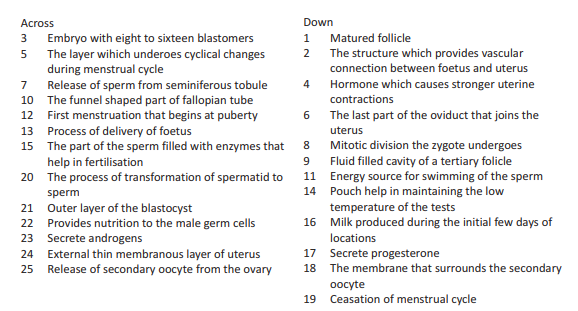
Across
3. Embryo with eight to sixteen blastomers [1 Mark]
Answer:
1. Morula.
2. The 8 to 16 celled embryonic stage formed by cleavage divisions.
Teacher's Note:
a) The embryo divides repeatedly to form a solid ball of cells.
b) It reaches the uterus around the 4th day post-fertilization.
c) Cleavage increases cell number without increasing overall cytoplasmic mass.
5. The layer which undergoes cyclical changes during menstrual cycle [1 Mark]
Answer:
1. Endometrium.
2. The innermost glandular lining of the uterus.
Teacher's Note:
a) It undergoes proliferation, secretory phase, and breakdown during menstruation.
b) Estrogen and progesterone strictly regulate these cyclical changes.
c) Implantation of the blastocyst occurs successfully within this well-developed layer.
7. Release of sperm from seminiferous tubule [1 Mark]
Answer:
1. Spermiation.
2. The process by which mature spermatozoa are released from Sertoli cells.
Teacher's Note:
a) It is distinct from spermiogenesis and ejaculation.
b) Sperm heads become embedded in Sertoli cells prior to release.
c) Hormones like FSH assist in the maturation and release processes.
10. The funnel shaped part of fallopian tube [1 Mark]
Answer:
1. Infundibulum.
2. The proximal widened section near the ovary possessing finger-like projections called fimbriae.
Teacher's Note:
a) Fimbriae help in the collection of the ovum after ovulation.
b) It leads into the wider region of the oviduct known as the ampulla.
c) Ciliated epithelium inside assists gamete transport.
12. First menstruation that begins at puberty [1 Mark]
Answer:
1. Menarche.
2. The onset of the first menstrual bleeding in human females.
Teacher's Note:
a) It marks the attainment of sexual maturity and reproductive capability.
b) Controlled by the activation of the hypothalamic-pituitary-ovarian axis.
c) Typically occurs between 11 to 15 years of age.
13. Process of delivery of foetus [1 Mark]
Answer:
1. Parturition.
2. The expulsion of the fully developed foetus from the mother's uterus.
Teacher's Note:
a) Triggered by a neuroendocrine mechanism involving cortisol, estrogen, and oxytocin.
b) Results in strong uterine contractions called the foetal ejection reflex.
c) Followed by the expulsion of the placenta.
15. The part of the sperm filled with enzymes that help in fertilisation [1 Mark]
Answer:
1. Acrosome.
2. A cap-like structure covering the anterior portion of the sperm nucleus.
Teacher's Note:
a) Derived from the Golgi apparatus during spermiogenesis.
b) Contains lytic enzymes like hyaluronidase to digest egg membranes.
c) Essential for successful sperm penetration into the secondary oocyte.
20. The process of transformation of spermatid to sperm [1 Mark]
Answer:
1. Spermiogenesis.
2. The morphological metamorphosis converting non-motile round spermatids into motile spermatozoa.
Teacher's Note:
a) Involves formation of the acrosome, axial filament, and mitochondrial spiral.
b) Excess cytoplasm is shed and phagocytosed by Sertoli cells.
c) Do not confuse with spermiation, which is the release process.
21. Outer layer of the blastocyst [1 Mark]
Answer:
1. Trophoblast.
2. The single layer of flat cells enclosing the blastocoel and inner cell mass.
Teacher's Note:
a) Facilitates attachment to the uterine endometrium.
b) Forms extraembryonic membranes and the fetal component of the placenta.
c) Outer cells differentiate into syncytiotrophoblast and cytotrophoblast.
22. Provides nutrition to the male germ cells [1 Mark]
Answer:
1. Sertoli cells.
2. Somatic nurse cells located within the seminiferous tubules.
Teacher's Note:
a) Also provide structural support and phagocytose residual cytoplasm.
b) Secrete inhibin and androgen-binding protein.
c) Form the blood-testis barrier to protect developing germ cells.
23. Secrete androgens [1 Mark]
Answer:
1. Leydig cells.
2. Endocrine interstitial cells situated in the connective tissue between seminiferous tubules.
Teacher's Note:
a) Stimulated to synthesize and secrete testosterone by luteinizing hormone.
b) Essential for spermatogenesis and secondary sexual characters in males.
c) Also known as interstitial cells of Leydig.
24. External thin membranous layer of uterus [1 Mark]
Answer:
1. Perimetrium.
2. The outer serous coat covering the muscular uterine wall.
Teacher's Note:
a) Forms part of the visceral peritoneum.
b) Outer layer of the three distinct layers of the uterine wall.
c) Protects the underlying myometrium and endometrium.
25. Release of secondary oocyte from the ovary [1 Mark]
Answer:
1. Ovulation.
2. The rupture of the mature Graafian follicle to release the secondary oocyte.
Teacher's Note:
a) Triggered by a sudden surge of luteinizing hormone mid-cycle.
b) Marks the transition from the follicular phase to the luteal phase.
c) Essential step for potential fertilization in the fallopian tube.
Down
1. Matured follicle [1 Mark]
Answer:
1. Graafian.
2. The fully mature tertiary ovarian follicle ready to undergo ovulation.
Teacher's Note:
a) Characterized by a fluid-filled antrum and distinct cumulus oophorus.
b) Contains the secondary oocyte surrounded by the zona pellucida.
c) Secretes large amounts of estrogens under hormonal control.
2. The structure which provides vascular connection between foetus and uterus [1 Mark]
Answer:
1. Placenta.
2. The intimate structural and functional physiological barrier and conduit.
Teacher's Note:
a) Facilitates supply of oxygen and nutrients to the embryo.
b) Acts as an endocrine tissue producing hCG, hPL, estrogens, and progesterones.
c) Removes carbon dioxide and metabolic wastes from the embryo.
4. Hormone which causes stronger uterine contractions [1 Mark]
Answer:
1. Oxytocin.
2. A neurohypophysial hormone acting on the myometrium.
Teacher's Note:
a) Operates via a positive feedback loop during parturition.
b) Stimulates milk ejection reflex from mammary glands post-birth.
c) Released by the posterior pituitary gland.
6. The last part of the oviduct that joins the uterus [1 Mark]
Answer:
1. Isthmus.
2. The narrow, thick-walled terminal segment of the fallopian tube.
Teacher's Note:
a) Connects the ampulla directly to the uterine cavity.
b) Site where fertilization occasionally nears completion before entering the uterus.
c) Part of the three main divisions of the oviduct.
8. Mitotic division the zygote undergoes [1 Mark]
Answer:
1. Cleavage.
2. Rapid mitotic cell divisions occurring as the zygote moves down the oviduct.
Teacher's Note:
a) Results in the formation of smaller daughter cells called blastomeres.
b) Does not involve the growth phase between divisions.
c) Transforms a unicellular zygote into a multicellular blastocyst.
9. Fluid filled cavity of a tertiary folicle [1 Mark]
Answer:
1. Antrum.
2. The central fluid-filled cavity characteristic of secondary and tertiary ovarian follicles.
Teacher's Note:
a) Distinguishes primary follicles from secondary and tertiary stages.
b) Filled with follicular fluid secreted by surrounding granulosa cells.
c) Expands as the follicle matures into a Graafian follicle.
11. Energy source for swimming of the sperm [1 Mark]
Answer:
1. Fructose.
2. A monosaccharide sugar secreted primarily by the seminal vesicles.
Teacher's Note:
a) Provides metabolic fuel for mitochondrial respiration in the sperm middle piece.
b) Crucial component of seminal plasma ensuring sperm motility.
c) Used in forensic tests to confirm the presence of semen.
14. Pouch help in maintaining the low temperature of the tests [1 Mark]
Answer:
1. Scrotum.
2. The external pouch containing the testes outside the abdominal cavity.
Teacher's Note:
a) Maintains temperature 2.0°C to 2.5°C lower than internal body temperature.
b) Necessary for normal spermatogenesis.
c) Contains dartos and cremaster muscles for thermoregulation.
16. Milk produced during the initial few days of locations [1 Mark]
Answer:
1. Colostrum.
2. The yellowish fluid secreted by mammary glands during the initial days of lactation.
Teacher's Note:
a) Contains abundant IgA antibodies conferring passive immunity to the newborn.
b) Low in fat but high in proteins and protective factors.
c) Essential for neonatal gut protection and immune development.
17. Secrete progesterone [1 Mark]
Answer:
1. Corpus luteum.
2. A temporary endocrine structure developed from the ruptured ovarian follicle.
Teacher's Note:
a) Secretes large amounts of progesterone crucial for maintaining the endometrium.
b) Essential for the establishment and maintenance of pregnancy.
c) Degenerates into corpus albicans if fertilization does not occur.
18. The membrane that surrounds the secondary oocyte [1 Mark]
Answer:
1. Zona pellucida.
2. A non-cellular glycoprotein layer secreted around the oocyte.
Teacher's Note:
a) Prevents polyspermy during fertilization.
b) Ensures species-specific binding of spermatozoa.
c) Remains intact until the blastocyst stage to prevent premature implantation.
19. Ceasation of menstrual cycle [1 Mark]
Answer:
1. Menopause.
2. The permanent cessation of menstruation in human females.
Teacher's Note:
a) Typically occurs between 45 and 50 years of age.
b) Caused by the depletion of ovarian follicles and loss of estrogen responsiveness.
c) Marks the end of the female reproductive phase.
Free study material for Biology
Biology Class 12 Exam Resources: Chapter 02 Human Reproduction
Core Study Kit: Class 12 Biology Chapter 02 Human Reproduction
Review targeted study resources for Chapter 02 Human Reproduction tailored for Class 12 learners. Utilizing these structured notes and quick-revision tools ensures complete alignment with current CBSE evaluation standards.
NCERT-Aligned Solutions for Chapter 02 Human Reproduction
Each resource draws directly from authorized textbooks to maintain academic accuracy. Evaluating solved examples allows Class 12 students to master the formal presentation and answer-writing standards expected in upcoming school exams.
Next Steps in Your Exam Preparation
For peak performance in upcoming evaluations, integrate official Biology sample papers directly into your study schedule. Follow up your revision by attempting online MCQ tests for Chapter 02 Human Reproduction to refine calculation speed and precision.
FAQs
Our advanced study package for Chapter 02 Human Reproduction includes detailed concepts, diagrams, Mind Maps, and explanation of complex topics to ensure Class 12 students learn as per syllabus for 2026 exams.
The Mind Maps provided for Chapter 02 Human Reproduction act as visual anchors which will help faster recall during high-pressure exams.
Yes, teachers use our Class 12 Biology resources for lesson planning as they are in simple language and have lot of solved examples.
Yes, You can download the complete, mobile-friendly PDF of the Biology Chapter 02 Human Reproduction advanced resources for free.
Yes, our subject matter experts have updated the Chapter 02 Human Reproduction material to align with the rationalized NCERT textbooks and have removed deleted topics and added new competency-based questions.