

Advanced Study Material for Class 12 Biology: Chapter 11 Organisms and Populations
Review targeted academic resources with the CBSE Class 12 Biology Organisms and Populations Key Points. Built according to official CBSE standards for the 2026-27 term, these downloadable Class 12 Biology study materials support effective daily practice and deeper conceptual understanding for Chapter 11 Organisms and Populations.
Practice Class 12 Biology Resources: Chapter 11 Organisms and Populations
Navigate directly to the advanced Biology study materials using the digital viewer below. Each resource pack includes detailed conceptual summaries and solved practice questions, allowing students to instantly reinforce their learning.
CBSE Class 12 Biology Organisms and Populations Key Points. Please refer to the examination notes which you can use for preparing and revising for exams. These notes will help you to revise the concepts quickly and get good marks.
ORGANISMS AND POPULATIONS
(KEY POINTS)
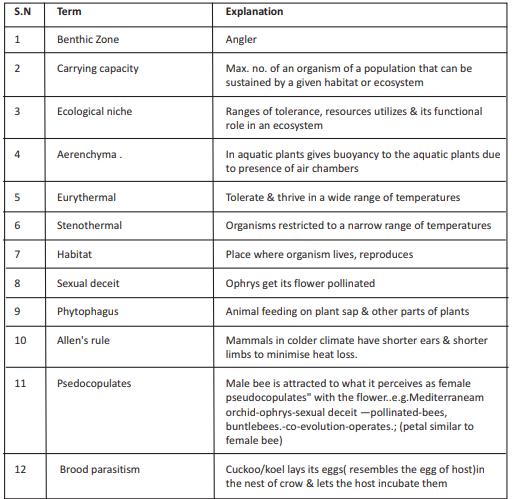
Important Questions for NCERT Class 12 Biology Organisms and Populations
Ques. Certain characteristic demographic features of developing countries are
(a) high fertility, low or rapidly falling mortality rate, rapid population growth and a very young age distribution
(b) high fertility, high density, rapidly rising mortality rate and a very young age distribution
(c) high infant mortality, low fertility, uneven population growth and a very young age distribution
(d) high mortality, high density, uneven population growth and a very old age distribution.
Answer: A
Ques. What is a keystone species?
(a) A species which makes up only a small proportion of the total biomass of a community, yet has a huge impact on the community’s organization and survival.
(b) A common species that has plenty of biomass, yet has a fairly low impact on the community’s organization.
(c) A rare species that has minimal impact on the biomass and on other species in the community
(d) A dominant species that constitutes a large proportion of the biomass and which affects many other species.
Answer: A
Ques. The maximum growth rate occurs in
(a) stationary phase
(b) senescent phase
(c) lag phase
(d) exponential phase.
Answer: D
Ques. Mycorrhiza is an example of
(a) symbiotic relationship
(b) ectoparasitism
(c) endoparasitism
(d) decomposers.
Answer: A
Ques. Two opposite forces operate in the growth and development of every population. One of them is related to the ability to reproduce at a given rate. The force opposite to it is called
(a) fecundity
(b) environmental resistances
(c) biotic control
(d) mortality.
Answer: B
Ques. Which type of association is found in between entomophilous flower and pollinating agent?
(a) Mutualism (b) Commensalism
(c) Co-operation (d) Co-evolution
Answer: D
Ques. Two different species cannot live for long duration in the same niche or habitat. This law is
(a) Allen’s law
(b) Gause’s hypothesis
(c) Dollo’s rule
(d) Weismann’s theory.
Answer: B
Ques. In a population, unrestricted reproductive capacity is called as
(a) biotic potential (b) fertility rate
(c) carrying capacity (d) birth rate.
Answer: A
Ques. In which of the following plant sunken stomata are found?
(a) Nerium (b) Hydrilla
(c) Mango (d) Guava
Answer: A
Ques. An interesting modification of flower shape for insect pollination occurs in some orchids in which a male insect mistakes the pattern on the orchid flower for the female species and tries to copulate with it, thereby pollinating the flower. This phenomenon is called
(a) pseudopollination (b) pseudoparthenocarpy
(c) mimicry (d) pseudocopulation.
Answer: D
Ques. The abundance of a species population, within its habitat, is called
(a) relative density (b) regional density
(c) absolute density (d) niche density.
Answer: D
Ques. Which one of the following pairs is correctly matched?
(a) Parasitism - intraspecific relationship
(b) Uricotelism - aquatic habitat
(c) Excessive perspiration - xeric adaptation
(d) Streamlined body - aquatic adaptation
Answer: D
Ques. Mycorrhiza exhibits the phenomenon of
(a) parasitism (b) symbiosis
(c) antagonism (d) endemism.
Answer: B
Ques. Association of animals when both partners are benefitted
(a) colony (b) mutualism
(c) commensalism (d) ammensalism.
Answer: B
Ques. Which one is true?
(a) Commensalism when none of the interacting populations affect each other.
(b) Symbiosis when the interaction is useful to both the populations.
(c) Symbiosis when neither populations affects each other.
(d) Commensalism when the interaction is useful to both the populations.
Answer: B
Ques. The relation between algae and fungi in a lichen is
(a) symbiosis (b) parasitism
(c) commenalism (d) protocooperation.
Answer: A
Ques. A mutually beneficial association necessary for survival of both partners is
(a) mutualism/symbiosis
(b) commensalism
(c) amensalism
(d) both (a) and (b).
Answer: A
Ques. Competition for light, nutrients and space is most severe between
(a) closely related organism growing in different niches
(b) closely related organisms growing in the same area/niche
(c) distantly related organisms growing in the same habitat
(d) distantly related organisms growing in different niches.
Answer: B
Please click the link below to download pdf file of CBSE Class 12 Biology Organisms and Populations Key Points.
Free study material for Biology
CBSE Class 12 Biology Study Material: Chapter 11 Organisms and Populations
Quick Revision Material for Chapter 11 Organisms and Populations
Review targeted study resources for Chapter 11 Organisms and Populations tailored for Class 12 learners. Utilizing these structured notes and quick-revision tools ensures complete alignment with current CBSE evaluation standards.
Expert Notes and Solved Exam Questions
Built using official NCERT guidelines for Class 12 Biology, these materials provide reliable academic support. Integrating past examination questions and step-by-step solutions helps students understand official CBSE grading criteria.
Additional Study Resources for Class 12
Wrap up your chapter revision by testing your knowledge against standard objective question formats. Explore our full library of free, up-to-date sample papers and online assessments to secure top grades in your CBSE examinations.
FAQs
Our advanced study package for Chapter 11 Organisms and Populations includes detailed concepts, diagrams, Mind Maps, and explanation of complex topics to ensure Class 12 students learn as per syllabus for 2026 exams.
The Mind Maps provided for Chapter 11 Organisms and Populations act as visual anchors which will help faster recall during high-pressure exams.
Yes, teachers use our Class 12 Biology resources for lesson planning as they are in simple language and have lot of solved examples.
Yes, You can download the complete, mobile-friendly PDF of the Biology Chapter 11 Organisms and Populations advanced resources for free.
Yes, our subject matter experts have updated the Chapter 11 Organisms and Populations material to align with the rationalized NCERT textbooks and have removed deleted topics and added new competency-based questions.