

Class 12 Biology Study Guide: CBSE Class 12 Biology all chapters crossword
Explore structured advanced study materials through the CBSE Class 12 Biology all chapters crossword. Tailored for Class 12 learners, utilizing these Biology resources ensures thorough preparation and strengthens foundational knowledge before final CBSE evaluations.
Download Crossword Study Material PDF
View or download the dedicated CBSE Class 12 Biology all chapters crossword resource below. Engaging with these advanced study guides under focused conditions ensures continuous academic progress and mastery of the 2026-27 curriculum for Crossword.
CBSE Class 12 Biology all chapters crossword. Please refer to the examination notes which you can use for preparing and revising for exams. These notes will help you to revise the concepts quickly and get good marks.
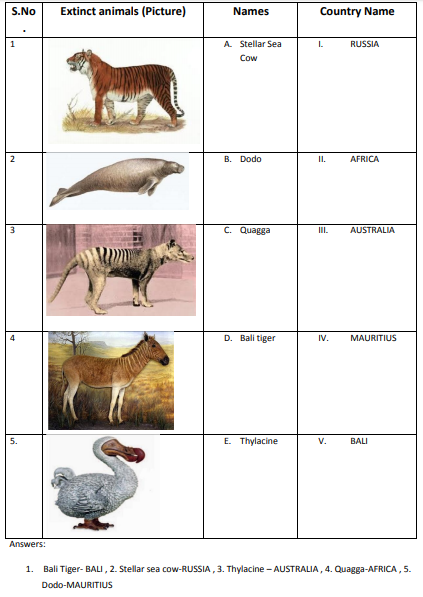
DOUBLE MATCH THE FOLLOWING:
Match the extinct animals shown in the pictures with their correct names and native country names: [5 Marks]
[Figure: Table containing 5 rows with pictures of extinct animals in column 2, animal names A to E in column 3, and country names I to V in column 4. Row 1 shows a Bali tiger; Row 2 shows a Steller's sea cow; Row 3 shows a Thylacine; Row 4 shows a Quagga; Row 5 shows a Dodo.]
Answer:
1. 1 - D - V (Bali tiger - BALI)
2. 2 - A - I (Steller's sea cow - RUSSIA)
3. 3 - E - III (Thylacine - AUSTRALIA)
4. 4 - C - II (Quagga - AFRICA)
5. 5 - B - IV (Dodo - MAURITIUS)
Teacher's Note:
a) This question tests knowledge of recently extinct animal species and their native geographical ranges.
b) Pay close attention to endemic species and their specific island or continental habitats to avoid confusion.
c) Biodiversity loss through human activity is a major theme in the study of ecology and conservation.
d) Cross-matching tabular data requires systematic verification of each category before final pairing.
[Figure: Crossword puzzle grid with green-shaded starting cells numbered 1 to 10, accompanied by two clue lists titled Top to bottom and Left to right, and chapter name headers for Microbes in Human Welfare and Biotechnology: Principles and Processes]
1. Top to bottom: 1. used to prepare bakery products. [1 Mark]
Answer:
1. Saccharomyces
Teacher's Note:
a) Yeast is commonly used in baking for fermentation.
b) It produces carbon dioxide which makes bread rise.
2. Top to bottom: 4. traditional south Indian drink prepared from palm. [1 Mark]
Answer:
1. Toddy
Teacher's Note:
a) Toddy is a fermented beverage obtained from sap of palms.
b) Fermentation is carried out by natural yeasts.
3. Top to bottom: 6. fungus produced immunosuppressive agent. [1 Mark]
Answer:
1. Trichoderma
Teacher's Note:
a) Trichoderma polysporum produces cyclosporin A.
b) It is used as an immunosuppressive agent in organ transplant patients.
4. Top to bottom: 7. enzyme act as clot buster. [1 Mark]
Answer:
1. Streptokinase
Teacher's Note:
a) Streptokinase is produced by the bacterium Streptococcus.
b) It dissolves clots in blood vessels of patients with myocardial infarction.
5. Top to bottom: 9. single cell protein [1 Mark]
Answer:
1. Spirullina
Teacher's Note:
a) Single cell protein represents alternative protein sources for animal and human nutrition.
b) Spirulina can be grown easily on waste materials.
6. Left to right: 2. rod shaped bacteria [1 Mark]
Answer:
1. Bacillus
Teacher's Note:
a) Bacilli are cylindrical or rod-shaped prokaryotic cells.
b) They are commonly found in diverse environments.
7. Left to right: 3. production of carbon dioxide in swiss cheese. [1 Mark]
Answer:
1. Propionibacterium
Teacher's Note:
a) Propionibacterium sharmanii helps ripen Swiss cheese.
b) Large holes are created by the release of large amounts of carbon dioxide.
8. Left to right: 5. name of the fungus responsible for production of citric acid [1 Mark]
Answer:
1. Aspergillus
Teacher's Note:
a) Aspergillus niger is a fungus used commercially.
b) It is primarily utilized for the industrial production of citric acid.
9. Left to right: 8. nitrogen fixing cyanobacteria [1 Mark]
Answer:
1. Nostoc
Teacher's Note:
a) Cyanobacteria are autotrophic microbes that fix atmospheric nitrogen.
b) Nostoc enriches soil fertility in aquatic and terrestrial habitats.
10. Left to right: 10. enzyme responsible for production of methane [1 Mark]
Answer:
1. Methanogens
Teacher's Note:
a) Methanogens anaerobically breakdown cellulosic material.
b) They produce biogas containing methane, carbon dioxide, and hydrogen.
1. Study the given palindromic sequences and restriction enzyme cutting sites, and answer the following questions. [3 Marks]
(A) Identify the restriction enzymes that produce blunt ends.
(B) Identify the restriction enzymes that produce sticky ends.
(C) What is a palindromic nucleotide sequence in DNA?
| Enzyme | Cutting site | Ends |
|---|---|---|
| AluI | 5' ...AG↓CT... 3' 3' ...TC↑GA... 5' | blunt |
| HaeIII | 5' ...GG↓CC... 3' 3' ...CC↑GG... 5' | blunt |
| BamHI | 5' ...G↓GATCC... 3' 3' ...CCTAG↑G... 5' | sticky |
| HindIII | 5' ...A↓AGCTT... 3' 3' ...TTCGA↑A... 5' | sticky |
| EcoRI | 5' ...G↓AATTC... 3' 3' ...CTTAA↑G... 5' | sticky |
AluI and HaeIII produce blunt ends. BamHI, HindIII and EcoRI produce “sticky” ends.
Pallindromic Sequences
5'-ACCGAATTCGCA-3'
3'-TGGCTTAAGCGT-5'
[Figure: Diagram showing restriction enzyme cutting sites for AluI, HaeIII, BamHI, HindIII, and EcoRI on DNA strands with red arrows indicating cleavage sites, along with a highlighted palindromic sequence 5'-ACCGAATTCGCA-3' and its complementary strand 3'-TGGCTTAAGCGT-5']
Answer:
1. AluI and HaeIII produce blunt ends.
2. BamHI, HindIII, and EcoRI produce sticky ends.
3. A palindromic nucleotide sequence in DNA is a sequence of base pairs that reads the same on the two strands when orientation of reading is kept the same (5' to 3').
Teacher's Note:
a) Restriction endonucleases inspect DNA length to find specific recognition sequences.
b) Students often confuse blunt ends with staggered cuts that generate overhanging single-stranded stretches called sticky ends.
c) Palindromic sequences provide specific target sites for restriction enzymes to cleave DNA cleanly.
1. Study the given figures representing gel electrophoresis and cloning vectors pBR322 and pUC19, and answer the following questions. [5 Marks]
[Figure: Gel electrophoresis process showing DNA sample, restriction enzymes cleavage, loading into wells on porous gel between electrodes, and smaller DNA segments moving faster and farther toward the positively charged cathode. Also showing Cloning Vectors pBR322 (4361 bp) with restriction sites HindIII, EcoRI, BamHI, SalI, PstI, EcoRV, NdeI, amp, tet, ori, and pUC19 with EcoRI, Multiple Cloning Site (MCS), HindIII, LacZ, AmpR, Ori V, Promotor, gene for alpha-peptide of beta-galactosidase]
Figure S-2: Gel Electrophoresis (labels): DNA Sample; Restriction Enzymes. 1. Restriction enzymes cleave DNA into smaller segments of various sizes. 2. DNA segments are loaded into wells in a porous gel. The gel floats in a buffer solution within a chamber between two electrodes. 3. When an electric current is passed through the chamber, DNA fragments move toward the positively-charged cathode. 4. Smaller DNA segments move faster and farther than larger DNA segments. (Electrodes marked − and +.)
Cloning Vectors: pBR322 (4361 bp) with sites HindIII, EcoRI, EcoRV, BamHI, SalI, PstI, NdeI, genes amp and tet, and ori. pUC19 (labelled pUCl9): Eco R1, Multiple Clone Site (MCS), Hind 3, LacZ', LacI, AmpR, Ori V, Promotor. AmpR = Ampicillin Resistance gene; LacZ' = Gene for alpha-peptide of β-galactosidase (Specialised E. coli used contains remaining portion).
Answer:
1. Gel electrophoresis is a technique used to separate DNA fragments based on their size through a porous matrix under an electric field.
2. DNA fragments are negatively charged, so they move towards the positive electrode (anode), though the diagram labels the positive side as the cathode, smaller fragments move faster and farther.
3. pBR322 is a widely used artificial plasmid cloning vector containing antibiotic resistance genes (ampR and tetR) and an origin of replication (ori).
4. Restriction sites within antibiotic resistance markers allow for insertional inactivation, facilitating the selection of recombinant transformants.
5. pUC19 contains a lacZ gene for blue-white selection, allowing recombinant colonies to be easily distinguished from non-recombinant ones based on color.
Teacher's Note:
a) Gel electrophoresis separates molecules by size, where smaller fragments travel a greater distance through the agarose gel matrix.
b) A common student error is confusing the direction of movement or misinterpreting the charge of DNA.
c) Antibiotic resistance genes serve as selectable markers to identify cells that have successfully taken up the plasmid vector.
d) Multiple cloning sites simplify the insertion of foreign DNA fragments by providing unique cleavage sites for various restriction enzymes.
1. Study the given diagram illustrating the steps in ELISA and recombinant DNA technology, and answer the questions that follow. [5 Marks]
[Figure: Flowchart showing steps in PCR and ELISA, and Agrobacterium-mediated plant transformation. The top section shows PCR with targeted sequence, primers, Taq polymerase, dNTPs, and repeated cycles. The middle section shows ELISA with anti-rotavirus antibody, enzyme-conjugated antibody, washing steps, substrate addition, and color development. The bottom section shows Agrobacterium tumefaciens with Ti plasmid, insertion of gene of interest to form recombinant plasmid, introduction into plant cells, and regeneration of new plant with new trait.]
PCR (diagram labels): Targeted sequence (3'–5' strand and 5'–3' strand). ↓ Heat, cool, add primers to get ssDNA that primers anneal to. ↓ Two single strands (5'…3' and 3'…5'), each with a Primer (arrows). ↓ Add Taq polymerase, dGTP, dCTP, dATP, dTTP to synthesize complimentary strand. ↓ Two double-stranded DNA molecules (3'/5' and 5'/3' ends). ↓ Repeat cycle 25 to 75 times.
ELISA (diagram labels): 1. Add sample containing rotavirus – Well coated with anti-rotavirus antibody. Wash 3 times. 2. Add enzyme-conjugated rotavirus antibody – Rotavirus antigens captured by antibody. Wash 3 times. 3. Add enzyme's substrate – Specific anti-rotavirus enzyme conjugate binds to captured rotavirus antigens. Incubate at 39°C. 4. A colored product is formed – Color develops.
Agrobacterium tumefaciens (diagram labels): Ti plasmid; T DNA; Site where restriction enzyme cuts; DNA containing the gene of interest; Recombinant Ti plasmid; 1. Treat foreign DNA and plasmid with restriction enzyme and DNA ligase. 2. Introduce the recombinant plasmid into cultured plant cells; Inserted T DNA carrying new gene. 3. Regenerate new plant from cultured cells; Plant with new trait. (© 2012 Pearson Education, Inc.)
Answer:
1. ELISA stands for Enzyme Linked Immunosorbent Assay, which is based on the principle of antigen-antibody interaction.
2. In ELISA, infection by pathogen can be detected by the presence of antigens like proteins, glycoproteins, etc., or by detecting the antibodies synthesized against the pathogen.
3. The PCR (Polymerase Chain Reaction) technique shown in the upper part involves three steps: denaturation, annealing, and extension using thermostable Taq polymerase.
4. Agrobacterium tumefaciens acts as a natural genetic engineer as it delivers a piece of DNA (T-DNA) to transform normal plant cells into a tumor and direct the plant cells to produce chemicals required by the pathogen.
5. The tumor inducing (Ti) plasmid of Agrobacterium tumefaciens is modified into a cloning vector, which is no longer pathogenic to plants but is still able to use the mechanisms to deliver genes of interest into a variety of plants.
Teacher's Note:
a) Focuses on molecular diagnosis and recombinant DNA technology applications in biotechnology.
b) Students often confuse the roles of primers and Taq polymerase in PCR cycles.
c) Remember that Taq polymerase is isolated from a bacterium called Thermus aquaticus, which remains active during high temperature denaturation.
d) Ensure all steps of ELISA from antigen coating to color development are clearly explained in sequence.
1. Study the given diagram illustrating recombinant DNA technology and answer the questions that follow: [3 Marks]
[Figure: Flowchart of recombinant DNA technology showing a human cell with chromosomes from which the gene responsible for controlling formation of insulin is sliced up, and a bacterium with an isolated plasmid cut with an enzyme. The human insulin gene is inserted into the plasmid, forming a plasmid with a gene inserted in a bacterium. This suitable bacterium undergoes reproduction of bacteria and plasmids, leading to the production of insulin.]
Diagram labels: human cell; bacterium; chromosomes; plasmid; 'sliced up' chromosome; isolated plasmid; gene responsible for controlling formation of insulin; plasmid cut with enzyme; gene inserted in plasmid; suitable bacterium; plasmid with gene inserted in bacterium; reproduction of bacteria and plasmids; production of insulin.
Answer:
1. The process illustrated is recombinant DNA technology or genetic engineering used for the production of human insulin.
2. Plasmids from bacteria act as vectors to carry the foreign gene of interest into the host organism.
3. Restriction enzymes are used to cut the plasmid DNA and the human DNA containing the insulin gene, which are then joined using DNA ligase.
Teacher's Note:
a) Recombinant DNA technology allows genes of interest to be expressed in heterologous hosts like bacteria.
b) Students often confuse the role of restriction enzymes with DNA ligase; remember restriction enzymes cut while ligase joins.
c) Bacterial plasmids are extrachromosomal, self-replicating circular DNA molecules ideal for gene cloning.
2. State the role of plasmids in recombinant DNA technology as depicted in the diagram. [1 Mark]
Answer:
1. Plasmids serve as vectors or vehicles to transfer the gene responsible for the formation of insulin into a suitable bacterial host cell.
Teacher's Note:
a) Vectors must be capable of autonomous replication inside the host cell.
ADA gene therapy for SCID (Klug & Cummings 1997)
- Bacterium carrying plasmid with cloned normal human ADA gene
- Genetically disabled retrovirus
- Cloned ADA gene is incorporated into virus
- T cells with disabled ADA gene isolated from SCID patient
- Retrovirus infects T cells, transfers ADA gene to cells
- Cells are grown in culture to ensure ADA gene is active
- Genetically altered cells are reimplanted, produce ADA
Chapter No. 13: Name of the Chapter: Organisms and Populations
[Figure: Diagram showing organism responses to environmental gradient with a bell-shaped curve representing optimum tolerance range, zones of stress on either side, and zones of intolerance at the extremes, plotting population size against environmental gradient from low to high]
Answer:
1. The graph represents the organism's response to an environmental gradient showing different zones of tolerance.
2. The optimum tolerance range shows maximum fitness, growth, and abundant organisms.
3. Zones of stress show reduced population numbers where organisms are few due to physiological stress.
4. Zones of intolerance at the extreme ends show absence of organisms.
Teacher's Note:
a) This graph illustrates the ecological principle of tolerance limits and distribution of organisms along environmental gradients.
b) Students often confuse the zone of stress with the zone of intolerance; remember stress allows few organisms while intolerance allows none.
c) This concept is foundational for understanding ecological niches and species distribution patterns.
Malaria parasite life cycle (figure labels):
- Victim is bitten by infected mosquito. Mosquito injects sporozoites into human.
- Parasites develop in the liver.
- Parasites finish maturation in the red blood cells and release gametes (male ♂ and female ♀).
- Mosquito takes blood - including the parasite gametes.
- Fertilization and development of zygote happens within the mosquito vector.
[Drawing of a sea anemone on a hermit crab shell – not redrawn]
Chapter No. 14: Ecosystem - Ecosystem energy flow
[Figure: Two diagrams representing ecosystem energy flow. The first diagram is a linear food chain showing Producers at the first trophic level, Herbivores (Primary consumers) at the second trophic level, Carnivores (Secondary consumers) at the third trophic level, and Carnivores (Tertiary consumers) at the fourth trophic level, with Sunlight entering from the bottom. The second diagram is an ecological pyramid showing the amount of energy stored per unit time across the four trophic levels from First to Fourth.]
Answer:
1. Energy flow in an ecosystem is always unidirectional.
2. Green plants (producers) capture about 1 percent of the solar energy incident on the earth and convert it into food energy.
3. According to the 10 percent law, only 10 percent of the energy is transferred from one trophic level to the next.
4. The ecological pyramid of energy is always upright as energy is lost as heat at each transfer.
Teacher's Note:
a) The concept demonstrates the application of the first and second laws of thermodynamics in ecological energetics.
b) Students often confuse unidirectional energy flow with the cyclic movement of nutrients.
c) Lindeman proposed the ten percent law of energy transfer in food chains.
d) Energy decreases significantly at higher trophic levels, limiting the length of food chains.
[Figure: Two diagrams showing an aquatic ecosystem with producers, consumers, and decomposers, and a greenhouse effect radiation balance diagram with solar radiation, reflection, and greenhouse gases.]
Aquatic ecosystem labels: Producers (rooted plants); Producers (phytoplankton); Primary consumers; Secondary consumer; Tertiary consumer; Dissolved chemicals; Sediment; Decomposers.
Radiation balance diagram labels: SUN; SPACE; EARTH; GREENHOUSE GASES. Incoming Solar Radiation 342 W m-2; Reflected Solar Radiation 107 W m-2; Outgoing Longwave Radiation 235 W m-2; Solar Radiation Reflected by Clouds, Aerosol and Atmosphere 77; Solar Radiation Reflected by Surface 30; Solar radiation absorbed by atmosphere 67; Atmospheric infrared window 40; Upward infrared emission from atmosphere 195; Latent Heat 78; 350; Back Radiation 324; Solar radiation absorbed by surface 168; Thermals 24; Evapo-transpiration 78; Infrared emission from surface 390; Infrared absorbed 324.
Chapter No. 15 - Name of the Chapter: Biodiversity and Conservation [10 Marks]
ACROSS
1. A type of in-situ conservation
3. Measuring Unit of Ozone
5. Name of blindness caused by UV-B
8. Increase in concentration of the toxicant at successive trophic levels
11. Natural aging of a lake by nutrient enrichment of its water
DOWNWORD
2. World's most problematic aquatic weed
4. Compressed Natural Gas (CNG) is... [Note: Clue incomplete in original sheet, refers to clean fuel / methane]
6. A type of ex-situ conservation
7. Material used for sound proofing of recording studio and auditorium is
9. Slash and burn agriculture also known as
10. In 1987, which form of pollution was added in Air Act-1981
Answer:
1. ACROSS - 1. National Park (or Sanctuary / Biosphere Reserve)
2. ACROSS - 3. Dobson
3. ACROSS - 5. Snow (snow blindness)
4. ACROSS - 8. Biomagnification
5. ACROSS - 11. Eutrophication
6. DOWNWORD - 2. Eichornia (water hyacinth)
7. DOWNWORD - 4. Methane
8. DOWNWORD - 6. Botanical garden (or Zoo / Cryopreservation)
9. DOWNWORD - 7. Styrofoam
10. DOWNWORD - 9. Jhum cultivation
11. DOWNWORD - 10. Noise
Teacher's Note:
a) Crossword puzzles reinforce key ecological and environmental terminology from NCERT chapters.
b) Biomagnification and eutrophication are frequently asked board exam concepts.
c) In-situ and ex-situ conservation methods form a core distinction in biodiversity.
d) Check for spelling accuracy when transcribing terms like Dobson and Eutrophication.
ACROSS : 1. Cryopreservation, 3. Dobson, 5. Snow, 8. Biomagnification, 11. Eutrophication [2 Marks]
Answer:
1. The crossword puzzle clues correspond to various environmental and biological terms.
2. Across clues identify terms related to ecological concepts and atmospheric measurements.
Teacher's Note:
a) Crossword puzzles test terminology and definitions from multiple biology chapters.
b) Pay close attention to the letter count and numbering in the grid.
DOWNWARD : 2. Eichhornia, 4. Methane, 6. Zoo, 7. Styrofoam, 9. Jhum, 10. Noise [2 Marks]
Answer:
1. The downward clues represent ecological terms, pollutants, and agricultural practices.
2. Each term fits precisely into the designated numbered grid slots.
Teacher's Note:
a) Eichhornia is an invasive aquatic weed also known as terror of Bengal.
b) Jhum cultivation refers to shifting agriculture practiced in northeastern states.
Chapter No. Name of the Chapter: Organisms and Populations [1 Mark]
Answer:
1. Chapter relates to ecology focusing on organisms and populations.
2. Topics include adaptations, population growth, and interactions.
Teacher's Note:
a) This chapter forms the foundation of ecological studies in class 12 biology.
DOUBLE MATCH THE FOLLOWING : [4 Marks]
[Figure: Table containing extinct animals with pictures in column 2, names in column 3, and country names in column 4. Row 1 shows a tiger-like striped animal with label F. Stellar Sea Cow and VI. RUSSIA. Row 2 shows a marine mammal-like animal with label G. Dodo and VII. AFRICA.]
| S.No. | Extinct animals (Picture) | Names | Country Name |
|---|---|---|---|
| 1 | [Figure: Picture of Bali tiger] | F. Stellar Sea Cow | VI. RUSSIA |
| 2 | [Figure: Picture of Stellar's sea cow] | G. Dodo | VII. AFRICA |
Answer:
1. Match extinct animal pictures with their correct names and native regions.
2. Stellar's Sea Cow became extinct due to overexploitation from Russia region.
3. Dodo was native to Mauritius, though historical matching exercises test specific curriculum pairings.
4. Double matching reinforces biodiversity loss and extinction concepts.
Teacher's Note:
a) Biodiversity and conservation is a high-weightage unit in board exams.
b) Students must memorize specific examples of recent extinctions like Dodo, Quagga, Thylacine, and Stellar's Sea Cow.
c) Double matching requires correct correlation across three different attributes.
d) Always verify geographical locations and endemic species names carefully.
Match the extinct animals shown in the images with their correct names and regions of extinction: [3 Marks]
[Figure: Three images showing extinct animals. Row 3: Thylacine (striped carnivorous marsupial). Row 4: Quagga (zebra-like extinct subspecies of plains zebra). Row 5: Dodo (flightless bird).]
| S.No. | Extinct animals (Picture) | Names | Country Name |
|---|---|---|---|
| 3 | [Figure: Picture of Thylacine] | H. Quagga | VIII. AUSTRALIA |
| 4 | [Figure: Picture of Quagga] | I. Bali tiger | IX. MAURITIUS |
| 5 | [Figure: Picture of Dodo] | J. Thylacine | X. BALI |
Answer:
1. Bali Tiger - BALI, 2. Stellar sea cow - RUSSIA, 3. Thylacine - AUSTRALIA, 4. Quagga - AFRICA, 5. Dodo - MAURITIUS.
(Picture 1: Bali tiger - I - X; picture 2: Stellar sea cow - F - VI; picture 3: Thylacine - J - VIII; picture 4: Quagga - H - VII; picture 5: Dodo - G - IX.)
Teacher's Note:
a) Biodiversity loss and extinction are major topics in ecology and conservation.
b) Pay close attention to endemic species and their native geographical regions.
c) Matching columns require careful cross-referencing of visual features with textual data.
Top to bottom
1. used to prepare bakery products. [1 Mark]
Answer: Saccharomyces
Teacher's Note:
a) Yeast is commonly used in baking.
b) Saccharomyces cerevisiae is the scientific name.
4. traditional south Indian drink prepared from palm. [1 Mark]
Answer: Toddy
Teacher's Note:
a) Fermented sap of palms is used.
b) It is a traditional beverage.
6. fungus produced immunosuppressive agent. [1 Mark]
Answer: Trichoderma
Teacher's Note:
a) Trichoderma polysporum produces cyclosporin A.
b) It is used in organ transplant patients.
7. enzyme act as clot buster. [1 Mark]
Answer: Streptokinase
Teacher's Note:
a) Produced by Streptococcus.
b) Used for patients with myocardial infarction.
9. single cell protein [1 Mark]
Answer: Spirulina
Teacher's Note:
a) Rich in protein, vitamins, and minerals.
b) Can be grown easily on waste materials.
Left to right
2. rod shaped bacteria [1 Mark]
Answer: Bacillus
Teacher's Note:
a) Bacillus refers to rod-shaped morphology.
b) Common bacterial shape classification.
3. production of carbon dioxide in swiss cheese. [1 Mark]
Answer: Propionibacterium
Teacher's Note:
a) Responsible for large holes in Swiss cheese.
b) It is a bacterium.
5. name of the fungus responsible for production of citric acid [1 Mark]
Answer: Aspergillus
Teacher's Note:
a) Aspergillus niger is used industrially.
b) Produces organic acids efficiently.
8. nitrogen fixing cyanobacteria [1 Mark]
Answer: Nostoc
Teacher's Note:
a) Free-living nitrogen fixer.
b) Contains specialized cells called heterocysts.
10. enzyme responsible for production of methane [1 Mark]
Answer: Methanogens
Teacher's Note:
a) Strict anaerobes found in rumen and biogas plants.
b) Produce biogas containing methane.
BIODIVERSITY AND CONSERVATION
[Figure: Crossword puzzle grid with numbered cells for ACROSS and DOWNWORD clues, containing letters C, E, M, D, O, S, I, B, J, N, F]
ACROSS
1. A type of in-situ conservation - [1 Mark]
Answer: Cryopreservation
Teacher's Note:
a) In-situ conservation protects species in their natural habitats.
b) Cryopreservation is actually an ex-situ conservation method mentioned in the official answer key.
c) The term refers to preservation at ultra-low temperatures.
3. Measuring Unit of Ozone : [1 Mark]
Answer: Dobson
Teacher's Note:
a) Ozone thickness in a column of air from the ground to the top of the atmosphere is measured in terms of Dobson units (DU).
b) Named after the physicist G.M.B. Dobson.
5. Name of blindness caused by UV-B - [1 Mark]
Answer: Snow blindness
Teacher's Note:
a) High dose of UV-B radiation causes inflammation of the cornea.
b) This condition is commonly known as snow blindness.
8. Increase in concentration of the toxicant at successive trophic levels - [1 Mark]
Answer: Biomagnification
Teacher's Note:
a) Biomagnification results in a progressive increase in toxicant concentration at successive trophic levels.
b) Commonly seen with substances like DDT and mercury.
11. Natural aging of a lake by nutrient enrichment of its water - [1 Mark]
Answer: Eutrophication
Teacher's Note:
a) Eutrophication is the natural aging of a lake by nutrient enrichment of its water.
b) Pollutants from man-made activities can accelerate this process, known as cultural eutrophication.
DOWNWORD
2. World's most problematic aquatic weed - [1 Mark]
Answer: Eichhornia
Teacher's Note:
a) Eichhornia crassipes is also known as water hyacinth.
b) It is an exotic weed introduced into India that clogs water bodies.
4. Compressed Natural Gas (CNG) is - [1 Mark]
Answer: Methane
Teacher's Note:
a) Compressed Natural Gas consists primarily of methane.
b) It is used as an eco-friendly fuel for vehicles to reduce air pollution.
6. A type of ex-situ conservation - [1 Mark]
Answer: Zoo
Teacher's Note:
a) Ex-situ conservation involves protecting endangered species outside their natural habitat.
b) Zoological parks and botanical gardens are prime examples.
7. Material used for sound proofing of recording studio and auditorium is - [1 Mark]
Answer: Styrofoam
Teacher's Note:
a) Soundproofing materials absorb sound waves to reduce echo and reverberation.
b) Styrofoam and specialized acoustic foams are frequently utilized.
9. Slash and burn agriculture also known as - [1 Mark]
Answer: Jhum
Teacher's Note:
a) Jhum cultivation is a practice of shifting agriculture in north-east India.
b) Farmers clear forest land by cutting and burning vegetation for crops.
10. In 1987, which form of pollution was added in Air Act-1981 - [1 Mark]
Answer: Noise
Teacher's Note:
a) The Air (Prevention and Control of Pollution) Act was amended in 1987.
b) Noise was officially recognized and included as an air pollutant.
Free study material for Biology
Biology Class 12 Exam Resources: Crossword
Essential Notes for Class 12 Biology
Explore essential learning tools for Class 12 Biology Crossword. This curated collection features in-depth notes and targeted practice questions built around the active 2026 curriculum to streamline your daily revision.
Verified Solutions for Class 12 Biology
Designed around the official curriculum, these study guides guarantee standard compliance. Reviewing step-by-step solutions clarifies complex sub-topics within Crossword and demystifies standard marking schemes for Biology evaluations.
Enhance Accuracy with Online Tests
For peak performance in upcoming evaluations, integrate official Biology sample papers directly into your study schedule. Follow up your revision by attempting online MCQ tests for Crossword to refine calculation speed and precision.
FAQs
Our advanced study package for Crossword includes detailed concepts, diagrams, Mind Maps, and explanation of complex topics to ensure Class 12 students learn as per syllabus for 2026 exams.
The Mind Maps provided for Crossword act as visual anchors which will help faster recall during high-pressure exams.
Yes, teachers use our Class 12 Biology resources for lesson planning as they are in simple language and have lot of solved examples.
Yes, You can download the complete, mobile-friendly PDF of the Biology Crossword advanced resources for free.
Yes, our subject matter experts have updated the Crossword material to align with the rationalized NCERT textbooks and have removed deleted topics and added new competency-based questions.