

Class 12 Biology Study Guide: CBSE Class 12 Biology Human Health and Diseases Flow Chart
Access comprehensive study materials and useful resources for Chapter 07 Human Health and Diseases using the CBSE Class 12 Biology Human Health and Diseases Flow Chart. Designed to align with the 2026-27 CBSE academic guidelines, these advanced resources help Class 12 Biology students reinforce core concepts beyond standard textbooks.
Download Chapter 07 Human Health and Diseases Study Material PDF
Navigate directly to the advanced Biology study materials using the digital viewer below. Each resource pack includes detailed conceptual summaries and solved practice questions, allowing students to instantly reinforce their learning.
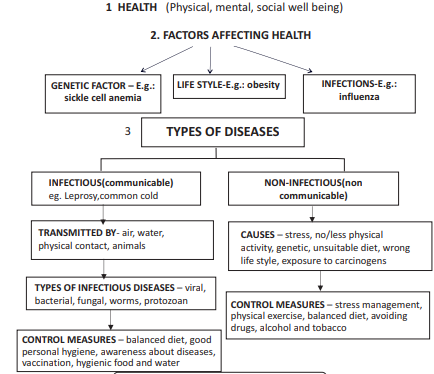
This Class 12 Biology flow chart on Chapter 8, Human Health and Diseases, summarises health and its factors, the types of diseases with their causes and control measures, the two types of acquired immunity, and the types of immune responses.
1. HEALTH
Health is a state of complete physical, mental and social well-being.
2. FACTORS AFFECTING HEALTH
1. Genetic factors, for example sickle cell anaemia.
2. Life style factors, for example obesity.
3. Infections, for example influenza.
3. TYPES OF DISEASES
Infectious (communicable) diseases
Examples: leprosy, common cold.
Transmitted by air, water, physical contact and animals.
Types of infectious diseases: viral, bacterial, fungal, worm (helminth) and protozoan diseases.
Control measures: balanced diet, good personal hygiene, awareness about diseases, vaccination, hygienic food and water.
Non-infectious (non-communicable) diseases
Causes: stress, no or less physical activity, genetic factors, unsuitable diet, wrong life style and exposure to carcinogens.
Control measures: stress management, physical exercise, balanced diet, avoiding drugs, alcohol and tobacco.
4. TYPES OF ACQUIRED IMMUNITY
Active immunity
The antibody is produced within one's own body when exposed to an antigen. It is long lasting, does not cause allergy, but takes time to activate. Example: exposure to chicken pox, measles, etc.
Passive immunity
Antibodies are transferred from another individual. It is not long lasting, sometimes causes allergy, but provides immediate relief. Examples: colostrum (IgA) given to a baby, and antitoxin given for snake bite. Vaccine given for tetanus.
5. TYPES OF IMMUNE RESPONSES
Humoral immunity
The response is produced by antibodies made by B lymphocytes, and is found in blood and lymph.
Antibody types: IgA, IgM, IgE and IgG.
An antibody has two small light chains and two longer heavy chains (H₂L₂).
Cell-mediated immunity
The response is produced by T lymphocytes. It plays a role in organ transplantation.
Important Questions for NCERT Class 12 Biology Human Health and Diseases
Ques. Which one of the following is not correctly matched?
(a) Glossina palpalis - Sleeping sickness
(b) Culex pipiens - Filariasis
(c) Aedes aegypti - Dengue fever
(d) Anopheles culicifacies - Leishmaniasis
Answer: D
Ques. Salmonella is related with
(a) typhoid (b) polio
(c) T.B. (d) tetanus.
Answer: A
Ques. Which is the most infectious disease?
(a) Hepatitis-B (b) AIDS
(c) Amoebiasis (d) Malaria
Answer: A
Ques. Which is showing accurate pairing?
(a) Syphilis - Treponema pallidum
(b) AIDS - Bacillus conjugalis
(c) Gonorrhoea - Leishmania donovani
(d) Typhoid - Mycobacterium leprae
Answer: A
Ques. Saline solution is given to patients of cholera because
(a) Na+ prevents water loss from body
(b) NaCl function as regulatory material
(c) NaCl produces energy
(d) NaCl is antibacterial.
Answer: A
Ques. Botulism caused by Clostridium botulinum affects the
(a) lymph gland
(b) central nervous system
(c) spleen
(d) intestine.
Answer: B
Ques. Typhoid fever is caused by
(a) Shigella (b) Escherichia
(c) Giardia (d) Salmonella.
Answer: D
Ques. Diphtheria is caused by
(a) nematodes (b) bacteria
(c) virus (d) none of these.
Answer: B
Ques. Which of the following diseases is now considered completely eradicated from India?
(a) Small pox (b) Poliomyelitis
(c) Plague (d) Kala-azar
Answer: A
Ques. Which of the following symptoms indicate red sickness?
(a) Nausea and loss of hair
(b) Ulcerated skin, nausea and loss of hair
(c) Red and ulcerated skin
(d) Nausea and anaemia
Answer: B
Ques. Which of the following pair of diseases is caused by virus?
(a) Rabies, mumps (b) Cholera, tuberculosis
(c) Typhoid, tetanus (d) AIDS, syphilis
Answer: A
Ques. Which one of the following pairs is not correctly matched?
(a) Syphilis – Trichuris trichiura
(b) Sleeping sickness – Trypanosoma gambiense
(c) Dengue fever – Arbovirus
(d) Plague – Yersinia pestis
Answer: A
Ques. Which of the following causes plague?
(a) Trichinella spiralis
(b) Salmonella typhimurium
(c) Yersinia pestis
(d) Leishmania donovani
Answer: C
Ques. Which one of the following does correctly match a sexually transmitted disease with its pathogen?
(a) Syphilis-Treponema pallidum
(b) Gonorrhoea-Entamoeba histolytica
(c) Urethritis-Bacillus anthracis
(d) Softsore-Bacillus brevis
Answer: A
Ques. Schizont stage of Plasmodium occurs in human
(a) erythrocytes (b) liver cells
(c) erythrocytes and liver cells
(d) erythrocytes, liver cells and spleen cells.
Answer: C
Ques. If all ponds and puddles are destroyed, the organism likely to be destroyed is
(a) Leishmania (b) Trypanosoma
(c) Ascaris (d) Plasmodium.
Answer: D
Ques. Give the correct matching of causative agent/germ and disease.
(a) Anopheles – Malaria
(b) Leishmania – Sleeping sickness
(c) Glossina – Kala-azar
(d) Wuchereria – Filariasis
Answer: D
Ques. The part of life cycle of malarial parasite Plasmodium vivax, that is passed in female Anopheles is
(a) sexual cycle
(b) pre-erythrocytic schizogony
(c) exoerythrocytic schizogony
(d) post-erythrocytic schizogony.
Answer: A
Ques. African sleeping sickness is due to
(a) Plasmodium vivax transmitted by tse-tse fly
(b) Trypanosoma lewsii transmitted by bed bug
(c) Trypanosoma gambiense transmitted by Glossina palpalis
(d) Entamoeba gingivalis spread by housefly.
Answer: C
Ques. Malignant tertian malarial parasite, belongs to class
(a) Plasmodium falciparum
(b) P. vivax
(c) P. ovale
(d) P. malariae.
Answer: A
Ques. Who discovered Plasmodium in RBC of human beings?
(a) Ronald Ross (b) Mendel
(c) Laveran (d) Stephens
Answer: C
Free study material for Biology
Useful Resources and Notes for Class 12 Biology Chapter 07 Human Health and Diseases
Quick Revision Material for Chapter 07 Human Health and Diseases
Review targeted study resources for Chapter 07 Human Health and Diseases tailored for Class 12 learners. Utilizing these structured notes and quick-revision tools ensures complete alignment with current CBSE evaluation standards.
Expert Notes and Solved Exam Questions
Each resource draws directly from authorized textbooks to maintain academic accuracy. Evaluating solved examples allows Class 12 students to master the formal presentation and answer-writing standards expected in upcoming school exams.
Additional Study Resources for Class 12
Maximize your grade potential by utilizing Class 12 Biology practice papers in tandem with these structured notes. All printable assignments and interactive mock tests on our platform are updated for the 2026 session and available free of charge.
FAQs
Our advanced study package for Chapter 07 Human Health and Diseases includes detailed concepts, diagrams, Mind Maps, and explanation of complex topics to ensure Class 12 students learn as per syllabus for 2026 exams.
The Mind Maps provided for Chapter 07 Human Health and Diseases act as visual anchors which will help faster recall during high-pressure exams.
Yes, teachers use our Class 12 Biology resources for lesson planning as they are in simple language and have lot of solved examples.
Yes, You can download the complete, mobile-friendly PDF of the Biology Chapter 07 Human Health and Diseases advanced resources for free.
Yes, our subject matter experts have updated the Chapter 07 Human Health and Diseases material to align with the rationalized NCERT textbooks and have removed deleted topics and added new competency-based questions.