

Chapter-wise Worksheets for Class 10 Mathematics: Chapter 06 Triangles
Explore structured practice materials through the CBSE Class 10 Mathematics Triangles Worksheet Set 08. Tailored for Class 10 learners, utilizing these Mathematics worksheets ensures thorough preparation and strengthens problem-solving accuracy before final school evaluations.
Practice Class 10 Mathematics Worksheets: Chapter 06 Triangles
Navigate directly to the solved Mathematics worksheets using the digital viewer below. Each practice set includes detailed step-by-step solutions, allowing students to instantly cross-check their work and identify areas requiring further revision.
Triangles

Key Points
Similar Figures: Two figures having similar shapes (size may or may not same), called Similar figures.
Examples: (a) & (b) & (c) &
A pair of Circles A pair of squares A pair of Equ. Triangles
- Pairs of all regular polygons, containing equal number of sides are examples of Similar Figures.
- Similar Triangles: Two Triangles are said to be similar if
(a) Their corresponding angles are equal ( also called Equiangular Triangles)
(b) Ratio of their corresponding sides are equal/proportional
- All congruent figures are similar but similar figures may /may not congruent
- Conditions for similarity of two Triangles
(a) AAA criterion/A-A corollary
(b) SAS similarity criterion
(c) SSS similarity criterion (where ‘S’ stands for ratio of corresponding sides of two Triangles)
Important Theorems of the topicTriangles
(a) Basic Proportionality Theorem (B.P.T.)/Thale’s Theorem
(b) Converse of B.P.T.
(c) Area related theorem of Similar Triangles
(d) Pythagoras Theorem
(e) Converse of Pythagoras Theorem
Level I
(1) In the figure XY ∕∕ QR , PQ/ XQ = 7/3 and PR =6.3cm then find YR
(2) If ΔABC ~ Δ DEF and their areas be 64cm2& 121cm2 respectively , then find BC if EF =15.4 cm
(3) ABC is an isosceles Δ ,right angled at C then prove that AB2 = 2AC2
(4) If ΔABC ~ Δ DEF, ∟A=460, ∟E= 620 then the measure of ∟C=720. Is it true? Give reason.
(5) The ratio of the corresponding sides of two similar triangles is 16:25 then find the ratio of their perimeters.
(6) A man goes 24 km in due east and then He goes 10 km in due north. How far is He from the starting Point?
(7) The length of the diagonals of a rhombus is 16cm & 12cm respectively then find the perimeter of the rhombus.
(8) In the figure LM ∕∕CB and LN ∕∕ CD then prove that AM/AB = AN /AD
(9) Which one is the sides of a right angled triangles among the following (a) 6cm,8cm & 11cm (b) 3cm,4cm & 6cm (c) 5cm , 12cm & 13cm
Level II
(1) In the figure ABD is a triangle right angled at A and AC is perpendicular to BD then show that AC2= BC x DC
(2) Two poles of height 10m & 15 m stand vertically on a plane ground. If the distance between their feet is 5√3m then find the distance between their tops.
(3) D & E are the points on the sides AB & AC of ΔABC, as shown in the figure. If ∟B = ∟AED then show that ΔABC ~ΔAED
(4) In the adjoining figure AB ∕∕ DC and diagonal AC & BD intersect at point O. If AO = (3x-1)cm , OB= (2x+1)cm, OC=(5x-3 )cm and OD=( 6x-5)cm then find the value of x.
(5) In the figure D &E trisect BC. Prove that 8AE2= 3AC2+ 5AD2
(6) In the figure OA/OC = OD /OB then prove that ∟A= ∟C
Question. Can cos θ = 5/4 be possible?
Answer: No
Question. If θ = 45°, find the value of sec² θ.
Answer: 2
Question. If θ is a positive acute angle such that sec θ = cosec60°, then find the value of 2 cos² θ-1.
Answer: 1/4
Question. Find the value of 9 sec² A – 9 tan²A.
Answer: -9
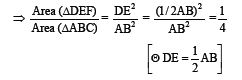
Question. If ar ΔABC = 1/4 ar ΔDEF Find AB/DE
Answer: 1/2
Question. Find the value of sin65° – cos25° without using tables.
Answer: 0
Question. In ΔABC, if 2AB2=AC2, Find ∠ B.
Answer: 90o
Question. If 2 sin X/2 – 1 = 0, find the value of x.
Answer: 900
Question. If sec 5A = cosec(A – 36°), find the value of A.
Answer: 210
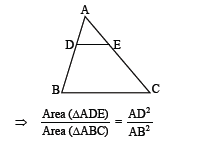
Question. ΔADE ˜ Δ ABC , if DE=4cm, BC=8cm and ar(ΔADE)=25sq cm. Find the area of ΔABC.
Answer: 100
Key Points
Similar Figures
Two geometric figures are called similar if they share the exact same shape, even though their sizes may differ. Some common examples include:
- Any pair of circles
- Any pair of squares
- Any pair of equilateral triangles
Additionally, any two regular polygons with the same number of sides are always similar to each other.
Similar Triangles
Two triangles are considered similar when they satisfy the following conditions:
- All corresponding angles are equal (such triangles are also known as equiangular triangles).
- The lengths of their corresponding sides are in the same ratio (proportional).
It is important to remember that all congruent shapes are similar, but similar shapes are not necessarily congruent.
Conditions for Triangle Similarity
- AAA Criterion / AA Corollary: If corresponding angles are equal, the triangles are similar.
- SAS Similarity Criterion: If two sides are proportional and the included angle is equal, the triangles are similar.
- SSS Similarity Criterion: If all corresponding sides are in the same ratio, the triangles are similar.
Important Theorems
- Basic Proportionality Theorem (B.P.T.) / Thales' Theorem
- Converse of Basic Proportionality Theorem
- Area Theorem of Similar Triangles
- Pythagoras Theorem
- Converse of Pythagoras Theorem
Level I
Question 1. In the figure XY // QR , PQ/ XQ = 7/3 and PR =6.3cm then find YR
Answer: According to the Basic Proportionality Theorem (B.P.T.), since the line \( XY \) is parallel to \( QR \), the ratio of the segments is equal:
\( \frac{PQ}{XQ} = \frac{PR}{YR} \)
Substitute the given values into the ratio:
\( \frac{7}{3} = \frac{6.3}{YR} \)
\( \implies YR = \frac{3 \times 6.3}{7} \)
\( \implies YR = 3 \times 0.9 = 2.7\text{ cm} \)
In simple words: Since the lines are parallel, we can set up equal ratios for the sides of the triangle. Solving the proportion gives us YR as 2.7 cm.
Exam Tip: State the name of the theorem (Basic Proportionality Theorem or B.P.T.) explicitly in your solution before setting up the ratio of the sides.
Question 2. If ∆ABC ~ ∆ DEF and their areas be 64cm2& 121cm2 respectively , then find BC if EF =15.4 cm
Answer: For any two similar triangles, the ratio of their areas is equal to the ratio of the squares of their corresponding sides:
\( \frac{\text{ar}(\Delta ABC)}{\text{ar}(\Delta DEF)} = \frac{BC^2}{EF^2} \)
Substitute the given values into the formula:
\( \frac{64}{121} = \frac{BC^2}{(15.4)^2} \)
Taking the square root on both sides:
\( \frac{8}{11} = \frac{BC}{15.4} \)
\( \implies BC = \frac{8 \times 15.4}{11} \)
\( \implies BC = 8 \times 1.4 = 11.2\text{ cm} \)
In simple words: The ratio of the areas of similar triangles equals the square of the ratio of their sides. Taking the square root of both sides makes the calculation simple and gives BC as 11.2 cm.
Exam Tip: Taking the square root of both sides first is much simpler and faster than squaring 15.4 and then solving.
Question 3. ABC is an isosceles ∆ ,right angled at C then prove that AB2 = 2AC2
Answer: In the right-angled triangle \( ABC \), using Pythagoras' theorem with the right angle at vertex \( C \):
\( AB^2 = AC^2 + BC^2 \)
Since \( ABC \) is an isosceles triangle, the two perpendicular sides must be of equal length:
\( AC = BC \)
Substitute \( BC = AC \) into the Pythagoras equation:
\( AB^2 = AC^2 + AC^2 \)
\( \implies AB^2 = 2AC^2 \)
In simple words: Since the triangle has a right angle and two equal sides, Pythagoras' theorem lets us replace one side with the other, giving the required equation.
Exam Tip: Clearly state which angle is \( 90^\circ \) so that the hypotenuse is correctly identified as the side opposite to it.
Question 4. If ∆ABC ~ ∆ DEF, ∟A=460, ∟E= 620 then the measure of ∟C=720. Is it true? Give reason.
Answer: Yes, the statement is true.
Since \( \Delta ABC \sim \Delta DEF \), their corresponding angles must be equal:
\( \angle A = \angle D = 46^\circ \)
\( \angle B = \angle E = 62^\circ \)
Using the angle sum property in \( \Delta ABC \):
\( \angle A + \angle B + \angle C = 180^\circ \)
\( \implies 46^\circ + 62^\circ + \angle C = 180^\circ \)
\( \implies 108^\circ + \angle C = 180^\circ \)
\( \implies \angle C = 180^\circ - 108^\circ = 72^\circ \)
Therefore, the measure of \( \angle C \) is indeed \( 72^\circ \).
In simple words: Similar triangles have the exact same angles. Since angle A is 46 degrees and angle B is 62 degrees, we subtract their sum from 180 degrees to get 72 degrees for angle C.
Exam Tip: Mention the angle sum property of a triangle explicitly when calculating the third angle.
Question 5. The ratio of the corresponding sides of two similar triangles is 16:25 then find the ratio of their perimeters.
Answer: Let \( \Delta ABC \sim \Delta DEF \). For similar triangles, the ratio of their perimeters is equal to the ratio of their corresponding sides:
\( \frac{\text{Perimeter of } \Delta ABC}{\text{Perimeter of } \Delta DEF} = \frac{AB}{DE} = \frac{BC}{EF} = \frac{AC}{DF} \)
Given that the ratio of the corresponding sides is \( 16:25 \):
\( \frac{\text{Perimeter of } \Delta ABC}{\text{Perimeter of } \Delta DEF} = \frac{16}{25} \)
Therefore, the ratio of their perimeters is \( 16:25 \).
In simple words: The perimeter of a shape changes in the exact same ratio as its side lengths, so the ratio of the perimeters remains 16:25.
Exam Tip: Do not confuse the perimeter ratio (which is equal to the side ratio) with the area ratio (which is equal to the square of the side ratio).
Question 6. A man goes 24 km in due east and then He goes 10 km in due north. How far is He from the starting Point?
Answer: The movement of the man forms a right-angled triangle where the legs are 24 km and 10 km, and the distance from the starting point represents the hypotenuse.
Using Pythagoras' theorem:
\( \text{Distance} = \sqrt{24^2 + 10^2} \)
\( \implies \text{Distance} = \sqrt{576 + 100} \)
\( \implies \text{Distance} = \sqrt{676} = 26\text{ km} \)
Therefore, the man is 26 km away from his starting point.
In simple words: Walking east and then north forms a right angle. We can use Pythagoras' theorem to calculate the straight-line distance, which is 26 km.
Exam Tip: Draw a small directional diagram (East-West, North-South) to show how the right angle is formed.
Question 7. The length of the diagonals of a rhombus is 16cm & 12cm respectively then find the perimeter of the rhombus.
Answer: The diagonals of a rhombus bisect each other at right angles.
If the diagonals are \( d_1 = 16\text{ cm} \) and \( d_2 = 12\text{ cm} \), the halves of the diagonals are:
\( \frac{16}{2} = 8\text{ cm} \) and \( \frac{12}{2} = 6\text{ cm} \)
These half-diagonals form the legs of a right-angled triangle, where the hypotenuse is the side of the rhombus \( s \).
Using Pythagoras' theorem:
\( s = \sqrt{8^2 + 6^2} \)
\( \implies s = \sqrt{64 + 36} \)
\( \implies s = \sqrt{100} = 10\text{ cm} \)
Since all four sides of a rhombus are equal:
\( \text{Perimeter} = 4 \times s = 4 \times 10 = 40\text{ cm} \)
In simple words: The diagonals of a rhombus cross at right angles, dividing each other in half to make legs of 6 cm and 8 cm. Using Pythagoras' theorem, the side of the rhombus is 10 cm, so the perimeter is 40 cm.
Exam Tip: Remember to state the property that diagonals of a rhombus bisect each other at right angles, as this justifies the use of Pythagoras' theorem.
Question 8. In the figure LM ∕∕CB and LN ∕∕ CD then prove that AM/AB = AN /AD
Answer: In \( \Delta ABC \), since \( LM \parallel BC \), we apply the Basic Proportionality Theorem (B.P.T.):
\( \frac{AM}{AB} = \frac{AL}{AC} \) - (Equation 1)
Similarly, in \( \Delta ACD \), since \( LN \parallel CD \), we apply the Basic Proportionality Theorem (B.P.T.):
\( \frac{AN}{AD} = \frac{AL}{AC} \) - (Equation 2)
Comparing Equation 1 and Equation 2, we get:
\( \frac{AM}{AB} = \frac{AN}{AD} \)
Hence, proven.
In simple words: The parallel lines split the sides of the top and bottom triangles in the exact same ratio compared to the shared diagonal, which makes the two side ratios equal to each other.
Exam Tip: Clearly number your equations so you can easily reference them when comparing the common ratio.
Question 9. Which one is the sides of a right angled triangles among the following (a) 6cm,8cm & 11cm (b) 3cm,4cm & 6cm (c) 5cm , 12cm & 13cm
Answer: To find which set of side lengths belongs to a right-angled triangle, we use the converse of Pythagoras' theorem. The sum of the squares of the two smaller sides must equal the square of the longest side (\( p^2 + b^2 = h^2 \)).
(a) For \( 6\text{ cm}, 8\text{ cm}, 11\text{ cm} \):
\( 6^2 + 8^2 = 36 + 64 = 100 \)
\( 11^2 = 121 \)
Since \( 100 \neq 121 \), this is not a right-angled triangle.
(b) For \( 3\text{ cm}, 4\text{ cm}, 6\text{ cm} \):
\( 3^2 + 4^2 = 9 + 16 = 25 \)
\( 6^2 = 36 \)
Since \( 25 \neq 36 \), this is not a right-angled triangle.
(c) For \( 5\text{ cm}, 12\text{ cm}, 13\text{ cm} \):
\( 5^2 + 12^2 = 25 + 144 = 169 \)
\( 13^2 = 169 \)
Since \( 169 = 169 \), this forms a right-angled triangle.
Therefore, options (c) are the sides of a right-angled triangle.
In simple words: We square each number. Only for group (c) does the sum of the two smaller squares (25 + 144) equal the largest square (169).
Exam Tip: The hypotenuse is always the longest side, so always compare the square of the largest number with the sum of the squares of the other two numbers.
Level II
Question 1. In the figure ABD is a triangle right angled at A and AC is perpendicular to BD then show that AC2= BC x DC
Answer: Let \( \angle BAC = \angle 1 \) and \( \angle CAD = \angle 2 \). Since \( \angle BAD = 90^\circ \):
\( \angle 1 + \angle 2 = 90^\circ \) - (Equation 1)
In right-angled \( \Delta ACD \), \( \angle ACD = 90^\circ \), so:
\( \angle 2 + \angle D = 90^\circ \) - (Equation 2)
From Equation 1 and Equation 2, we have:
\( \angle 1 + \angle 2 = \angle 2 + \angle D \implies \angle 1 = \angle D \)
Now, compare \( \Delta ACD \) and \( \Delta BCA \):
\( \angle ACD = \angle BCA = 90^\circ \)
\( \angle ADC = \angle BAC \) (since \( \angle D = \angle 1 \))
By AA similarity criterion:
\( \Delta ACD \sim \Delta BCA \)
Since corresponding sides of similar triangles are in proportion:
\( \frac{AC}{BC} = \frac{DC}{AC} \)
\( \implies AC^2 = BC \times DC \)
Hence, proven.
In simple words: Since the altitude splits the large right triangle into two smaller triangles with the same angles, these two smaller triangles are similar. Setting up their side ratios yields the required squared equation.
Exam Tip: Be careful with the ordering of vertices when stating similarity (\( \Delta ACD \sim \Delta BCA \)) to ensure corresponding sides are correctly matched.
Question 2. Two poles of height 10m & 15 m stand vertically on a plane ground. If the distance between their feet is 5√3m then find the distance between their tops.
Answer: Let the heights of the two vertical poles be \( AB = 15\text{ m} \) and \( CD = 10\text{ m} \). The distance between their feet is \( BD = 5\sqrt{3}\text{ m} \).
Draw a line \( CE \) from the top of the shorter pole parallel to the ground, meeting the taller pole at \( E \).
This forms a rectangle \( BDEC \), so:
\( BE = CD = 10\text{ m} \)
\( CE = BD = 5\sqrt{3}\text{ m} \)
The remaining segment of the taller pole is:
\( AE = AB - BE = 15 - 10 = 5\text{ m} \)
Now, in right-angled \( \Delta AEC \), using Pythagoras' theorem:
\( AC^2 = AE^2 + CE^2 \)
\( \implies AC^2 = 5^2 + (5\sqrt{3})^2 \)
\( \implies AC^2 = 25 + 75 = 100 \)
\( \implies AC = \sqrt{100} = 10\text{ m} \)
Therefore, the distance between the tops of the poles is 10 m.
In simple words: Drawing a horizontal line from the top of the short pole to the tall pole creates a right-angled triangle. Its height is 5 m and its base is \( 5\sqrt{3} \) m, giving a hypotenuse of 10 m.
Exam Tip: Mentioning the construction of the horizontal parallel line to form a right triangle is necessary for a complete geometric proof.
Question 3. D & E are the points on the sides AB & AC of ∆ABC, as shown in the figure. If ∟B = ∟AED then show that ∆ABC ~∆AED
Answer: In \( \Delta AED \) and \( \Delta ABC \):
\( \angle AED = \angle ABC \) (given)
\( \angle A = \angle A \) (common angle)
By AA similarity criterion:
\( \Delta ABC \sim \Delta AED \)
Hence, proven.
In simple words: Since both triangles share the top angle A, and we are told that angle B is equal to angle AED, the two triangles have matching angles and are therefore similar.
Exam Tip: The order of the vertices is very important when writing similarity. Since \( \angle B = \angle AED \), \( B \) corresponds to \( E \), and \( C \) corresponds to \( D \), leading to \( \Delta ABC \sim \Delta AED \).
Question 4. In the adjoining figure AB ∕∕ DC and diagonal AC & BD intersect at point O. If AO = (3x-1)cm , OB= (2x+1)cm, OC=(5x-3 )cm and OD=( 6x-5)cm then find the value of x.
Answer: The diagonals of a trapezium with parallel sides \( AB \parallel CD \) divide each other proportionally at their intersection point \( O \):
\( \frac{AO}{OC} = \frac{BO}{OD} \)
Substitute the given algebraic expressions:
\( \frac{3x - 1}{5x - 3} = \frac{2x + 1}{6x - 5} \)
Cross-multiply to solve for \( x \):
\( (3x - 1)(6x - 5) = (2x + 1)(5x - 3) \)
\( \implies 18x^2 - 15x - 6x + 5 = 10x^2 - 6x + 5x - 3 \)
\( \implies 18x^2 - 21x + 5 = 10x^2 - x - 3 \)
Rearranging into a quadratic equation:
\( 8x^2 - 20x + 8 = 0 \)
Divide by 4:
\( 2x^2 - 5x + 2 = 0 \)
Factorize the quadratic equation:
\( 2x^2 - 4x - x + 2 = 0 \)
\( \implies 2x(x - 2) - 1(x - 2) = 0 \)
\( \implies (2x - 1)(x - 2) = 0 \)
This gives two possible values:
\( x = 2 \) or \( x = \frac{1}{2} \)
If \( x = \frac{1}{2} \), the segment \( OC = 5(\frac{1}{2}) - 3 = -0.5\text{ cm} \), which is impossible because length cannot be negative.
Therefore, the only valid value is \( x = 2 \).
In simple words: The diagonals of a trapezium split each other in equal ratios. Writing this as a fraction and cross-multiplying gives a quadratic equation with solutions 2 and 0.5. We ignore 0.5 because it makes a length negative.
Exam Tip: Always check both algebraic solutions against the original length expressions to discard any value that results in a negative length.
Question 5. In the figure D &E trisect BC. Prove that 8AE2= 3AC2+ 5AD2
Answer: Let \( BD = DE = EC = p \). Then:
\( BE = 2p \)
\( BC = 3p \)
Now, apply Pythagoras' theorem to the right-angled triangles with vertex \( B \):
In \( \Delta ABD \):
\( AD^2 = AB^2 + BD^2 \)
\( \implies AD^2 = AB^2 + p^2 \) - (Equation 1)
In \( \Delta ABE \):
\( AE^2 = AB^2 + BE^2 \)
\( \implies AE^2 = AB^2 + (2p)^2 = AB^2 + 4p^2 \) - (Equation 2)
In \( \Delta ABC \):
\( AC^2 = AB^2 + BC^2 \)
\( \implies AC^2 = AB^2 + (3p)^2 = AB^2 + 9p^2 \) - (Equation 3)
Now, evaluate the right-hand side (RHS) of the required proof using Equation 1 and Equation 3:
\( \text{RHS} = 3AC^2 + 5AD^2 \)
\( \implies \text{RHS} = 3(AB^2 + 9p^2) + 5(AB^2 + p^2) \)
\( \implies \text{RHS} = 3AB^2 + 27p^2 + 5AB^2 + 5p^2 \)
\( \implies \text{RHS} = 8AB^2 + 32p^2 \)
Factor out 8:
\( \implies \text{RHS} = 8(AB^2 + 4p^2) \)
Using Equation 2:
\( \implies \text{RHS} = 8AE^2 = \text{LHS} \)
Hence, proven.
In simple words: By writing the segments as single units of length, we apply Pythagoras' theorem to three nested triangles. Expanding and simplifying the right-hand side of the proof shows it perfectly matches the left-hand side.
Exam Tip: Setting a variable like \( p \) for the equal trisected segments simplifies the algebra significantly and prevents computational errors.
Question 6. In the figure OA/OC = OD /OB then prove that ∟A= ∟C
Answer: We are given:
\( \frac{OA}{OC} = \frac{OD}{OB} \)
Rearranging this ratio:
\( \frac{OA}{OD} = \frac{OC}{OB} \)
Now, consider \( \Delta AOD \) and \( \Delta COB \):
\( \frac{OA}{OD} = \frac{OC}{OB} \) (as rearranged)
\( \angle AOD = \angle COB \) (vertically opposite angles)
By SAS similarity criterion:
\( \Delta AOD \sim \Delta COB \)
Since corresponding angles of similar triangles are equal:
\( \angle A = \angle C \)
Hence, proven.
In simple words: Rearranging the side ratios and noting that the middle angles are vertically opposite proves the two triangles are similar, which means their corresponding angles are equal.
Exam Tip: Don't forget to mention "vertically opposite angles" as the geometric justification for the angle equality.
Question 7. Using converse of B.P.T. prove that the line joining the mid points of any two sides of a triangle is parallel to the third side of the triangle.
Answer: Let \( D \) and \( E \) be the midpoints of sides \( AB \) and \( AC \) of \( \Delta ABC \) respectively.
Since \( D \) is the midpoint of \( AB \):
\( AD = DB \implies \frac{AD}{DB} = 1 \) - (Equation 1)
Since \( E \) is the midpoint of \( AC \):
\( AE = EC \implies \frac{AE}{EC} = 1 \) - (Equation 2)
From Equation 1 and Equation 2, we have:
\( \frac{AD}{DB} = \frac{AE}{EC} \)
By the converse of the Basic Proportionality Theorem (B.P.T.), since the line \( DE \) divides the two sides in the same ratio, \( DE \) must be parallel to the third side \( BC \):
\( DE \parallel BC \)
Hence, proven.
In simple words: Since D and E are exactly in the middle of their sides, both split their sides into a 1-to-1 ratio. Since these ratios are equal, the line connecting them is parallel to the base.
Exam Tip: The converse of B.P.T. states that if a line divides two sides of a triangle proportionally, it is parallel to the third side - make sure to state this definition.
Question 8. In the given figure ∆ABC &∆ DBC are on the same base BC . if AD intersect BC at O then prove that ar(∆ABC)/ar(∆ DBC) = AO/DO
Answer: Draw perpendiculars \( AM \perp BC \) and \( DN \perp BC \).
Now, compare \( \Delta AOM \) and \( \Delta DON \):
\( \angle AMO = \angle DNO = 90^\circ \) (by construction)
\( \angle AOM = \angle DON \) (vertically opposite angles)
By AA similarity criterion:
\( \Delta AOM \sim \Delta DON \)
Consequently, the ratios of their corresponding sides are equal:
\( \frac{AM}{DN} = \frac{AO}{DO} \) - (Equation 1)
Now, find the ratio of the areas of \( \Delta ABC \) and \( \Delta DBC \):
\( \text{ar}(\Delta ABC) = \frac{1}{2} \times BC \times AM \)
\( \text{ar}(\Delta DBC) = \frac{1}{2} \times BC \times DN \)
Taking their ratio:
\( \frac{\text{ar}(\Delta ABC)}{\text{ar}(\Delta DBC)} = \frac{\frac{1}{2} \times BC \times AM}{\frac{1}{2} \times BC \times DN} = \frac{AM}{DN} \)
Substitute Equation 1 into this ratio:
\( \frac{\text{ar}(\Delta ABC)}{\text{ar}(\Delta DBC)} = \frac{AO}{DO} \)
Hence, proven.
In simple words: Drawing perpendicular heights to the shared base BC creates two similar right-angled triangles. The ratio of their heights equals the ratio of their diagonal segments, which matches the ratio of the areas.
Exam Tip: Clearly explain the construction of the perpendiculars \( AM \) and \( DN \) as it forms the basis of the proof.
Level III
Question 1. A point O is in the interior of a rectangle ABCD, is joined with each of the vertices A, B, C & D. Prove that OA2 +OC2 = OB2+OD2
Answer: Draw a line \( PQ \parallel BC \) passing through the point \( O \), where \( P \) lies on \( AB \) and \( Q \) lies on \( CD \).
Since \( ABCD \) is a rectangle, \( PQ \) is also perpendicular to \( AB \) and \( CD \). This creates rectangles \( APQD \) and \( BPQC \), which means:
\( AP = DQ \) and \( BP = CQ \)
Now, apply Pythagoras' theorem in the four right-angled triangles formed with vertex \( O \):
In \( \Delta OPB \): \( OB^2 = BP^2 + OP^2 \) - (Equation 1)
In \( \Delta OQD \): \( OD^2 = OQ^2 + DQ^2 \) - (Equation 2)
In \( \Delta OQC \): \( OC^2 = OQ^2 + CQ^2 \) - (Equation 3)
In \( \Delta OAP \): \( OA^2 = AP^2 + OP^2 \) - (Equation 4)
Add Equation 1 and Equation 2:
\( OB^2 + OD^2 = BP^2 + OP^2 + OQ^2 + DQ^2 \)
Substitute \( BP = CQ \) and \( DQ = AP \) into the equation:
\( OB^2 + OD^2 = CQ^2 + OP^2 + OQ^2 + AP^2 \)
Rearranging the terms:
\( OB^2 + OD^2 = (AP^2 + OP^2) + (OQ^2 + CQ^2) \)
Using Equation 3 and Equation 4:
\( OB^2 + OD^2 = OA^2 + OC^2 \)
Hence, proven.
In simple words: Drawing a parallel line through point O divides the rectangle into smaller right-angled triangles. Applying Pythagoras' theorem and substituting equal opposite sides proves the sum of squares is equal.
Exam Tip: Define the constructed line \( PQ \) clearly as being parallel to \( BC \) to justify using Pythagoras' theorem.
Question 2. In an equilateral triangle ABC, D is a point on the base BC such that BD= 1/3 BC ,then show that 9AD2= 7AB2
Answer: Let the side of the equilateral triangle \( ABC \) be \( a \), so \( AB = BC = AC = a \).
Given \( BD = \frac{1}{3}BC = \frac{a}{3} \).
Draw altitude \( AE \perp BC \). In an equilateral triangle, the altitude bisects the base:
\( BE = EC = \frac{a}{2} \)
The segment \( DE \) is:
\( DE = BE - BD = \frac{a}{2} - \frac{a}{3} = \frac{a}{6} \)
In right-angled \( \Delta ADE \), using Pythagoras' theorem:
\( AD^2 = AE^2 + DE^2 \) - (Equation 1)
In right-angled \( \Delta ABE \), we also have:
\( AE^2 = AB^2 - BE^2 \)
Substitute this into Equation 1:
\( AD^2 = AB^2 - BE^2 + DE^2 \)
Substitute the values of the segments in terms of \( a \):
\( AD^2 = a^2 - \left(\frac{a}{2}\right)^2 + \left(\frac{a}{6}\right)^2 \)
\( AD^2 = a^2 - \frac{a^2}{4} + \frac{a^2}{36} \)
Find a common denominator of 36:
\( AD^2 = \frac{36a^2 - 9a^2 + a^2}{36} \)
\( AD^2 = \frac{28a^2}{36} \)
Simplify the fraction:
\( AD^2 = \frac{7}{9}a^2 \)
Since \( a = AB \):
\( AD^2 = \frac{7}{9}AB^2 \)
\( \implies 9AD^2 = 7AB^2 \)
Hence, proven.
In simple words: Drawing the height bisects the base. By expressing all line segments in terms of the triangle's side length \( a \), we apply Pythagoras' theorem to find \( AD^2 \), which simplifies directly to \( \frac{7}{9}AB^2 \).
Exam Tip: Expressing all segments in terms of a single variable \( a \) is much cleaner and less prone to mistakes than keeping fractional notations of different sides.
Question 3. Prove that in a rhombus, sum of squares of the sides is equal to the sum of the squares of its diagonals
Answer: Let \( ABCD \) be a rhombus whose diagonals \( AC \) and \( BD \) intersect at right angles at point \( O \).
Since the diagonals bisect each other:
\( OA = \frac{AC}{2} \) and \( OB = \frac{BD}{2} \)
In right-angled \( \Delta AOB \), using Pythagoras' theorem:
\( AB^2 = OA^2 + OB^2 \)
Substitute the diagonal halves:
\( AB^2 = \left(\frac{AC}{2}\right)^2 + \left(\frac{BD}{2}\right)^2 \)
\( AB^2 = \frac{AC^2}{4} + \frac{BD^2}{4} \)
\( \implies 4AB^2 = AC^2 + BD^2 \) - (Equation 1)
Since all sides of a rhombus are equal in length (\( AB = BC = CD = DA \)):
\( AB^2 + BC^2 + CD^2 + DA^2 = 4AB^2 \)
Substitute this into Equation 1:
\( AB^2 + BC^2 + CD^2 + DA^2 = AC^2 + BD^2 \)
Hence, proven.
In simple words: The diagonals of a rhombus meet at \( 90^\circ \) and split each other in half. Applying Pythagoras' theorem to one of the triangles and using the fact that all four sides are equal gives the formula directly.
Exam Tip: Mention the key properties of rhombus diagonals (bisecting each other and intersecting at \( 90^\circ \)) to justify the Pythagoras step.
Question 4. In the adjoining figure ABCD is a parallelogram. Through the midpoint M of the side CD, a line is drawn which cuts diagonal AC at L and AD produced at E. Prove that EL =2BL
Answer: Compare \( \Delta BCM \) and \( \Delta EDM \):
\( \angle DEM = \angle CBM \) (alternate interior angles since \( AE \parallel BC \))
\( \angle DME = \angle CMB \) (vertically opposite angles)
\( DM = MC \) (since \( M \) is the midpoint of \( CD \))
By ASA congruence criterion:
\( \Delta BCM \cong \Delta EDM \)
Therefore, by CPCT:
\( DE = BC \)
We also know that opposite sides of a parallelogram are equal:
\( AD = BC \)
Adding these two equations:
\( AE = AD + DE = BC + BC = 2BC \)
Now, compare \( \Delta AEL \) and \( \Delta CBL \):
\( \angle ALE = \angle CLB \) (vertically opposite angles)
\( \angle EAL = \angle BCL \) (alternate interior angles since \( AE \parallel BC \))
By AA similarity criterion:
\( \Delta AEL \sim \Delta CBL \)
This gives the ratio of corresponding sides:
\( \frac{EL}{BL} = \frac{AE}{BC} \)
Substitute \( AE = 2BC \):
\( \frac{EL}{BL} = \frac{2BC}{BC} = 2 \)
\( \implies EL = 2BL \)
Hence, proven.
In simple words: The two small triangles on the side are congruent, meaning AD and DE are both equal to BC, so the whole top side AE is twice as long as BC. Using similarity of the diagonal triangles proves EL is twice as long as BL.
Exam Tip: First prove congruence to establish that \( AE = 2BC \), then use similarity to complete the proof.
Question 5. ABC & DBC are two triangles on the same base BC and on the same side of BC with ∟A = ∟D =900. If CA & BD meet each other at E then show that AE x EC = BE x ED
Answer: Compare \( \Delta AEB \) and \( \Delta DEC \):
\( \angle A = \angle D = 90^\circ \) (given)
\( \angle AEB = \angle DEC \) (vertically opposite angles)
By AA similarity criterion:
\( \Delta AEB \sim \Delta DEC \)
Since corresponding sides of similar triangles are in proportion:
\( \frac{AE}{DE} = \frac{BE}{EC} \)
Cross-multiplying gives:
\( AE \times EC = BE \times ED \)
Hence, proven.
In simple words: The two opposite vertical triangles are similar because they share vertically opposite angles and both have a right angle. Setting up their side ratios and cross-multiplying proves the equation.
Exam Tip: AA similarity is the most common tool for proving product relations of segments; always look for vertically opposite angles and right angles first.
Question 6. ABC is a Triangle, right angle at C and p is the length of the perpendicular drawn from C to AB. By expressing the area of the triangle in two ways show that (i) pc =ab (ii) 1 /p2 = 1/a2 +1/b2
Answer: Let \( BC = a \), \( AC = b \), and \( AB = c \) in right-angled \( \Delta ABC \). The perpendicular from \( C \) to \( AB \) is \( CD = p \).
(i) Show that \( pc = ab \):
We can calculate the area of \( \Delta ABC \) in two different ways:
First, taking \( BC \) as base and \( AC \) as height:
\( \text{Area} = \frac{1}{2} \times a \times b \) - (Equation 1)
Second, taking \( AB \) as base and \( CD \) as height:
\( \text{Area} = \frac{1}{2} \times c \times p \) - (Equation 2)
Equating Equation 1 and Equation 2:
\( \frac{1}{2} a b = \frac{1}{2} c p \)
\( \implies pc = ab \)
Hence, proven.
(ii) Show that \( \frac{1}{p^2} = \frac{1}{a^2} + \frac{1}{b^2} \):
Using Pythagoras' theorem in right-angled \( \Delta ABC \):
\( c^2 = a^2 + b^2 \) - (Equation 3)
From part (i), we have:
\( c = \frac{ab}{p} \)
Substitute this into Equation 3:
\( \left(\frac{ab}{p}\right)^2 = a^2 + b^2 \)
\( \implies \frac{a^2 b^2}{p^2} = a^2 + b^2 \)
Divide both sides by \( a^2 b^2 \):
\( \frac{1}{p^2} = \frac{a^2 + b^2}{a^2 b^2} \)
\( \implies \frac{1}{p^2} = \frac{1}{a^2} + \frac{1}{b^2} \)
Hence, proven.
In simple words: First, expressing the area with two different base-height combinations proves that \( pc = ab \). Second, using Pythagoras' theorem and substituting \( c = \frac{ab}{p} \) allows us to simplify and get the reciprocal square relationship.
Exam Tip: This is a classic board exam question. Make sure to clearly state that the area of a triangle is unique, justifying why we can equate the two area expressions.
Question 7. Prove that the ratio of the areas of two similar triangles is equal to the ratio of their corresponding sides.
Answer: Let \( \Delta ABC \sim \Delta PQR \). We need to prove that:
\( \frac{\text{ar}(\Delta ABC)}{\text{ar}(\Delta PQR)} = \left(\frac{AB}{PQ}\right)^2 = \left(\frac{BC}{QR}\right)^2 = \left(\frac{AC}{PR}\right)^2 \)
Draw altitudes \( AM \perp BC \) and \( PN \perp QR \).
Now, find the ratio of their areas:
\( \text{ar}(\Delta ABC) = \frac{1}{2} \times BC \times AM \)
\( \text{ar}(\Delta PQR) = \frac{1}{2} \times QR \times PN \)
\( \implies \frac{\text{ar}(\Delta ABC)}{\text{ar}(\Delta PQR)} = \frac{BC \times AM}{QR \times PN} = \left(\frac{BC}{QR}\right) \times \left(\frac{AM}{PN}\right) \) - (Equation 1)
Compare \( \Delta ABM \) and \( \Delta PQN \):
\( \angle B = \angle Q \) (since \( \Delta ABC \sim \Delta PQR \))
\( \angle AMB = \angle PNQ = 90^\circ \) (by construction)
By AA similarity criterion:
\( \Delta ABM \sim \Delta PQN \)
Therefore:
\( \frac{AM}{PN} = \frac{AB}{PQ} \) - (Equation 2)
Since \( \Delta ABC \sim \Delta PQR \):
\( \frac{AB}{PQ} = \frac{BC}{QR} = \frac{AC}{PR} \) - (Equation 3)
From Equation 2 and Equation 3:
\( \frac{AM}{PN} = \frac{BC}{QR} \)
Substitute this into Equation 1:
\( \frac{\text{ar}(\Delta ABC)}{\text{ar}(\Delta PQR)} = \left(\frac{BC}{QR}\right) \times \left(\frac{BC}{QR}\right) = \left(\frac{BC}{QR}\right)^2 \)
Using the equality of ratios:
\( \frac{\text{ar}(\Delta ABC)}{\text{ar}(\Delta PQR)} = \left(\frac{AB}{PQ}\right)^2 = \left(\frac{BC}{QR}\right)^2 = \left(\frac{AC}{PR}\right)^2 \)
Hence, proven.
In simple words: The ratio of the areas of similar triangles is the product of their base ratio and height ratio. Since the triangles are similar, the height ratio equals the base ratio, making the area ratio equal to the square of the side ratio.
Exam Tip: Draw the two triangles \( \Delta ABC \) and \( \Delta PQR \) with their respective altitudes to make the proof easy to follow.
Question 8. In the figure AB|| DE and BD|| EF. Prove that DC2= CF x AC
Answer: In \( \Delta ABC \), since \( DE \parallel AB \), we apply the Basic Proportionality Theorem (B.P.T.):
\( \frac{AC}{DC} = \frac{BC}{EC} \) - (Equation 1)
In \( \Delta DBC \), since \( EF \parallel BD \), we apply the Basic Proportionality Theorem (B.P.T.):
\( \frac{DC}{CF} = \frac{BC}{EC} \) - (Equation 2)
Comparing Equation 1 and Equation 2, both are equal to the common ratio \( \frac{BC}{EC} \):
\( \frac{AC}{DC} = \frac{DC}{CF} \)
Cross-multiplying:
\( DC^2 = CF \times AC \)
Hence, proven.
In simple words: Applying the Basic Proportionality Theorem to the two nested triangles shows that both side ratios are equal to the same shared segment ratio, which directly yields the squared formula.
Exam Tip: Clearly state the parallel lines in each step to justify using the Basic Proportionality Theorem.
Self-Evaluation Questions
Question 1. Find the value of x for which DE ||BC in the adjoining figure
Answer: Since \( DE \parallel BC \), by the Basic Proportionality Theorem (B.P.T.):
\( \frac{AD}{DB} = \frac{AE}{EC} \)
Substitute the given algebraic expressions:
\( \frac{x}{3x + 1} = \frac{x + 3}{3x + 11} \)
Cross-multiplying:
\( x(3x + 11) = (x + 3)(3x + 1) \)
\( \implies 3x^2 + 11x = 3x^2 + x + 9x + 3 \)
\( \implies 3x^2 + 11x = 3x^2 + 10x + 3 \)
Subtract \( 3x^2 \) from both sides:
\( 11x = 10x + 3 \)
\( \implies x = 3 \)
In simple words: Set up a proportion using the sides of the triangle divided by the parallel line. Cross-multiplying cancels the \( x^2 \) terms, leaving a simple equation that solves to \( x = 3 \).
Exam Tip: Ensure that you write out the algebraic steps carefully so you don't make sign errors when cross-multiplying.
Question 2. In an equilateral triangle prove that three times the square of one side is equal to four times the square of one of its altitude.
Answer: Let \( ABC \) be an equilateral triangle with side length \( a \), so \( AB = BC = AC = a \). Let \( AD \) be the altitude drawn from \( A \) to \( BC \).
In an equilateral triangle, the altitude is also the median, so:
\( BD = \frac{BC}{2} = \frac{a}{2} \)
Using Pythagoras' theorem in right-angled \( \Delta ABD \):
\( AB^2 = AD^2 + BD^2 \)
\( \implies a^2 = AD^2 + \left(\frac{a}{2}\right)^2 \)
\( \implies a^2 = AD^2 + \frac{a^2}{4} \)
Multiply the entire equation by 4 to clear the fraction:
\( 4a^2 = 4AD^2 + a^2 \)
\( \implies 4a^2 - a^2 = 4AD^2 \)
\( \implies 3a^2 = 4AD^2 \)
Since \( a \) is the side length \( AB \):
\( 3AB^2 = 4AD^2 \)
Hence, proven.
In simple words: The height splits the base of the equilateral triangle in half. Applying Pythagoras' theorem and multiplying by 4 shows that three times the square of the side equals four times the square of the height.
Exam Tip: Mention that the altitude in an equilateral triangle bisects the base, which justifies writing \( BD = \frac{BC}{2} \).
Question 3. The perpendicular from A on the side BC of a triangle ABC intersect BC at D such that DB = 3CD. Prove that 2AB2= 2AC2+ BC2
Answer: We are given \( BD = 3CD \). Since \( BC = BD + CD \):
\( BC = 3CD + CD = 4CD \)
\( \implies CD = \frac{BC}{4} \) and \( BD = \frac{3BC}{4} \)
Using Pythagoras' theorem in right-angled triangles \( \Delta ABD \) and \( \Delta ACD \):
\( AB^2 = AD^2 + BD^2 \) - (Equation 1)
\( AC^2 = AD^2 + CD^2 \) - (Equation 2)
Subtract Equation 2 from Equation 1:
\( AB^2 - AC^2 = BD^2 - CD^2 \)
Substitute the expressions for \( BD \) and \( CD \) in terms of \( BC \):
\( AB^2 - AC^2 = \left(\frac{3BC}{4}\right)^2 - \left(\frac{BC}{4}\right)^2 \)
\( AB^2 - AC^2 = \frac{9BC^2}{16} - \frac{BC^2}{16} \)
\( AB^2 - AC^2 = \frac{8BC^2}{16} = \frac{BC^2}{2} \)
Multiply the entire equation by 2:
\( 2(AB^2 - AC^2) = BC^2 \)
\( \implies 2AB^2 - 2AC^2 = BC^2 \)
\( \implies 2AB^2 = 2AC^2 + BC^2 \)
Hence, proven.
In simple words: The base BC is split into segments of length \( \frac{1}{4}BC \) and \( \frac{3}{4}BC \). Subtracting the Pythagoras formulas for the two right triangles cancels out the common height, directly giving the required relation.
Exam Tip: Expressing both segments \( BD \) and \( CD \) in terms of the main side \( BC \) is the key step to eliminating intermediate variables.
Question 4. In the adjoining figure P is the midpoint of BC and Q is the midpoint of AP. If BQ when produced meets AC at R ,then prove that RA = 1/3 CA
Answer: To prove this, draw a helper line \( PS \parallel BR \), where \( S \) lies on \( AC \).
In \( \Delta RBC \export \):
Since \( P \) is the midpoint of \( BC \) (given) and \( PS \parallel BR \) (by construction), we apply the Midpoint Theorem:
\( S \) must be the midpoint of \( RC \), which means:
\( RS = CS \) - (Equation 1)
In \( \Delta APR \):
Since \( Q \) is the midpoint of \( AP \) (given) and \( QR \parallel PS \) (as \( BR \parallel PS \)), we apply the Midpoint Theorem:
\( R \) must be the midpoint of \( AS \), which means:
\( AR = RS \) - (Equation 2)
Combining Equation 1 and Equation 2:
\( AR = RS = CS \)
Since \( AC = AR + RS + CS \):
\( AC = 3AR \)
\( \implies AR = \frac{1}{3}AC \)
Hence, proven.
In simple words: Drawing a parallel line helps us use the Midpoint Theorem twice. This shows that AC is split into three equal pieces, so AR is exactly one-third of the total length.
Exam Tip: Mentioning the construction of \( PS \parallel BR \) is critical for this proof, as the Midpoint Theorem cannot be applied without it.
Question 5. BL and CM are medians of triangle ABC , right angled at A then prove that 4(BL2+CM2)= 5BC2
Answer: In right-angled \( \Delta ABC \), since \( BL \) and \( CM \) are medians:
\( AL = \frac{AC}{2} \) and \( AM = \frac{AB}{2} \)
Using Pythagoras' theorem in the right-angled triangles:
In \( \Delta ABL \):
\( BL^2 = AB^2 + AL^2 \)
\( \implies BL^2 = AB^2 + \left(\frac{AC}{2}\right)^2 = AB^2 + \frac{AC^2}{4} \)
Multiply by 4:
\( 4BL^2 = 4AB^2 + AC^2 \) - (Equation 1)
In \( \Delta ACM \):
\( CM^2 = AC^2 + AM^2 \)
\( \implies CM^2 = AC^2 + \left(\frac{AB}{2}\right)^2 = AC^2 + \frac{AB^2}{4} \)
Multiply by 4:
\( 4CM^2 = 4AC^2 + AB^2 \) - (Equation 2)
Add Equation 1 and Equation 2:
\( 4BL^2 + 4CM^2 = (4AB^2 + AC^2) + (4AC^2 + AB^2) \)
\( \implies 4(BL^2 + CM^2) = 5AB^2 + 5AC^2 \)
\( \implies 4(BL^2 + CM^2) = 5(AB^2 + AC^2) \)
Since \( AB^2 + AC^2 = BC^2 \) (by Pythagoras' theorem in \( \Delta ABC \)):
\( 4(BL^2 + CM^2) = 5BC^2 \)
Hence, proven.
In simple words: Write Pythagoras' theorem for the two smaller right triangles that contain the medians. Adding these two equations and factoring out 5 yields the hypotenuse of the large triangle.
Exam Tip: Remember to state that \( AL = \frac{AC}{2} \) and \( AM = \frac{AB}{2} \) clearly because \( BL \) and \( CM \) are medians.
Question 6. In ∆ABC if AB =6√3cm , AC =12cm and BC=6cm then show that ∟B =900
Answer: Let's find the squares of the lengths of all three sides:
\( AC^2 = 12^2 = 144 \)
\( AB^2 = (6\sqrt{3})^2 = 36 \times 3 = 108 \)
\( BC^2 = 6^2 = 36 \)
Now, sum the squares of the two shorter sides:
\( AB^2 + BC^2 = 108 + 36 = 144 \)
Since \( AB^2 + BC^2 = AC^2 \), the converse of Pythagoras' theorem holds true.
Therefore, the angle opposite to the longest side \( AC \) is a right angle:
\( \angle B = 90^\circ \)
Hence, proven.
In simple words: Squaring the sides gives 108, 36, and 144. Since 108 + 36 = 144, the side lengths satisfy Pythagoras' theorem, proving angle B is 90 degrees.
Exam Tip: Cite the "Converse of Pythagoras' Theorem" explicitly to justify why the angle is \( 90^\circ \).
Question 7. In the adjoining figure ∠QRP =900, ∠PMR=900,QR =26cm, PM= 8cm and MR =6cm then find the area of ∆PQR
Answer: First, use Pythagoras' theorem in right-angled \( \Delta PMR \):
\( PR^2 = PM^2 + MR^2 \)
\( \implies PR^2 = 8^2 + 6^2 = 64 + 36 = 100 \)
\( \implies PR = \sqrt{100} = 10\text{ cm} \)
Now, in right-angled \( \Delta PQR \) (since \( \angle QRP = 90^\circ \)):
\( PQ^2 = QR^2 - PR^2 \)
\( \implies PQ^2 = 26^2 - 10^2 = 676 - 100 = 576 \)
\( \implies PQ = \sqrt{576} = 24\text{ cm} \)
The area of right-angled \( \Delta PQR \) is:
\( \text{Area} = \frac{1}{2} \times \text{base} \times \text{height} = \frac{1}{2} \times PR \times PQ \)
\( \implies \text{Area} = \frac{1}{2} \times 10 \times 24 = 120\text{ cm}^2 \)
In simple words: Use Pythagoras' theorem in the smaller right triangle to find the shared side PR (10 cm). Then, use Pythagoras' theorem in the larger right triangle to find PQ (24 cm). Finally, compute the area of the triangle as 120 square cm.
Exam Tip: Be careful when selecting the base and height for the area of right triangle \( \Delta PQR \); they must be the two perpendicular sides, \( PR \) and \( PQ \).
Question 8. If the ratio of the corresponding sides of two similar triangles is 2:3 then find the ratio of their corresponding altitudes.
Answer: Let \( \Delta ABC \sim \Delta DEF \). Let the corresponding altitudes be \( AM \) and \( DN \).
Since \( \Delta ABC \sim \Delta DEF \):
\( \frac{AB}{DE} = \frac{BC}{EF} = \frac{AC}{DF} = \frac{2}{3} \)
Now, compare \( \Delta ABM \) and \( \Delta DEN \):
\( \angle B = \angle E \) (corresponding angles of similar triangles)
\( \angle AMB = \angle DNE = 90^\circ \) (altitudes)
By AA similarity criterion:
\( \Delta ABM \sim \Delta DEN \)
This gives:
\( \frac{AM}{DN} = \frac{AB}{DE} \)
Since \( \frac{AB}{DE} = \frac{2}{3} \):
\( \frac{AM}{DN} = \frac{2}{3} \)
Therefore, the ratio of their corresponding altitudes is \( 2:3 \).
In simple words: For any two similar triangles, all corresponding linear measurements (like sides, perimeters, and heights) share the exact same ratio, which is 2:3.
Exam Tip: The ratio of the areas is equal to the square of the ratio of the sides (\( 4:9 \")), but the ratio of any linear elements like altitudes remains equal to the side ratio (\( 2:3 \)).
Question 9. In the adjoining figure ABC is a ∆ right angled at C. P& Q are the points on the sides CA & CB respectively which divides these sides in the ratio 2:1, then prove that 9(AQ2 + BP2 ) = 13 AB2
Answer: Since \( P \) divides \( CA \) in the ratio \( 2:1 \), we have:
\( CP = \frac{2}{3}AC \) - (Equation 1)
Since \( Q \) divides \( CB \) in the ratio \( 2:1 \), we have:
\( CQ = \frac{2}{3}BC \) - (Equation 2)
Using Pythagoras' theorem in right-angled \( \Delta ACQ \):
\( AQ^2 = CQ^2 + AC^2 \)
Substitute Equation 2:
\( AQ^2 = \left(\frac{2}{3}BC\right)^2 + AC^2 = \frac{4}{9}BC^2 + AC^2 \)
Multiply by 9:
\( 9AQ^2 = 4BC^2 + 9AC^2 \) - (Equation 3)
Similarly, in right-angled \( \Delta BCP \):
\( BP^2 = CP^2 + BC^2 \)
Substitute Equation 1:
\( BP^2 = \left(\frac{2}{3}AC\right)^2 + BC^2 = \frac{4}{9}AC^2 + BC^2 \)
Multiply by 9:
\( 9BP^2 = 4AC^2 + 9BC^2 \) - (Equation 4)
Add Equation 3 and Equation 4:
\( 9AQ^2 + 9BP^2 = (4BC^2 + 9AC^2) + (4AC^2 + 9BC^2) \)
\( \implies 9(AQ^2 + BP^2) = 13BC^2 + 13AC^2 \)
\( \implies 9(AQ^2 + BP^2) = 13(BC^2 + AC^2) \)
Since \( BC^2 + AC^2 = AB^2 \) (by Pythagoras' theorem in \( \Delta ABC \)):
\( 9(AQ^2 + BP^2) = 13AB^2 \)
Hence, proven.
In simple words: The ratio divides the sides so that the inner segments are \( \frac{2}{3} \) of the main sides. Applying Pythagoras' theorem to the two triangles and adding them allows us to group the terms to form the hypotenuse \( AB^2 \).
Exam Tip: Ensure that you write \( CP = \frac{2}{3}AC \) (since the ratio is \( 2:1 \) starting from \( A \)), and correctly identify the hypotenuse for each right triangle.
Question 10. In the adjoining figure AB || PQ ||CD, AB =x unit, CD= y unit & PQ = z unit then prove that 1/x +1/ y = 1/z
Answer: In \( \Delta ABD \), since \( PQ \parallel AB \):
\( \frac{PQ}{AB} = \frac{DQ}{BD} \implies \frac{z}{x} = \frac{DQ}{BD} \) - (Equation 1)
In \( \Delta BCD \), since \( PQ \parallel CD \):
\( \frac{PQ}{CD} = \frac{BQ}{BD} \implies \frac{z}{y} = \frac{BQ}{BD} \) - (Equation 2)
Add Equation 1 and Equation 2:
\( \frac{z}{x} + \frac{z}{y} = \frac{DQ}{BD} + \frac{BQ}{BD} \)
\( \implies z \left(\frac{1}{x} + \frac{1}{y}\right) = \frac{DQ + BQ}{BD} \)
Since \( DQ + BQ = BD \):
\( z \left(\frac{1}{x} + \frac{1}{y}\right) = \frac{BD}{BD} = 1 \)
Divide both sides by \( z \):
\( \frac{1}{x} + \frac{1}{y} = \frac{1}{z} \)
Hence, proven.
In simple words: Using parallel lines and similar triangles, we find that the ratio of each outer vertical segment to the inner vertical segment corresponds to parts of the horizontal base. Adding these ratios gives 1, which leads directly to the reciprocal formula.
Exam Tip: This reciprocal formula \( \frac{1}{x} + \frac{1}{y} = \frac{1}{z} \) is very useful and appears frequently in both proof and numerical questions.
Question 11. State and prove Pythagoras theorem. Using this theorem find the distance between the tops of two vertical poles of height 12m & 18m respectively fixed at a distance of 8m apart from each other.
Answer: Statement: In a right-angled triangle, the square of the hypotenuse is equal to the sum of the squares of the other two sides.
Proof: Let \( ABC \) be a triangle right-angled at \( B \).
Draw altitude \( BD \perp AC \).
In \( \Delta ADB \) and \( \Delta ABC \):
\( \angle ADB = \angle ABC = 90^\circ \)
\( \angle A = \angle A \) (common)
By AA similarity:
\( \Delta ADB \sim \Delta ABC \implies \frac{AD}{AB} = \frac{AB}{AC} \implies AB^2 = AD \times AC \) - (Equation 1)
Similarly, in \( \Delta BDC \) and \( \Delta ABC \):
\( \angle BDC = \angle ABC = 90^\circ \)
\( \angle C = \angle C \) (common)
By AA similarity:
\( \Delta BDC \sim \Delta ABC \implies \frac{CD}{BC} = \frac{BC}{AC} \implies BC^2 = CD \times AC \) - (Equation 2)
Adding Equation 1 and Equation 2:
\( AB^2 + BC^2 = (AD \times AC) + (CD \times AC) \)
\( \implies AB^2 + BC^2 = AC(AD + CD) \)
Since \( AD + CD = AC \):
\( AB^2 + BC^2 = AC \times AC = AC^2 \)
Hence, proven.
Free study material for Mathematics
Download Class 10 Mathematics Chapter 06 Triangles Practice Worksheets
Mastering Chapter 06 Triangles with Printable Worksheets
Access structured practice worksheets for Chapter 06 Triangles aligned with the 2026 CBSE curriculum. These downloadable exercises for Class 10 Mathematics help students build accuracy and reinforce core concepts for upcoming school tests.
Verified Solutions and NCERT Alignment
Built using official NCERT guidelines for Class 10 Mathematics, these practice sheets provide reliable academic support. Cross-reference your completed work with our detailed solutions to learn standard answer-writing formats for CBSE exams.
Additional Study Resources for Class 10 Mathematics
Wrap up your chapter revision by testing your knowledge against standard objective question formats. Explore our full library of free, up-to-date printable assignments to maximize your academic results in upcoming CBSE evaluations.
FAQs
You can download the latest chapter-wise printable worksheets for Class 10 Mathematics Chapter 06 Triangles for free from StudiesToday.com. These have been made as per the latest CBSE curriculum for this academic year.
Yes, Class 10 Mathematics worksheets for Chapter 06 Triangles focus on activity-based learning and also competency-style questions. This helps students to apply theoretical knowledge to practical scenarios.
Yes, we have provided solved worksheets for Class 10 Mathematics Chapter 06 Triangles to help students verify their answers instantly.
Yes, our Class 10 Mathematics test sheets are mobile-friendly PDFs and can be printed by teachers for classroom.
For Chapter 06 Triangles, regular practice with our worksheets will improve question-handling speed and help students understand all technical terms and diagrams.