

Chapter-wise Worksheets for Class 10 Mathematics: Chapter 14 Probability
Access comprehensive chapter-wise worksheets for Chapter 14 Probability using the CBSE Class 10 Mathematics Probability Worksheet Set 02. Designed to align with the 2026-27 academic syllabus for Class 10 Mathematics, these printable practice sets help students reinforce key concepts and improve their overall exam readiness.
Practice Class 10 Mathematics Worksheets: Chapter 14 Probability
View or download the dedicated CBSE Class 10 Mathematics Probability Worksheet Set 02 resource below. Engaging with these practice papers under focused study conditions ensures continuous academic progress and mastery of the 2026-27 curriculum for Chapter 14 Probability.
Case Study Based Questions
I. Five friends make up their minds to play a game by using a spinner. They put a spinner down on the ground and set around themselves to play. A spinner contains eight regions, numbered through 8, as shown in the figure, the arrow has an equally likely chance of landing on any of the eight regions. If the arrow lands on a line, the result is not counted and the arrow spun again.
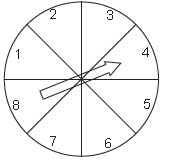
Question. How many possible outcomes are in the sample spaces?
(a) 4
(b) 6
(c) 8
(d) 10
Answer : C
Question. What is the probability that the arrow lands on 4?
(a) 1/4
(b) 1/6
(c) 1/2
(d) 1/8
Answer : D
Question. The set of possible outcomes for event A, in which the arrow lands on an even number is
(a) 2, 4, 6, 8
(b) 2, 4, 6, 10
(c) 2, 6, 8, 10
(d) 4, 6, 8, 10
Answer : A
Question. The probability that the arrow lands on an even number is
(a) 1/4
(b) 1/6
(c) 1/8
(d) 1/2
Answer : D
Question. The probability that the arrow will point at any factor of 8 is
(a) 1/2
(b) 1/4
(c) 1/6
(d) 1/8
Answer : A
II. Some boys are playing with numbers. There is a box which contains 90 discs. They are numbered from 1 to 90. The boys are drawing disc one by one from the box at random and want to find the probability of a particular number.
Question. If one disc is drawn at random from the box, the probability that it bears a two-digit number is
(a) 9/10
(b) 8/90
(c) 89/90
(d) 79/90
Answer : A
Question. Then they put the disc into the box and draw another disc at random. They want to know the probability that it bears a perfect square number. So, the probability of perfect square number is
(a) 8/90
(b) 3/10
(c) 1/10
(d) 1/9
Answer : C
Question. They put the disc into the box and another boy draws another disc at random, and wants to know the probability that it bears a number divisible by 5. So the probability is
(a) 2/5
(b) 3/5
(c) 4/5
(d) 1/5
Answer : D
Question. After putting the disc into the box, the next boy draws a disc at random and wants to know the probability that it bears a prime number. The probability is
(a) 5/18
(b) 4/15
(c) 2/15
(d) 13/45
Answer : C
Question. The boys put all the disc together into the box and next boy draws a disc at random and find the probability that the disc bears a number divisible by 7.
(a) 1/15
(b) 2/15
(c) 4/15
(d) 1/5
Answer : B
Q.-Two dice are thrown at a time. Find the probability of the following -
(i) these numbers shown are equal;
(ii) the difference of numbers shown is 1.
Answer : The sample space in a throw of two dice
s = {1, 2, 3, 4, 5, 6} ×{1, 2, 3, 4, 5, 6}.
total no. of cases n (s) = 6 × 6 = 36.
(i) Here E1 = the event of showing equal number on both dice
= {(1, 1) (2, 2) (3, 3) (4, 4) (5, 5) (6, 6) }
∴ n (E1 ) = 6
∴ P (E1) =n(E1 )/n(s) =6/36 =1/6
(ii) Here E2 = the event of showing numbers whose difference is 1.
= {(1, 2) (2, 1) (2, 3) (3, 2) (3, 4) (4, 3) (4, 5) (5, 4) (5, 6) (6, 5)}
∴ n (E2) = 10
∴ p (E2) = n(E2)/n(s) =10/36= 5/18
Question. Probability that a non leap year should have 53 Mondays, will be
(A) 2/7
(B) 3/7
(C) 1/7
(D) 5/7
Answer: C
Question. A bag contains 10 red balls and some white balls. If the probability of drawing a white ball is double that of a red ball, then number of white balls in the bag will be
(A) 10
(B) 15
(C) 20
(D) 25
Answer: C
QuestionBox A contains 30% first grade articles. Box B contains 40% first grade articles. One article is drawn from each box. Then the probability that both articles drawn are first grade is
(A) 1/25
(B) 3/25
(C) 7/25
(D) 9/25
Answer: B
Question. A bag contains 2 red, 3 green and 2 blue balls. Two balls are drawn at random. What is the probability that none of the balls drawn is blue?
(A) 10/21
(B) 11/21
(C) 2/7
(D) 5/7
Answer: A
Question. In a box, there are 8 red, 7 blue and 6 green balls. One ball is picked up randomly. What is the probability that it is neither red nor green?
(A) 1/3
(B) 3/4
(C) 7/19
(D) 8/21
Answer: A
Question. A box contains 90 discs which are numbered from 1 to 90. If one disc is drawn at random from the box, then the probability that it bears a two-digit number is :
(A) 9/10
(B) 7/10
(C) 3/5
(D) 2/5.
Answer: A
Question. A game consists of tossing a one rupee coin 3 times and noting its outcome each time. Hanif wins if all the tosses give the same result i.e., three heads or three tails, and loses otherwise. Calculate the probability that Hanif will lose the game.
(A) 1/4
(B) 1
(C) 3/4
(D) 0.
Answer: C
Question. Three unbiased coins are tossed together. Then the probability of getting at least one head and one tail is
(A) 1/4
(B) 1
(C) 3/4
(D) 0.
Answer: C
Question. A die is thrown twice. Then the probability that 5 will come up at least once is
(A) 11/36
(B) 7/36
(C) 5/36
(D) 0.
Answer: B
Question. Ina single throw of two dice,the probability of getting a doublet of odd numbers is
(A) 11/12
(B) 1/12
(C) 5/12
(D) 5/6.
Answer: C
Question. In a single throw of three dice, the probability of getting a total of 17 or 18 is
(A) 53/54
(B) 51/54
(C) 1/54
(D) 0.
Answer: B
Question. Three fair dice are rolled, then the probability that the same number will appear on each of them is
(A) 1/6
(B) 1/18
(C) 1/36
(D) 3/28
Answer: C
Question. Mallica and Deepica are friends. Then the probability that both have same birthday is (ignoring a leap year)
(A) 364/365
(B) 1/365
(C) 363/365
(D) 2/365
Answer: A
Question. A letter is chosen at random from the word “probability”. The probability that it is a vowel is
(A) 1/11
(B) 2/11
(C) 3/11
(D) 4/11
Answer: D
Question. Mallica and Deepica are friends. Then the probability that both have different birthdays is
(A) 364/365
(B) 1/365
(C) 363/365
(D) 2/365
Answer: B
Question. Each outcome of a sample space related to any random experiment is known as
(A) compound event
(B) elementary event
(C) sure event
(D) impossible event
Answer: B
Question. A card is drawn at random from a pack of 52 playing cards. Then the probability that the card is neither an ace nor a king is
(A) 10/13
(B) 11/13
(C) 7/13
(D) 9/13.
Answer: C
PRACTICE EXERCISE
Question. A die is thrown once. What is the probability of getting :
(i) an even number (ii) an odd number (iii) a number ≥ 3
(iv) a number 5 or 6 (v) a number > 6
Solution. (i) 1/2 (ii) 1/2 (iii) 2/3 (iv) 1/3 (v) 0
Question. Find the probability that a number selected at a random from the numbers 1, 2, 3, ...., 35 is a
(i) prime number (ii) multiple of 7
(iii) a multiple of 3 or 5
Solution. (i) 11/35 (ii) 1/7 (iii) 16/35
Question. What is the probability that an ordinary year has 53 mondays?
Solution. 1/7
Question. Two black kings and two black jacks are removed from a pack of 52 cards. Find the probability of getting:
(i) a card of hearts (ii) a card of clubs
(iii) a king (iv) a black card
(v) either a red card or a king (vi) a red king
(vii) neither an ace nor a king (viii) a jack, queen or a king
Solution. (i) 13/48 (ii) 11/48 (iii) 1/24 (iv) 11/24 (v) 13/24 (vi) 1/24 (vii) 7/8 (viii) 1/6
Question. The probability that it will rain tomorrow is 0.86. What is the probability that it will not rain tomorrow?
Solution. 0.14
Question. A bag contains 5 red, 8 white and 7 black balls. A ball is drawn at random from the bag. Find the probability that the ball drawn is ;
(i) red or white (ii) not black (iii) neither white nor black
Solution. (i) 13/20 (ii) 13/20 (iii) 1/4
Question. 17 cards numbered 1, 2, 3, ...., 17 are put in a box and mixed thoroughly. One person draws a card from the box. Find the probability that the number on the card is :
(i) odd (ii) a prime (iii) divisible by 3
(iv) divisible by 2 and 3 both
Solution. (i) 9/17 (ii) 7/17 (iii) 5/17 (iv) 2/17
Question. A die is thrown once. Find the probability of gething :
(i) a multiple of 3 (ii) a multiple of 2 or 3 (iii) a prime number
Solution. (i) 1/3 (ii) 2/3 (iii) 1/2
Question. A bag contains 4 red balls, 5 black balls and 3 green balls. A ball is drawn at random from a bag. Find the probability that the ball drawn is :
(i) a red ball (ii) a black ball
(iii) not a green ball (iv) a black or a green ball
Solution. (i) 1/3 (ii) 5/12 (iii) 3/4 (iv) 2/3
Question. A card is drawn at random from a pack of 52 cards. Find the probability that the card drawn is :
(i) a jack, queen or a king (ii) a face card
(iii) a black king (iv) black and a king
(v) neither a heart nor a king (vi) spade or an ace
(vii) a queen of diamond (viii) either a black card or a king
(ix) an ace of heart (x) neither an ace nor a king
(xi) ‘10’ of black suit (xii) a club
(xiii) neither a red card nor a queen (xiv) a ‘8’ of heart
(xv) an ace of red colour
Solution. (i) 3/13 (ii) 3/13 (iii) 1/26 (iv) 1/26 (v) 9/13 (vi) 4/13 (vii) 1/52 (viii) 7/13 (ix) 1/52 (x) 11/13 (xi) 1/26 (xii) 1/4 (xiii) 6/13 (xiv) 1/52 (xv) 1/26
Question. A bag contains 5 red balls and some black balls. If the probability of drawing a black ball is double that of a red ball, find the number of black balls in the bag.
Solution. 10
Question. Two coins are tossed simultaneously. Find the probability of getting :
(i) two heads (ii) exactly one tail (iii) no tail
Solution. (i) 1/4 (ii) 1/2 (iii) 1/4 (iv) 3/4 (v) 3/4
Question. A bag contains 3 red, 5 black and 7 white balls. A ball is drawn from the bag at random. Find the probability that the ball drawn is :
(i) white (ii) red (iii) not black
(iv) red or white
Solution. (i) 7/15 (ii) 1/5 (iii) 2/3 (iv) 2/3
Question. A piggy bank contains hundred 50 p coins, fifty Re 1 coins, twenty Rs. 2 coins and ten Rs. 5 coins. If it is equally likely that one of the coins will fall out when the bank is turned upside down, what is the probability that the coin :
(i) will be a 50 p coin? (ii) will not be a Rs. 5 coin?
Solution. (i) 5/9 (ii) 17/18
Question. An integer is chosen from 1 to 15. Find the probability that the integer chosen is divisible by 4.
Solution. 1/5
Question. A pair of dice is thrown once. Find the probability of getting the sum of numbers on two dice as 11.
Solution. 1/18
Question. A bag contains 8 red, 6 white and 4 black balls. A ball is drawn at random from the bag. Find the probability that the drawn ball is :
(i) red or white (ii) neither white nor black.
Solution. (i) 7/9 (ii) 4/9
Question. Cards marked with numbers 3 to 152 are thoroughly mixed. If one card is drawn at random; find the probability that the number on the card is :
(i) an odd number (ii) a number less than 25
(iii) a number greater than 140 (iv) a number which is a perfect square
(v) a prime number between 10 and 40.
Solution. (i) 1/2 (ii) 11/75 (iii) 2/25 (iv) 11/150 (v) 4/75
Question. A die, in the shape of a tetrahedron, has four faces on which numerals 3, 4, 5, 8 are written. The die is rolled. Find the probability of getting an even number.
Solution. 3/4
Question. A card is drawn at random from a well-shuffled deck of playing cards. Find the probability that the card drawn is :
(i) a card of spade or an ace (ii) a red king
(iii) neither a king nor a queen (iv) either a king or a queen
(v) a face card
Solution. (i) 4/13 (ii) 1/26 (iii) 11/13 (iv) 2/13 (v) 3/13
Question. A box contains 100 bulbs out of which 10 are defective. What is the probability that if a bulb is drawn, it is
(i) defective (ii) non-defective.
Solution. (i) 0.1 (ii) 0.9
Question. A bag contains 5 red balls and some black balls. If the probability of drawing a black ball is double that of a red ball, find the number of black balls in a bag.
Solution. 10
Question. From a well shuffled pack of 52 cards, two black kings and two black jacks are removed. From the remaining cards, a card is drawn at random. Find the probability that drawn card is neither an ace nor a king.
Solution. 7/8
Question. Three unbiased coins are tossed simultaneously. Find the probability of getting :
(i) one head (ii) two heads (iii) All heads
(iv) at least two heads (v) at least one head and one tail
Solution. (i) 3/8 (ii) 3/8 (iii) 1/8 (iv) 1/2 (v) 3/4
Question. Out of 400 bulbs in a box, 15 bulbs are defective. One bulb is taken out at random from the box. Find the probability that the drawn bulb is not defective.
Solution. 77/80
Question. A card is drawn from a well shuffled pack of 52 cards. Find the probability that the card is neither a red card nor a queen.
Solution. 6/13
Question. A bag contains 5 white balls, 7 red balls, 4 black balls and 2 blue balls. One ball is drawn at random from the bag. What is the probability that the ball drawn is :
(i) white or blue (ii) red or black (iii) not white
(iv) neither white nor black
Solution. (i) 1/2 (ii) 13/20 (iii) 2/5 (iv) 9/10
Question. Cards bearing numbers 3,5,7…35 are kept in a bag. A card is drawn at random from the bag. Find the probability of getting a card bearing (a) a prime number less than 15(b) a number divisible by 3 and 5.
Solution. A.5/17 B.1/17
Question. A card is drawn from a well shuffled deck of 52cards. Find the probability of getting an ace.
Solution. 1/13
Question. A card is drawn at random from a well-shuffled deck of playing cards. Find the probability of drawing (a) A face card(b)card which is neither a king nor a red card
Solution. A. 3/13 B. 6/13
Question. A child game has 8 triangles of which three are blue and rest are red and ten squares of which six are blue and rest are red. One piece is drawn at random. Find the probability of that is (a) A square (b) A triangle of red colour.
Solution. A. 5/9 B. 5/18
Question. A game consists of tossing a one-rupee coin 3 times and noting its outcome each time. Hanif wins if all the tosses ,give the same result,i.e.,3 heads or three tails and loses otherwise. Calculate the probability that Hanif will lose the game.
Solution. 3/4
Question. Cards bearing numbers 1,3,5…37 are kept in a bag. A card is drawn at random from the bag. Find the Probability of getting a card bearing
(a) A prime number less than15
(b) A number divisible by 3 and 5.
Solution. A.5/19 B.1/19
Question. A dice has its six faces marked 0,1,1,1,6,6. Two such dice are thrown together and total score is recorded.(a) how many different scores are possible? (b) What is the probability of getting a total of seven?
Solution. A. 6 scores B. 1/3
Question. Two dice are thrown simultaneously. Find the probability of getting an even number as the sum.
Solution. 1/2
Question. A die is thrown once. Find the probability of getting.
a) Prime number
b) A number divisible by 2.
Solution. 1/2 , 1/2
Question. All the red face cards are removed from a pack of 52 playing cards. A card is drawn at random from the remaining cards after reshuffling them. Find the probability that the card drawn is
(i) Of red colour ii) a queen iii) an ace iv) a face card.
Solution. 10/23, 1/23,2/23,3/23
Question. In a family of 3 children, find the probability of having at least 1 boy.
Solution. 7/8
Question. Find the probability that a leap year selected at random will contain 53 Sundays.
Solution. 2 / 7
Question.In a survey, it was found that 40% people use petrol, 35% uses diesel and remaining uses CNG for their vehicles. Find the probability that a person uses CNG at random.
(a) Which fuel out of above 3 is appropriate for the welfare of the society?
Solution. Probability =0.25 CNG
Question. A die is thrown once. What is probability of getting a number greater than 4?
Solution. 1/3
Question. A bag contains 4 red and 6 blackballs. A ball is taken out of the bag at random. Find the probability of getting a blackball?
Solution. 3/5
Question. Two dice are thrown simultaneously. What is the probability that:
(a) 5 will not come up either of them? (b) 5 will come up on at least one? (c) 5 will come at both dice?
Solution. A. 25/36 B. 11/36 C. 1/36
Question. The king, queen and jack of clubs are removed from a deck of 52 playing cards and remaining cards are shuffled. A card is drawn from the remaining cards. Find the probability of getting a card of (a) heart(b) queen(c) clubs
Solution. A. 13/49 B. 3/49, C 10/49
Question. Two dice are rolled once. Find the probability of getting such numbers on the two dice whose product is 12.
Solution. 1/9
Question. Red queens and black jacks are removed from a pack of 52 playing cards. A card is drawn at random from the remaining card, after reshuffling them. Find the probability that the drawn card is:
(i) King ii) of red colour iii) a face card iv) queen
Solution. 1/12, 24/48, 1/6, 1/24
Question. Three unbiased coins are thrown simultaneously. Find the probability of getting.
i. Exactly two heads.
ii. At least two heads.
iii. At most two heads.
Solution. 3/8, 1/2 , 7/8
Question. A number is selected randomly from all possible 3-digit numbers. What is the probability that the number selected is :
(i) an odd number (ii) having all 3 digits same (iii) divisible by 3
Solution. (i) 1/2 (ii) 1/100 (iii) 1/3
Question. A card is drawn at random from a well-shuffled deck of playing cards. Find the probability that the card drawn is :
(i) a card of spade or an ace (ii) a red king (iii) neither a king nor a queen
(iv) either a king or a queen
Solution. (i) 4/13 (ii) 1/26 (iii) 11/13 (iv) 2/13
Question. In a family, there are 3 children. Assuming that the chances of a child being a male or a female are equal, find the probability that :
(i) there is one girl in the family.
(ii) there is no male child in the family.
(iii) there is atleast one male child in the family.
Solution. (i) 1/4 (ii) 1/4 (iii) 3/4
Question. Cards marked with numbers 3, 4, 5, ...., 50 are placed in a box and mixed thoroughly. One card is drawn at random from the box. Find the probability that number on the card drawn is :
(i) divisible by 7 (ii) a number which is a perfect square
Solution. (i) 7/48 (ii) 1/8
Question. Balls marked with numbers 2 to 101 are placed in a box and mixed thoroughly. One ball is drawn at random from this box. Find the probability that the number on the ball is :
(i) an even number (ii) an odd number
(iii) a number less than 17 (iv) a number which is a perfect square
(v) a number which is a perfect cube (vi) a number divisible by 9
(vii) a prime number less than 41 (viii) a number which is divisible by 3 or 5.
Solution. (i) 1/2 (ii) 1/2 (iii) 3/20 (iv) 9/100 (v) 3/100 (vi) 11/100 (vii) 12/100 (viii) 47/100
Question. A bag contains 5 red balls and some blue balls. If the probability of drawing a blue ball from the bag is four times that of a red ball, find the number of blue balls in the bag.
Solution. 20
Question. A number x is selected from the numbers 1, 2, 3 and then a second number y is selected randomly from the numbers 1, 4, 9. What is the probability that the product xy < 9?
Solution. 5/9
Question. Two customers are visiting a particular shop in the same week (Tuesday to Saturday). Each is equally likely to visit on any one day as on another. What is the probability that both will visit the shop on :
(i) the same day (ii) different days? (iii) Consecutive days
Solution. (i) 1/5 (ii) 4/5 (iii) 8/25
Question. If x and y are natural numbers such that 1 ≤ x ≤ 4 and 3 ≤ y ≤ 6. What is the probability that :
(i) x + y ≥ 8 (ii) xy is even.
Solution. (i) 3/8 (ii) 3/4
Question. The letters A, B, C, A, D, E, B, A, B and F are marked on different cards such that one card has only one letter on it. A man draws one card. Find the probability that the card drawn is marked :
(i) letter A (ii) letter B (iii) letter B or D
(iv) letter A or C
Solution. (i) 3/10 (ii) 3/10 (iii) 2/5
Question. In a simultaneous throw of a pair of dice, find the probability of getting :
(i) 7 as a sum
(ii) a doublet of odd numbers
(iii) not a doublet
(iv) an odd number on the first die
(v) a sum less than 6
(vi) a sum more than 10
(vii) neither 9 nor 11 as the sum of the numbers on the faces
(viii) a total of atleast 10
(ix) a multiple of 3 as the sum
(x) a doublet of prime numbers
Solution. (i) 1/6 (ii) 1/12 (iii) 5/6 (iv) 1/2 (v) 5/18 (vi) 1/12 (vii) 5/6 (viii) 1/6 (ix) 1/3 (x) 1/12
Question. From a pack of 52 playing cards jacks, queens, kings and aces of red colour are removed. From the remaining, a card is drawn at random. Find the probability that the card drawn is :
(i) a black queen (ii) a red card (iii) a black jack
(iv) a picture card (Jacks, queens and kings are picture cards)
Solution. (i) 1/22 (ii) 9/22 (iii) 1/22 (iv) 3/22
Question. A letter is chosen at random from the letters of the word ‘MATHEMATICS’. Find the probability that the letter chosen is a
(i) vowel (ii) consonant.
Solution. (i) 4/11 (ii) 7/11
Question. Find the probability that a number selected from the number 1 to 25 is not a prime number when each of the given numbers is equally likely to be selected.
Solution. 16/25
Question. Achild has a block in the shape of a cube with one letter written on each face as shown below : 25
The cube is thrown once. What is the probability of getting :
(i) A ? (ii) D ?
Solution. (i) 1/3 (ii) 1/6
Question. A bag contains 36 balls out of which x are black.
(i) If one ball is drawn at random, what is the probability of getting a black ball?
(ii) If 12 more black balls are put in the bag, the probability of drawing a black ball is 1/2 . Find x.
Solution. (i) x/36 (ii) 12
Question. Ram and Shyam are friends. What is the probability that both will have :
(i) different birthday ? (ii) the same birthday?
(ignore the leap year).
Solution. (i) 364/365 (ii) 1/365
Question. 1000 tickets of a lottery were sold and there are 5 prizes on these tickets. If Saket has purchased one lottery ticket, what is the probability of winning a prize?
Solution. 0.005
Question 1. A die is thrown once. List the Sample space (write all the possible outcomes). Find the probability of getting i) an odd number ii) an even number iii) a prime iv) a composite no. v) a number that is neither prime nor composite vi) a factor of 6 vii) a proper factor of 6 viii) a no. < 5
Answer:
When a standard six-sided die is rolled, the total set of possible results (sample space) is:
\( S = \{1, 2, 3, 4, 5, 6\} \)
So, the total count of outcomes is \( n(S) = 6 \).
(i) The odd numbers are \( \{1, 3, 5\} \).
Number of favourable outcomes = 3.
Probability of getting an odd number = \( \frac{3}{6} = \frac{1}{2} \).
(ii) The even numbers are \( \{2, 4, 6\} \).
Number of favourable outcomes = 3.
Probability of getting an even number = \( \frac{3}{6} = \frac{1}{2} \).
(iii) The prime numbers are \( \{2, 3, 5\} \). (Note that 1 is not prime).
Number of favourable outcomes = 3.
Probability of getting a prime number = \( \frac{3}{6} = \frac{1}{2} \).
(iv) The composite numbers are \( \{4, 6\} \).
Number of favourable outcomes = 2.
Probability of getting a composite number = \( \frac{2}{6} = \frac{1}{3} \).
(v) The only number on a die that is neither prime nor composite is 1.
Number of favourable outcomes = 1.
Probability of getting a number neither prime nor composite = \( \frac{1}{6} \).
(vi) The factors of 6 are \( \{1, 2, 3, 6\} \).
Number of favourable outcomes = 4.
Probability of getting a factor of 6 = \( \frac{4}{6} = \frac{2}{3} \).
(vii) The proper factors of 6 are factors of 6 excluding 6 itself, which are \( \{1, 2, 3\} \).
Number of favourable outcomes = 3.
Probability of getting a proper factor of 6 = \( \frac{3}{6} = \frac{1}{2} \).
(viii) The numbers strictly less than 5 are \( \{1, 2, 3, 4\} \).
Number of favourable outcomes = 4.
Probability of getting a number less than 5 = \( \frac{4}{6} = \frac{2}{3} \).
In simple words: When you roll a die, there are 6 possible numbers that can show up. We count how many numbers match our specific goal and divide that count by 6 to get the final probability.
Exam Tip: Remember that 1 is neither prime nor composite. Additionally, "proper factors" of a number include all of its factors except the number itself.
Question 2. Two dice are thrown simultaneously. List the Sample Space for the experiment. (List all the possible outcomes)
Answer:
When two distinct dice are rolled at the same time, each die can show any number from 1 to 6. The complete set of outcomes (sample space) consists of 36 pairs:
\[ S = \left\{ \begin{array}{cccccc}
(1,1), & (1,2), & (1,3), & (1,4), & (1,5), & (1,6) \\
(2,1), & (2,2), & (2,3), & (2,4), & (2,5), & (2,6) \\
(3,1), & (3,2), & (3,3), & (3,4), & (3,5), & (3,6) \\
(4,1), & (4,2), & (4,3), & (4,4), & (4,5), & (4,6) \\
(5,1), & (5,2), & (5,3), & (5,4), & (5,5), & (5,6) \\
(6,1), & (6,2), & (6,3), & (6,4), & (6,5), & (6,6)
\end{array} \right\} \]
The total number of elements in the sample space is \( n(S) = 36 \).
In simple words: When rolling two dice, we write down every combination of the numbers on the first die and the second die. This gives a total of 36 possible pairs.
Exam Tip: Writing the sample space in a neat \( 6 \times 6 \) grid makes it very easy to spot patterns like equal sums, doublets, or specific products without missing any outcomes.
Question 3. In a single throw of two dice, find the probability of getting i) a total of 7. ii) a total of 11. iii) Doublets iv) Six as a product
Answer:
When throwing two dice, the total number of outcomes is \( n(S) = 36 \).
(i) Let \( E_1 \) be the event of getting a total of 7.
Favourable outcomes: \( \{(1,6), (2,5), (3,4), (4,3), (5,2), (6,1)\} \)
Number of favourable outcomes, \( n(E_1) = 6 \).
Probability of getting a total of 7 = \( \frac{n(E_1)}{n(S)} = \frac{6}{36} = \frac{1}{6} \).
(ii) Let \( E_2 \) be the event of getting a total of 11.
Favourable outcomes: \( \{(5,6), (6,5)\} \)
Number of favourable outcomes, \( n(E_2) = 2 \).
Probability of getting a total of 11 = \( \frac{n(E_2)}{n(S)} = \frac{2}{36} = \frac{1}{18} \).
(iii) Let \( E_3 \) be the event of getting doublets (the same number on both dice).
Favourable outcomes: \( \{(1,1), (2,2), (3,3), (4,4), (5,5), (6,6)\} \)
Number of favourable outcomes, \( n(E_3) = 6 \).
Probability of getting doublets = \( \frac{n(E_3)}{n(S)} = \frac{6}{36} = \frac{1}{6} \).
(iv) Let \( E_4 \) be the event of getting a product of six.
Favourable outcomes: \( \{(1,6), (2,3), (3,2), (6,1)\} \)
Number of favourable outcomes, \( n(E_4) = 4 \).
Probability of getting a product of six = \( \frac{n(E_4)}{n(S)} = \frac{4}{36} = \frac{1}{9} \).
In simple words: Since rolling two dice has 36 possible outcomes, we list the pairs that satisfy each rule, count them, and divide that count by 36.
Exam Tip: Doublets mean matching numbers on both dice. On a grid of 36 outcomes, these always lie along the main diagonal from top-left to bottom-right.
Question 4. If a single coin is tossed, what are the possible outcomes
Answer:
When a single coin is flipped, there are only two possible results: landing on heads or landing on tails.
Sample Space, \( S = \{H, T\} \)
Here, \( H \) represents Heads and \( T \) represents Tails.
In simple words: Flipping one coin can only end in two ways: it either shows heads or shows tails.
Exam Tip: The total number of outcomes for tossing \( n \) coins is always \( 2^n \). For a single coin (\( n=1 \)), it is \( 2^1 = 2 \).
Question 5. Two unbiased coins are tossed once. List all the possible outcomes (Write the Sample Space)
Answer:
When two fair coins are tossed at the same time, the set of all possible outcomes is:
\( S = \{HH, HT, TH, TT\} \)
Where:
- \( HH \) means heads on both coins,
- \( HT \) means heads on the first and tails on the second,
- \( TH \) means tails on the first and heads on the second,
- \( TT \) means tails on both coins.
The total number of outcomes is \( n(S) = 4 \).
In simple words: Tossing two coins gives four possible combinations: two heads, head-tail, tail-head, or two tails.
Exam Tip: Make sure not to treat \( HT \) and \( TH \) as the same outcome, since they represent distinct results depending on which coin shows heads and which shows tails.
Question 6. If three coins are tossed simultaneously, what are all the possible outcomes?
Answer:
Tossing three coins together gives a total of \( 2^3 = 8 \) possible outcomes. The complete sample space is:
\( S = \{HHH, HHT, HTH, HTT, THH, THT, TTH, TTT\} \)
Where \( H \) stands for Heads and \( T \) stands for Tails.
In simple words: With three coins, there are 8 different ways they can land, ranging from all heads to all tails.
Exam Tip: To write this list systematically without missing any, write 4 heads and 4 tails first, then alternate H and T in pairs, and finally alternate H and T singly.
Question 7. Two unbiased coins are tossed simultaneously. what is the probability of getting i) exactly one head ii) at least one head iii) no head iv) at the most one head v) neither head nor tail.
Answer:
When two fair coins are tossed, the sample space is \( S = \{HH, HT, TH, TT\} \) with \( n(S) = 4 \).
(i) Let \( E_1 \) be the event of getting exactly one head.
Favourable outcomes: \( \{HT, TH\} \)
Number of favourable outcomes, \( n(E_1) = 2 \).
Probability of getting exactly one head = \( \frac{2}{4} = \frac{1}{2} \).
(ii) Let \( E_2 \) be the event of getting at least one head.
Favourable outcomes: \( \{HH, HT, TH\} \)
Number of favourable outcomes, \( n(E_2) = 3 \).
Probability of getting at least one head = \( \frac{3}{4} \).
(iii) Let \( E_3 \) be the event of getting no head.
Favourable outcomes: \( \{TT\} \)
Number of favourable outcomes, \( n(E_3) = 1 \).
Probability of getting no head = \( \frac{1}{4} \).
(iv) Let \( E_4 \) be the event of getting at the most one head.
Favourable outcomes: \( \{HT, TH, TT\} \)
Number of favourable outcomes, \( n(E_4) = 3 \).
Probability of getting at the most one head = \( \frac{3}{4} \).
(v) Let \( E_5 \) be the event of getting neither head nor tail.
Since every toss must result in either a head or a tail, it is impossible to get neither. This is an impossible event.
Number of favourable outcomes, \( n(E_5) = 0 \).
Probability of getting neither head nor tail = \( 0 \).
In simple words: Tossing two coins has 4 possible outcomes. We list the ones that match each situation and divide by 4. Getting "neither" is impossible, so its probability is 0.
Exam Tip: Pay close attention to "at least" (minimum value, can be more) and "at most" (maximum value, can be less, including zero) to avoid selecting wrong outcomes.
Question 8. Three coins are tossed simultaneously. Write the Sample Space and answer the following. What is the probability of getting i) Two Heads ii) at least one head iii) at least two heads iv) Three Heads
Answer:
When three coins are tossed, the sample space \( S \) is:
\( S = \{HHH, HHT, HTH, HTT, THH, THT, TTH, TTT\} \)
The total number of outcomes is \( n(S) = 8 \).
(i) Let \( E_1 \) be the event of getting exactly two heads.
Favourable outcomes: \( \{HHT, HTH, THH\} \)
Number of favourable outcomes, \( n(E_1) = 3 \).
Probability of getting two heads = \( \frac{3}{8} \).
(ii) Let \( E_2 \) be the event of getting at least one head.
Favourable outcomes include all outcomes with 1, 2, or 3 heads: \( \{HHH, HHT, HTH, HTT, THH, THT, TTH\} \).
Number of favourable outcomes, \( n(E_2) = 7 \).
Probability of getting at least one head = \( \frac{7}{8} \).
(iii) Let \( E_3 \) be the event of getting at least two heads.
Favourable outcomes are those with 2 or 3 heads: \( \{HHH, HHT, HTH, THH\} \).
Number of favourable outcomes, \( n(E_3) = 4 \).
Probability of getting at least two heads = \( \frac{4}{8} = \frac{1}{2} \).
(iv) Let \( E_4 \) be the event of getting three heads.
Favourable outcomes: \( \{HHH\} \)
Number of favourable outcomes, \( n(E_4) = 1 \).
Probability of getting three heads = \( \frac{1}{8} \).
In simple words: When three coins are flipped, there are 8 possible ways they can land. We look for how many ways match our target and divide by 8 to find the probability.
Exam Tip: "At least one head" is the complement of "no heads" (\( TTT \)). Calculating \( 1 - P(\text{no heads}) = 1 - \frac{1}{8} = \frac{7}{8} \) is a very fast shortcut.
Question 9. A bag contains 5 red marbles, 8 white marbles, 4 green marbles and 7 black marbles. If one marble is drawn (taken) at random, find the probability that it is i) red ii) white iii) green iv) black. Verify that the sum of the probabilities of all these elementary events of the experiment is 1
Answer:
First, find the total number of marbles in the bag:
Total marbles = \( 5 \text{ (red)} + 8 \text{ (white)} + 4 \text{ (green)} + 7 \text{ (black)} = 24 \).
So, the total number of possible outcomes is \( n(S) = 24 \).
(i) Probability of drawing a red marble:
Number of red marbles = 5.
\( P(\text{red}) = \frac{5}{24} \).
(ii) Probability of drawing a white marble:
Number of white marbles = 8.
\( P(\text{white}) = \frac{8}{24} = \frac{1}{3} \).
(iii) Probability of drawing a green marble:
Number of green marbles = 4.
\( P(\text{green}) = \frac{4}{24} = \frac{1}{6} \).
(iv) Probability of drawing a black marble:
Number of black marbles = 7.
\( P(\text{black}) = \frac{7}{24} \).
Verification:
The sum of the probabilities of all elementary events is:
\( P(\text{red}) + P(\text{white}) + P(\text{green}) + P(\text{black}) = \frac{5}{24} + \frac{8}{24} + \frac{4}{24} + \frac{7}{24} \)
\( \implies \frac{5 + 8 + 4 + 7}{24} = \frac{24}{24} = 1 \).
Thus, the sum of the probabilities is verified to be 1.
In simple words: There are 24 marbles in total. We find the probability of drawing each color by dividing its count by 24. Since these are all the possible colors, their probabilities add up to exactly 1.
Exam Tip: Always state the total count of items first, and keep the fractions unsimplified when checking the sum of probabilities to make addition straightforward.
Question 10. the Probability that it will rain tomorrow is 0.75. what is the probability that it will not rain tomorrow?
Answer:
Let \( E \) be the event that it will rain tomorrow.
We are given: \( P(E) = 0.75 \).
Let \( \bar{E} \) be the complementary event that it will not rain tomorrow.
Using the complementary probability formula:
\( P(\bar{E}) = 1 - P(E) \)
\( \implies P(\bar{E}) = 1 - 0.75 = 0.25 \).
Thus, the probability that it will not rain tomorrow is 0.25.
In simple words: The total probability of any event happening or not happening is always 1. Subtracting the chance of rain (0.75) from 1 leaves a 0.25 chance of no rain.
Exam Tip: Remember the basic formula \( P(E) + P(\text{not } E) = 1 \) for any complementary events.
Question 11. one card is drawn from a well shuffled deck of 52 playing cards, at random. Find the probability that the card is i) Red ii) a King iii) a Queen iv) a king or a queen v) An Ace vi) 10 of a black suit
Answer:
A standard playing card deck contains a total of 52 cards, so \( n(S) = 52 \).
(i) Probability of getting a Red card:
The total count of red cards (Hearts and Diamonds) is 26.
Probability = \( \frac{26}{52} = \frac{1}{2} \).
(ii) Probability of getting a King:
There are 4 Kings in a deck.
Probability = \( \frac{4}{52} = \frac{1}{13} \).
(iii) Probability of getting a Queen:
There are 4 Queens in a deck.
Probability = \( \frac{4}{52} = \frac{1}{13} \).
(iv) Probability of getting a king or a queen:
The number of Kings is 4 and the number of Queens is 4. Total cards that are either a King or a Queen = \( 4 + 4 = 8 \).
Probability = \( \frac{8}{52} = \frac{2}{13} \).
(v) Probability of getting An Ace:
There are 4 Aces in a deck.
Probability = \( \frac{4}{52} = \frac{1}{13} \).
(vi) Probability of getting 10 of a black suit:
The black suits are Spades and Clubs. There is one "10" in Spades and one "10" in Clubs, making a total of 2 cards.
Probability = \( \frac{2}{52} = \frac{1}{26} \).
In simple words: With 52 cards in a deck, we count how many cards match the description and divide that count by 52 to find the probability.
Exam Tip: Understanding the deck composition (26 red cards, 26 black cards, 4 suits of 13 cards each, and 12 face cards) is extremely helpful for card-based probability questions.
Question 12. A card is drawn at random from a well shuffled deck of playing cards. Find the probability that the card is i) a king or a Jack ii) not an ace iii) neither a king nor a queen iv) a face card
Answer:
The total number of outcomes in a standard deck of cards is \( n(S) = 52 \).
(i) Probability of getting a king or a Jack:
There are 4 Kings and 4 Jacks in a deck. Number of favourable cards = \( 4 + 4 = 8 \).
Probability = \( \frac{8}{52} = \frac{2}{13} \).
(ii) Probability of getting not an ace:
There are 4 Aces in the deck, so the number of cards that are not Aces is \( 52 - 4 = 48 \).
Probability = \( \frac{48}{52} = \frac{12}{13} \).
(iii) Probability of getting neither a king nor a queen:
There are 4 Kings and 4 Queens in the deck (8 cards in total). The cards that are neither are \( 52 - 8 = 44 \).
Probability = \( \frac{44}{52} = \frac{11}{13} \).
(iv) Probability of getting a face card:
The face cards are Kings, Queens, and Jacks. There are 12 face cards in total (4 of each).
Probability = \( \frac{12}{52} = \frac{3}{13} \).
In simple words: We count how many cards in a deck of 52 fit our criteria and divide by 52 to get our answer.
Exam Tip: For "not" or "neither" questions, it is often simpler to calculate the probability of the event happening first, and then subtract it from 1.
Question 13. A card is drawn from a well-shuffled deck of playing Cards. What is the probability that the card is i) a black jack ii) a red king iii) not a face card iv) 8 of a Heart
Answer:
In a standard deck, the total number of outcomes is \( n(S) = 52 \).
(i) Probability of getting a black jack:
There are 2 black suits (Spades and Clubs), and each has 1 Jack, so there are 2 black Jacks in total.
Probability = \( \frac{2}{52} = \frac{1}{26} \).
(ii) Probability of getting a red king:
There are 2 red suits (Hearts and Diamonds), and each has 1 King, so there are 2 red Kings in total.
Probability = \( \frac{2}{52} = \frac{1}{26} \).
(iii) Probability of getting not a face card:
There are 12 face cards (Kings, Queens, and Jacks) in a deck. The number of non-face cards is \( 52 - 12 = 40 \).
Probability = \( \frac{40}{52} = \frac{10}{13} \).
(iv) Probability of getting 8 of a Heart:
There is exactly one card in the deck that is the 8 of Hearts.
Probability = \( \frac{1}{52} \).
In simple words: We find the count of cards matching the description in the deck and divide it by 52 to calculate the probability.
Exam Tip: Be careful with cards of a specific suit and value, like the "8 of Hearts". There is only 1 such card in the entire deck of 52.
Question 14. From a deck of 52 playing cards, King, Queen, Jack and Ace of Hearts are removed. The remaining cards are thoroughly shuffled. If a card is drawn, what is the probability that it is i) a king ii) a Heart iii) red card iv) either a king or a queen?
Answer:
Initially, there are 52 cards in a deck. Since four cards (the King, Queen, Jack, and Ace of Hearts) are removed, the total number of remaining cards is:
\( n(S) = 52 - 4 = 48 \).
(i) Probability of getting a king:
Originally there were 4 Kings. Since the King of Hearts was removed, there are only 3 Kings left.
Probability = \( \frac{3}{48} = \frac{1}{16} \).
(ii) Probability of getting a Heart:
Originally there were 13 Hearts. Since 4 Hearts were removed, there are only \( 13 - 4 = 9 \) Hearts left.
Probability = \( \frac{9}{48} = \frac{3}{16} \).
(iii) Probability of getting a red card:
Originally there were 26 red cards. Since the 4 removed cards are all Hearts (which are red), the number of remaining red cards is \( 26 - 4 = 22 \).
Probability = \( \frac{22}{48} = \frac{11}{24} \).
(iv) Probability of getting either a king or a queen:
There were 4 Kings and 4 Queens (8 cards in total). Since the King of Hearts and the Queen of Hearts are removed, the number of remaining Kings and Queens is \( 8 - 2 = 6 \).
Probability = \( \frac{6}{48} = \frac{1}{8} \).
In simple words: Since we took out 4 Heart cards, we now have only 48 cards left in total. We adjust the counts of each category of cards to find the new probability.
Exam Tip: Whenever cards are removed from a deck, always subtract them from both the total count of cards in the sample space and from the specific categories (like red cards, suits, or face cards) before calculating the probabilities.
Free study material for Mathematics
Chapter 14 Probability Printable Worksheets and Exercises for Class 10 Mathematics
Download Chapter Worksheets: Class 10 Mathematics
Review targeted practice exercises for Class 10 Mathematics Chapter 14 Probability. Curated to match official CBSE guidelines, these printable problem sets support daily revision and improve overall test readiness.
Concept Clarification for Chapter 14 Probability
Built using official NCERT guidelines for Class 10 Mathematics, these practice sheets provide reliable academic support. Cross-reference your completed work with our detailed solutions to learn standard answer-writing formats for CBSE exams.
Effective Revision Strategies for School Exams
Follow up your worksheet practice by attempting the interactive online MCQ tests for Chapter 14 Probability to evaluate your execution speed. All printable assignments and revision sheets on our platform are updated for the 2026 session and available free of charge.
FAQs
You can download the latest chapter-wise printable worksheets for Class 10 Mathematics Chapter 14 Probability for free from StudiesToday.com. These have been made as per the latest CBSE curriculum for this academic year.
Yes, Class 10 Mathematics worksheets for Chapter 14 Probability focus on activity-based learning and also competency-style questions. This helps students to apply theoretical knowledge to practical scenarios.
Yes, we have provided solved worksheets for Class 10 Mathematics Chapter 14 Probability to help students verify their answers instantly.
Yes, our Class 10 Mathematics test sheets are mobile-friendly PDFs and can be printed by teachers for classroom.
For Chapter 14 Probability, regular practice with our worksheets will improve question-handling speed and help students understand all technical terms and diagrams.