

Chapter-wise Worksheets for Class 10 Mathematics: Chapter 11 Areas related to Circles
Access comprehensive chapter-wise worksheets for Chapter 11 Areas related to Circles using the CBSE Class 10 Mathematics Areas Related To Circles Worksheet Set 02. Designed to align with the 2026-27 academic syllabus for Class 10 Mathematics, these printable practice sets help students reinforce key concepts and improve their overall exam readiness.
Practice Class 10 Mathematics Worksheets: Chapter 11 Areas related to Circles
Navigate directly to the solved Mathematics worksheets using the digital viewer below. Each practice set includes detailed step-by-step solutions, allowing students to instantly cross-check their work and identify areas requiring further revision.
Question. In a circle of radius 21 cm, an arc subtends an angle of 60° at the centre. The length of the arc is
(a) 11 cm
(b) 22 cm
(c) 27 cm
(d) 44 cm
Answer : B
Question. The angle described by a minute hand in 5 minutes is
(a) 30°
(b) 60°
(c) 90°
(d) None of these
Answer : A
Question. All the vertices of a rhombus lie on a circle. The area of the rhombus, if the area of the circle is 1256 cm2 is [Use π = 3.14]
(a) 300 cm2
(b) 600 cm2
(c) 800 cm2
(d) 900 cm2
Answer : C
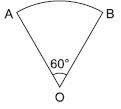
Question. The given figure is a sector of circle of radius 10.5 cm. The perimeter of the sector is [Take π = 7/22 ]
(a) 32 cm
(b) 44 cm
(c) 54 cm
(d) None of these
Answer : A
Question. In a circle of diameter 42 cm,if an arc subtends an angle of 60° at the centre where p = 22/7, then what will be the length of arc?
(a) 11 cm
(b) 20 cm
(c) 22 cm
(d) 28 cm
Answer : C
Question. A horse is tied to a pole with 28 m long rope. The perimeter of the field where the horse can graze is (Take π = 22/7)
(a) 60 cm
(b) 85 cm
(c) 124 cm
(d) 176 cm
Answer : D
Question. A car has two wipers which do not overlap. Each wiper has a blade of length 21 cm sweeping through an angle 120°. The total area cleaned at each sweep of the blades is [Take π = 7/22]
(a) 360 cm2
(b) 448 cm2
(c) 556 cm2
(d) 924 cm2
Answer : D
Question. The difference of the areas of two segments of a circle formed by a chord of radius 5 cm subtending an angle of 90° at the centre is
(a) (25π/4 - 25/2)cm2
(b) (15π/4 - 7/2)cm2
(c) (7π/4 - 3/2)cm2
(d) None of these
Answer : A
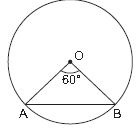
Question. The area of the sector in the following figure showing a chord AB of a circle of radius 18 cm subtending an angle of 60° at the centre O is [Take π = 3.14]
(a) 151.31 cm2
(b) 169.56 cm2
(c) 173.33 cm2
(d) None of these
Answer : B
Question. An arc of length 15.7 cm subtends a right angle at the centre of the circle. Then the radius of the circle is
(a) 20 cm
(b) 10 cm
(c) 15 cm
(d) 12 cm
Answer : B
Question. A piece of wire 22 cm long is bent into the form of an arc of a circle subtending an angle of 60° at its centre. The radius of the circle is [Take π = 7/22]
(a) 7 cm
(b) 14 cm
(c) 21 cm
(d) 28 cm
Answer : C
Question. The short and long hands of a clock are 4 cm and 6 cm long respectively. The sum of distances travelled by their tips in 2 days is
(a) 1148 cm
(b) 1426.35 cm
(c) 1910.85 cm
(d) None of these
Answer : C
Question. The area of the sector of a circle of radius 5 cm, if the corresponding arc length is 3.5 cm is
(a) 3.25 cm2
(b) 8.75 cm2
(c) 4.60 cm2
(d) 5.50 cm2
Answer : B
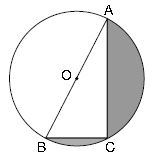
Question. The area of the shaded region in the given figure, if AC = 24 cm, BC = 10 cm and O is the centre of the circle is [Take π = 3.14]
(a) 128.56 cm2
(b) 145.33 cm2
(c) 248.16 cm2
(d) None of these
Answer : B
Question. The area of the largest circle that can be drawn inside the given rectangle of length ‘a’ cm and breadth ‘b’ cm (a > b) is
(a) (1/2)πb cm2
(b) (1/3)πb cm2
(c) (1/4)πb cm2
(d) πb2 cm2
Answer : C
Assertion-Reason Type Questions
In the following questions, a statement of assertion (A) is followed by a statement of reason (R).
Choose the correct choice as:
(a) Both assertion (A) and reason (R) are true and reason (R) is the correct explanation of assertion (A).
(b) Both assertion (A) and reason (R) are true but reason (R) is not the correct explanation of assertion (A).
(c) Assertion (A) is true but reason (R) is false.
(d) Assertion (A) is false but reason (R) is true.
Question. Assertion (A): In a circle of radius 6 cm, the angle of a sector is 60°. Then the area of the sector is 18(6/7)cm2.
Reason (R): Area of the circle with radius r is πr2.
Answer : B
Question. Assertion (A): The length of the minute hand of a clock is 7 cm. Then the area swept by the minute hand in 5 minute is 12(5/6)cm2.
Reason (R): The length of an arc of a sector of angle q and radius r is given by l = θ/360 x 2πr
Answer : B
Question 1. A bicycle wheel makes 5000 revolution in moving 11 km. find the diameter of the wheel
Answer: Total distance covered by the bicycle is 11 km, which is equal to 1,100,000 cm.
The distance traveled in one full rotation of the wheel represents its boundary length (circumference).
Distance covered in a single rotation = \( \frac{1,100,000}{5000} = 220 \) cm.
Since the circumference is given by \( \pi d \):
\( \pi d = 220 \)
\( \frac{22}{7} \times d = 220 \)
\( d = \frac{220 \times 7}{22} = 70 \) cm.
Therefore, the diameter of the wheel is 70 cm.
In simple words: The wheel turns 5,000 times to go 11 km. By dividing the total distance by the number of turns, we find the circumference is 220 cm, which gives a wheel diameter of 70 cm.
Exam Tip: Be sure to convert kilometers into centimeters first to match the required standard units for bicycle wheel diameters.
Question 2. The radius of the wheel of a bus is 70cm, how many revolutions per minute must a wheel make in order to move at a speed of 66 km/h
Answer: The radius of the bus wheel is \( r = 70 \) cm.
The distance covered in one single revolution is the wheel's circumference:
\( C = 2\pi r = 2 \times \frac{22}{7} \times 70 = 440 \) cm = 4.4 m.
The speed of the bus is 66 km/h, which we can convert into meters per minute:
Speed = \( \frac{66 \times 1000 \text{ m}}{60 \text{ min}} = 1100 \) m/min.
The number of revolutions per minute required is:
Revolutions = \( \frac{\text{Distance covered per minute}}{\text{Distance in one revolution}} \)
Revolutions = \( \frac{1100}{4.4} = 250 \).
The wheel must complete 250 revolutions per minute.
In simple words: The bus needs to travel 1,100 meters every minute. Since one turn of the wheel covers 4.4 meters, the wheel needs to rotate 250 times each minute to maintain this speed.
Exam Tip: Converting speed from km/h directly into meters per minute simplifies your fraction division during calculations.
Question 3. A wheel has diameter 84cm. Find how many complete revolutions must it make to cover 792 metres
Answer: Given the diameter of the wheel \( d = 84 \) cm, its radius is \( r = 42 \) cm.
The distance covered in one full rotation is its boundary length:
\( C = 2\pi r = 2 \times \frac{22}{7} \times 42 = 264 \) cm = 2.64 m.
The total distance to cover is 792 m.
The number of complete revolutions required is:
Revolutions = \( \frac{\text{Total Distance}}{\text{Circumference}} \)
Revolutions = \( \frac{792}{2.64} = 300 \).
Therefore, the wheel must make 300 complete revolutions.
In simple words: Each turn of the wheel covers 2.64 meters. To travel 792 meters in total, the wheel needs to rotate exactly 300 times.
Exam Tip: Always make sure both the total distance and the wheel's circumference are expressed in the same unit (meters or centimeters) before dividing.
Question 4. In the figure o is the centre of a circle. The area of sector OAPB is 5/18 of the area of the circle. Find x
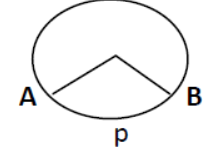
Answer: Let \( x \) be the central angle subtended by the sector OAPB.
The area of a sector is given by \( \frac{x}{360^\circ} \times \text{Area of circle} \).
According to the given condition:
\( \text{Area of sector} = \frac{5}{18} \times \text{Area of circle} \)
By comparing these two expressions:
\( \frac{x}{360^\circ} = \frac{5}{18} \)
\( x = \frac{5}{18} \times 360^\circ \)
\( x = 100^\circ \).
Therefore, the value of \( x \) is 100 degrees.
In simple words: Since the slice of the circle covers 5/18 of its total space, its angle must be 5/18 of the full 360 degrees, which is 100 degrees.
Exam Tip: Sector areas are directly proportional to their central angles, allowing you to set up simple ratio comparisons.
Question 5. Area of a sector of a circle is 1/6 to the area of circle. Find the degree measure of its minor arc
Answer: Let \( \theta \) be the central angle of the sector.
The area of the sector is given as \( \frac{1}{6} \) of the total circle area:
\( \frac{\theta}{360^\circ} \times \text{Area of circle} = \frac{1}{6} \times \text{Area of circle} \)
Simplifying this equation:
\( \frac{\theta}{360^\circ} = \frac{1}{6} \)
\( \theta = \frac{360^\circ}{6} = 60^\circ \).
Therefore, the degree measure of the minor arc is 60 degrees.
In simple words: A sector that covers 1/6 of a circle has a central angle of 60 degrees because a full circle is 360 degrees.
Exam Tip: Central angle measure of a sector is identical to the degree measure of its corresponding minor arc.
Question 6. Area of a sector of a circle of radius 14cm is 154 cm2 . Find the length of the corresponding arc of the sector
Answer: Given the radius of the circle \( r = 14 \) cm and the area of the sector is \( 154 \text{ cm}^2 \).
We know the relation between sector area and arc length \( l \) is:
\( \text{Area of sector} = \frac{1}{2} \times l \times r \)
Substitute the given values into the equation:
\( 154 = \frac{1}{2} \times l \times 14 \)
\( 154 = 7l \)
\( l = \frac{154}{7} = 22 \) cm.
Therefore, the length of the corresponding arc is 22 cm.
In simple words: Using the direct relationship between a sector's area and its arc length, we find that the boundary curve of this slice is exactly 22 cm long.
Exam Tip: Utilizing the formula \( \text{Area} = \frac{1}{2}lr \) is much faster than finding the central angle first when calculating arc length.
Question 7. If the diameter of a semi circle protractor is 14 cm. Find its perimeter
Answer: The diameter of the semicircle protractor is \( d = 14 \) cm, which means its radius is \( r = 7 \) cm.
The boundary of a semicircle protractor includes the curved boundary plus the straight diameter edge.
\( \text{Perimeter} = \pi r + d \)
\( \text{Perimeter} = \left(\frac{22}{7} \times 7\right) + 14 \)
\( \text{Perimeter} = 22 + 14 = 36 \) cm.
Therefore, the perimeter of the protractor is 36 cm.
In simple words: The curved top edge is 22 cm long, and the straight bottom edge is 14 cm. Adding them together gives a total boundary length of 36 cm.
Exam Tip: Do not forget to add the straight diameter edge when calculating the total perimeter of a closed semicircle shape.
Question 8. The circumference of a circle A is 132cm. It is equal to the sum of the circumference of two circles B & C, the radius of the circle B is 14cm. Find the radius of circle C.
Answer: Let \( r_B \) and \( r_C \) be the radii of circles B and C respectively.
We are given that \( r_B = 14 \) cm.
According to the problem:
\( \text{Circumference of A} = \text{Circumference of B} + \text{Circumference of C} \)
\( 132 = 2\pi r_B + 2\pi r_C \)
\( 132 = 2\pi(r_B + r_C) \)
\( 132 = 2 \times \frac{22}{7} \times (14 + r_C) \)
\( 132 = \frac{44}{7}(14 + r_C) \)
\( 14 + r_C = \frac{132 \times 7}{44} \)
\( 14 + r_C = 3 \times 7 \)
\( 14 + r_C = 21 \)
\( r_C = 21 - 14 = 7 \) cm.
Therefore, the radius of circle C is 7 cm.
In simple words: The combined boundaries of B and C equal 132 cm. Since B has a radius of 14 cm, solving the boundary equation reveals that C must have a radius of 7 cm.
Exam Tip: Factor out the constant term \( 2\pi \) to make simplifying linear circle relations much easier.
Question 9. The area of quadrant is 154sq cm. Find its perimeter.
Answer: Let \( r \) be the radius of the circle.
The area of a quadrant of a circle is given by \( \frac{1}{4}\pi r^2 \):
\( \frac{1}{4}\pi r^2 = 154 \)
\( \frac{1}{4} \times \frac{22}{7} \times r^2 = 154 \)
\( \frac{11}{14} r^2 = 154 \)
\( r^2 = \frac{154 \times 14}{11} = 14 \times 14 = 196 \)
\( r = 14 \) cm.
The boundary of a quadrant consists of the curved arc plus the two straight boundary radii:
\( \text{Perimeter} = \frac{1}{4}(2\pi r) + 2r = \frac{1}{2}\pi r + 2r \)
\( \text{Perimeter} = \left(\frac{1}{2} \times \frac{22}{7} \times 14\right) + 2(14) \)
\( \text{Perimeter} = 22 + 28 = 50 \) cm.
Therefore, the perimeter of the quadrant is 50 cm.
In simple words: Finding the radius from the area gives us 14 cm. The boundary consists of the curved edge (22 cm) and two straight radii sides (28 cm), totaling 50 cm.
Exam Tip: Be sure to include both of the straight radial borders when determining the total boundary perimeter of a quadrant slice.
Question 10. Two circles touch externally. The sum of their areas is 130 ∏ sq.cm and the distance between their centres is 14cm. Find the radii of the Circles
Answer: Let the radii of the two circles be \( r_1 \) and \( r_2 \).
Since they touch each other externally, the distance between their center points is the sum of their radii:
\( r_1 + r_2 = 14 \implies r_2 = 14 - r_1 \quad \text{--- (Equation 1)} \)
The sum of their areas is given as \( 130\pi \text{ cm}^2 \):
\( \pi r_1^2 + \pi r_2^2 = 130\pi \)
\( r_1^2 + r_2^2 = 130 \quad \text{--- (Equation 2)} \)
Substitute Equation 1 into Equation 2:
\( r_1^2 + (14 - r_1)^2 = 130 \)
\( r_1^2 + 196 - 28r_1 + r_1^2 = 130 \)
\( 2r_1^2 - 28r_1 + 66 = 0 \)
Divide the entire equation by 2:
\( r_1^2 - 14r_1 + 33 = 0 \)
Factoring this quadratic equation:
\( (r_1 - 11)(r_1 - 3) = 0 \)
\( r_1 = 11 \) cm or \( r_1 = 3 \) cm.
If \( r_1 = 11 \), then \( r_2 = 3 \). If \( r_1 = 3 \), then \( r_2 = 11 \).
The radii of the two circles are 11 cm and 3 cm.
In simple words: The sum of the two radii is 14 cm, and the sum of their squared values is 130. Solving this gives us circle radii of 11 cm and 3 cm.
Exam Tip: When circles touch externally, the distance between centers is \( r_1 + r_2 \). If they touch internally, the distance is \( r_1 - r_2 \).
Question 11. Find the area of a quadrant of a circle whose circumference is 44cm
Answer: Let \( r \) be the radius of the circle.
Given the circumference \( 2\pi r = 44 \) cm:
\( 2 \times \frac{22}{7} \times r = 44 \)
\( r = \frac{44 \times 7}{44} = 7 \) cm.
The area of a quadrant is:
\( \text{Area} = \frac{1}{4}\pi r^2 \)
\( \text{Area} = \frac{1}{4} \times \frac{22}{7} \times 7 \times 7 \)
\( \text{Area} = \frac{77}{2} = 38.5 \text{ cm}^2 \).
Therefore, the area of the quadrant is 38.5 sq. cm.
In simple words: The perimeter tells us the circle's radius is 7 cm. A quarter-slice of this circle has an area of exactly 38.5 sq. cm.
Exam Tip: A quadrant is always exactly one-fourth (\( \frac{1}{4} \)) of the entire circle's surface area.
Question 12. The perimeter of a sheet of paper in the shape of a quadrant of a circle is 75 cm. Find its area
Answer: Let \( r \) be the radius of the quadrant.
The perimeter of a quadrant includes the curved edge plus two straight radii sides:
\( \text{Perimeter} = \frac{\pi r}{2} + 2r = 75 \)
\( r\left(\frac{\pi}{2} + 2\right) = 75 \)
\( r\left(\frac{22}{14} + 2\right) = 75 \)
\( r\left(\frac{11}{7} + 2\right) = 75 \)
\( r\left(\frac{25}{7}\right) = 75 \)
\( r = \frac{75 \times 7}{25} = 21 \) cm.
The area of the quadrant is:
\( \text{Area} = \frac{1}{4}\pi r^2 \)
\( \text{Area} = \frac{1}{4} \times \frac{22}{7} \times 21 \times 21 \)
\( \text{Area} = \frac{1}{4} \times 22 \times 3 \times 21 = \frac{1386}{4} = 346.5 \text{ cm}^2 \).
Therefore, the area of the quadrant sheet is 346.5 sq. cm.
In simple words: Using the perimeter boundary equation, we find that the radius is 21 cm. A quarter slice of this circle has an area of 346.5 sq. cm.
Exam Tip: Be careful to use \( \frac{\pi r}{2} + 2r \) for the quadrant perimeter instead of just the curved arc portion \( \frac{\pi r}{2} \).
Question 13. A circular disc of 6cm radius is divided into 3 sectors with central angles 120˚, 150˚and 90˚.Find the ratio of the areas of 3 Sectors
Answer: The area of a sector of a circle is directly proportional to its central angle, as \( \text{Area} = \frac{\theta}{360^\circ} \pi r^2 \).
Since the radius \( r \) is identical for all three sectors, the ratio of their areas is equal to the ratio of their central angles:
\( \text{Ratio of Areas} = 120^\circ : 150^\circ : 90^\circ \)
Dividing each term by their greatest common divisor, 30:
\( \text{Ratio of Areas} = 4 : 5 : 3 \).
Therefore, the ratio of the areas of the 3 sectors is 4 : 5 : 3.
In simple words: Since all sectors belong to the same circle, the ratio of their areas is the same as the ratio of their angles. Simplifying 120, 150, and 90 gives the ratio 4:5:3.
Exam Tip: Do not waste time calculating the actual numeric areas of the sectors when only their ratio is required.
Question 14. The difference between circumferences and diameter of a circle is 105 cm. Find the radius of the circle
Answer: Let \( r \) be the radius of the circle.
Circumference is \( 2\pi r \) and diameter is \( 2r \).
According to the given condition:
\( 2\pi r - 2r = 105 \)
\( 2r(\pi - 1) = 105 \)
\( 2r\left(\frac{22}{7} - 1\right) = 105 \)
\( 2r \times \frac{15}{7} = 105 \)
\( \frac{30r}{7} = 105 \)
\( r = \frac{105 \times 7}{30} = 3.5 \times 7 = 24.5 \) cm.
Therefore, the radius of the circle is 24.5 cm.
In simple words: The boundary exceeds the width across the center by 105 cm. Solving this relation reveals that the radius is exactly 24.5 cm.
Exam Tip: Factoring out \( 2r \) from the beginning simplifies the fractional algebra steps significantly.
Question 15. Find the area of a major sector of a circle of diameter 42 cm and central angle is 60˚
Answer: Given diameter \( d = 42 \) cm, the radius of the circle is \( r = 21 \) cm.
The central angle of the minor sector is \( 60^\circ \).
Therefore, the central angle of the corresponding major sector is:
\( \theta = 360^\circ - 60^\circ = 300^\circ \).
The area of this major sector is:
\( \text{Area} = \frac{\theta}{360^\circ} \times \pi r^2 \)
\( \text{Area} = \frac{300^\circ}{360^\circ} \times \frac{22}{7} \times 21 \times 21 \)
\( \text{Area} = \frac{5}{6} \times \frac{22}{7} \times 441 \)
\( \text{Area} = \frac{5}{6} \times 22 \times 3 \times 21 = 5 \times 11 \times 21 = 1155 \text{ cm}^2 \).
Therefore, the area of the major sector is 1155 sq. cm.
In simple words: The remaining larger portion of the circle has an angle of 300 degrees. Calculating the area for this slice gives 1,155 sq. cm.
Exam Tip: Be sure to calculate the major angle \( (360^\circ - \text{minor angle}) \) first when finding major sector areas.
Question 16. If the area and circumference of a circle are numerically equal, then find the radius of the circle
Answer: Let the radius of the circle be \( r \).
According to the given condition:
\( \text{Area of circle} = \text{Circumference of circle} \)
\( \pi r^2 = 2\pi r \)
Divide both sides by \( \pi r \) (since \( r \neq 0 \)):
\( r = 2 \).
Therefore, the radius of the circle is 2 units.
In simple words: By equating the area formula to the perimeter formula, we find that a radius of exactly 2 is the only value where both calculations yield the same number.
Exam Tip: This is a standard conceptual question; simply equate \( \pi r^2 = 2\pi r \) and solve for \( r \).
Question 17. The length of a rope by which a cow is tethered is increased from 16m to 23m. How much additional area can the cow graze? Now (π =22/7)
Answer: Let the initial rope length be \( r = 16 \) m and the new rope length be \( R = 23 \) m.
The area the cow can graze forms a circle with the rope length as the radius.
The extra grazing area is the difference between the two circular areas:
\( \text{Additional Area} = \pi R^2 - \pi r^2 = \pi(R^2 - r^2) \)
\( \text{Additional Area} = \frac{22}{7} \times (23^2 - 16^2) \)
Using the identity \( A^2 - B^2 = (A-B)(A+B) \):
\( \text{Additional Area} = \frac{22}{7} \times (23 - 16)(23 + 16) \)
\( \text{Additional Area} = \frac{22}{7} \times 7 \times 39 \)
\( \text{Additional Area} = 22 \times 39 = 858 \text{ m}^2 \).
Therefore, the additional area the cow can graze is 858 sq. m.
In simple words: Increasing the rope length lets the cow reach an outer ring of grass. This extra ring has a surface area of exactly 858 sq. m.
Exam Tip: Use the difference-of-squares factoring shortcut to simplify working with large numbers like \( 23^2 - 16^2 \).
Question 18. What will be the increase in area of circle if its radius is increased by 40%
Answer: Let the original radius of the circle be \( r \).
Original Area \( A_1 = \pi r^2 \).
If the radius is increased by \( 40\% \), the new radius is:
\( R = r + 0.4r = 1.4r \).
The new area is:
\( A_2 = \pi R^2 = \pi (1.4r)^2 = 1.96\pi r^2 \).
The fractional increase in area is:
\( \text{Increase} = A_2 - A_1 = 1.96\pi r^2 - \pi r^2 = 0.96\pi r^2 \).
Percentage increase in area is:
\( \text{Percentage Increase} = \frac{0.96\pi r^2}{\pi r^2} \times 100\% = 96\% \).
Therefore, the area of the circle increases by 96%.
In simple words: Since area depends on the square of the radius, multiplying the radius by 1.4 increases the final area by a factor of 1.96, which represents a 96% increase.
Exam Tip: A change of \( x\% \) in the radius leads to a percentage area change of \( \left(2x + \frac{x^2}{100}\right)\% \).
Question 19. An arc of a circle is of length 5π cm and the sector it bounds has an area of 20π cm2 . Find the radius of the circle
Answer: Given the length of the arc \( l = 5\pi \) cm and the area of the sector is \( A = 20\pi \text{ cm}^2 \).
We know the formula relating sector area, arc length, and radius is:
\( A = \frac{1}{2} \times l \times r \)
Substitute the given values into the formula:
\( 20\pi = \frac{1}{2} \times 5\pi \times r \)
Divide both sides by \( \pi \):
\( 20 = 2.5r \)
\( r = \frac{20}{2.5} = 8 \) cm.
Therefore, the radius of the circle is 8 cm.
In simple words: Using the direct formula linking arc length and slice area, we find that the radius of this circle is exactly 8 cm.
Exam Tip: This simple relation \( \text{Area} = \frac{1}{2}lr \) is highly useful for circular sector questions on exams.
Question 20. The circumference of a circle exceeds the diameter by 16.8cm. Find the radius of circle
Answer: Let \( r \) be the radius of the circle.
The circumference of the circle is \( 2\pi r \) and its diameter is \( 2r \).
According to the problem:
\( 2\pi r - 2r = 16.8 \)
\( 2r(\pi - 1) = 16.8 \)
\( 2r\left(\frac{22}{7} - 1\right) = 16.8 \)
\( 2r \times \frac{15}{7} = 16.8 \)
\( \frac{30r}{7} = 16.8 \)
\( r = \frac{16.8 \times 7}{30} = 3.92 \) cm.
Therefore, the radius of the circle is 3.92 cm.
In simple words: Setting up the relationship between boundary and width, we find the circle's radius is exactly 3.92 cm.
Exam Tip: Factoring out \( 2r \) from the beginning helps to prevent unnecessary fraction mistakes during calculations.
Question 21. The area enclosed between two concentric circles is 770 sq cm. If the radius of outer circle is 21cm. Find the radius of the inner circle.
Answer: Let \( R \) be the outer radius and \( r \) be the inner radius.
Given \( R = 21 \) cm and the enclosed ring area is 770 sq. cm.
The area of the region between concentric circles is:
\( \pi(R^2 - r^2) = 770 \)
\( \frac{22}{7} \times (21^2 - r^2) = 770 \)
\( 441 - r^2 = \frac{770 \times 7}{22} \)
\( 441 - r^2 = 35 \times 7 \)
\( 441 - r^2 = 245 \)
\( r^2 = 441 - 245 = 196 \)
\( r = \sqrt{196} = 14 \) cm.
Therefore, the radius of the inner circle is 14 cm.
In simple words: The outer circle has an area of 1,386 sq. cm. Subtracting the ring's area leaves 616 sq. cm for the inner circle, which gives a radius of 14 cm.
Exam Tip: Be sure to write out intermediate values like \( 21^2 = 441 \) clearly to avoid simple computational errors.
Question 22. The length of the minute hand of a clock is 7cm. How much area does it sweep in 20minutes
Answer: The length of the minute hand is the radius \( r = 7 \) cm.
In 60 minutes, the minute hand completes a full rotation of \( 360^\circ \).
The angle swept in 20 minutes is:
\( \theta = \frac{20}{60} \times 360^\circ = 120^\circ \).
The area swept is:
\( \text{Area} = \frac{\theta}{360^\circ} \times \pi r^2 \)
\( \text{Area} = \frac{120^\circ}{360^\circ} \times \frac{22}{7} \times 7 \times 7 \)
\( \text{Area} = \frac{1}{3} \times 22 \times 7 = \frac{154}{3} \text{ cm}^2 \approx 51.33 \text{ cm}^2 \).
Therefore, the area swept by the minute hand is \( \frac{154}{3} \text{ cm}^2 \).
In simple words: A 20-minute movement covers exactly one-third of the clock's face, sweeping over an area of 51.33 sq. cm.
Exam Tip: Keep your final calculation as a fraction to match standard textbook solutions and avoid unnecessary decimal rounding errors.
Question 23. The perimeter of a sector of a circle of radius 5.2cm is 16.4cm.Find the area of sector
Answer: Let the radius be \( r = 5.2 \) cm and the perimeter of the sector be 16.4 cm.
The perimeter of a sector consists of the curved arc length \( l \) plus two straight radial borders:
\( \text{Perimeter} = l + 2r = 16.4 \)
\( l + 2(5.2) = 16.4 \)
\( l + 10.4 = 16.4 \)
\( l = 6 \) cm.
The area of the sector is:
\( \text{Area} = \frac{1}{2} \times l \times r \)
\( \text{Area} = \frac{1}{2} \times 6 \times 5.2 = 15.6 \text{ cm}^2 \).
Therefore, the area of the sector is 15.6 sq. cm.
In simple words: Subtracting the two straight radius edges from the total perimeter gives an arc length of 6 cm. This yields a sector area of 15.6 sq. cm.
Exam Tip: Always remember that the boundary of a sector contains two straight lines of length \( r \) in addition to the arc.
Question 24. Given a circle of radius 9cm, and the length of the chord AB of a circle is 9√3 cm, find the area of the sector formed by arc AB.
Answer: Let \( O \) be the center of the circle. Here, \( OA = OB = 9 \) cm and chord \( AB = 9\sqrt{3} \) cm.
Let \( M \) be the midpoint of the chord \( AB \). Since \( \triangle OAB \) is isosceles, \( OM \perp AB \) and \( AM = \frac{9\sqrt{3}}{2} \) cm.
In right-angled \( \triangle OAM \):
\( \sin\left(\frac{\theta}{2}\right) = \frac{AM}{OA} = \frac{9\sqrt{3}/2}{9} = \frac{\sqrt{3}}{2} \)
\( \frac{\theta}{2} = 60^\circ \implies \theta = 120^\circ \).
The central angle subtended by the arc AB is 120 degrees.
The area of the sector is:
\( \text{Area} = \frac{\theta}{360^\circ} \times \pi r^2 \)
\( \text{Area} = \frac{120^\circ}{360^\circ} \times \frac{22}{7} \times 9 \times 9 \)
\( \text{Area} = \frac{1}{3} \times \frac{22}{7} \times 81 = \frac{594}{7} \approx 84.85 \text{ cm}^2 \).
Therefore, the area of the sector is 84.85 sq. cm.
In simple words: By using trigonometry, we find that the chord subtends a 120-degree angle. This sector covers exactly one-third of the circle's area, which is 84.85 sq. cm.
Exam Tip: Use the sine ratio on the right triangle formed by drawing a perpendicular from the center to find the subtended central angle.
Question 25. Length of minor arc of a circle of radius 10 cm is 14cm. Find the area of minor sector of a circle.
Answer: Given the radius \( r = 10 \) cm and the arc length \( l = 14 \) cm.
The area of the minor sector is:
\( \text{Area} = \frac{1}{2} \times l \times r \)
\( \text{Area} = \frac{1}{2} \times 14 \times 10 = 70 \text{ cm}^2 \).
Therefore, the area of the minor sector is 70 sq. cm.
In simple words: Using the direct relationship between arc length and sector area, we multiply half the arc length by the radius, giving exactly 70 sq. cm.
Exam Tip: Utilizing the relationship \( \text{Area} = \frac{1}{2}lr \) saves time by bypassing the need to calculate the central angle.
Question 26. A chord 10 cm long is drawn in a circle of radius V50 cm. Find the area of minor segment
Answer: Let \( r = \sqrt{50} \) cm and the chord length be \( c = 10 \) cm.
In the triangle formed by the center \( O \) and the chord \( AB \):
\( OA^2 + OB^2 = (\sqrt{50})^2 + (\sqrt{50})^2 = 50 + 50 = 100 \).
Since \( AB^2 = 10^2 = 100 \), we have \( OA^2 + OB^2 = AB^2 \).
By the converse of Pythagoras' theorem, the central angle \( \theta = 90^\circ \).
The area of the minor sector is:
\( \text{Area of sector} = \frac{90^\circ}{360^\circ} \times \pi r^2 = \frac{1}{4} \times \frac{22}{7} \times 50 \approx 39.285 \text{ cm}^2 \).
The area of the right-angled triangle \( OAB \) is:
\( \text{Area of triangle} = \frac{1}{2} \times r \times r = \frac{1}{2} \times 50 = 25 \text{ cm}^2 \).
The area of the minor segment is:
\( \text{Area of segment} = \text{Area of sector} - \text{Area of triangle} = 39.285 - 25 = 14.285 \text{ cm}^2 \).
Therefore, the area of the minor segment is 14.285 sq. cm.
In simple words: The chord forms a right triangle at the center. Subtracting this triangle's area (25 sq. cm) from the 90-degree sector's area (39.285 sq. cm) leaves 14.285 sq. cm for the segment.
Exam Tip: Always check if the side-length relation \( r^2 + r^2 = c^2 \) holds, as it indicates a clean \( 90^\circ \) right angle at the center.
Question 27. A chord AB of a circle of radius 14cm makes a right angle at the centre of the circle. Find the area of the minor segment. (π = 22/7)
Answer: Here, the radius is \( r = 14 \) cm and the central angle is \( \theta = 90^\circ \).
The area of the minor sector is:
\( \text{Area of sector} = \frac{90^\circ}{360^\circ} \times \pi r^2 = \frac{1}{4} \times \frac{22}{7} \times 14 \times 14 = 154 \text{ cm}^2 \).
The area of the right-angled triangle \( OAB \) is:
\( \text{Area of triangle} = \frac{1}{2} \times r^2 = \frac{1}{2} \times 196 = 98 \text{ cm}^2 \).
The area of the minor segment is:
\( \text{Area of segment} = \text{Area of sector} - \text{Area of triangle} = 154 - 98 = 56 \text{ cm}^2 \).
Therefore, the area of the minor segment is 56 sq. cm.
In simple words: The sector has an area of 154 sq. cm, and the right triangle inside covers 98 sq. cm. Subtracting the triangle leaves exactly 56 sq. cm for the outer segment.
Exam Tip: For any quarter-circle sector with angle \( 90^\circ \), the triangle area is simply \( \frac{1}{2}r^2 \).
Question 28. Find the area of the major segment APB, of a circle of radius 35 cm and ∟AOB = 90˚ (π = 22/7)
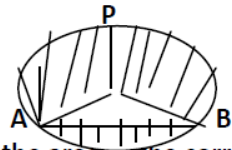
Answer: Let \( r = 35 \) cm and \( \theta = 90^\circ \).
The area of the entire circle is:
\( \text{Area of circle} = \pi r^2 = \frac{22}{7} \times 35 \times 35 = 3850 \text{ cm}^2 \).
The minor segment area is calculated first:
\( \text{Area of minor sector} = \frac{1}{4} \times \text{Area of circle} = \frac{3850}{4} = 962.5 \text{ cm}^2 \).
\( \text{Area of triangle OAB} = \frac{1}{2} \times r^2 = \frac{1}{2} \times 35 \times 35 = 612.5 \text{ cm}^2 \).
\( \text{Area of minor segment} = 962.5 - 612.5 = 350 \text{ cm}^2 \).
The area of the major segment APB is:
\( \text{Area of major segment} = \text{Area of circle} - \text{Area of minor segment} \)
\( \text{Area of major segment} = 3850 - 350 = 3500 \text{ cm}^2 \).
Therefore, the area of the major segment is 3500 sq. cm.
In simple words: The entire circle has an area of 3,850 sq. cm. Subtracting the small minor segment area (350 sq. cm) leaves 3,500 sq. cm for the major segment.
Exam Tip: Finding the major segment is easiest by subtracting the minor segment from the total area of the circle.
Question 29. A chord of a circle of radius 14cm subtends an angle of 120˚ at the centre Find the area of the corresponding minor segment of the circle (π = 22/7, √3 = 1.73)
Answer: Let \( r = 14 \) cm and \( \theta = 120^\circ \).
The area of the minor sector is:
\( \text{Area of sector} = \frac{120^\circ}{360^\circ} \times \pi r^2 = \frac{1}{3} \times \frac{22}{7} \times 14 \times 14 \approx 205.33 \text{ cm}^2 \).
The area of the triangle \( OAB \) with angle \( 120^\circ \) is:
\( \text{Area of triangle} = r^2 \sin\left(\frac{\theta}{2}\right) \cos\left(\frac{\theta}{2}\right) = 14^2 \times \sin(60^\circ) \cos(60^\circ) \)
\( \text{Area of triangle} = 196 \times \frac{\sqrt{3}}{2} \times \frac{1}{2} = 49\sqrt{3} \)
\( \text{Area of triangle} = 49 \times 1.73 = 84.77 \text{ cm}^2 \).
The area of the minor segment is:
\( \text{Area of segment} = \text{Area of sector} - \text{Area of triangle} = 205.33 - 84.77 = 120.56 \text{ cm}^2 \).
Therefore, the area of the corresponding minor segment is 120.56 sq. cm.
In simple words: The sector has an area of 205.33 sq. cm, and the triangle covers 84.77 sq. cm. Subtracting the triangle leaves 120.56 sq. cm for the segment.
Exam Tip: For a central angle of \( 120^\circ \), the triangle area formula \( r^2 \sin(60^\circ)\cos(60^\circ) \) is highly reliable and easy to use.
Question 30. From a thin metallic piece, in the shape of a trapezium ABCD in which AB II CD and ∟BCD = 90˚, a quarter circle BFEC is removed. Given AB = BC = 3.5 cm and DE = 2cm, calculate the area of the remaining (shaded) part of the metal sheet ( π = 22/7)
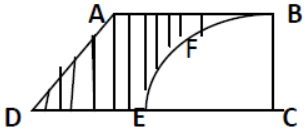
Answer: Let us identify the dimensions of the trapezium \( ABCD \).
Since \( AB \parallel CD \) and \( \angle BCD = 90^\circ \), \( BC = 3.5 \) cm is the vertical height.
The parallel sides are \( AB = 3.5 \) cm and \( CD \).
The quarter circle \( BFEC \) has radius \( r = BC = 3.5 \) cm, so \( EC = r = 3.5 \) cm.
The side \( CD = DE + EC = 2 + 3.5 = 5.5 \) cm.
The area of the trapezium \( ABCD \) is:
\( \text{Area of trapezium} = \frac{1}{2} \times (AB + CD) \times BC \)
\( \text{Area of trapezium} = \frac{1}{2} \times (3.5 + 5.5) \times 3.5 = \frac{1}{2} \times 9 \times 3.5 = 15.75 \text{ cm}^2 \).
The area of the removed quarter circle \( BFEC \) is:
\( \text{Area of quarter circle} = \frac{1}{4} \pi r^2 = \frac{1}{4} \times \frac{22}{7} \times 3.5 \times 3.5 = \frac{1}{4} \times 38.5 = 9.625 \text{ cm}^2 \).
The area of the remaining metal sheet is:
\( \text{Remaining Area} = 15.75 - 9.625 = 6.125 \text{ cm}^2 \).
Therefore, the area of the remaining metal sheet is 6.125 sq. cm.
In simple words: The total area of the trapezium is 15.75 sq. cm. Subtracting the quarter circle slice of 9.625 sq. cm leaves a remaining metal area of 6.125 sq. cm.
Exam Tip: Be sure to calculate the bottom side length \( CD \) first by summing \( DE \) and the quarter circle's radius \( EC \).
Surface Areas and Volumes
Question 1. A well of a diameter 3m is 14m deep dug the earth taken out of its spread evenly all around it to form an embankment of width 4m. Find the height of the embankment
Answer: Let the radius of the circular well be \( r = 1.5 \) m and its depth be \( h = 14 \) m.
The volume of the dug-out soil is:
\( V = \pi r^2 h = \pi \times (1.5)^2 \times 14 = 31.5\pi \text{ m}^3 \).
This soil is spread around the well to form a circular ring embankment of width 4 m.
The inner radius of the embankment is \( r = 1.5 \) m, and the outer radius is:
\( R = 1.5 + 4 = 5.5 \) m.
The surface area of the embankment ring is:
\( \text{Area} = \pi(R^2 - r^2) = \pi(5.5^2 - 1.5^2) = \pi(30.25 - 2.25) = 28\pi \text{ m}^2 \).
Let \( H \) be the height of the embankment:
\( \text{Height } H = \frac{\text{Volume of soil}}{\text{Area of embankment}} = \frac{31.5\pi}{28\pi} = 1.125 \) m.
Therefore, the height of the embankment is 1.125 m.
In simple words: The volume of soil dug out of the well is distributed over a ring-shaped surface around the opening. Dividing this volume by the ring's area gives a height of 1.125 meters.
Exam Tip: Keep \( \pi \) as a variable throughout your calculations, as it cancels out completely at the final division step.
Question 2. The radius of the base and the height of a right circular cylinder are in the ratio 2: 3 and its volume is 1617 cu. Cm. Find the Curved surface area of the cylinder (π = 22/7)
Answer: Let the base radius be \( r = 2x \) and the height be \( h = 3x \).
Given the volume of the cylinder is 1617 \( \text{cm}^3 \):
\( V = \pi r^2 h = 1617 \)
\( \frac{22}{7} \times (2x)^2 \times (3x) = 1617 \)
\( \frac{22}{7} \times 4x^2 \times 3x = 1617 \)
\( \frac{264}{7} x^3 = 1617 \)
\( x^3 = \frac{1617 \times 7}{264} = 42.875 \)
\( x = \sqrt[3]{42.875} = 3.5 \).
Now, the actual measurements are:
\( r = 2 \times 3.5 = 7 \) cm and \( h = 3 \times 3.5 = 10.5 \) cm.
The curved surface area is:
\( \text{CSA} = 2\pi r h = 2 \times \frac{22}{7} \times 7 \times 10.5 = 44 \times 10.5 = 462 \text{ cm}^2 \).
Therefore, the curved surface area of the cylinder is 462 sq. cm.
In simple words: The base radius is 7 cm and the height is 10.5 cm. Calculating the outer curved area with these dimensions yields exactly 462 sq. cm.
Exam Tip: Be sure to write down the ratio constant \( x \) and perform cubing on \( x \) properly when solving volume-ratio equations.
Question 3. A solid cylinder of diameter 12 cm and height 15 cm is melted and recast into toys with the shape of a right circular cone mounted on a hemisphere of radius 3cm, if the height of the toy is 12 cm, find the number of toys
Answer: For the solid cylinder:
Base radius \( R = 6 \) cm and height \( H = 15 \) cm.
\( \text{Volume of cylinder} = \pi R^2 H = \pi \times 6^2 \times 15 = 540\pi \text{ cm}^3 \).
For each composite toy:
Hemisphere radius \( r = 3 \) cm.
Cone base radius \( r = 3 \) cm.
Total height of the toy is 12 cm. Since the hemisphere radius is 3 cm, the cone height is:
\( h = 12 - 3 = 9 \) cm.
The volume of one toy is:
\( V_{\text{toy}} = \text{Volume of cone} + \text{Volume of hemisphere} \)
\( V_{\text{toy}} = \frac{1}{3}\pi r^2 h + \frac{2}{3}\pi r^3 \)
\( V_{\text{toy}} = \frac{1}{3}\pi \times 3^2 \times 9 + \frac{2}{3}\pi \times 3^3 \)
\( V_{\text{toy}} = 27\pi + 18\pi = 45\pi \text{ cm}^3 \).
The number of toys that can be made is:
\( \text{Number of toys} = \frac{\text{Volume of cylinder}}{V_{\text{toy}}} = \frac{540\pi}{45\pi} = 12 \).
Therefore, exactly 12 toys can be crafted.
In simple words: One toy requires \( 45\pi \) sq. cm of volume. Dividing the cylinder's total volume of \( 540\pi \) by this amount allows us to make exactly 12 toys.
Exam Tip: Carefully determine the height of the cone by subtracting the hemisphere's radius from the toy's total overall height.
Question 4. A farmer connects a pipe of internal diameter 20cm from a canal into a cylindrical tank in the field which is 10m in diameter and 2 meter deep? If water flows through the pipe at the rate of 6km per hour. In how much time the tank will be filled
Answer: Let us convert all measurements into meters.
For the circular pipe: radius \( r = 10 \text{ cm} = 0.1 \) m.
For the cylindrical tank: radius \( R = 5 \) m and depth \( H = 2 \) m.
The total volume of the tank is:
\( V_{\text{tank}} = \pi R^2 H = \pi \times 5^2 \times 2 = 50\pi \text{ m}^3 \).
The speed of water is 6 km/h, which is equal to 6000 m/h.
The volume of water delivered by the pipe per hour is:
\( V_{\text{water per hour}} = \pi r^2 \times \text{Speed} = \pi \times (0.1)^2 \times 6000 = 60\pi \text{ m}^3/\text{h} \).
The time required to fill the tank is:
\( \text{Time} = \frac{V_{\text{tank}}}{V_{\text{water per hour}}} = \frac{50\pi}{60\pi} = \frac{5}{6} \text{ hours} = 50 \text{ minutes} \).
Therefore, the tank will be filled in 50 minutes.
In simple words: The tank's volume is \( 50\pi \) cubic meters, and the pipe supplies \( 60\pi \) cubic meters of water per hour. This means the tank is filled in 5/6 of an hour, or 50 minutes.
Exam Tip: Be sure to keep consistent units (either all meters or all centimeters) across all parts of the calculation.
Question 5. A rocket in the form of a circular cylinder closed at the lower end. The diameter and height of the cylinder is 6m and 12m. The Cylindrical portion is Surmounted by a cone of the same radius that of cylinder, the slant height of the conical portion is 5cm. Find its total surface area and volume
Answer: Given that the rocket parts have a radius \( r = 3 \) m.
The cylinder height is \( H = 12 \) m.
The slant height of the cone is \( l = 5 \) m (noting 'cm' is a typo in the question).
The vertical height of the cone is:
\( h = \sqrt{l^2 - r^2} = \sqrt{5^2 - 3^2} = 4 \) m.
The total surface area includes the base, cylinder sides, and cone sides:
\( \text{TSA} = \pi r^2 + 2\pi r H + \pi r l = \pi r(r + 2H + l) \)
\( \text{TSA} = 3.14 \times 3 \times (3 + 24 + 5) = 9.42 \times 32 \approx 301.44 \text{ m}^2 \).
The total volume is the sum of cylinder and cone volumes:
\( \text{Volume} = \pi r^2 H + \frac{1}{3}\pi r^2 h \)
\( \text{Volume} = \pi \times 3^2 \times 12 + \frac{1}{3}\pi \times 3^2 \times 4 \)
\( \text{Volume} = 108\pi + 12\pi = 120\pi \approx 376.99 \text{ m}^3 \).
Therefore, the total surface area is 301.44 sq. m, and the volume is approximately 376.99 cubic m.
In simple words: The surface area is 301.44 sq. meters, and the total inner volume of the combined cylinder and cone parts is approximately 376.99 cubic meters.
Exam Tip: Write down all intermediate calculations clearly, and note that the lower end of the rocket is closed, so include the circular base in the TSA calculation.
Question 6. A cylindrical pipe has inner diameter of 7cm. Water is flowing through it at 192.5 liters per minute. Find the speed of the flow of water in km/h.
Answer: The diameter of the pipe is 7 cm, which means its radius is \( r = 3.5 \) cm.
The cross-sectional area of the pipe is:
\( A = \pi r^2 = \frac{22}{7} \times 3.5 \times 3.5 = 38.5 \text{ cm}^2 \).
The volume rate is 192.5 liters per minute, which is equal to 192,500 \( \text{cm}^3/\text{min} \).
The speed of water through the pipe is:
\( \text{Speed} = \frac{\text{Volume rate}}{A} = \frac{192,500}{38.5} = 5000 \text{ cm/min} = 50 \text{ m/min} \).
Convert the speed to kilometers per hour:
Speed = \( 50 \frac{\text{m}}{\text{min}} \times \frac{60 \text{ min}}{1 \text{ h}} \times \frac{1 \text{ km}}{1000 \text{ m}} = 3 \text{ km/h} \).
Therefore, the speed of flow is 3 km/h.
In simple words: Water moves through the pipe's cross-section at a rate of 5,000 cm per minute. Converting this into km/h gives a flow speed of exactly 3 km/h.
Exam Tip: Convert liters into cubic centimeters (1 Liter = 1000 cubic cm) to ensure consistent units for all terms.
Question 7. A solid is in the form of a cylinder with hemispherical ends. The total height of the solid is 19cm and the diameter of the Cylinder is 7 cm. Find the total surface area of a solid.
Answer: The base radius of the cylinder and hemispherical ends is \( r = 3.5 \) cm.
The total height is 19 cm, meaning the cylindrical height is:
\( H = 19 - 2r = 19 - 7 = 12 \) cm.
The total surface area includes the cylindrical side and both hemispherical end caps:
\( \text{TSA} = 2\pi r H + 2(2\pi r^2) = 2\pi r(H + 2r) \)
\( \text{TSA} = 2 \times \frac{22}{7} \times 3.5 \times (12 + 7) \)
\( \text{TSA} = 22 \times 19 = 418 \text{ cm}^2 \).
Therefore, the total surface area is 418 sq. cm.
In simple words: The cylinder has a length of 12 cm. Adding its curved area to the areas of both end caps yields a total combined surface area of 418 sq. cm.
Exam Tip: Subtracting twice the radius \( 2r \) from the total height is necessary to isolate the height of the cylindrical section.
Question 8. A wooden article was made by scooping out a hemisphere of radius 7cm, from each end of a solid cylinder of height 10cm and diameter 14cm. Find the total surface area of the article ( use ∏ = 22/7)
Answer: The radius of the cylinder and hemispheres is \( r = 7 \) cm.
The height of the cylinder is \( H = 10 \) cm.
The total surface area includes the curved cylindrical sides plus the inner scooped hemispherical areas:
\( \text{TSA} = 2\pi r H + 2(2\pi r^2) = 2\pi r(H + 2r) \)
\( \text{TSA} = 2 \times \frac{22}{7} \times 7 \times (10 + 14) \)
\( \text{TSA} = 44 \times 24 = 1056 \text{ cm}^2 \).
Therefore, the total surface area of the article is 1056 sq. cm.
In simple words: The inner scooped-out domes increase the total exposed area. Adding these dome areas to the outer cylinder area gives exactly 1,056 sq. cm.
Exam Tip: Scooping out hemispheres increases the surface area rather than decreasing it, as the inner hemispherical surfaces are now newly exposed.
Question 9. The sum of the radius of the base and height of a solid cylinder is 37cm. If the total surface area of the solid cylinder is 1628sqcm. Find the volume of the cylinder.
Answer: Given \( r + h = 37 \) cm.
The total surface area of the cylinder is:
\( \text{TSA} = 2\pi r(r + h) = 1628 \)
\( 2 \times \frac{22}{7} \times r \times 37 = 1628 \)
\( \frac{1628}{7} r = 1628 \implies r = 7 \) cm.
So the height is:
\( h = 37 - 7 = 30 \) cm.
The volume of the cylinder is:
\( V = \pi r^2 h = \frac{22}{7} \times 7^2 \times 30 = 22 \times 7 \times 30 = 4620 \text{ cm}^3 \).
Therefore, the volume of the cylinder is 4620 cubic cm.
In simple words: Solving the surface area equation gives a radius of 7 cm, making the height 30 cm. Substituting these values into the volume formula yields 4,620 cubic cm.
Exam Tip: Substituting the given value of \( (r+h) \) directly into the TSA formula simplifies the step of finding the radius \( r \).
Question 10. A cube and cuboids have the same volume, the dimension of the cuboid are in the ratio 1:2:4. If the difference between the Cost of polishing the cuboid and the cube at the rate of Rs 5 per sq m is Rs 80. Find their volumes
Answer: Let the dimensions of the cuboid be \( x \), \( 2x \), and \( 4x \).
Its volume is:
\( V_{\text{cuboid}} = x \times 2x \times 4x = 8x^3 \).
Since the cube has the same volume, its edge length is \( a = \sqrt[3]{8x^3} = 2x \).
Total Surface Area of the cube is:
\( A_{\text{cube}} = 6a^2 = 6(2x)^2 = 24x^2 \).
Total Surface Area of the cuboid is:
\( A_{\text{cuboid}} = 2(lb + bh + hl) = 2(2x^2 + 8x^2 + 4x^2) = 28x^2 \).
The difference in surface area is:
\( \Delta A = 28x^2 - 24x^2 = 4x^2 \).
The difference in polishing cost at Rs. 5 per sq. m is:
\( 5 \times 4x^2 = 80 \)
\( 20x^2 = 80 \implies x^2 = 4 \implies x = 2 \).
The volume is:
\( V = 8x^3 = 8(2)^3 = 64 \text{ m}^3 \).
Therefore, the volume is 64 cubic m.
In simple words: Using the polishing cost difference, we find the scale factor is 2. Substituting this back into the volume formula gives a total of 64 cubic meters.
Exam Tip: Represent the cube's side length in terms of \( x \) to keep both surface area equations consistent with one variable.
Question 11. Three cubes of a metal whose edges are in the ratio 3: 4: 5 are melted and converted into a single cube whose diagonal is 12√3. Find the edges. of three cubes
Answer: Let the edges of the three metal cubes be \( 3x \), \( 4x \), and \( 5x \).
The sum of their volumes is:
\( V_{\text{total}} = (3x)^3 + (4x)^3 + (5x)^3 = 27x^3 + 64x^3 + 125x^3 = 216x^3 \).
Let \( A \) be the edge length of the new single cube.
\( A^3 = 216x^3 \implies A = 6x \).
The diagonal of this new cube is given as \( A\sqrt{3} = 12\sqrt{3} \):
\( 6x\sqrt{3} = 12\sqrt{3} \implies 6x = 12 \implies x = 2 \).
The edge lengths of the three cubes are:
\( 3 \times 2 = 6 \) cm, \( 4 \times 2 = 8 \) cm, and \( 5 \times 2 = 10 \) cm.
In simple words: The new cube has an edge length of 12 cm. This allows us to solve for \( x = 2 \), which gives original cube edges of 6 cm, 8 cm, and 10 cm.
Exam Tip: Remember that the diagonal of any cube with side length \( s \) is given by the formula \( s\sqrt{3} \).
Question 12. Three cubes of each side 5 cm are joined end to end. Find the surface area of the resulting cuboids
Answer: When three cubes of side 5 cm are joined end to end, they form a cuboid with dimensions:
Length \( l = 15 \) cm, width \( w = 5 \) cm, and height \( h = 5 \) cm.
The total surface area of the resulting cuboid is:
\( \text{TSA} = 2(lw + wh + hl) \)
\( \text{TSA} = 2(15 \times 5 + 5 \times 5 + 5 \times 15) \)
\( \text{TSA} = 2(75 + 25 + 75) = 2(175) = 350 \text{ cm}^2 \).
Therefore, the surface area of the resulting cuboid is 350 sq. cm.
In simple words: Joining the three cubes forms a cuboid of length 15 cm. Calculating the surface area with its new dimensions yields exactly 350 sq. cm.
Exam Tip: Joining cubes only changes the length dimension; the width and height of the resulting shape remain unchanged.
Question 13. The surface area of a sphere is 616 cm2. Find its radius
Answer: Let \( r \) be the radius of the sphere.
The surface area of a sphere is \( 4\pi r^2 \):
\( 4\pi r^2 = 616 \)
\( 4 \times \frac{22}{7} \times r^2 = 616 \)
\( \frac{88}{7} r^2 = 616 \)
\( r^2 = \frac{616 \times 7}{88} = 7 \times 7 = 49 \)
\( r = 7 \) cm.
Therefore, the radius of the sphere is 7 cm.
In simple words: Setting up the sphere surface area equation, we find the squared radius is 49, giving an actual radius of exactly 7 cm.
Exam Tip: Keeping intermediate values as fractions helps simplify the calculations when dividing by \( 4\pi \).
Question 14. A path of 7m width runs around outside a circular park whose radius 18m. Find the area of path
Answer: The radius of the inner circular park is \( r = 18 \) m.
The outer radius including the 7 m wide path is:
\( R = 18 + 7 = 25 \) m.
The area of the circular path is the difference between the outer and inner areas:
\( \text{Area of path} = \pi(R^2 - r^2) = \frac{22}{7} \times (25^2 - 18^2) \)
\( \text{Area of path} = \frac{22}{7} \times (625 - 324) = \frac{22}{7} \times 301 \)
\( \text{Area of path} = 22 \times 43 = 946 \text{ m}^2 \).
Therefore, the area of the path is 946 sq. m.
In simple words: The outer ring has a radius of 25 m. Subtracting the inner circle area from the outer circle area leaves a path area of 946 sq. m.
Exam Tip: Be sure to add the path width to the inner radius to get the correct outer boundary radius.
Question 15. How many spherical lead shots each 4.2cm in diameter can be obtained from a rectangular solid of Lead with dimensions 66cm, 42cm and 21cm.
Answer: The volume of the rectangular solid of lead is:
\( V_{\text{solid}} = 66 \times 42 \times 21 = 58,212 \text{ cm}^3 \).
The diameter of each lead shot is 4.2 cm, meaning its radius is \( r = 2.1 \) cm.
The volume of one spherical lead shot is:
\( V_{\text{shot}} = \frac{4}{3}\pi r^3 = \frac{4}{3} \times \frac{22}{7} \times (2.1)^3 \)
\( V_{\text{shot}} = \frac{88}{21} \times 9.261 = 38.808 \text{ cm}^3 \).
The number of lead shots that can be obtained is:
\( \text{Number of shots} = \frac{V_{\text{solid}}}{V_{\text{shot}}} = \frac{58,212}{38.808} = 1500 \).
Therefore, exactly 1500 lead shots can be obtained.
In simple words: Dividing the total block volume of 58,212 cubic cm by the individual sphere volume of 38.808 cubic cm tells us we can craft exactly 1,500 spheres.
Exam Tip: Ensure that the diameter is divided by 2 to get the radius before calculating the volume of the sphere.
Question 16. A solid right circular cone of diameter of 14cm and height 8 cm is melted to form a hollow sphere. If the external diameter of the sphere is 10cm. Find its internal diameter.
Answer: For the solid cone: radius \( r = 7 \) cm and height \( h = 8 \) cm.
The volume of the cone is:
\( V_{\text{cone}} = \frac{1}{3}\pi r^2 h = \frac{1}{3}\pi \times 7^2 \times 8 = \frac{392\pi}{3} \text{ cm}^3 \).
For the hollow sphere: external radius \( R = 5 \) cm. Let \( r_i \) be the internal radius.
The volume of the hollow sphere is:
\( V_{\text{sphere}} = \frac{4}{3}\pi(R^3 - r_i^3) = \frac{4}{3}\pi(125 - r_i^3) \).
Since the cone is melted to form the sphere, their volumes are equal:
\( \frac{4}{3}\pi(125 - r_i^3) = \frac{392\pi}{3} \)
\( 4(125 - r_i^3) = 392 \)
\( 125 - r_i^3 = 98 \)
\( r_i^3 = 27 \implies r_i = 3 \) cm.
The internal diameter is \( 2 \times 3 = 6 \) cm.
In simple words: The volume of the metal remains constant. Solving the equation reveals that the inner radius of the hollow sphere is 3 cm, making the inner diameter 6 cm.
Exam Tip: Equate volumes and solve for \( r_i \) carefully. Remember to double the radius at the end to state the final diameter.
Question 17. A cone of base radius 20cm is divided into two parts by drawing a plane through the mid point of its Axis parallel to its base. Find the ratio of the Volume of the two parts.
Answer: Let the height of the original cone be \( H \) and its base radius be \( R = 20 \) cm.
The plane drawn through the midpoint of the axis divides the height into two equal halves of \( H/2 \).
The smaller upper cone has height \( H/2 \) and, by similar triangles, a base radius of \( R/2 = 10 \) cm.
The volume of the smaller upper cone is:
\( V_1 = \frac{1}{3}\pi \left(\frac{R}{2}\right)^2 \left(\frac{H}{2}\right) = \frac{1}{8} \left(\frac{1}{3}\pi R^2 H\right) = \frac{1}{8} V_{\text{total}} \).
The volume of the lower frustum part is:
\( V_2 = V_{\text{total}} - V_1 = \frac{7}{8} V_{\text{total}} \).
The ratio of the volume of the two parts is:
\( V_1 : V_2 = 1 : 7 \).
In simple words: The upper small cone has 1/8 of the total volume, leaving 7/8 for the lower frustum. This gives a volume ratio of exactly 1:7.
Exam Tip: The volume of similar cones scales with the cube of their linear dimensions, so a height ratio of \( \frac{1}{2} \) yields a volume ratio of \( \frac{1}{8} \).
Question 18. 21 Glass spheres each of radius 2cm are packed in a cuboidal box of internal dimensions 16cmx8cmx8cm and the box is filled with water. Find the volume of water filled in the box
Answer: The internal volume of the cuboidal box is:
\( V_{\text{box}} = 16 \times 8 \times 8 = 1024 \text{ cm}^3 \).
The volume of one glass sphere of radius 2 cm is:
\( V_{\text{sphere}} = \frac{4}{3}\pi r^3 = \frac{4}{3} \times \frac{22}{7} \times 2^3 = \frac{704}{21} \text{ cm}^3 \).
The combined volume of all 21 glass spheres is:
\( V_{\text{21 spheres}} = 21 \times \frac{704}{21} = 704 \text{ cm}^3 \).
The volume of water needed to fill the remaining space in the box is:
\( V_{\text{water}} = V_{\text{box}} - V_{\text{21 spheres}} = 1024 - 704 = 320 \text{ cm}^3 \).
Therefore, the volume of water filled is 320 cubic cm.
In simple words: The box has a capacity of 1,024 cubic cm. Since the 21 glass spheres occupy 704 cubic cm, the remaining 320 cubic cm space is filled with water.
Exam Tip: Notice how multiplying by 21 spheres nicely cancels out the denominator 21 in the volume equation.
Question 19. The radii of the internal and external surfaces of a metallic spherical shell are 3 cm and 5 cm reactively. It is melted and recast into a solid right circular cylinder of height 10 ⅔ cm. Find the diameter of the base of the cylinder
Answer: For the spherical shell: inner radius \( r = 3 \) cm and outer radius \( R = 5 \) cm.
The volume of the shell's metal is:
\( V_{\text{shell}} = \frac{4}{3}\pi(R^3 - r^3) = \frac{4}{3}\pi(125 - 27) = \frac{392\pi}{3} \text{ cm}^3 \).
The cylinder height is \( H = 10\frac{2}{3} = \frac{32}{3} \) cm.
Let \( R_c \) be the base radius of the cylinder.
\( V_{\text{cylinder}} = \pi R_c^2 H = \pi R_c^2 \times \frac{32}{3} \).
Equating the two volumes:
\( \pi R_c^2 \times \frac{32}{3} = \frac{392\pi}{3} \)
\( 32 R_c^2 = 392 \)
\( R_c^2 = \frac{392}{32} = 12.25 \implies R_c = 3.5 \) cm.
The base diameter is \( 2 \times 3.5 = 7 \) cm.
In simple words: The melted metal has a volume of \( \frac{392\pi}{3} \) cubic cm. Recasting it into a cylinder gives a base radius of 3.5 cm, which corresponds to a 7 cm base diameter.
Exam Tip: Retaining \( \pi \) as a variable on both sides simplifies the equation before calculating the base radius.
Question 20. A spherical copper shell, of external diameter 18cm, is melted and recast into a solid cone of base radius 14cm an Height 4 3/7cm Find the inner diameter of the shell
Answer: The external radius of the spherical shell is \( R = 9 \) cm. Let \( r \) be the inner radius.
The volume of the shell is:
\( V_{\text{shell}} = \frac{4}{3}\pi(R^3 - r^3) = \frac{4}{3}\pi(729 - r^3) \).
For the recast cone: base radius \( R_c = 14 \) cm and height \( h = 4\frac{3}{7} = \frac{31}{7} \) cm.
The volume of the cone is:
\( V_{\text{cone}} = \frac{1}{3}\pi R_c^2 h = \frac{1}{3}\pi \times 14^2 \times \frac{31}{7} = \frac{868\pi}{3} \text{ cm}^3 \).
Since the volumes are equal:
\( \frac{4}{3}\pi(729 - r^3) = \frac{868\pi}{3} \)
\( 4(729 - r^3) = 868 \)
\( 729 - r^3 = 217 \)
\( r^3 = 512 \implies r = 8 \) cm.
The inner diameter is \( 2 \times 8 = 16 \) cm.
In simple words: The volume of metal in the cone is \( \frac{868\pi}{3} \) cubic cm. Setting this equal to the shell's volume reveals that the inner radius is 8 cm, giving an inner diameter of 16 cm.
Exam Tip: Pay close attention when simplifying fractions with mixed numbers to ensure perfect computational accuracy.
Question 21. A hollow sphere of internal and external diameters 4cm and 8cm respectively is melted to form a cone of base diameter 8cm. Find the height and the slant height of the cone
Answer: For the hollow sphere: inner radius \( r = 2 \) cm and outer radius \( R = 4 \) cm.
The volume of the hollow sphere is:
\( V_{\text{sphere}} = \frac{4}{3}\pi(R^3 - r^3) = \frac{4}{3}\pi(64 - 8) = \frac{224\pi}{3} \text{ cm}^3 \).
For the cone: base radius \( R_c = 4 \) cm. Let \( h \) be the height.
The volume of the cone is:
\( V_{\text{cone}} = \frac{1}{3}\pi R_c^2 h = \frac{16\pi h}{3} \).
Equating the two volumes:
\( \frac{16\pi h}{3} = \frac{224\pi}{3} \implies 16h = 224 \implies h = 14 \) cm.
The slant height is:
\( l = \sqrt{R_c^2 + h^2} = \sqrt{4^2 + 14^2} = \sqrt{212} = 2\sqrt{53} \) cm.
Therefore, the height is 14 cm and the slant height is \( 2\sqrt{53} \) cm.
In simple words: The melted sphere's metal volume matches the cone's volume, giving a height of 14 cm. Using Pythagoras' theorem, the slant height is \( 2\sqrt{53} \) cm.
Exam Tip: Use the relationship \( l = \sqrt{r^2 + h^2} \) to correctly determine the slant height of a cone after finding its vertical height.
Question 22. The surface area of the sphere and cube are numerically equal. Prove that the volumes are in the ratio √6 : √π
Answer: Let \( r \) be the radius of the sphere and \( a \) be the edge length of the cube.
We are given that their surface areas are equal:
\( 4\pi r^2 = 6a^2 \implies \frac{r^2}{a^2} = \frac{6}{4\pi} = \frac{3}{2\pi} \implies \frac{r}{a} = \sqrt{\frac{3}{2\pi}} \).
The ratio of their volumes is:
\( \frac{V_{\text{sphere}}}{V_{\text{cube}}} = \frac{\frac{4}{3}\pi r^3}{a^3} = \frac{4}{3}\pi \left(\frac{r}{a}\right)^3 \)
Substitute \( \frac{r}{a} = \sqrt{\frac{3}{2\pi}} \) into the ratio equation:
\( \frac{V_{\text{sphere}}}{V_{\text{cube}}} = \frac{4}{3}\pi \left(\frac{3}{2\pi}\right)^{3/2} = \frac{4}{3}\pi \times \frac{3}{2\pi} \sqrt{\frac{3}{2\pi}} \)
\( \frac{V_{\text{sphere}}}{V_{\text{cube}}} = 2 \times \sqrt{\frac{3}{2\pi}} = \sqrt{\frac{12}{2\pi}} = \sqrt{\frac{6}{\pi}} = \frac{\sqrt{6}}{\sqrt{\pi}} \).
Therefore, the ratio of their volumes is \( \sqrt{6} : \sqrt{\pi} \).
In simple words: Setting their surface areas equal establishes a ratio between \( r \) and \( a \). Substituting this into the volume ratio yields the proven value of \( \sqrt{6} : \sqrt{\pi} \).
Exam Tip: Expressing the ratio \( \frac{r}{a} \) clearly as a radical makes it much simpler to substitute it into the cubed volume ratio expression.
Question 23. A bucket is in the form of a frustum of a cone with a capacity of 12308.8 cucm. The radii of the top and Bottom are 20cm and 12cm. Find the height of the bucket
Answer: Let the upper radius be \( R = 20 \) cm, the lower radius be \( r = 12 \) cm, and the capacity be \( V = 12,308.8 \text{ cm}^3 \).
The volume of a frustum is given by:
\( V = \frac{1}{3}\pi h (R^2 + r^2 + Rr) \)
Substitute the given values into the equation (using \( \pi \approx 3.14 \)):
\( 12308.8 = \frac{1}{3} \times 3.14 \times h \times (20^2 + 12^2 + 20 \times 12) \)
\( 12308.8 = \frac{3.14}{3} h \times (400 + 144 + 240) \)
\( 12308.8 = \frac{3.14}{3} h \times 784 \)
\( 12308.8 = 820.586 h \)
\( h = \frac{12308.8}{820.586} = 15 \) cm.
Therefore, the height of the bucket is 15 cm.
In simple words: Substituting the given dimensions into the frustum volume equation allows us to solve for a height of exactly 15 cm.
Exam Tip: Since the capacity value is a decimal, using \( \pi = 3.14 \) is usually the best choice for clean simplification.
Question 24. The radii of the circular ends of a bucket of height 15 cm are 14 cm and r cm(r <14 cm). If the volume of bucket is 5390cm3 , then find the value r.
Answer: Given frustum height \( H = 15 \) cm, upper radius \( R = 14 \) cm, and volume \( V = 5390 \text{ cm}^3 \).
The volume of a frustum is:
\( V = \frac{1}{3}\pi H (R^2 + r^2 + Rr) \)
\( 5390 = \frac{1}{3} \times \frac{22}{7} \times 15 \times (14^2 + r^2 + 14r) \)
\( 5390 = \frac{110}{7} (196 + r^2 + 14r) \)
Multiply both sides by \( \frac{7}{110} \):
\( 343 = 196 + r^2 + 14r \)
\( r^2 + 14r - 147 = 0 \)
Factoring this quadratic equation:
\( (r + 21)(r - 7) = 0 \).
Since the radius must be positive, we select \( r = 7 \) cm.
Therefore, the value of \( r \) is 7 cm.
In simple words: The quadratic equation derived from the volume formula gives two solutions. We pick the positive one, which gives an inner radius of 7 cm.
Exam Tip: Always discard the negative root of the quadratic equation since geometric dimensions like radius must be positive.
Question 25. The slant height of a frustum of a cone is 5 cm. If the difference between the radii of its two circular ends Is 4 cm, write the height of the frustum
Answer: For a frustum of a cone, the slant height \( l \) is related to its vertical height \( h \) by:
\( l = \sqrt{h^2 + (R - r)^2} \).
We are given that \( l = 5 \) cm and \( R - r = 4 \) cm.
Substitute these values into the equation:
\( 5 = \sqrt{h^2 + 4^2} \)
\( 25 = h^2 + 16 \)
\( h^2 = 9 \implies h = 3 \) cm.
Therefore, the height of the frustum is 3 cm.
In simple words: Using Pythagoras' theorem on the frustum's vertical cross-section, the height is found to be exactly 3 cm.
Exam Tip: This relation is a direct application of the Pythagorean theorem, which simplifies to a standard 3-4-5 right triangle.
Question 26. The slant height of a frustum of a cone is 4 cm and the circumferences of its circular ends are 18cm and 6 cm. Find curved surface area of the Frustum.
Answer: Let the slant height be \( l = 4 \) cm.
Let \( R \) and \( r \) be the radii of the circular ends.
The boundary circumferences are:
\( 2\pi R = 18 \implies \pi R = 9 \).
\( 2\pi r = 6 \implies \pi r = 3 \).
The curved surface area of a frustum is given by:
\( \text{CSA} = \pi(R + r)l = (\pi R + \pi r)l \)
Substitute the values into the equation:
\( \text{CSA} = (9 + 3) \times 4 = 12 \times 4 = 48 \text{ cm}^2 \).
Therefore, the curved surface area is 48 sq. cm.
In simple words: By writing the curved area formula in terms of the known boundary values, we find the curved surface area is exactly 48 sq. cm.
Exam Tip: Expressing \( \pi R \) and \( \pi r \) directly avoids the need to calculate the actual decimal values of the radii.
Question 27. A bucket made up of a metal sheet is in the form of a frustum of a cone of high 16cm with diameter of its lower and upper end are 16cm and 40cm Find the volume of the bucket.
Answer: Given frustum height \( h = 16 \) cm.
The lower radius is \( r = 8 \) cm, and the upper radius is \( R = 20 \) cm.
The volume of a frustum of a cone is:
\( V = \frac{1}{3}\pi h (R^2 + r^2 + Rr) \)
Substitute the given values into the formula (using \( \pi \approx 3.14 \)):
\( V = \frac{1}{3} \times 3.14 \times 16 \times (20^2 + 8^2 + 20 \times 8) \)
\( V = \frac{50.24}{3} \times (400 + 64 + 160) \)
\( V = \frac{50.24}{3} \times 624 \)
\( V = 50.24 \times 208 = 10449.92 \text{ cm}^3 \).
Therefore, the volume of the bucket is 10449.92 cubic cm.
In simple words: Setting up the frustum volume formula with the given radii and height yields a capacity of exactly 10,449.92 cubic cm.
Exam Tip: Be sure to divide the end diameters by 2 to get the correct radii values before starting the volume calculation.
Question 28. A tent is made in the form of a frustum of cone surmounted by another cone as shown in the figure. The diameters of the Frustum is 24m And 8m and the height of the frustum is 15m. If the total height of the tent is 18m, find the Quantity of Canvas required. Find the cost at Rs 7 per sqm
Answer: For the frustum base: lower radius \( R = 12 \) m, upper radius \( r = 4 \) m, and height \( h_1 = 15 \) m.
The total height of the tent is 18 m, meaning the height of the surmounting cone is:
\( h_2 = 18 - 15 = 3 \) m.
The base radius of this cone is equal to the upper radius of the frustum, \( r = 4 \) m.
The slant height of the cone is:
\( l_2 = \sqrt{r^2 + h_2^2} = \sqrt{4^2 + 3^2} = 5 \) m.
The slant height of the frustum is:
\( l_1 = \sqrt{h_1^2 + (R - r)^2} = \sqrt{15^2 + (12 - 4)^2} = \sqrt{225 + 64} = \sqrt{289} = 17 \) m.
The total quantity of canvas required is the sum of the curved surface areas:
\( \text{Total Area} = \text{CSA of frustum} + \text{CSA of cone} \)
\( \text{Total Area} = \pi(R + r)l_1 + \pi r l_2 \)
\( \text{Total Area} = \frac{22}{7} \times (12 + 4) \times 17 + \frac{22}{7} \times 4 \times 5 \)
\( \text{Total Area} = \frac{22}{7} \times (272 + 20) = \frac{22 \times 292}{7} \approx 917.71 \text{ m}^2 \).
The cost of canvas at Rs. 7 per sq. m is:
\( \text{Cost} = 7 \times \text{Total Area} = 7 \times \frac{22 \times 292}{7} = 22 \times 292 = \text{Rs. } 6424 \).
Therefore, the cost of canvas is Rs. 6,424.
In simple words: The canvas area is 917.71 sq. meters. Multiplying this area by the rate of Rs. 7 per sq. meter gives a total cost of Rs. 6,424.
Exam Tip: Be sure to sum the separate curved surface areas of both the frustum and the cone to find the total canvas needed.
Question 29. An open metal bucket is in the shape of a frustum of a cone of height 21 cm with radii of its lower and upper ends as 10 cm and 20 cm Respectively . Find the cost of milk which can completely fill the bucket at Rs 30 per litre
Answer: Given frustum height \( h = 21 \) cm, lower radius \( r = 10 \) cm, and upper radius \( R = 20 \) cm.
The volume of the bucket is:
\( V = \frac{1}{3}\pi h (R^2 + r^2 + Rr) \)
\( V = \frac{1}{3} \times \frac{22}{7} \times 21 \times (20^2 + 10^2 + 20 \times 10) \)
\( V = 22 \times (400 + 100 + 200) \)
\( V = 22 \times 700 = 15,400 \text{ cm}^3 = 15.4 \text{ liters} \).
The cost of milk at Rs. 30 per liter is:
\( \text{Cost} = 15.4 \times 30 = \text{Rs. } 462 \).
Therefore, the cost of milk required is Rs. 462.
In simple words: The bucket's capacity is exactly 15.4 liters. At a rate of Rs. 30 per liter, the total cost to fill the bucket with milk is Rs. 462.
Exam Tip: Remember that 1,000 cubic centimeters is exactly equal to 1 liter of volume.
Question 30. A cylinder and a cone are of same base radius and of same height. Find the ratio of the volume of cylinder to that of the cone
Answer: Let the cylinder and the cone have base radius \( r \) and height \( h \).
The volume of the cylinder is:
\( V_{\text{cylinder}} = \pi r^2 h \).
The volume of the cone is:
\( V_{\text{cone}} = \frac{1}{3}\pi r^2 h \).
The ratio of their volumes is:
\( \frac{V_{\text{cylinder}}}{V_{\text{cone}}} = \frac{\pi r^2 h}{\frac{1}{3}\pi r^2 h} = 3 : 1 \).
Therefore, the ratio of their volumes is 3 : 1.
In simple words: A cylinder holds exactly three times as much volume as a cone of the same height and base radius, making their volume ratio 3:1.
Exam Tip: This ratio is a standard geometric property; always express the comparison in its simplest whole-number form.
Question 31. The radii of the circular ends of a solid frustum of a cone are 18 cm and 12 cm and its height is 8 cm. Find its total Surface area
Answer: Given frustum dimensions: \( R = 18 \) cm, \( r = 12 \) cm, and \( h = 8 \) cm.
The slant height \( l \) of the frustum is:
\( l = \sqrt{h^2 + (R - r)^2} = \sqrt{8^2 + (18 - 12)^2} = \sqrt{64 + 36} = 10 \) cm.
The total surface area of a solid frustum includes the curved side and both circular ends:
\( \text{TSA} = \pi(R + r)l + \pi R^2 + \pi r^2 \)
\( \text{TSA} = \pi [ (18 + 12) \times 10 + 18^2 + 12^2 ] \)
\( \text{TSA} = \pi [ 300 + 324 + 144 ] \)
\( \text{TSA} = 768\pi \approx 768 \times 3.1416 = 2412.74 \text{ cm}^2 \).
Therefore, the total surface area of the frustum is approximately 2412.74 sq. cm.
In simple words: The slant height is 10 cm. Adding the area of the curved surface to both circular bases gives a total surface area of 2,412.74 sq. cm.
Exam Tip: Be sure to include both the upper and lower circular base areas when calculating the total surface area of a solid frustum.
Free study material for Mathematics
CBSE Class 10 Mathematics Worksheets for Chapter 11 Areas related to Circles
Mastering Chapter 11 Areas related to Circles with Printable Worksheets
Explore reliable practice questions for Chapter 11 Areas related to Circles tailored for Class 10 Mathematics learners. Use these structured worksheets to evaluate exam preparedness and strengthen problem-solving skills throughout the 2026 academic session.
Verified Solutions and NCERT Alignment
Designed around the official curriculum for Class 10 Mathematics, these practice sheets guarantee standard compliance. Reviewing step-by-step solutions after completion sharpens your accuracy and clarifies complex sub-topics within Chapter 11 Areas related to Circles.
Additional Study Resources for Class 10 Mathematics
Follow up your worksheet practice by attempting the interactive online MCQ tests for Chapter 11 Areas related to Circles to evaluate your execution speed. All printable assignments and revision sheets on our platform are updated for the 2026 session and available free of charge.
FAQs
You can download the latest chapter-wise printable worksheets for Class 10 Mathematics Chapter 11 Areas related to Circles for free from StudiesToday.com. These have been made as per the latest CBSE curriculum for this academic year.
Yes, Class 10 Mathematics worksheets for Chapter 11 Areas related to Circles focus on activity-based learning and also competency-style questions. This helps students to apply theoretical knowledge to practical scenarios.
Yes, we have provided solved worksheets for Class 10 Mathematics Chapter 11 Areas related to Circles to help students verify their answers instantly.
Yes, our Class 10 Mathematics test sheets are mobile-friendly PDFs and can be printed by teachers for classroom.
For Chapter 11 Areas related to Circles, regular practice with our worksheets will improve question-handling speed and help students understand all technical terms and diagrams.