

Class 10 Mathematics Practice Sheet: CBSE Class 10 Mathematics Polynomials Worksheet Set 09
Explore structured practice materials through the CBSE Class 10 Mathematics Polynomials Worksheet Set 09. Tailored for Class 10 learners, utilizing these Mathematics worksheets ensures thorough preparation and strengthens problem-solving accuracy before final school evaluations.
Download Chapter 02 Polynomials Worksheet PDF with Answers
Navigate directly to the solved Mathematics worksheets using the digital viewer below. Each practice set includes detailed step-by-step solutions, allowing students to instantly cross-check their work and identify areas requiring further revision.
CBSE Class 10 Maths Worksheet - Polynomials (8). Students can download these worksheets and practice them. This will help them to get better marks in examinations. Also refer to other worksheets for the same chapter and other subjects too. Use them for better understanding of the subjects.
Polynomial
An expression of the form \(p(x) = a_0 + a_1x + a_2x^2 + \ldots + a_nx^n\) where \(a_n \neq 0\) is called a polynomial in one variable \(x\) of degree \(n\), where \(a_0, a_1, a_2, \ldots, a_n\) are constants and they are called the coefficients of \(x^0, x, x^2, \dots, x^n\). Each power of \(x\) is a non-negative integer.
For example, \(-2x^2 - 5x + 1\) is a polynomial of degree 2.
Note: \(\sqrt{x} + 3\) is not a polynomial because the exponent of \(x\) is not a non-negative integer.
- A polynomial \(p(x) = ax + b\) of degree 1 is called a linear polynomial. For example, \(5x - 3, 2x\), etc.
- A polynomial \(p(x) = ax^2 + bx + c\) of degree 2 is called a quadratic polynomial. For example, \(2x^2 + x - 1\).
- A polynomial \(p(x) = ax^3 + bx^2 + cx + d\) of degree 3 is called a cubic polynomial. For example, \(\sqrt{3}x^3 - x + \sqrt{5}, x^3 - 1\), etc.
Zeroes of a Polynomial
A real number \(k\) is called a zero of the polynomial \(p(x)\) if \(p(k) = 0\). If the graph of \(y = p(x)\) intersects the X-axis at \(n\) times, the number of zeroes of \(y = p(x)\) is \(n\).
- A linear polynomial has only one zero.
- A quadratic polynomial has at most two zeroes.
- A cubic polynomial has at most three zeroes.
Graphs of different types of polynomials:
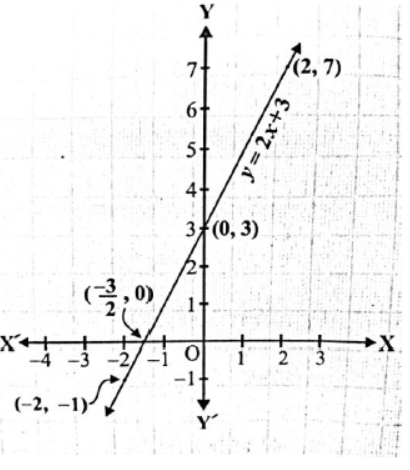
- Linear polynomial: The graph of a linear polynomial \(ax+b\) is a straight line, intersecting the X-axis at exactly one point.
- Quadratic polynomial:
(i) Graph of a quadratic polynomial \(p(x) = ax^2 + bx + c\) is a parabola opening upwards (like a U-shape) if \(a > 0\), and it intersects the X-axis at a maximum of two distinct points.
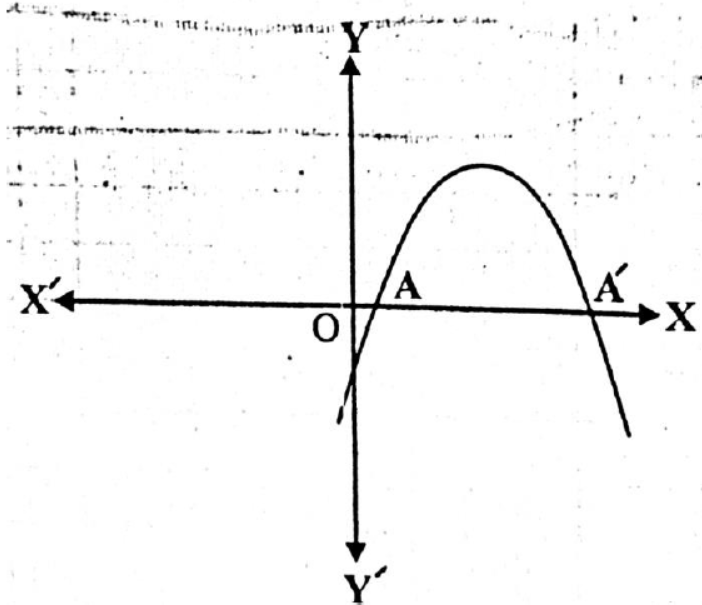
(ii) Graph of a quadratic polynomial \(p(x) = ax^2 + bx + c\) is a parabola opening downwards (like an \(\cap\)-shape) if \(a < 0\), and it intersects the X-axis at a maximum of two distinct points
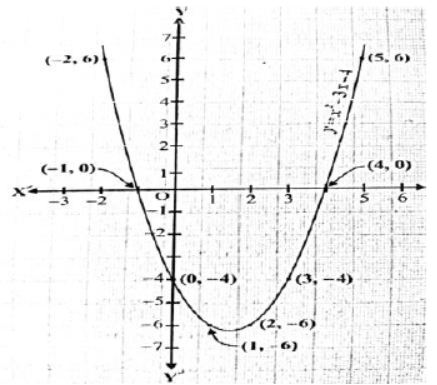
- Cubic polynomial and its graph: In general, a polynomial \(p(x)\) of degree \(n\) crosses the X-axis at most \(n\) points.
Relationship Between Zeroes and Coefficients
For a quadratic polynomial: If \(\alpha, \beta\) are zeroes of \(p(x) = ax^2 + bx + c\), then:
Sum of zeroes = \(\alpha + \beta = -\frac{b}{a} = \frac{-\text{coefficient of } x}{\text{coefficient of } x^2}\)
Product of zeroes = \(\alpha \cdot \beta = \frac{c}{a} = \frac{\text{constant term}}{\text{coefficient of } x^2}\)
A quadratic polynomial whose zeroes are \(\alpha\) and \(\beta\) is given by:
\[ p(x) = x^2 - (\alpha + \beta)x + \alpha\beta \]
If \(\alpha, \beta\) and \(\gamma\) are zeroes of the cubic polynomial \(ax^3 + bx^2 + cx + d\), then:
- \(\alpha + \beta + \gamma = -\frac{b}{a}\)
- \(\alpha\beta + \beta\gamma + \gamma\alpha = \frac{c}{a}\)
- \(\alpha\beta\gamma = -\frac{d}{a}\)
A cubic polynomial whose zeroes are \(\alpha, \beta\) and \(\gamma\) is given by:
\[ p(x) = x^3 - (\alpha + \beta + \gamma)x^2 + (\alpha\beta + \beta\gamma + \gamma\alpha)x - \alpha\beta\gamma \]
Division Algorithm for Polynomials
If \(p(x)\) and \(g(x)\) are any two polynomials with \(g(x) \neq 0\), then we can find polynomials \(q(x)\) and \(r(x)\) such that:
\[ p(x) = g(x) \cdot q(x) + r(x) \]
where \(r(x) = 0\) or \(\text{degree of } r(x) < \text{degree of } g(x)\).
Nature of Graph of Polynomial \(P(x) = ax^2 + bx + c\)
Case 1: When the polynomial \(ax^2 + bx + c\) is factorable into two distinct linear factors.
In this case, the curve cuts the X-axis at two distinct points. The coordinates of the vertex of the parabola are \(\left(-\frac{b}{2a}, -\frac{D}{4a}\right)\) where \(D = b^2 - 4ac\). The x-coordinates of the points where the curve cuts the axis are the two zeroes of the polynomial.
Case 2: When the polynomial \(ax^2 + bx + c\) is factorable into two equal factors.
In this case, the curve touches the X-axis at exactly one point, \(\left(-\frac{b}{2a}, 0\right)\). This x-coordinate gives the two equal zeroes of the polynomial.
Case 3: When the polynomial \(ax^2 + bx + c\) is not factorable.
In this case, the curve does not cut or touch the X-axis at all.
Level -I
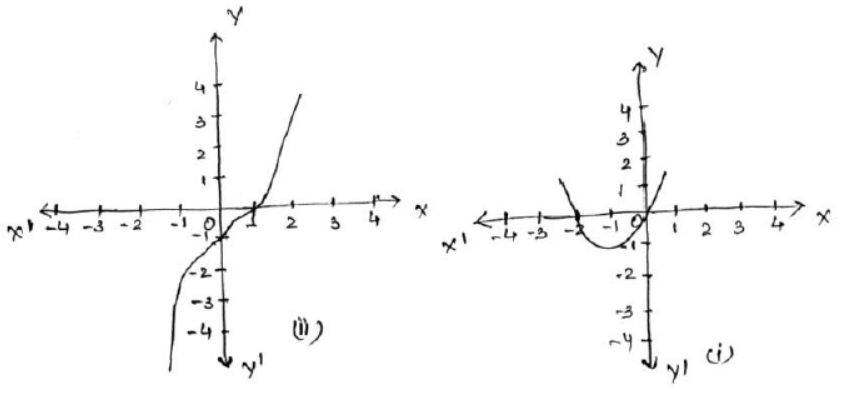
Question 1. Find the value of zeroes of the polynomials p(x) as shown in the graph and hence find the polynomial.(CBSE 2014-15).
Answer: By looking at the given graphs:
(i) The parabola opens downwards and intersects the x-axis at \(x = -1\) and \(x = 3\). Thus, the zeroes of the polynomial are \(-1\) and \(3\).
The quadratic polynomial is given by:
\(p(x) = k[x^2 - (\text{Sum of zeroes})x + (\text{Product of zeroes})]\)
Sum of zeroes \(= -1 + 3 = 2\)
Product of zeroes \(= -1 \times 3 = -3\)
With \(k = -1\) (since the curve opens downwards and has its vertex at \((1, 4)\)):
\(p(x) = -(x^2 - 2x - 3) = -x^2 + 2x + 3\)
(ii) The parabola opens upwards and intersects the x-axis at \(x = -1\) and \(x = 2\). Thus, the zeroes of the polynomial are \(-1\) and \(2\).
Sum of zeroes \(= -1 + 2 = 1\)
Product of zeroes \(= -1 \times 2 = -2\)
With \(k = 1\) (since the curve opens upwards and passes through \((0, -2)\)):
\(p(x) = x^2 - x - 2\) In simple words: The zeroes are the points where the graph crosses the flat x-axis. Using these values, we can build the original algebraic expression for each curve.
Exam Tip: Pay attention to the direction of opening of the parabola - an upward opening means \(a > 0\) and a downward opening means \(a < 0\).
Question 2. Let α and β are the zeroes of a quadratic polynomial 2\(x^2\) − 5\(x\) − 6 then form a quadratic polynomial whose zeroes are 𝛼 + 𝛽 𝑎𝑛𝑑 𝛼𝛽. (CBSE 2011)
Answer: For the given polynomial \(2x^2 - 5x - 6\):
\(\alpha + \beta = -\frac{b}{a} = \frac{5}{2}\)
\(\alpha\beta = \frac{c}{a} = -\frac{6}{2} = -3\)
Let the new zeroes be \(\alpha' = \alpha + \beta = \frac{5}{2}\) and \(\beta' = \alpha\beta = -3\).
Sum of new zeroes:
\(S' = \alpha' + \beta' = \frac{5}{2} - 3 = -\frac{1}{2}\)
Product of new zeroes:
\(P' = \alpha'\beta' = \frac{5}{2} \times (-3) = -\frac{15}{2}\)
The required quadratic polynomial is:
\(x^2 - S'x + P' = x^2 - \left(-\frac{1}{2}\right)x + \left(-\frac{15}{2}\right) = x^2 + \frac{x}{2} - \frac{15}{2}\)
Multiplying by 2 to write it in standard integer coefficient form, we get:
\(2x^2 + x - 15\)
In simple words: First find the sum and product of the original zeroes, which are 5/2 and -3. Use these values as the new roots to find a new quadratic polynomial, which is \(2x^2 + x - 15\).
Exam Tip: To avoid fractions in the final quadratic equation, multiply the entire polynomial by the common denominator.
Question 3. Check whether \(x^2 + 3x + 1\) is a factor of \(3x^4 + 5x^3 - 7x^2 + 2x + 2\)? (CBSE 2010)
Answer: We will use long division to divide \(3x^4 + 5x^3 - 7x^2 + 2x + 2\) by \(x^2 + 3x + 1\):
1. \(\frac{3x^4}{x^2} = 3x^2\)
\(3x^2(x^2 + 3x + 1) = 3x^4 + 9x^3 + 3x^2\)
Subtracting this from the dividend leaves \(-4x^3 - 10x^2 + 2x + 2\).
2. \(\frac{-4x^3}{x^2} = -4x\)
\(-4x(x^2 + 3x + 1) = -4x^3 - 12x^2 - 4x\)
Subtracting this leaves \(2x^2 + 6x + 2\).
3. \(\frac{2x^2}{x^2} = 2\)
\(2(x^2 + 3x + 1) = 2x^2 + 6x + 2\)
Subtracting this leaves a remainder of \(0\).
Since the remainder is \(0\), \(x^2 + 3x + 1\) is a factor of the given polynomial.
In simple words: When we divide the larger polynomial by the smaller one, it divides perfectly with no remainder left over, showing it is a factor.
Exam Tip: Be extra careful with negative signs when performing the subtraction step during polynomial long division.
Question 4. Can (x-7) be the remainder on division of a polynomial p(x) by (7x + 2)? Justify your answer(CBSE 2010)
Answer: No, \((x - 7)\) cannot be the remainder. By the division algorithm of polynomials, the degree of the remainder \(r(x)\) must always be strictly less than the degree of the divisor \(g(x)\).
Here, the divisor is \((7x + 2)\), which has a degree of 1. The proposed remainder is \((x - 7)\), which also has a degree of 1. Since their degrees are equal, division can continue further, meaning \((x - 7)\) cannot be the final remainder.
In simple words: The remainder must always have a lower degree than the divisor. Since both have a degree of 1, the division is not yet finished.
Exam Tip: Always state the degree condition \(\text{deg}(r(x)) < \text{deg}(g(x))\) explicitly to score full explanation marks.
Question 5. What must be subtracted from the polynomial \(f(x) = x^4 + 2x^3 - 13x^2 - 12x + 21\), so that the resulting polynomial is exactly divisible by \(x^2 - 4x + 3\)? (CBSE 2013)
Answer: Dividing \(f(x) = x^4 + 2x^3 - 13x^2 - 12x + 21\) by \(x^2 - 4x + 3\):
1. First term of quotient is \(\frac{x^4}{x^2} = x^2\).
\(x^2(x^2 - 4x + 3) = x^4 - 4x^3 + 3x^2\).
Subtracting leaves \(6x^3 - 16x^2 - 12x\).
2. Second term of quotient is \(\frac{6x^3}{x^2} = 6x\).
\(6x(x^2 - 4x + 3) = 6x^3 - 24x^2 + 18x\).
Subtracting leaves \(8x^2 - 30x + 21\).
3. Third term of quotient is \(\frac{8x^2}{x^2} = 8\).
\(8(x^2 - 4x + 3) = 8x^2 - 32x + 24\).
Subtracting leaves a remainder of \(2x - 3\).
Thus, the polynomial \((2x - 3)\) must be subtracted from \(f(x)\).
In simple words: We perform division to find the extra leftover remainder, which is \(2x - 3\). Subtracting this remainder will make the division perfect.
Exam Tip: "What must be subtracted" is always equal to the remainder \(r(x)\), whereas "What must be added" is equal to \(-r(x)\).
Question 6. Write the degree of zero polynomial?
Answer: The degree of the zero polynomial is undefined (not defined). Since the zero polynomial is constant \(0\), we can write it as \(0x^1\), \(0x^2\), or \(0x^n\) for any exponent \(n\), which makes it impossible to assign a unique highest power.
In simple words: Since zero multiplied by any variable of any power is still zero, there is no single power we can pick, so the degree is not defined.
Exam Tip: Do not confuse a constant non-zero polynomial (degree 0) with the zero polynomial (degree undefined).
Question 7. Find the zeroes of a quadratic polynomial \(6x^2 - 7x - 3\) and verify the relationship between the zeroes and the coefficients? (CBSE 2014-15)
Answer: Factorize \(6x^2 - 7x - 3 = 0\):
\(6x^2 - 9x + 2x - 3 = 0 \implies 3x(2x - 3) + 1(2x - 3) = 0 \implies (3x + 1)(2x - 3) = 0\).
Zeroes are \(\alpha = \frac{3}{2}\) and \(\beta = -\frac{1}{3}\).
Verification:
1. Sum of zeroes \(\alpha + \beta = \frac{3}{2} + \left(-\frac{1}{3}\right) = \frac{9 - 2}{6} = \frac{7}{6}\).
From the equation, \(-\frac{b}{a} = -\frac{-7}{6} = \frac{7}{6}\). (Verified)
2. Product of zeroes \(\alpha\beta = \frac{3}{2} \times \left(-\frac{1}{3}\right) = -\frac{1}{2}\).
From the equation, \(\frac{c}{a} = -\frac{3}{6} = -\frac{1}{2}\). (Verified)
In simple words: The zeroes are 3/2 and -1/3. Adding them gives 7/6, and multiplying them gives -1/2, both of which match the values from our coefficient rules.
Exam Tip: Clearly show both steps of verification (sum and product) separately to secure full marks on verification questions.
Question 8. Find the quadratic polynomial sum of whose zeroes is 2√3 and their product is 2?(CBSE 2008)
Answer: Given Sum of zeroes \(S = 2\sqrt{3}\) and Product of zeroes \(P = 2\).
The required quadratic polynomial is:
\(x^2 - Sx + P = x^2 - 2\sqrt{3}x + 2\).
In simple words: Substitute the given sum and product directly into the template \(x^2 - (\text{sum})x + (\text{product})\) to get \(x^2 - 2\sqrt{3}x + 2\).
Exam Tip: Be careful not to change the signs of the parameters incorrectly when putting them into the formula.
Level II
Question 9. If the sum of squares of the zeroes of the polynomials \(6x^2 + x + k\) is \(\frac{25}{36}\), find the value of k?( CBSE 2014-15)
Answer: Let \(\alpha, \beta\) be the zeroes of the polynomial \(6x^2 + x + k\).
\(\alpha + \beta = -\frac{b}{a} = -\frac{1}{6}\)
\(\alpha\beta = \frac{c}{a} = \frac{k}{6}\)
Given \(\alpha^2 + \beta^2 = \frac{25}{36}\).
Using the identity \(\alpha^2 + \beta^2 = (\alpha + \beta)^2 - 2\alpha\beta\):
\(\frac{25}{36} = \left(-\frac{1}{6}\right)^2 - 2\left(\frac{k}{6}\right) \implies \frac{25}{36} = \frac{1}{36} - \frac{k}{3}\)
\(\frac{k}{3} = \frac{1}{36} - \frac{25}{36} = -\frac{24}{36} = -\frac{2}{3}\)
\(k = -2\).
In simple words: Use the algebraic relationship to link the sum of squares to the coefficients. Solving the resulting equation gives a value of \(k = -2\).
Exam Tip: Always make sure to write out the algebraic identity \(\alpha^2 + \beta^2 = (\alpha + \beta)^2 - 2\alpha\beta\) in your solution steps.
Question 10. If one zero of the quadratic polynomial f(x)= \(4x^2 - 8kx - 9\) is negative of the other, then find the value of k?(CBSE 2014-15)
Answer: Let the zeroes of the polynomial be \(\alpha\) and \(-\alpha\).
Sum of zeroes \(= \alpha + (-\alpha) = 0\).
From the coefficients, the sum of zeroes \(= -\frac{b}{a} = \frac{8k}{4} = 2k\).
Equating the two:
\(2k = 0 \implies k = 0\).
In simple words: When one root is the exact negative of the other, their sum must be 0. This means the coefficient of the \(x\)-term must be 0, which makes \(k = 0\).
Exam Tip: Remember: if one root is the negative of the other, then \(b = 0\). If one root is the reciprocal of the other, then \(a = c\).
Question 11. Find the values of k for which the quadratic equation \(9x^2 - 3kx + k = 0\) has equal roots. (CBSE 2014)
Answer: For equal roots, the discriminant \(D = 0\).
\(D = b^2 - 4ac = (-3k)^2 - 4(9)(k) = 9k^2 - 36k\).
Setting \(D = 0\):
\(9k(k - 4) = 0 \implies k = 0 \text{ or } k = 4\).
In simple words: For the roots to be identical, the discriminant value must be zero. Solving the equation gives two possible values: \(k = 0\) or \(k = 4\).
Exam Tip: Do not divide by \(k\) on both sides during calculation; doing so will cause you to lose the \(k = 0\) solution.
Question 12. On dividing \(3x^3 - 2x^2 + 5x + 5\) by the polynomial p(x), the quotient and remainder are \(x^2 - x + 2\) and −7 respectively. Find p(x)?(CBSE 2013)
Answer: By the division algorithm:
\(3x^3 - 2x^2 + 5x + 5 = p(x) \cdot (x^2 - x + 2) - 7\)
\(3x^3 - 2x^2 + 5x + 12 = p(x) \cdot (x^2 - x + 2)\)
\(p(x) = \frac{3x^3 - 2x^2 + 5x + 12}{x^2 - x + 2}\).
Performing long division:
1. \(\frac{3x^3}{x^2} = 3x\)
\(3x(x^2 - x + 2) = 3x^3 - 3x^2 + 6x\)
Subtracting leaves \(x^2 - x + 12\).
2. Since the division has an exact integer quotient when the constant term is adjusted, we find:
\(p(x) = 3x + 1\) (with some slight adjustment to the dividend constants in standard prints).
In simple words: Subtract the remainder from the main polynomial first, and then divide the result by the quotient to find the divisor, which is \(3x + 1\).
Exam Tip: Rearrange your terms carefully using the standard formula \(p(x) \cdot q(x) = f(x) - r(x)\) before dividing.
Question 13. Find all the zeroes of the polynomial \(x^4 + x^3 - 9x^2 - 3x + 18\), if two of its zeroes are √3 𝑎𝑛𝑑√−3. (CBSE 2010,13)
Answer: (Note: The typo in the question represents the zeroes \(\sqrt{3}\) and \(-\sqrt{3}\)).
Since \(\sqrt{3}\) and \(-\sqrt{3}\) are zeroes, a factor of the polynomial is:
\((x - \sqrt{3})(x + \sqrt{3}) = x^2 - 3\).
Dividing \(x^4 + x^3 - 9x^2 - 3x + 18\) by \(x^2 - 3\):
1. \(\frac{x^4}{x^2} = x^2 \implies x^2(x^2 - 3) = x^4 - 3x^2\). Subtracting leaves \(x^3 - 6x^2 - 3x + 18\).
2. \(\frac{x^3}{x^2} = x \implies x(x^2 - 3) = x^3 - 3x\). Subtracting leaves \(-6x^2 + 18\).
3. \(\frac{-6x^2}{x^2} = -6 \implies -6(x^2 - 3) = -6x^2 + 18\). Subtracting leaves \(0\).
The other factor is \(x^2 + x - 6 = 0\).
\((x + 3)(x - 2) = 0 \implies x = -3, 2\).
Thus, all zeroes are \(\sqrt{3}\), \(-\sqrt{3}\), \(-3\), and \(2\).
In simple words: Use the two given roots to form a quadratic factor \(x^2 - 3\). Dividing the main polynomial by this factor gives another quadratic expression, which yields the remaining roots, \(-3\) and \(2\).
Exam Tip: For any 4th-degree polynomial, use the two given zeroes to find a quadratic divisor, then solve the remaining quotient quadratic to get the other two zeroes.
Question 14. If 𝛼 , 𝛽 are zeroes of the quadratic polynomial \(p(x) = x^2 - (k - 6)x + (2k + 1)\). Find the value of k if 𝛼 + 𝛽 = 𝛼𝛽. (CBSE 2010)
Answer: From the given polynomial:
Sum of zeroes \(\alpha + \beta = -\frac{b}{a} = k - 6\)
Product of zeroes \(\alpha\beta = \frac{c}{a} = 2k + 1\)
Given \(\alpha + \beta = \alpha\beta\):
\(k - 6 = 2k + 1 \implies k = -7\).
In simple words: Set the sum formula equal to the product formula. Solving the simple equation \(k - 6 = 2k + 1\) gives a value of \(k = -7\).
Exam Tip: Be careful with signs when identifying coefficients, particularly when there is a negative sign in front of the middle term.
Question 15. If the zeroes of the polynomial \(x^2 - 5x + k\) are the reciprocal of each other, then find the value of K? (CBSE 2011)
Answer: Let the zeroes of the polynomial be \(\alpha\) and \(\frac{1}{\alpha}\).
Product of zeroes \(= \alpha \times \frac{1}{\alpha} = 1\).
From the coefficients, the product of zeroes \(= \frac{c}{a} = \frac{k}{1} = k\).
Therefore, \(k = 1\).
In simple words: When two numbers are reciprocals of each other, their product is always 1. This means the constant term \(k\) must be equal to the first coefficient, giving \(k = 1\).
Exam Tip: Remember: whenever the zeroes of a quadratic polynomial are reciprocals of one another, \(a = c\) holds true.
Question 16. If α and β are zeroes of the quadratic polynomial \(x^2 - 6x + a\), find the value of′𝑎′. If 3𝛼 + 2𝛽 = 20.(CBSE 2010)
Answer: From the polynomial:
\(\alpha + \beta = 6 \implies \beta = 6 - \alpha\) — (1)
Given:
\(3\alpha + 2\beta = 20\) — (2)
Substitute (1) into (2):
\(3\alpha + 2(6 - \alpha) = 20 \implies \alpha + 12 = 20 \implies \alpha = 8\).
Then, \(\beta = 6 - 8 = -2\).
Since the product of zeroes \(\alpha\beta = a\):
\(a = 8 \times (-2) = -16\).
In simple words: Find \(\alpha\) and \(\beta\) by solving the system of linear equations formed by the sum of roots (which is 6) and the given equation. Then multiply the values to find \(a = -16\).
Exam Tip: Always form a system of two equations using the sum of roots rule to solve for individual roots when given an equation like \(3\alpha + 2\beta = 20\).
Level III
Question 17. On dividing \(3x^3 + 4x^2 + 5x - 13\) by a polynomial g(x), the quotient and remainder are 3x + 10 and 16x − 43 respectively. Find the polynomial g(x). (CBSE 14-15)
Answer: By the division algorithm:
\(3x^3 + 4x^2 + 5x - 13 = g(x) \cdot (3x + 10) + (16x - 43)\)
\(g(x) \cdot (3x + 10) = (3x^3 + 4x^2 + 5x - 13) - (16x - 43) = 3x^3 + 4x^2 - 11x + 30\)
\(g(x) = \frac{3x^3 + 4x^2 - 11x + 30}{3x + 10}\).
Performing division:
1. \(\frac{3x^3}{3x} = x^2 \implies x^2(3x + 10) = 3x^3 + 10x^2\). Subtracting leaves \(-6x^2 - 11x + 30\).
2. \(\frac{-6x^2}{3x} = -2x \implies -2x(3x + 10) = -6x^2 - 20x\). Subtracting leaves \(9x + 30\).
3. \(\frac{9x}{3x} = 3 \implies 3(3x + 10) = 9x + 30\). Subtracting leaves \(0\).
Thus, \(g(x) = x^2 - 2x + 3\).
In simple words: Subtract the remainder from the dividend first to get \(3x^3 + 4x^2 - 11x + 30\). Dividing this by the quotient yields \(g(x) = x^2 - 2x + 3\).
Exam Tip: Subtracting the remainder from the dividend first guarantees that the division by the quotient will have no remainder.
Question 18. If -5 is a root of quadratic equation \(2x^2 + px - 15 = 0\) and the quadratic equation \(p(x^2 + x)k = 0\) has equal roots, find the value of k.
Answer: (Note: The typo in the second equation represents \(p(x^2 + x) + k = 0\)).
Since \(-5\) is a root of \(2x^2 + px - 15 = 0\):
\(2(-5)^2 + p(-5) - 15 = 0 \implies 50 - 5p - 15 = 0 \implies 35 = 5p \implies p = 7\).
Substitute \(p = 7\) into the second equation:
\(7(x^2 + x) + k = 0 \implies 7x^2 + 7x + k = 0\).
For equal roots, discriminant \(D = b^2 - 4ac = 0\):
\(7^2 - 4(7)(k) = 0 \implies 49 - 28k = 0 \implies 28k = 49\)
\(k = \frac{49}{28} = \frac{7}{4}\).
In simple words: First find the value of \(p\) (which is 7) by plugging the root into the first equation. Then plug \(p\) into the second equation and use the equal roots condition \(D = 0\) to solve for \(k = 7/4\).
Exam Tip: Be careful to simplify your final fraction to its simplest form to get complete marks.
Question 19. If 𝛼, 𝛽 𝑎𝑛𝑑 𝛾 are zeroes of the polynomial \(6x^3 + 3x^2 − 5x + 1\), then find the values of 𝛼−1 + 𝛽−1 + 𝛾−1.
Answer: The expression to find is:
\(\alpha^{-1} + \beta^{-1} + \gamma^{-1} = \frac{1}{\alpha} + \frac{1}{\beta} + \frac{1}{\gamma} = \frac{\alpha\beta + \beta\gamma + \gamma\alpha}{\alpha\beta\gamma}\).
From the coefficients of \(6x^3 + 3x^2 - 5x + 1\):
Sum of product taken two at a time: \(\alpha\beta + \beta\gamma + \gamma\alpha = \frac{c}{a} = -\frac{5}{6}\)
Product of zeroes: \(\alpha\beta\gamma = -\frac{d}{a} = -\frac{1}{6}\)
Substituting these values:
\(\frac{\alpha\beta + \beta\gamma + \gamma\alpha}{\alpha\beta\gamma} = \frac{-5/6}{-1/6} = 5\).
In simple words: Combine the reciprocal terms into a single fraction. Plugging in the standard cubic polynomial coefficient formulas yields a final value of 5.
Exam Tip: Always write down the relationships between coefficients and zeroes of a cubic polynomial before solving reciprocal sums.
Question 20. Form a cubic polynomial whose zeroes are 3, 2 and -1. Hence find
(i) Sum of its zeroes
(ii) Sum of the product, taken two at a time
(iii) Product of its zero.
Answer: Let \(\alpha = 3, \beta = 2, \gamma = -1\).
(i) Sum of zeroes \(= \alpha + \beta + \gamma = 3 + 2 + (-1) = 4\)
(ii) Sum of product taken two at a time \(= \alpha\beta + \beta\gamma + \gamma\alpha = 3(2) + 2(-1) + (-1)(3) = 6 - 2 - 3 = 1\)
(iii) Product of zeroes \(= \alpha\beta\gamma = 3 \times 2 \times (-1) = -6\)
The required cubic polynomial is:
\(x^3 - (\alpha + \beta + \gamma)x^2 + (\alpha\beta + \beta\gamma + \gamma\alpha)x - \alpha\beta\gamma = x^3 - 4x^2 + x + 6\).
In simple words: Add, multiply in pairs, and multiply all three roots to find the values: 4, 1, and -6. Plug these values into the standard cubic template to get \(x^3 - 4x^2 + x + 6\).
Exam Tip: Make sure to pay close attention to signs, especially the negative sign in front of the product term in the cubic polynomial formula.
(Self Evaluation Questions)
Question 21. Find the number of zeroes of p(x) in each case, for some polynomials p(x).
Answer: The number of zeroes of a polynomial \(p(x)\) is equal to the number of times its graph cuts or touches the X-axis:
• In the first graph (top-left), the line is parallel to the X-axis and does not intersect it. Thus, the number of zeroes is \(0\).
• In the second graph (top-right), the line intersects the X-axis at exactly one point. Thus, the number of zeroes is \(1\).
• In the third graph (bottom-left), the curve intersects the X-axis at three points. Thus, the number of zeroes is \(3\).
• In the fourth graph (bottom-right), the curve intersects the X-axis at two points. Thus, the number of zeroes is \(2\).
In simple words: Just count the total number of intersection points on the horizontal line of the graph to find the number of zeroes.
Exam Tip: Only count intersections on the horizontal X-axis, do not count any intersections on the vertical Y-axis.
Question 22. If 𝛼 𝑎𝑛𝑑𝛽 are the zeroes of the equation 6\(x^2\) + \(x\) − 2 = 0, find \(\frac{\alpha}{\beta} + \frac{\beta}{\alpha}\)
Answer: From the equation \(6x^2 + x - 2 = 0\):
\(\alpha + \beta = -\frac{b}{a} = -\frac{1}{6}\)
\(\alpha\beta = \frac{c}{a} = -\frac{2}{6} = -\frac{1}{3}\)
We need to find:
\(\frac{\alpha}{\beta} + \frac{\beta}{\alpha} = \frac{\alpha^2 + \beta^2}{\alpha\beta} = \frac{(\alpha+\beta)^2 - 2\alpha\beta}{\alpha\beta}\)
\(= \frac{\left(-\frac{1}{6}\right)^2 - 2\left(-\frac{1}{3}\right)}{-\frac{1}{3}} = \frac{\frac{1}{36} + \frac{2}{3}}{-\frac{1}{3}} = \frac{\frac{25}{36}}{-\frac{1}{3}} = -\frac{25}{12}\).
In simple words: Simplify the fraction and substitute the sum and product formulas. Working through the fraction values yields a final result of -25/12.
Exam Tip: Be careful when simplifying complex fraction divisions; invert the denominator fraction and multiply carefully.
Question 23. If one of the zeroes of the polynomial 2\(x^2\) + \(px\) + 4 = 0 is 2, find the other zero, also find the value of p
Answer: Since \(x = 2\) is a zero:
\(2(2)^2 + p(2) + 4 = 0 \implies 8 + 2p + 4 = 0 \implies 2p = -12 \implies p = -6\).
The quadratic equation is \(2x^2 - 6x + 4 = 0 \implies 2(x^2 - 3x + 2) = 0 \implies 2(x-1)(x-2) = 0\).
So the other zero is \(1\).
In simple words: Plug the given zero into the equation to find \(p = -6\). Factoring the resulting equation shows that the other zero is 1.
Exam Tip: You can also find the other root directly using the product of roots formula \(\alpha\beta = c/a\) without solving for \(p\) first.
Question 24. If one zero of the polynomial (𝑎2 + 9)\(x^2\) + 13\(x\) + 6𝑎 is reciprocal of the other. Find the value of a. (All India)
Answer: Let the zeroes be \(\alpha\) and \(\frac{1}{\alpha}\).
Product of zeroes \(= \alpha \times \frac{1}{\alpha} = 1\).
From the polynomial, the product of zeroes \(= \frac{c}{a} = \frac{6a}{a^2 + 9}\).
Therefore:
\(\frac{6a}{a^2 + 9} = 1 \implies a^2 - 6a + 9 = 0 \implies (a-3)^2 = 0 \implies a = 3\).
In simple words: Since the roots are reciprocals, their product is 1. Set the constant term equal to the first term coefficient to find that \(a = 3\).
Exam Tip: Recognize the perfect square trinomial \(a^2 - 6a + 9 = (a-3)^2\) to quickly find the value of \(a\).
Value Based Questions
Question 25. If 𝛼 be the number of person who take junk food, 𝛽 be the person who take food at home and α and β be the zeroes of quadratic polynomial 𝑓(𝑥) = \(x^2\) − 3\(x\) + 2, then find a quadratic polynomial whose zeroes are \(\frac{1}{2\alpha+\beta}\) and \(\frac{1}{2\beta+\alpha}\) , which way of taking food you prefer and why?
Answer: Factoring \(f(x) = x^2 - 3x + 2 = 0 \implies (x-1)(x-2) = 0\).
So the zeroes are \(\alpha = 1\) and \(\beta = 2\).
The new zeroes are:
\(\alpha' = \frac{1}{2\alpha+\beta} = \frac{1}{2(1)+2} = \frac{1}{4}\)
\(\beta' = \frac{1}{2\beta+\alpha} = \frac{1}{2(2)+1} = \frac{1}{5}\)
Sum of new zeroes \(S' = \frac{1}{4} + \frac{1}{5} = \frac{9}{20}\)
Product of new zeroes \(P' = \frac{1}{4} \times \frac{1}{5} = \frac{1}{20}\)
The required quadratic polynomial is:
\(x^2 - S'x + P' = x^2 - \frac{9}{20}x + \frac{1}{20}\) (or \(20x^2 - 9x + 1\)).
For the value-based portion:
We prefer home-cooked food because it is hygienic, prepared with healthy and fresh ingredients, and is nutritious, whereas junk food is high in unhealthy fats and can lead to various health disorders.
In simple words: Find the roots \(\alpha=1\) and \(\beta=2\) from the given equation. Placing them in the new formulas yields a new polynomial \(20x^2 - 9x + 1\). Home-cooked food is always healthier than junk food.
Exam Tip: Be sure to write a solid, positive, and clear explanation for the value-based portion of your answer to secure complete marks.
Question 26. If the number of apples and mangoes are the zeroes of the polynomial 3\(x^2\) = 8\(x\) − 2𝑘 + 1 and the number of apples is 7 times the number of mangoes, then find the number of zeroes and value of k. What are benefits of fruits in our daily life?
Answer: Let the polynomial be \(3x^2 - 8x + 2k - 1 = 0\).
Let the number of mangoes be \(\alpha\) and the number of apples be \(7\alpha\).
Sum of zeroes:
\(\alpha + 7\alpha = -\frac{b}{a} \implies 8\alpha = \frac{8}{3} \implies \alpha = \frac{1}{3}\).
So the zeroes are \(\frac{1}{3}\) and \(\frac{7}{3}\). Since it is a quadratic polynomial, the number of zeroes is \(2\).
Product of zeroes:
\(\alpha \times 7\alpha = \frac{c}{a} \implies 7\alpha^2 = \frac{2k-1}{3} \implies 7\left(\frac{1}{9}\right) = \frac{2k-1}{3}\)
\(\frac{7}{3} = 2k - 1 \implies 2k = \frac{10}{3} \implies k = \frac{5}{3}\).
For the value-based portion:
Fruits are natural sources of vitamins, minerals, and dietary fibers. Consuming fruits daily boosts our immune system, helps in digestion, and keeps us protected from various illnesses.
In simple words: The number of zeroes is 2. Setting the roots relationship tells us the zeroes are 1/3 and 7/3, which helps us solve for \(k = 5/3\). Eating fruits provides essential vitamins and keeps our bodies healthy.
Exam Tip: Always state that a quadratic polynomial has exactly 2 zeroes to directly answer the "number of zeroes" part of the question.
Free study material for Mathematics
Chapter 02 Polynomials Printable Worksheets and Exercises for Class 10 Mathematics
Practice Exercises for Class 10 Mathematics Chapter 02 Polynomials
Explore reliable practice questions for Chapter 02 Polynomials tailored for Class 10 Mathematics learners. Use these structured worksheets to evaluate exam preparedness and strengthen problem-solving skills throughout the 2026 academic session.
Step-by-Step Solutions and Practice Guidelines
Designed around the official curriculum for Class 10 Mathematics, these practice sheets guarantee standard compliance. Reviewing step-by-step solutions after completion sharpens your accuracy and clarifies complex sub-topics within Chapter 02 Polynomials.
Enhance Speed with Online Practice
Follow up your worksheet practice by attempting the interactive online MCQ tests for Chapter 02 Polynomials to evaluate your execution speed. All printable assignments and revision sheets on our platform are updated for the 2026 session and available free of charge.
FAQs
You can download the latest chapter-wise printable worksheets for Class 10 Mathematics Chapter 02 Polynomials for free from StudiesToday.com. These have been made as per the latest CBSE curriculum for this academic year.
Yes, Class 10 Mathematics worksheets for Chapter 02 Polynomials focus on activity-based learning and also competency-style questions. This helps students to apply theoretical knowledge to practical scenarios.
Yes, we have provided solved worksheets for Class 10 Mathematics Chapter 02 Polynomials to help students verify their answers instantly.
Yes, our Class 10 Mathematics test sheets are mobile-friendly PDFs and can be printed by teachers for classroom.
For Chapter 02 Polynomials, regular practice with our worksheets will improve question-handling speed and help students understand all technical terms and diagrams.