

Download Class 10 Mathematics Practice Worksheets
Review targeted academic worksheets with the CBSE Class 10 Mathematics Arithmetic Progression Worksheet Set 02. Built according to official educational standards for the 2026-27 term, these downloadable Class 10 Mathematics resources support effective daily practice and detailed self-evaluation for Chapter 05 Arithmetic Progression.
Access Chapter 05 Arithmetic Progression Practice Papers and Solutions
Navigate directly to the solved Mathematics worksheets using the digital viewer below. Each practice set includes detailed step-by-step solutions, allowing students to instantly cross-check their work and identify areas requiring further revision.
Arithmetic Progression MCQ Questions with Answers Class 10
Answer : 3
Question. In an AP, if d = – 4, n = 7, an = 4, then a is
(a) 6
(b) 7
(c) 20
(d) 28
Answer : D
Question. The nth term of the AP: a, 3a, 5a, ... is
(a) na
(b) (2n – 1)a
(c) (2n + 1)a
(d) 2na
Answer : B
Question. The first term of an AP is p and the common difference is q, then its 10th term is
(a) q + 9p
(b) p – 9q
(c) p + 9q
(d) 2p + 9p
Answer : C
Question. If 4/5, a, 2 are three consecutive terms of an AP, then the value of a is
(a) 5/2
(b) 2/7
(c) 5/7
(d) 7/5
Answer : A
Answer the following:
Question. Write first four terms of the AP, whose first term and the common difference are given as follows: a = 10, d = 10
Answer : 10, 20, 30, 40
(2) Find the 10th term of the AP: 2, 7, 12, ...
Answer : 47
Question. In the given AP, find the missing terms: ......., 13, ......., 3.
Answer : 18, 8
Question. Find the 6th term from the end of the AP: 17, 14, 11, ..., –40.
Answer : –25
Question. Which term of the AP: 21, 18, 15, ... is zero?
Answer : 8
Question. Write the next term of the AP: √8, √18, √32 , ...........
Answer : √50 or 5√2
Question. Find a, b, and c such that the numbers a, 7, b, 23, c are in AP.
Answer : a = –1, b = 15, c = 31
Question. Find the 9th term from the end (towards the first term) of the AP: 5, 9, 13, ..., 185.
Answer : Reversing the given AP, we get
185, 181, 174, ..., 9, 5
Ninth term a9 = a + (9 – 1)d
= 185 + 8 × (– 4)
= 185 – 32
= 153
Question. For what value of k will k + 9, 2k – 1 and 2k + 7 are the consecutive terms of an AP?
Answer : Given that k + 9, 2k – 1 and 2k + 7 are in AP
Then,
(2k – 1) – (k + 9) = (2k + 7) – (2k – 1)
⇒ k – 10 = 8
⇒ k = 18
Question. For what value of k will the consecutive terms 2k + 1, 3k + 3 and 5k – 1 form an AP?
Answer : Given that 2k + 1, 3k + 3 and 5k – 1 are in AP.
So, (3k + 3) – (2k + 1) = (5k – 1) – (3k + 3)
⇒ k + 2 = 2k – 4
⇒ 2k – k = 2 + 4
⇒ k = 6
Question. Find the eleventh term from the last term of the AP: 27, 23, 19, ..., –65.
Answer : a11 = –25
Question. If the first three terms of an AP are b, c and 2b, then find the ratio of b and c.
Answer : b, c and 2b are in AP
⇒ c = 3b/2
∴ b : c = 2 : 3
Question. Find the value of x so that –6, x, 8 are in AP.
Answer : 1
Question. Find the 11th term of the AP: –27, –22, –17, –12, ... .
Answer : 23
Question. The nth term of an AP is (7 – 4n), then what is its common difference?
Answer : an = 7 – 4n
⇒ a1 = 7 – 4 × 1 = 3
⇒ a2 = 7 – 4 × 2 = 7 – 8 = –1
a3 = 7 – 4 × 3 = 7 – 12 = –5
Now, a2 – a1 = –1 – 3 = –4
a3 – a2 = –5 – (–1)
= –5 + 1 = –4
So, the common difference of AP is –4.
Question. Find the common difference of the AP whose first term is 12 and fifth term is 0.
Answer : A5 = a1 + 4d = 0
12 + 4d = 0
d = –3
Assertion Reasoning Questions Arithmetic Progression
Directions:
(a) If both Assertion and Reason are correct and Reason is the correct explanation of Assertion.
(b) If both Assertion and Reason are correct, but Reason is not the correct explanation of Assertion.
(c) If Assertion is correct but Reason is incorrect.
(d) If Assertion is incorrect but Reason is correct.
Question. Assertion : If Sn is the sum of the first n terms of an A.P., then its nth term an is given by an = Sn – Sn – 1 .
Reason : The 10th term of the A.P. 5, 8, 11, 14, ………………. is 35.
Answer : C
Question. Assertion: arithmetic mean between 5 and 90 is 47.5
Reason: arithmetic mean between two given number a,b is (a+b)/2
Answer : A
Question. Assertion: the value of n, if a = 10, d = 5, an = 95.
Reason: the formula of general term an is an= a+(n-1)d.
Answer : A
Question. Assertion: The constant difference between any two terms of an AP is commonly known as common difference
Reason: the common difference of 2,4,6,8 this A.P. sequence is 2
Answer : A
Question. Assertion : Let the positive numbers a, b, c be in A.P., then 1/bc, 1/ac, 1/ab are also in A.P.
Reason : If each term of an A.P. is divided by abc, then the resulting sequence is also in A.P.
Answer : A
CASE STUDY QUESTIONS
Q1. Your elder brother wants to buy a car and plans to take loan from a bank for his car. He repays his total loan of Rs 1,18,000 by paying every month starting with the first instalment of Rs 1000. If he increases the instalment by Rs 100 every month , answer the following:

Question. Find the amount paid by him in 30th installment.
Answer : 3900
Question. Find the amount paid by him in the 30 installments.
Answer : 73500
Question. If total instalments are 40 then amount paid in the last installment?
Answer : 490
Q2. In a potato race, a bucket is placed at the starting point, which is 5 m from the first potato, and the other potatoes are placed 3 m apart in a straight line. There are ten potatoes in the line A competitor starts from the bucket, picks up the nearest potato, runs back with it, drops it in the bucket, runs back to pick up the next potato, runs to the bucket to drop it in, and she continues in the same way until all the potatoes are in the bucket. What is the total distance the competitor has to run?
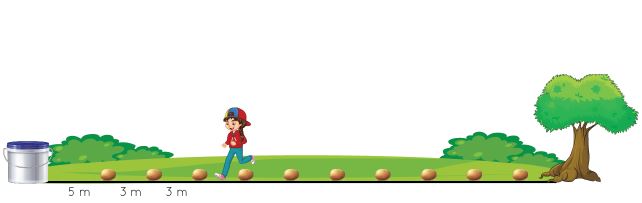
Question. Find terms of AP formed in above situation
Answer : 10, 16 , 22……..
Question. What is the total distance the competitor has to run?
Answer : Total distance 370
Question. Find distance cover after 4 potato drop In the bucket?
Answer : 152 m
Very Short Answer Type Questions
Question. Check whether – 150 is a term of the AP : 11, 8, 5, 2 . . .
Answer : No
Question. A contract on construction job specifies a penalty for delay of completion beyond a certain date as follows: ₹ 200 for the first day, ₹ 250 for the second day, ₹ 300 for the third day, etc., the penalty for each succeeding day being ₹ 50 more than for the preceding day. How much money the contractor has to pay as penalty, if he has delayed the work by 30 days?
Answer : Rs 27750
Question. Find the 31st term of an AP whose 11th term is 38 and the 16th term is 73.
Answer : 178
Question. Find the 20th term from the last term of the AP : 3, 8, 13, . . ., 253
Answer : 20th term from the last term is 158
Question. In a flower bed, there are 23 rose plants in the first row, 21 in the second, 19 in the third, and so on.
There are 5 rose plants in the last row. How many rows are there in the flower bed?
Answer : 10 rows
Question. For the AP : 1/3, 5/3, 9/3, 13/3,....... write the first term a and the common difference d.
Answer : a = 1/3, d= 4/3
Question. The 17th term of an AP exceeds its 10th term by 7. Find the common difference.
Answer : 1
Question. 200 logs are stacked in following manner . 20 logs in the bottom row , 19 in the next row 18 in the row next to it and so on . how many rows are the 200 logs placed and how many logs are in the top row ?
Answer : total rows 16 and 5 logs placed in top row
Question. Ramkali saves Rs 5 in the first week, of a year and increased her weekly savings by Rs 1.75. If in the nth week her weekly savings became Rs 20.75, find n.
Answer : 10
Question. The digits of a positive number of three digits are in A.P. and their sum is 15. The number obtained by reversing the digits is 594 less than the original number. Find the number.
Answer : 852
Question. The sum of the third and seventh terms of an A.P. is 40 and the sum of its sixth and 14th terms is 70. Find the sum of the first ten terms of the A.P.
Answer : 215
Question. If sum of first n terms of an AP is 4n – n2 What is the first term What is the sum first two terms ?
Find 10th term , 3rd term and nth term .
Answer : S1 = 3 S2 = 4 a10= -15 a3 = -1 and nth term = 5-2n
KEY CONCEPT
- AN AP is a list of number in which difference of a term and the preceding term is always constant. The constant is called common difference (\(d\)) of AP. \(d=a_{n+1}-a_n\)
- If a is the first term and ‘\(d\)’ is the common difference of an AP, then the AP is \(a, a+d, a+2d, a+3d\ldots\)
- The \(n\)th term of an AP is denoted by \(a_n\)
\(a_n=a+(n-1)d\) where \(a = \text{first term}\) and \(d = \text{common difference}\), \(n = \text{number of term}\) - \(n\)th term from the end \(= l-(n-1)d\) where \(l = \text{last term}\)
- Various terms in an AP can be chosen in following manner:
No. of terms: 3, terms: \(a-d, a, a+d\), common difference: \(d\)
No. of terms: 4, terms: \(a-3d, a-d, a+d, a+3d\), common difference: \(2d\)
No. of terms: 5, terms: \(a-2d, a-d, a, a+d, a+2d\), common difference: \(d\) - sum of first \(n\) natural number is \(\frac{n(n+1)}{2}\)
- the sum of \(n\) terms of an AP with first term \(a\) and common difference \(d\) is denoted by
\(S_n = \frac{n}{2}\{2a+(n-1)d\}\)
\(S_n = \frac{n}{2}(a+l)\)
\(a_n = S_n - S_{n-1}\)
LEVEL-I
Question. Write fourth term of an AP if its nth term is 3n+2.
Answer: \(14\)
Question. Find A.P Which fifth term is 5 and common difference is – 3.
Answer: \(17, 14, 11, 8, 5, \ldots\)
Question. Determine the 10th term from the end of the A.P 4,9,14……..254
Answer: \(209\)
Question. Find whether O is a term of the A.P 40, 37, 34, 31 ………….
Answer: No, because solving \(40 + (n-1)(-3) = 0\) gives \(n = \frac{43}{3}\), which is not a positive integer.
Question. Write the value of x for which x+2 , 2x , 2x+3 are three consecutive terms of an A.P
Answer: \(x = 5\)
Question. Find the sum of first 24 term of AP 5,8,11,14………..
Answer: \(948\)
Question. Which term of the A.P 12,7,2-3…… is -98
Answer: \(23^{\text{th}}\) term
Question. The nth term of an A.P is 3n+5 find its common difference.
Answer: \(3\)
Question. Write the next term of A.P \(\sqrt{2}\), \(\sqrt{18}\) .
Answer: \(\sqrt{50}\) (or \(5\sqrt{2}\))
Question. If 4/5 ,a,2 three consecutive term of an A.P then find A
Answer: \(a = \frac{7}{5}\)
LEVEL- II
Question. Find the middle term of A.P 6,13,20,………..216
Answer: \(111\)
Question. The 6th term of an A.P is -10 and its 10th term is -26. Determine the 15th term of an A.P
Answer: \(-46\)
Question. The 8th term of an A.P is 0 prove that its 38th term is triple its 18th term.
Answer: Let \(a\) and \(d\) be the first term and common difference respectively. Given \(a_8 = 0 \implies a + 7d = 0 \implies a = -7d\). Now, \(a_{18} = a + 17d = -7d + 17d = 10d\) and \(a_{38} = a + 37d = -7d + 37d = 30d\). Since \(30d = 3 \times 10d\), we have \(a_{38} = 3 a_{18}\). Hence Proved.
Question. The sum of three numbers in A.P is 21 and their product is 231 find the numbers.
Answer: \(3, 7, 11\) or \(11, 7, 3\)
Question. Find the sum of 25th term of an AP which nth term is given by tn=(7-3n)
Answer: Sum of first 25 terms is \(-800\) (the \(25^{\text{th}}\) term itself is \(-68\)).
Question. Find the sum of all two digit odd positive numbers
Answer: \(2475\)
Question. Find the sum of three digits numbers which are divisible by 11
Answer: \(44550\)
Question. The sum of first 6 term of A.P is 42. The ratio its 10th term to 38th term is 1:3. Calculate the first and 13th term of the A.P
Answer:
• If the question contains a typo and the ratio is \(10^{\text{th}}\) to \(30^{\text{th}}\) term (standard question): First term \(a = 2\), and \(13^{\text{th}}\) term \(= 26\).
• If solved exactly as written (ratio of \(10^{\text{th}}\) to \(38^{\text{th}}\) term): First term \(a = \frac{14}{3}\), and \(13^{\text{th}}\) term \(= \frac{238}{15}\).
Question. How many term of the A.P 17, 15, 13, 11…… must be added to get the sum 72? Explain the double answer.
Answer: \(n = 6\) or \(n = 12\). The double answer occurs because the sum of terms from the \(7^{\text{th}}\) to the \(12^{\text{th}}\) term is zero (\(5 + 3 + 1 - 1 - 3 - 5 = 0\)).
Question. The sum of n, 2n, 3n term of an A.P are S1, S2, and S3 respectively. Prove that S3 = 3(S2-S1)
Answer: Let \(S_1 = \frac{n}{2}[2a + (n-1)d]\), \(S_2 = n[2a + (2n-1)d]\), and \(S_3 = \frac{3n}{2}[2a + (3n-1)d]\).
Then, \(3(S_2 - S_1) = 3 \left( n[2a + (2n-1)d] - \frac{n}{2}[2a + (n-1)d] \right) = \frac{3n}{2} [4a + (4n-2)d - 2a - (n-1)d] = \frac{3n}{2} [2a + (3n-1)d] = S_3\). Hence Proved.
LEVEL - III
Question. If in an A.P the sum of first m term = n and the sum of 1st n term = m, then Prove that sum of (m+n) term is –(m+n)
Answer: Let \(S_m = n \implies 2a + (m-1)d = \frac{2n}{m}\) and \(S_n = m \implies 2a + (n-1)d = \frac{2m}{n}\). Subtracting these gives \((m-n)d = \frac{2n}{m} - \frac{2m}{n} \implies d = -\frac{2(m+n)}{mn}\). Finding \(2a = \frac{2(m^2+mn+n^2-m-n)}{mn}\) and substituting both into \(S_{m+n} = \frac{m+n}{2}[2a + (m+n-1)d]\) yields \(S_{m+n} = -(m+n)\). Hence Proved.
Question. If \(\frac{a^{n+1}+b^{n+1}}{a^n+b^n}\) is the A.M between a and b find the value of n.
Answer: \(n = 0\)
Question. If the pth , qth, rth term of an A.P be a,b,c respectively then show that a(q-r)+b(r-p)+c(p-q) = 0
Answer: Let the first term be \(A\) and common difference be \(D\). Then \(a = A+(p-1)D\), \(b = A+(q-1)D\), and \(c = A+(r-1)D\).
Substituting these into \(a(q-r) + b(r-p) + c(p-q)\) gives \(A(q-r+r-p+p-q) + D[(p-1)(q-r) + (q-1)(r-p) + (r-1)(p-q)] = A(0) + D(0) = 0\). Hence Proved.
Question. A man saved Rs 32 during first year Rs. 36 in second year and in this way he increases his saving by Rs. 4 every year find in what time his saving will be Rs 200
Answer: \(5\) years
Question. Find the sum of the following. (1 - 1/n) + (1 - 2/n) + (1 - 3/n) + ----------- upto nth terms
Answer: \(\frac{n-1}{2}\)
SELF EVALUATION
Question. Find the value of x for A.P, 1+6+11+16………..+x= 148
Answer: \(x = 36\)
Question. A man repays a loan for Rs 3250 by paying Rs 20 in the first month and then increases the payments Rs15 every month. How long will it take him to clear the loan?
Answer: \(20\) months
Question. If the sum of m terms of an A.P is the same as the sum of its n terms . Show that the sum of its (m+ n) term is zero.
Answer: Let \(S_m = S_n \implies \frac{m}{2}[2a+(m-1)d] = \frac{n}{2}[2a+(n-1)d] \implies 2a + (m+n-1)d = 0\).
Therefore, \(S_{m+n} = \frac{m+n}{2}[2a + (m+n-1)d] = \frac{m+n}{2}(0) = 0\). Hence Proved.
Question. Is 51 a term of the A.P, 5,8,11,14,…………..
Answer: No, because solving \(5 + (n-1)3 = 51\) yields \(n = \frac{49}{3}\), which is not an integer.
Question. . if the mth term of an A.P is 1/n and nth term is 1/m then show that sum of mn term is 1/2(mn+1).
Answer: Given \(a_m = a + (m-1)d = \frac{1}{n}\) and \(a_n = a + (n-1)d = \frac{1}{m}\). Subtracting equations gives \(d = \frac{1}{mn}\) and substituting yields \(a = \frac{1}{mn}\).
Therefore, \(S_{mn} = \frac{mn}{2}[2a + (mn-1)d] = \frac{mn}{2}[\frac{2}{mn} + \frac{mn-1}{mn}] = \frac{1}{2}(mn+1)\). Hence Proved.
Question. If 2x, x+10,3x+2 are in A.P find the value of x.
Answer: \(x = 6\)
Question. .Find the sum of all 3-digits numbers which are multiple of 7.
Answer: \(70336\)
Question. In an A.P the sum of first n terms is (3n2/2 + 5n/2) .Find its 25th term.
Answer: \(76\)
Question. The first term of an A.P is -7 and common difference is 5 .Find its 18th term and the general term.
Answer: \(18^{\text{th}}\) term is \(78\), General term is \(5n - 12\)
Question. Determine the 10th term from the end of the A.P. 4,9,14,…………………….254.
Answer: \(209\)
VALUE BASED QUESTIONS
Question. A sum of Rs 700 is to be used to given 7 cash prizes to the students of a school for their overall academic performance, punctuality, regularity, cleanliness, confidence and creativity and discipline .If each prize is Rs20 less than its preceding prize .Find the value of each of the prizes.
I) which value according to you should be awarded with maximum amount. Justify your answer.
Answer: The prizes are Rs 160, Rs 140, Rs 120, Rs 100, Rs 80, Rs 60, and Rs 40.
I) Overall academic performance should be awarded with the maximum amount because it represents a comprehensive achievement requiring consistency, hard work, and balanced development across all scholastic areas.
Free study material for Mathematics
CBSE Class 10 Mathematics Worksheets for Chapter 05 Arithmetic Progression
Download Chapter Worksheets: Class 10 Mathematics
Explore reliable practice questions for Chapter 05 Arithmetic Progression tailored for Class 10 Mathematics learners. Use these structured worksheets to evaluate exam preparedness and strengthen problem-solving skills throughout the 2026 academic session.
Concept Clarification for Chapter 05 Arithmetic Progression
Built using official NCERT guidelines for Class 10 Mathematics, these practice sheets provide reliable academic support. Cross-reference your completed work with our detailed solutions to learn standard answer-writing formats for CBSE exams.
Effective Revision Strategies for School Exams
Follow up your worksheet practice by attempting the interactive online MCQ tests for Chapter 05 Arithmetic Progression to evaluate your execution speed. All printable assignments and revision sheets on our platform are updated for the 2026 session and available free of charge.
FAQs
You can download the latest chapter-wise printable worksheets for Class 10 Mathematics Chapter 05 Arithmetic Progression for free from StudiesToday.com. These have been made as per the latest CBSE curriculum for this academic year.
Yes, Class 10 Mathematics worksheets for Chapter 05 Arithmetic Progression focus on activity-based learning and also competency-style questions. This helps students to apply theoretical knowledge to practical scenarios.
Yes, we have provided solved worksheets for Class 10 Mathematics Chapter 05 Arithmetic Progression to help students verify their answers instantly.
Yes, our Class 10 Mathematics test sheets are mobile-friendly PDFs and can be printed by teachers for classroom.
For Chapter 05 Arithmetic Progression, regular practice with our worksheets will improve question-handling speed and help students understand all technical terms and diagrams.