

Chapter-wise Worksheets for Class 10 Mathematics: Chapter 06 Triangles
Review targeted academic worksheets with the CBSE Class 10 Mathematics Triangles Worksheet Set 05. Built according to official educational standards for the 2026-27 term, these downloadable Class 10 Mathematics resources support effective daily practice and detailed self-evaluation for Chapter 06 Triangles.
Practice Class 10 Mathematics Worksheets: Chapter 06 Triangles
View or download the dedicated CBSE Class 10 Mathematics Triangles Worksheet Set 05 resource below. Engaging with these practice papers under focused study conditions ensures continuous academic progress and mastery of the 2026-27 curriculum for Chapter 06 Triangles.
Triangles
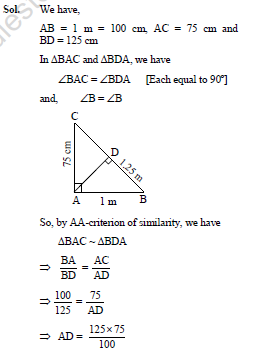
Q.- In figure, ∠CAB = 90º and AD ⊥ BC. If AC = 75 cm, AB = 1 m and BD = 1.25 m,find AD.
Q.-
Q.-

Q.-

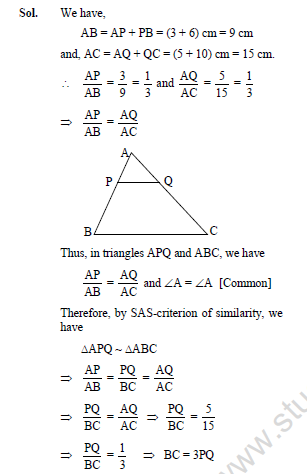
Q.-
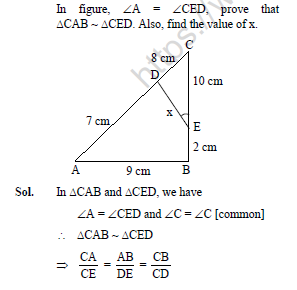
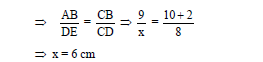
Question 1. What value of x will make DE II AB in the given figure?
Answer:
By the Basic Proportionality Theorem (Thales's Theorem), the line \( DE \) is parallel to the base \( AB \) if and only if it divides the other two sides in the same ratio: \[ \frac{CD}{AD} = \frac{CE}{BE} \] Based on the given figure, we have: \( CD = x - 2 \) \( AD = x \) \( CE = x - 1 \) \( BE = x + 2 \) Substituting these expressions into the ratio: \[ \frac{x - 2}{x} = \frac{x - 1}{x + 2} \] By cross-multiplying, we get: \( (x - 2)(x + 2) = x(x - 1) \)
\( \implies x^2 - 4 = x^2 - x \)
\( \implies -4 = -x \)
\( \implies x = 4 \) Thus, the value of \( x \) that makes \( DE \parallel AB \) is \( 4 \).
In simple words: To make the line inside parallel to the bottom, the sides must be split in equal ratios. Solving the equation from this ratio gives us \( x = 4 \).
Exam Tip: Always double check that you set up the ratio starting from the vertex opposite to the parallel side (vertex C in this case).
Question 2. In figure, DE is parallel to base BC. If AD = 2.5 cm, BD = 3.0 cm and AE = 3.75 cm, find the length of AC
Answer:
Since \( DE \parallel BC \), by the Basic Proportionality Theorem (BPT): \[ \frac{AD}{BD} = \frac{AE}{CE} \] Substituting the given dimensions: \[ \frac{2.5}{3.0} = \frac{3.75}{CE} \] Solving for \( CE \): \( CE = \frac{3.75 \times 3.0}{2.5} \)
\( \implies CE = 4.5\text{ cm} \) The total length of side \( AC \) is: \( AC = AE + CE \)
\( \implies AC = 3.75 + 4.5 = 8.25\text{ cm} \)
In simple words: The parallel line splits both sides in the same proportion. Finding the missing segment gives us 4.5 cm, and adding it to the top segment gives a total length of 8.25 cm for side AC.
Exam Tip: Be careful not to stop after calculating CE. The question asks for the entire length AC, so you must add AE and CE together.
Question 3. In the figure. XY II BC . Find the length of XY
Answer:
In \( \triangle ABC \), since \( XY \parallel BC \), the corresponding angles are equal: \( \angle AXY = \angle ABC \) and \( \angle AYX = \angle ACB \). By AA Similarity, we have: \( \triangle AXY \sim \triangle ABC \) Thus, the ratios of their corresponding sides are equal: \[ \frac{AX}{AB} = \frac{XY}{BC} \] We are given: \( AX = 1\text{ cm} \) \( XB = 2\text{ cm} \) \( BC = 6\text{ cm} \) Calculate the total length of side \( AB \): \( AB = AX + XB = 1 + 2 = 3\text{ cm} \) Substituting these values into the ratio: \[ \frac{1}{3} = \frac{XY}{6} \]
\( \implies XY = \frac{6}{3} = 2\text{ cm} \)
In simple words: The small top triangle is a miniature version of the big triangle. Since the big side is 3 times longer than the small side, the big base is also 3 times longer than the small base, making XY equal to 2 cm.
Exam Tip: Avoid the common error of using \( \frac{AX}{XB} = \frac{XY}{BC} \). BPT applies only to side segments, while similarity of triangles is required when dealing with parallel base lengths like XY and BC.
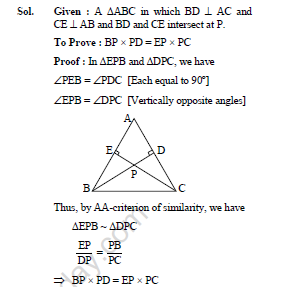
Question 4. In figure, considering triangles BEP and CDP, prove that: BP X PD = EP X PC
Answer:
In \( \triangle BEP \) and \( \triangle CDP \): 1. \( \angle BEP = \angle CDP = 90^\circ \) (since \( BD \) and \( CE \) are altitudes to sides \( AC \) and \( AB \)) 2. \( \angle BPE = \angle CPD \) (vertically opposite angles) By AA Similarity: \( \triangle BEP \sim \triangle CDP \) Since the corresponding sides of similar triangles are in proportion: \[ \frac{BP}{CP} = \frac{EP}{DP} \] Cross-multiplying these terms gives: \( BP \times PD = EP \times PC \) Hence proved.
In simple words: By showing that the two small opposite triangles are similar using their angles, we write the ratio of their sides and cross-multiply to get the desired proof.
Exam Tip: Clearly state the reason for angle equality, such as "vertically opposite angles" and "perpendicular altitudes", to secure full step marks.
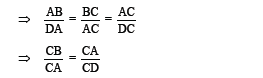
Question 5. D is a point on the side BC of a ∆ABC such that angle ADC = angle BAC. Prove that CA ∕∕ CD = CB ∕∕ CA
Answer:
Let us compare \( \triangle BAC \) and \( \triangle ADC \): 1. \( \angle BAC = \angle ADC \) (given in the problem) 2. \( \angle C = \angle C \) (common angle for both triangles) By AA Similarity Criterion: \( \triangle BAC \sim \triangle ADC \) Since similar triangles have proportional corresponding sides, we can write: \[ \frac{BC}{AC} = \frac{AC}{DC} \] By rearranging the terms: \[ \frac{CA}{CD} = \frac{CB}{CA} \] This can also be written in equation form as: \( CA^2 = CB \times CD \) Hence proved.
In simple words: The big triangle and the smaller triangle share one corner and have another equal angle, making them similar. This similarity lets us set up a proportional fraction of their matching sides.
Exam Tip: Keep the correspondence of vertices exact when writing the similarity statement, i.e., write \( \triangle BAC \sim \triangle ADC \) so you do not make mistakes with side ratios.
Question 6. In figure angle ACB = 90• , CD perpendicular to AB, prove that CD2 = BD . AD
Answer:
In right-angled \( \triangle ACB \) with \( \angle ACB = 90^\circ \) and \( CD \perp AB \): Let \( \angle A = \theta \). In right-angled \( \triangle ACD \): \( \angle ACD = 90^\circ - \theta \) Since \( \angle ACB = 90^\circ \): \( \angle BCD = 90^\circ - \angle ACD = 90^\circ - (90^\circ - \theta) = \theta \) In right-angled \( \triangle BCD \): \( \angle CBD = 90^\circ - \theta \) Comparing \( \triangle ACD \) and \( \triangle CBD \): 1. \( \angle ADC = \angle CDB = 90^\circ \) 2. \( \angle ACD = \angle CBD = 90^\circ - \theta \) 3. \( \angle CAD = \angle BCD = \theta \) By AAA Similarity Criterion: \( \triangle ACD \sim \triangle CBD \) Since the corresponding sides are proportional: \[ \frac{CD}{BD} = \frac{AD}{CD} \] Cross-multiplying yields: \( CD^2 = BD \cdot AD \) Hence proved.
In simple words: The altitude drawn from a right angle splits the main triangle into two similar triangles. Comparing their side ratios leads directly to this square property.
Exam Tip: Remember that a perpendicular dropped from the right-angled vertex to the hypotenuse divides the triangle into two triangles that are similar to each other and to the main triangle.
Question 7. A vertical pole which is 2.25m long casts a 6.75m long shadow on the ground. At the same time a vertical Tower casts a 90m long shadow on the ground. Find the height of the tower
Answer:
Because both shadows are measured at the exact same time of day, the sun's angle of elevation is identical for both objects. Thus, the right-angled triangles formed by the pole and its shadow, and the tower and its shadow, are similar. Let \( h \) be the height of the tower. \[ \frac{\text{Height of the pole}}{\text{Length of its shadow}} = \frac{\text{Height of the tower}}{\text{Length of its shadow}} \] Substitute the values: \[ \frac{2.25}{6.75} = \frac{h}{90} \] Simplify the left side: \[ \frac{1}{3} = \frac{h}{90} \]
\( \implies h = \frac{90}{3} = 30\text{ m} \) The height of the tower is \( 30\text{ m} \).
In simple words: Since both shadows are cast at the same time, the ratio of height to shadow is equal. The pole's shadow is 3 times its height, so the tower's height must be one-third of its 90m shadow, which is 30m.
Exam Tip: Always state the assumption or fact that "the sun's rays are parallel at the same time", which justifies the similarity of the triangles.
Question 8. If Δ ABC ~ Δ PQR. Also ar (ΔABC) = 4 ar (Δ PQR). If BC = 12cm, find QR
Answer:
By the theorem on areas of similar triangles, the ratio of the areas of two similar triangles is equal to the square of the ratio of their corresponding sides: \[ \frac{\text{ar}(\triangle ABC)}{\text{ar}(\triangle PQR)} = \left(\frac{BC}{QR}\right)^2 \] Given that \( \text{ar}(\triangle ABC) = 4 \text{ ar}(\triangle PQR) \): \[ \frac{\text{ar}(\triangle ABC)}{\text{ar}(\triangle PQR)} = 4 \] Substituting this into our equation: \[ 4 = \left(\frac{12}{QR}\right)^2 \] Taking the square root on both sides: \[ 2 = \frac{12}{QR} \]
\( \implies QR = \frac{12}{2} = 6\text{ cm} \)
In simple words: When a triangle's area is 4 times larger than another similar triangle, its side lengths must be 2 times larger. Since the larger side is 12 cm, the smaller corresponding side is 6 cm.
Exam Tip: Take the square root of the area ratio before cross-multiplying to simplify the arithmetic and prevent large square term mistakes.
Question 9. The areas two similar triangles ABC and DEF are 36 cm2 and 81 cm2 respectively. If EF = 6.9 cm, determine BC
Answer:
Since \( \triangle ABC \sim \triangle DEF \), the ratio of their areas is equal to the square of the ratio of their corresponding sides: \[ \frac{\text{ar}(\triangle ABC)}{\text{ar}(\triangle DEF)} = \left(\frac{BC}{EF}\right)^2 \] Given: \( \text{ar}(\triangle ABC) = 36\text{ cm}^2 \) \( \text{ar}(\triangle DEF) = 81\text{ cm}^2 \) \( EF = 6.9\text{ cm} \) Substitute the known values: \[ \frac{36}{81} = \left(\frac{BC}{6.9}\right)^2 \] Taking the square root on both sides: \[ \frac{6}{9} = \frac{BC}{6.9} \] Simplify the fraction: \[ \frac{2}{3} = \frac{BC}{6.9} \]
\( \implies BC = \frac{2 \times 6.9}{3} \)
\( \implies BC = 2 \times 2.3 = 4.6\text{ cm} \)
In simple words: The ratio of the areas is 36 to 81, so the ratio of their sides is the square root of that, which is 6 to 9 (or 2 to 3). Finding the matching side gives us 4.6 cm.
Exam Tip: Simplify the fraction \( \frac{6}{9} \) to \( \frac{2}{3} \) first; it makes division of decimals much easier to calculate mentally.
Question 10. Two isosceles triangles have equal angles and their areas are in the ratio 81: 25. Find the ratio of their Corresponding heights
Answer:
Since both isosceles triangles have equal angles, they are similar to each other. The ratio of the areas of two similar triangles is equal to the square of the ratio of their corresponding heights: \[ \frac{\text{ar}(\triangle_1)}{\text{ar}(\triangle_2)} = \left(\frac{h_1}{h_2}\right)^2 \] Given the area ratio is \( 81 : 25 \): \[ \frac{81}{25} = \left(\frac{h_1}{h_2}\right)^2 \] Taking the square root on both sides: \[ \frac{h_1}{h_2} = \sqrt{\frac{81}{25}} = \frac{9}{5} \] Thus, the ratio of their corresponding heights is \( 9 : 5 \).
In simple words: Since the triangles are similar, the ratio of their heights is simply the square root of the ratio of their areas, which is 9 to 5.
Exam Tip: This rule applies to any corresponding linear measurements of similar triangles, including medians, altitudes, angle bisectors, and perimeters.
Question 11. D, E and F are respectively the mid points of the sides BC, CA and AB of ΔABC. Find the ratio of the areas of Δ DEF and Δ ABC
Answer:
By the Midpoint Theorem, the segment joining the midpoints of two sides of a triangle is parallel to the third side and half its length. Thus, in \( \triangle ABC \): \( DE = \frac{1}{2}AB \) \( EF = \frac{1}{2}BC \) \( DF = \frac{1}{2}AC \) Since the sides of \( \triangle DEF \) are proportional to the sides of \( \triangle CAB \) in the ratio \( 1 : 2 \), the triangles are similar by the SSS Similarity Criterion: \( \triangle DEF \sim \triangle CAB \) The ratio of their areas is the square of the ratio of their corresponding sides: \[ \frac{\text{ar}(\triangle DEF)}{\text{ar}(\triangle ABC)} = \left(\frac{DE}{AB}\right)^2 = \left(\frac{1}{2}\right)^2 = \frac{1}{4} \] Thus, the ratio of the areas of \( \triangle DEF \) and \( \triangle ABC \) is \( 1 : 4 \).
In simple words: Joining the midpoints of a triangle splits it into four smaller, identical triangles of equal area. Therefore, the inner triangle takes up exactly one-fourth of the total area.
Exam Tip: Be sure to write the ratio in the exact order requested by the question—here it is \( \text{ar}(\triangle DEF) : \text{ar}(\triangle ABC) \), which is \( 1 : 4 \), not \( 4 : 1 \).
Question 12. The perimeters of two similar triangles are 36cm and 48cm respectively. If one side of the first triangle is 9cm, what is the corresponding side of the other triangle
Answer:
For any two similar triangles, the ratio of their perimeters is equal to the ratio of their corresponding sides: \[ \frac{\text{Perimeter of } \triangle_1}{\text{Perimeter of } \triangle_2} = \frac{\text{Side of } \triangle_1}{\text{Corresponding side of } \triangle_2} \] Let the corresponding side of the second triangle be \( y \). Substituting the given values: \[ \frac{36}{48} = \frac{9}{y} \] Simplify the fraction on the left: \[ \frac{3}{4} = \frac{9}{y} \]
\( \implies 3y = 36 \)
\( \implies y = 12\text{ cm} \) The corresponding side of the other triangle is \( 12\text{ cm} \).
In simple words: Similar triangles scale down or up uniformly. Since the perimeter of the second triangle is \( 1.33 \) times the first, its corresponding side will also be \( 1.33 \) times longer than 9 cm, which equals 12 cm.
Exam Tip: Keep the first triangle's values in the numerators and the second triangle's values in the denominators to maintain proper alignment in your proportions.
Question 13. In triangle ABC, AB= √3a, AC = a and BC = 2a. Prove that ∟A = 90°
Answer:
Let us calculate the squares of the lengths of all three sides of \( \triangle ABC \): \( AB^2 = (\sqrt{3}a)^2 = 3a^2 \) \( AC^2 = (a)^2 = a^2 \) \( BC^2 = (2a)^2 = 4a^2 \) Adding the squares of the two shorter sides: \( AB^2 + AC^2 = 3a^2 + a^2 = 4a^2 \) Since \( BC^2 = 4a^2 \), we observe that: \( AB^2 + AC^2 = BC^2 \) By the Converse of Pythagoras' Theorem, \( \triangle ABC \) is a right-angled triangle with the right angle located opposite to the longest side \( BC \). Therefore, \( \angle A = 90^\circ \). Hence proved.
In simple words: Squaring the sides gives \( 3a^2 \), \( a^2 \), and \( 4a^2 \). Since the sum of the first two squares equals the third, Pythagoras' theorem is satisfied, meaning it is a right triangle with a 90-degree angle opposite the hypotenuse.
Exam Tip: Always specify "Converse of Pythagoras' Theorem" as the exact geometric justification when proving a right angle from side lengths.
Question 14. In triangle ABC, ∟BAC = 90° and AD ┴ BC. If BD = 8cm, DC= 18 cm, find AD
Answer:
In a right-angled \( \triangle ABC \) with \( \angle BAC = 90^\circ \) and \( AD \perp BC \): The altitude \( AD \) divides the triangle into two similar triangles: \( \triangle ABD \sim \triangle CAD \) Because they are similar, the ratios of their corresponding sides are equal: \[ \frac{AD}{CD} = \frac{BD}{AD} \]
\( \implies AD^2 = BD \times CD \) Substituting the given values: \( AD^2 = 8 \times 18 \)
\( \implies AD^2 = 144 \)
\( \implies AD = \sqrt{144} = 12\text{ cm} \) The length of \( AD \) is \( 12\text{ cm} \).
In simple words: The altitude squared equals the product of the two segments it creates on the base. Multiplying 8 by 18 gives 144, and its square root is 12 cm.
Exam Tip: Memorize the geometric mean theorem: the altitude to the hypotenuse is the geometric mean of the two hypotenuse segments.
Question 15. Two poles of height 8m and 13m stand on a plane ground. If the distance between their tips is 13m, find the distance between their feet
Answer:
Let the two vertical poles be \( AB = 13\text{ m} \) and \( CD = 8\text{ m} \), standing perpendicular to the ground \( BD \). The distance between their tips is \( AC = 13\text{ m} \). Draw a line \( CE \) perpendicular to \( AB \), meeting it at \( E \). This forms a rectangle \( BCDE \), where: \( BE = CD = 8\text{ m} \) \( CE = BD \) (the distance between their feet) Now, determine the segment \( AE \): \( AE = AB - BE = 13 - 8 = 5\text{ m} \) In right-angled \( \triangle AEC \), by Pythagoras' theorem: \( AC^2 = AE^2 + CE^2 \)
\( \implies 13^2 = 5^2 + CE^2 \)
\( \implies 169 = 25 + CE^2 \)
\( \implies CE^2 = 144 \)
\( \implies CE = 12\text{ m} \) Since \( CE = BD \), the distance between their feet is \( 12\text{ m} \).
In simple words: Drawing a horizontal line from the shorter pole to the taller one creates a right triangle. The vertical leg of this triangle is 5m (the height difference) and the hypotenuse is 13m, so the horizontal distance must be 12m.
Exam Tip: Sketching a clean diagram for word problems involving heights and distances is crucial to visualize and set up the right-angled triangle correctly.
Question 16. Two poles of height 10m and 15m stand vertically on a plane ground. If the distance between their feet is 5√3m, find the distance between their tops
Answer:
Let the two vertical poles be \( AB = 15\text{ m} \) and \( CD = 10\text{ m} \). The horizontal distance between their feet is \( BD = 5\sqrt{3}\text{ m} \). Draw a perpendicular line \( CE \) from \( C \) to \( AB \), meeting \( AB \) at \( E \). This creates a rectangle \( BCDE \), where: \( BE = CD = 10\text{ m} \) \( CE = BD = 5\sqrt{3}\text{ m} \) Find the length of segment \( AE \): \( AE = AB - BE = 15 - 10 = 5\text{ m} \) In the right-angled \( \triangle AEC \), apply Pythagoras' theorem to find the distance between their tops, \( AC \): \( AC^2 = AE^2 + CE^2 \)
\( \implies AC^2 = 5^2 + (5\sqrt{3})^2 \)
\( \implies AC^2 = 25 + 75 \)
\( \implies AC^2 = 100 \)
\( \implies AC = \sqrt{100} = 10\text{ m} \) The distance between the tops of the poles is \( 10\text{ m} \).
In simple words: The difference in height is 5m and the horizontal gap is \( 5\sqrt{3} \)m. Using these as the two sides of a right triangle, we find the hypotenuse (the line between their tops) is 10m.
Exam Tip: Be careful when squaring terms with roots: \( (5\sqrt{3})^2 = 25 \times 3 = 75 \).
Question 17. The perpendicular from A on side BC of a triangle ABC intersects BC at D such that BD = 3CD. Prove that 2 AB² - 2 AC² = BC²
Answer:
Since \( D \) lies on side \( BC \), we can write: \( BC = BD + CD \) Given \( BD = 3CD \): \( BC = 3CD + CD = 4CD \)
\( \implies CD = \frac{BC}{4} \)
\( \implies BD = \frac{3BC}{4} \) In right-angled \( \triangle ABD \), using Pythagoras' theorem: \( AB^2 = AD^2 + BD^2 \)
\( \implies AD^2 = AB^2 - BD^2 \) (Equation 1) In right-angled \( \triangle ACD \), using Pythagoras' theorem: \( AC^2 = AD^2 + CD^2 \)
\( \implies AD^2 = AC^2 - CD^2 \) (Equation 2) Equating Equations 1 and 2: \( AB^2 - BD^2 = AC^2 - CD^2 \)
\( \implies AB^2 - AC^2 = BD^2 - CD^2 \) Substitute the expressions of \( BD \) and \( CD \) in terms of \( BC \): \( AB^2 - AC^2 = \left(\frac{3BC}{4}\right)^2 - \left(\frac{BC}{4}\right)^2 \)
\( \implies AB^2 - AC^2 = \frac{9BC^2}{16} - \frac{BC^2}{16} \)
\( \implies AB^2 - AC^2 = \frac{8BC^2}{16} \)
\( \implies AB^2 - AC^2 = \frac{BC^2}{2} \) Multiplying both sides by 2: \( 2AB^2 - 2AC^2 = BC^2 \) Hence proved.
In simple words: By writing Pythagoras' theorem for both right triangles sharing the height AD, we subtract the equations and replace the base parts with fractions of BC to get the final proof.
Exam Tip: Expressing segments of the base in terms of the whole base length is a key strategy for similarity and right-triangle proofs.
Question 18. In an isosceles triangle ABC with AB = AC, BD is a perpendicular from B to the side AC. Prove that BD² - CD² = 2CD . AD
Answer:
In right-angled \( \triangle ABD \) (since \( BD \perp AC \)): \( AB^2 = BD^2 + AD^2 \)
\( \implies BD^2 = AB^2 - AD^2 \) Since the triangle is isosceles with \( AB = AC \): \( BD^2 = AC^2 - AD^2 \) We can write \( AC \) as the sum of \( AD \) and \( CD \): \( BD^2 = (AD + CD)^2 - AD^2 \)
\( \implies BD^2 = AD^2 + CD^2 + 2(CD)(AD) - AD^2 \)
\( \implies BD^2 = CD^2 + 2CD \cdot AD \) Rearranging the terms: \( BD^2 - CD^2 = 2CD \cdot AD \) Hence proved.
In simple words: Since AB equals AC, we can swap them in Pythagoras' theorem. Expanding the side AC into two smaller segments lets us cancel out the extra terms and find the proof.
Exam Tip: Substitute given equalities (like AB = AC) early in your geometric proofs to simplify the expressions.
Question 19. P and Q are points on the sides CA and CB respectively of a ΔABC right angled at C. Prove that AQ² + BP² = AB² + PQ²
Answer:
Let us apply Pythagoras' theorem in the relevant right-angled triangles with vertex \( C \): 1. In right-angled \( \triangle AQC \): \( AQ^2 = AC^2 + CQ^2 \) (Equation 1) 2. In right-angled \( \triangle BPC \): \( BP^2 = BC^2 + CP^2 \) (Equation 2) Adding Equation 1 and Equation 2: \( AQ^2 + BP^2 = AC^2 + CQ^2 + BC^2 + CP^2 \)
\( \implies AQ^2 + BP^2 = (AC^2 + BC^2) + (CP^2 + CQ^2) \) (Equation 3) Now apply Pythagoras' theorem in the other right-angled triangles: 3. In right-angled \( \triangle ABC \): \( AB^2 = AC^2 + BC^2 \) (Equation 4) 4. In right-angled \( \triangle PQC \): \( PQ^2 = CP^2 + CQ^2 \) (Equation 5) Substitute Equations 4 and 5 into Equation 3: \( AQ^2 + BP^2 = AB^2 + PQ^2 \) Hence proved.
In simple words: We write Pythagoras' equations for the diagonal segments AQ and BP, add them up, and then group the terms to match the hypotenuses of the large and small triangles.
Exam Tip: Identify all right-angled triangles in the diagram first, and list their Pythagorean relations to see how they can be combined.
Question 20. In ∆ ABC, If AD is the median, show that AB² + AC² = 2(AD² + BD²)
Answer:
Let \( AD \) be the median to the side \( BC \) of \( \triangle ABC \) (so \( BD = CD \)). Draw a perpendicular \( AE \perp BC \). In right-angled \( \triangle AEB \), by Pythagoras' theorem: \( AB^2 = AE^2 + BE^2 \)
\( \implies AB^2 = AE^2 + (BD + DE)^2 \)
\( \implies AB^2 = AE^2 + BD^2 + DE^2 + 2(BD)(DE) \) Since \( AE^2 + DE^2 = AD^2 \) in right-angled \( \triangle AED \): \( AB^2 = AD^2 + BD^2 + 2(BD)(DE) \) (Equation 1) In right-angled \( \triangle AEC \), by Pythagoras' theorem: \( AC^2 = AE^2 + CE^2 \)
\( \implies AC^2 = AE^2 + (CD - DE)^2 \)
\( \implies AC^2 = AE^2 + CD^2 + DE^2 - 2(CD)(DE) \) Using \( AE^2 + DE^2 = AD^2 \) and substituting \( CD = BD \): \( AC^2 = AD^2 + BD^2 - 2(BD)(DE) \) (Equation 2) Adding Equation 1 and Equation 2: \( AB^2 + AC^2 = (AD^2 + BD^2 + 2(BD)(DE)) + (AD^2 + BD^2 - 2(BD)(DE)) \)
\( \implies AB^2 + AC^2 = 2AD^2 + 2BD^2 \)
\( \implies AB^2 + AC^2 = 2(AD^2 + BD^2) \) Hence proved.
In simple words: By drawing an altitude and using Pythagoras' theorem on the left and right sides, we add the equations so the middle terms cancel out, leaving exactly twice the square of the median and half-base.
Exam Tip: This result is also known as Apollonius's Theorem, which is highly useful for solving median-based length problems quickly.
Question 21. In figure, T trisects the side QR of right triangle PQR. Prove that 8 PT² = 3 PR² + 5 PS²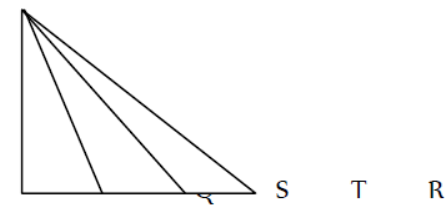
Answer:
Let \( S \) and \( T \) be the points of trisection of side \( QR \). Thus, we have: \( QS = ST = TR = x \) This implies: \( QT = 2x \) \( QR = 3x \) Let the triangle be right-angled at \( Q \). Using Pythagoras' theorem in the three right-angled triangles: 1. In \( \triangle PQS \): \( PS^2 = PQ^2 + QS^2 = PQ^2 + x^2 \)
\( \implies PQ^2 = PS^2 - x^2 \) (Equation 1) 2. In \( \triangle PQT \): \( PT^2 = PQ^2 + QT^2 = PQ^2 + (2x)^2 = PQ^2 + 4x^2 \) (Equation 2) 3. In \( \triangle PQR \): \( PR^2 = PQ^2 + QR^2 = PQ^2 + (3x)^2 = PQ^2 + 9x^2 \) (Equation 3) Substitute Equation 1 into Equations 2 and 3: \( PT^2 = (PS^2 - x^2) + 4x^2 = PS^2 + 3x^2 \)
\( \implies 3x^2 = PT^2 - PS^2 \) (Equation 4) \( PR^2 = (PS^2 - x^2) + 9x^2 = PS^2 + 8x^2 \)
\( \implies 8x^2 = PR^2 - PS^2 \) (Equation 5) From Equation 4, we have \( x^2 = \frac{PT^2 - PS^2}{3} \). Substituting this into Equation 5: \( 8\left(\frac{PT^2 - PS^2}{3}\right) = PR^2 - PS^2 \) Multiply the entire equation by 3: \( 8(PT^2 - PS^2) = 3(PR^2 - PS^2) \)
\( \implies 8PT^2 - 8PS^2 = 3PR^2 - 3PS^2 \)
\( \implies 8PT^2 = 3PR^2 + 5PS^2 \) Hence proved.
In simple words: Since S and T divide the base into three equal segments, we write Pythagoras' equations for each segment level, express them all using one segment length, and solve.
Exam Tip: Setting equal segments of a trisected side to a variable like \( x \) makes algebraic manipulation and substitution straightforward.
Question 22. If BL and CM are medians of a triangle ABC right angled at A, then prove that 4( BL² + CM² ) = 5 BC²
Answer:
In right-angled \( \triangle ABC \) with \( \angle A = 90^\circ \): Since \( BL \) and \( CM \) are medians, \( L \) and \( M \) are midpoints of \( AC \) and \( AB \). \( AL = \frac{AC}{2} \) and \( AM = \frac{AB}{2} \) In right-angled \( \triangle BAL \): \( BL^2 = AB^2 + AL^2 = AB^2 + \left(\frac{AC}{2}\right)^2 = AB^2 + \frac{AC^2}{4} \) Multiplying by 4: \( 4BL^2 = 4AB^2 + AC^2 \) (Equation 1) In right-angled \( \triangle CAM \): \( CM^2 = AC^2 + AM^2 = AC^2 + \left(\frac{AB}{2}\right)^2 = AC^2 + \frac{AB^2}{4} \) Multiplying by 4: \( 4CM^2 = 4AC^2 + AB^2 \) (Equation 2) Add Equation 1 and Equation 2: \( 4BL^2 + 4CM^2 = (4AB^2 + AC^2) + (4AC^2 + AB^2) \)
\( \implies 4(BL^2 + CM^2) = 5AB^2 + 5AC^2 \)
\( \implies 4(BL^2 + CM^2) = 5(AB^2 + AC^2) \) Using Pythagoras' theorem for the main triangle \( \triangle ABC \), we know \( BC^2 = AB^2 + AC^2 \): \( 4(BL^2 + CM^2) = 5BC^2 \) Hence proved.
In simple words: We write the squared length of both medians using Pythagoras' theorem, multiply by 4 to get rid of fractions, and add them together to reveal 5 times the hypotenuse squared.
Exam Tip: Median proofs in right-angled triangles usually require using Pythagoras' theorem on the smaller right triangles created by the medians.
Question 23. In a triangle ABC, AB = BC = CA = 2a and AD perpendicular to BC. Prove that AD= a √ 3 and area of ∆ ABC = √3 a ²
Answer:
In equilateral \( \triangle ABC \), the altitude \( AD \perp BC \) also acts as the median. Therefore, \( D \) is the midpoint of side \( BC \): \( BD = CD = \frac{BC}{2} = \frac{2a}{2} = a \) In right-angled \( \triangle ABD \), by Pythagoras' theorem: \( AB^2 = AD^2 + BD^2 \)
\( \implies (2a)^2 = AD^2 + a^2 \)
\( \implies 4a^2 = AD^2 + a^2 \)
\( \implies AD^2 = 3a^2 \)
\( \implies AD = a\sqrt{3} \) (Proved) Now, calculate the area of \( \triangle ABC \): \( \text{Area} = \frac{1}{2} \times \text{Base} \times \text{Height} \)
\( \implies \text{Area} = \frac{1}{2} \times BC \times AD \)
\( \implies \text{Area} = \frac{1}{2} \times 2a \times a\sqrt{3} = \sqrt{3}a^2 \) (Proved)
In simple words: Since all sides are \( 2a \), the height splits the bottom side into \( a \) and \( a \). Pythagoras' theorem gives a height of \( a\sqrt{3} \), and multiplying half of the base by height yields an area of \( \sqrt{3}a^2 \).
Exam Tip: Remember the standard formulas for an equilateral triangle of side \( s \): height is \( \frac{\sqrt{3}}{2}s \) and area is \( \frac{\sqrt{3}}{4}s^2 \). Substitute \( s = 2a \) to check your work.
Question 24. In an equilateral triangle ABC, AD is the altitude drawn from A on side BC. Prove that 3 AB² = 4 AD²
Answer:
Let the side of the equilateral triangle \( \triangle ABC \) be \( s \). Therefore, \( AB = BC = AC = s \). The altitude \( AD \perp BC \) bisects the base \( BC \), meaning: \( BD = \frac{BC}{2} = \frac{s}{2} \) In the right-angled \( \triangle ABD \), using Pythagoras' theorem: \( AB^2 = AD^2 + BD^2 \) \[ s^2 = AD^2 + \left(\frac{s}{2}\right)^2 \] \[ s^2 = AD^2 + \frac{s^2}{4} \] \[ s^2 - \frac{s^2}{4} = AD^2 \] \[ \frac{3s^2}{4} = AD^2 \] \[ 3s^2 = 4AD^2 \] Since \( s = AB \), we can substitute it back: \( 3AB^2 = 4AD^2 \) Hence proved.
In simple words: Squaring the side and height relations of an equilateral triangle reveals that 3 times the square of any side equals 4 times the square of the altitude.
Exam Tip: Since all three sides of an equilateral triangle are equal, this identity also holds true for any other side: \( 3BC^2 = 4AD^2 \) or \( 3AC^2 = 4AD^2 \).
Question 25. In a triangle ABC, AD is perpendicular on BC , prove that AB² + CD² = AC² + BD²
Answer:
Given that \( AD \perp BC \): In right-angled \( \triangle ABD \), by Pythagoras' theorem: \( AB^2 = AD^2 + BD^2 \)
\( \implies AD^2 = AB^2 - BD^2 \) (Equation 1) In right-angled \( \triangle ACD \), by Pythagoras' theorem: \( AC^2 = AD^2 + CD^2 \)
\( \implies AD^2 = AC^2 - CD^2 \) (Equation 2) Equating Equations 1 and 2: \( AB^2 - BD^2 = AC^2 - CD^2 \) Rearranging the terms to place negative terms on the opposite sides: \( AB^2 + CD^2 = AC^2 + BD^2 \) Hence proved.
In simple words: Both smaller triangles share the vertical height AD. By expressing AD squared for both triangles and equating them, we get our proved identity.
Exam Tip: When two right-angled triangles share a common side, express that common side in terms of the other sides for both triangles and equate them.
Question 26. Prove that the sum of the squares of the sides of a rhombus is equal to the sum of the squares on its diagonals
Answer:
Let \( ABCD \) be a rhombus whose diagonals \( AC \) and \( BD \) intersect at point \( O \). We know that the diagonals of a rhombus bisect each other at right angles (\( 90^\circ \)): \( OA = OC = \frac{AC}{2} \) \( OB = OD = \frac{BD}{2} \) \( \angle AOB = \angle BOC = \angle COD = \angle DOA = 90^\circ \) In right-angled \( \triangle AOB \), using Pythagoras' theorem: \( AB^2 = OA^2 + OB^2 \) \[ AB^2 = \left(\frac{AC}{2}\right)^2 + \left(\frac{BD}{2}\right)^2 \] \[ AB^2 = \frac{AC^2}{4} + \frac{BD^2}{4} \]
\( \implies 4AB^2 = AC^2 + BD^2 \) Since all four sides of a rhombus are equal in length (\( AB = BC = CD = DA \)), we can write: \( 4AB^2 = AB^2 + BC^2 + CD^2 + DA^2 \) Substituting this back into the equation: \( AB^2 + BC^2 + CD^2 + DA^2 = AC^2 + BD^2 \) Hence proved.
In simple words: The diagonals of a rhombus meet at right angles and cut each other in half. Applying Pythagoras' theorem to the quarters and adding them up shows the sides squared equal the diagonals squared.
Exam Tip: Clearly state the key property of rhombus diagonals (that they bisect each other perpendicularly) at the start of your proof.
Question 27. P is a point in the interior of rectangle ABCD. If P is joined to each of the vertices of the rectangle, prove that PB² + PD² = PA² + PC²
Answer:
Let \( ABCD \) be a rectangle. Through point \( P \), draw a line parallel to \( AB \) (and thus parallel to \( CD \)) that intersects sides \( AD \) and \( BC \) at \( M \) and \( N \) respectively. Since \( MN \parallel AB \) and \( AB \perp AD \), the line \( MN \) is perpendicular to both \( AD \) and \( BC \): \( \angle AMP = \angle PNB = 90^\circ \) and \( \angle PMD = \angle PNC = 90^\circ \). This forms rectangles \( AMNB \) and \( DMNC \), meaning: \( AM = BN \) and \( MD = NC \). Now apply Pythagoras' theorem in the four right-angled triangles with vertex \( P \): 1. In \( \triangle PMA \): \( PA^2 = PM^2 + AM^2 \) (Equation 1) 2. In \( \triangle PMC \): \( PC^2 = PN^2 + NC^2 \) (Equation 2) 3. In \( \triangle PMB \): \( PB^2 = PN^2 + BN^2 \) (Equation 3) 4. In \( \triangle PMD \): \( PD^2 = PM^2 + MD^2 \) (Equation 4) Add Equation 3 and Equation 4: \( PB^2 + PD^2 = (PN^2 + BN^2) + (PM^2 + MD^2) \) Substitute \( BN = AM \) and \( MD = NC \): \( PB^2 + PD^2 = PN^2 + AM^2 + PM^2 + NC^2 \)
\( \implies PB^2 + PD^2 = (PM^2 + AM^2) + (PN^2 + NC^2) \) Using Equations 1 and 2: \( PB^2 + PD^2 = PA^2 + PC^2 \) Hence proved.
In simple words: Drawing a helper line through P parallel to the sides forms small right triangles. By matching their sides using Pythagoras' theorem, we prove the diagonal sum property.
Exam Tip: Remember to clearly write down the construction steps for the parallel line \( MN \) at the beginning to justify the creation of the right angles.
Free study material for Mathematics
Chapter 06 Triangles Printable Worksheets and Exercises for Class 10 Mathematics
Daily Practice Questions for Class 10 Mathematics
Explore reliable practice questions for Chapter 06 Triangles tailored for Class 10 Mathematics learners. Use these structured worksheets to evaluate exam preparedness and strengthen problem-solving skills throughout the 2026 academic session.
Detailed Answers for Class 10 Mathematics Chapter 06 Triangles
Built using official NCERT guidelines for Class 10 Mathematics, these practice sheets provide reliable academic support. Cross-reference your completed work with our detailed solutions to learn standard answer-writing formats for CBSE exams.
Complete Your Chapter Revision
Follow up your worksheet practice by attempting the interactive online MCQ tests for Chapter 06 Triangles to evaluate your execution speed. All printable assignments and revision sheets on our platform are updated for the 2026 session and available free of charge.
FAQs
You can download the latest chapter-wise printable worksheets for Class 10 Mathematics Chapter 06 Triangles for free from StudiesToday.com. These have been made as per the latest CBSE curriculum for this academic year.
Yes, Class 10 Mathematics worksheets for Chapter 06 Triangles focus on activity-based learning and also competency-style questions. This helps students to apply theoretical knowledge to practical scenarios.
Yes, we have provided solved worksheets for Class 10 Mathematics Chapter 06 Triangles to help students verify their answers instantly.
Yes, our Class 10 Mathematics test sheets are mobile-friendly PDFs and can be printed by teachers for classroom.
For Chapter 06 Triangles, regular practice with our worksheets will improve question-handling speed and help students understand all technical terms and diagrams.