

Class 10 Mathematics Practice Sheet: CBSE Class 10 Mathematics Quadratic Equation Worksheet Set 13
Explore structured practice materials through the CBSE Class 10 Mathematics Quadratic Equation Worksheet Set 13. Tailored for Class 10 learners, utilizing these Mathematics worksheets ensures thorough preparation and strengthens problem-solving accuracy before final school evaluations.
Download Chapter 04 Quadratic Equation Worksheet PDF with Answers
View or download the dedicated CBSE Class 10 Mathematics Quadratic Equation Worksheet Set 13 resource below. Engaging with these practice papers under focused study conditions ensures continuous academic progress and mastery of the 2026-27 curriculum for Chapter 04 Quadratic Equation.
Quadratic Equation
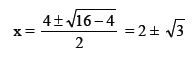
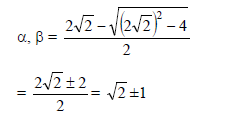
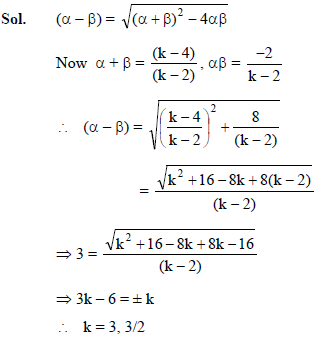
Ex.47 If the product of the roots of the quadratic equation mx2 – 2x + (2m–1) = 0 is 3 then find the value of m is -
Question 1. The equation x² + 4x + k = 0 has real roots. Find the value of k.
Answer:
For the quadratic equation \( x^2 + 4x + k = 0 \) to have real roots, the discriminant \( D \) must be greater than or equal to zero:
\( D \ge 0 \)
\( b^2 - 4ac \ge 0 \)
Substituting \( a = 1 \), \( b = 4 \), and \( c = k \):
\( 4^2 - 4(1)(k) \ge 0 \)
\( 16 - 4k \ge 0 \)
\( 16 \ge 4k \)
\( k \le 4 \)
Therefore, the value of \( k \) must be less than or equal to 4.
In simple words: To make sure the equation has real solutions, the discriminant must not be negative. Solving this inequality tells us that \( k \) cannot be larger than 4.
Exam Tip: Pay close attention to whether the question asks for "real roots" (\( D \ge 0 \)) or "real and distinct roots" (\( D > 0 \)), as this changes the inequality sign.
Question 2. If D = 0, the roots are __________ and each of them is ________. [Note: The equation is ax² + bx + c = 0]
Answer:
When the discriminant \( D \) of a quadratic equation is equal to zero, the roots are real and equal.
Using the quadratic formula:
\( x = \frac{-b \pm \sqrt{D}}{2a} \)
Since \( D = 0 \), both roots simplify to:
\( x = -\frac{b}{2a} \)
Therefore, the blank spaces should be filled with "real and equal" and \( -\frac{b}{2a} \) respectively.
In simple words: When \( D = 0 \), the quadratic curve touches the x-axis at exactly one point, meaning both solutions are identical and equal to \( -b \) divided by \( 2a \).
Exam Tip: Knowing the relationship between the discriminant value and the nature of roots is essential for answering fill-in-the-blank questions quickly.
Question 3. Comment on the nature of the roots without actually finding the roots if 4x² + 12x + 9 = 0.
Answer:
For the given quadratic equation \( 4x^2 + 12x + 9 = 0 \), we identify the coefficients as \( a = 4 \), \( b = 12 \), and \( c = 9 \).
Now, let us calculate the discriminant \( D \):
\( D = b^2 - 4ac \)
\( D = 12^2 - 4(4)(9) \)
\( D = 144 - 144 \)
\( D = 0 \)
Since the discriminant is zero, the roots of the equation are real and equal.
In simple words: We calculate the discriminant value, which turns out to be exactly zero. This tells us the equation has two identical real solutions.
Exam Tip: Always state the formula \( D = b^2 - 4ac \) first before substituting values to secure partial marking points even if you make a calculation error.
Question 4. If ax² + bx + c = 0, has equal roots, then c = ________.
Answer:
Since the quadratic equation has equal roots, its discriminant must be zero:
\( b^2 - 4ac = 0 \)
\( b^2 = 4ac \)
\( c = \frac{b^2}{4a} \)
Therefore, the blank should be filled with \( \frac{b^2}{4a} \).
In simple words: Since the roots are equal, we set the discriminant equation to zero and rearrange it to isolate \( c \), which gives \( b^2 \) divided by \( 4a \).
Exam Tip: Rearranging general formulas algebraically is a common testing method. Practice isolating different variables from standard equations.
Question 5. The positive value of k for which the equation x² + kx + 64 = 0 has equal roots is ________.
Answer:
For the equation \( x^2 + kx + 64 = 0 \) to have equal roots, its discriminant must be zero:
\( D = 0 \)
\( b^2 - 4ac = 0 \)
Substituting \( a = 1 \), \( b = k \), and \( c = 64 \):
\( k^2 - 4(1)(64) = 0 \)
\( k^2 - 256 = 0 \)
\( k^2 = 256 \)
\( k = \pm 16 \)
Since the question asks specifically for the positive value of \( k \), we choose:
\( k = 16 \).
In simple words: We set the discriminant to zero to find the values of \( k \) that yield identical roots. Taking the positive square root of 256 gives us 16.
Exam Tip: Do not forget to read the question carefully - neglecting the word "positive" and writing both \( \pm 16 \) can result in a minor deduction.
Question 6. The sum of the roots of the Q.E. x² + kx + 6 = 0 is -5 then k = ______.
Answer:
For a standard quadratic equation \( ax^2 + bx + c = 0 \), the sum of the roots is given by:
\( \text{Sum of roots} = -\frac{b}{a} \)
For our equation \( x^2 + kx + 6 = 0 \), we have \( a = 1 \) and \( b = k \):
\( \text{Sum of roots} = -k \)
We are given that the sum of the roots is -5:
\( -k = -5 \)
\( k = 5 \)
Therefore, the value of \( k \) is 5.
In simple words: The sum of the roots is equal to \( -b/a \), which means \( -k \) is equal to -5. Changing the signs on both sides tells us \( k \) is 5.
Exam Tip: Remember the sign difference between the sum of roots (\( -b/a \)) and the product of roots (\( c/a \)) to avoid confusing these coefficients.
Question 7. The product of the roots of the Q.E. 3x² + 23x + k = 0 is 20, then k = _____.
Answer:
The product of the roots of a quadratic equation is given by:
\( \text{Product of roots} = \frac{c}{a} \)
For the given equation \( 3x^2 + 23x + k = 0 \), we have \( a = 3 \) and \( c = k \):
\( \text{Product of roots} = \frac{k}{3} \)
Since the product is given as 20:
\( \frac{k}{3} = 20 \)
\( k = 60 \)
Therefore, the value of \( k \) is 60.
In simple words: The product of the solutions is the constant term divided by the first coefficient. Setting \( k/3 \) equal to 20 tells us that \( k \) must be 60.
Exam Tip: Simple algebraic steps like cross-multiplication are key here. Double-check your basic arithmetic to ensure full marks.
Question 8. If α and β are the roots of the Q.E. x² - 7x + 10 = 0 then the Q.E. where roots are 1/α and 1/β is _____.
Answer:
For the equation \( x^2 - 7x + 10 = 0 \), the sum and product of the roots are:
\( \alpha + \beta = -\frac{-7}{1} = 7 \)
\( \alpha\beta = \frac{10}{1} = 10 \)
We need to form a new quadratic equation whose roots are \( \frac{1}{\alpha} \) and \( \frac{1}{\beta} \).
Let us calculate the sum and product of these new roots:
\( \text{Sum of new roots} = \frac{1}{\alpha} + \frac{1}{\beta} = \frac{\alpha + \beta}{\alpha\beta} = \frac{7}{10} \)
\( \text{Product of new roots} = \frac{1}{\alpha} \times \frac{1}{\beta} = \frac{1}{\alpha\beta} = \frac{1}{10} \)
The new quadratic equation is given by:
\( x^2 - (\text{Sum of new roots})x + (\text{Product of new roots}) = 0 \)
\( x^2 - \frac{7}{10}x + \frac{1}{10} = 0 \)
Multiply the entire equation by 10 to write it in standard form:
\( 10x^2 - 7x + 1 = 0 \)
Therefore, the required equation is \( 10x^2 - 7x + 1 = 0 \).
In simple words: We calculate the sum and product of our new inverted roots using the original root relationships. Writing these into our standard equation format gives us the final quadratic relation.
Exam Tip: A useful shortcut for roots that are reciprocals is to simply reverse the coefficients of the original equation: \( ax^2 + bx + c = 0 \) becomes \( cx^2 + bx + a = 0 \).
Question 9. The 17th term of an A.P 2 1/2, 5, 7 1/2, 10, .... is __________.
Answer:
The given Arithmetic Progression is: \( \frac{5}{2}, 5, \frac{15}{2}, 10, \dots \)
Here:
- First term, \( a = \frac{5}{2} = 2.5 \)
- Common difference, \( d = 5 - 2.5 = 2.5 \)
We want to find the 17th term (\( a_{17} \)):
\( a_n = a + (n-1)d \)
\( a_{17} = 2.5 + (17 - 1)(2.5) \)
\( a_{17} = 2.5 + 16(2.5) \)
\( a_{17} = 2.5 + 40 = 42.5 \)
In fractional form, this is \( \frac{85}{2} \) or \( 42\frac{1}{2} \).
Therefore, the 17th term is 42.5 (or \( 42\frac{1}{2} \)).
In simple words: This progression starts at 2.5 and increases by 2.5 each step. Adding 2.5 sixteen times to our starting value gives us our 17th term, which is 42.5.
Exam Tip: Converting mixed fractions to decimals can often make your arithmetic calculations much faster and simpler during an exam.
Question 10. Which term of the A.P 70, 63, 56, 49, .... is 21?
Answer:
For the given Arithmetic Progression:
- First term, \( a = 70 \)
- Common difference, \( d = 63 - 70 = -7 \)
Let the \( n \)-th term of this progression be 21:
\( a_n = a + (n-1)d \)
\( 21 = 70 + (n-1)(-7) \)
\( 21 - 70 = -7(n-1) \)
\( -49 = -7(n-1) \)
\( n-1 = 7 \)
\( n = 8 \)
Therefore, 21 is the 8th term of the progression.
In simple words: The series starts at 70 and decreases by 7 each time. Solving the progression equation tells us that we reach the value 21 at the 8th term.
Exam Tip: When the terms are decreasing, make sure you write the common difference with a negative sign (\( d = -7 \)), as forgetting this is a very common error.
Question 11. The 23rd term from the last term of the A.P. 7, 9 1/2 , 12, 14 1/2 , 17, ... 257 is _____.
Answer:
The given progression is: \( 7, 9.5, 12, 14.5, 17, \dots, 257 \).
Here:
- Common difference, \( d = 9.5 - 7 = 2.5 \)
- Last term, \( l = 257 \)
To find a term from the end, we can write the formula:
\( a_n \text{ from end} = l - (n-1)d \)
Substituting our values for the 23rd term from the end:
\( a_{23} \text{ from end} = 257 - (23 - 1)(2.5) \)
\( a_{23} \text{ from end} = 257 - 22(2.5) \)
\( a_{23} \text{ from end} = 257 - 55 = 202 \).
Therefore, the 23rd term from the last term is 202.
In simple words: Instead of counting forward, we can count backward from the last term of 257 by subtracting our common difference of 2.5. Twenty-two steps backward brings us to 202.
Exam Tip: Reversing the entire AP (making 257 the first term and using \( d = -2.5 \)) is another highly intuitive way to solve "from the last term" questions.
Question 12. The 20th term of an A.P exceeds the 15th term by 10. The common difference is ____.
Answer:
According to the problem statement:
\( a_{20} = a_{15} + 10 \)
Using the formula \( a_n = a + (n-1)d \), we can substitute these terms:
\( [a + 19d] = [a + 14d] + 10 \)
Subtracting \( a \) from both sides:
\( 19d = 14d + 10 \)
\( 5d = 10 \)
\( d = 2 \)
Therefore, the common difference is 2.
In simple words: The difference between the 20th and 15th terms is exactly 5 steps of our common difference. Since this difference is 10, each step must be equal to 2.
Exam Tip: Notice that the first term \( a \) cancels out completely. This means you do not need to know the starting term to find the common difference.
Question 13. Third term of an A.P is 17 and the 10th term is 50 less than the 20th term. Form the A.P.
Answer:
We are given the following conditions:
1. The third term is 17:
\( a_3 = 17 \implies a + 2d = 17 \) - (i)
2. The 10th term is 50 less than the 20th term:
\( a_{10} = a_{20} - 50 \)
\( a + 9d = a + 19d - 50 \)
\( 10d = 50 \)
\( d = 5 \)
Now, substitute \( d = 5 \) back into equation (i):
\( a + 2(5) = 17 \)
\( a + 10 = 17 \)
\( a = 7 \)
The progression starts at 7 and increases by 5 each time:
\( 7, 12, 17, 22, \dots \)
Therefore, the required progression is \( 7, 12, 17, 22, \dots \).
In simple words: The difference of ten steps between the 10th and 20th terms is 50, which means the common difference is 5. Substituting this into our first term relation tells us the series starts at 7.
Exam Tip: Always write down at least the first four terms of your progression to clearly show its pattern to the examiner.
Question 14. Which of the following can form an A.P:
a) Simple Interest on a sum over years
b) Compound Interest on a sum over years
c) Both of these
d) Neither of these
Answer: (a) Simple Interest on a sum over years
Simple interest added each year remains constant because it is always calculated on the initial principal amount. Since the difference between consecutive years' totals is constant, it forms an Arithmetic Progression.
In contrast, compound interest increases exponentially each year, meaning the differences are not constant, so it does not form an Arithmetic Progression.
Therefore, the correct choice is option (a).
In simple words: Simple interest adds the exact same amount of money to the balance every year, creating a perfect progression. Compound interest adds larger and larger amounts each year, so it does not fit the pattern.
Exam Tip: Remember this comparison: simple interest creates an arithmetic progression, while compound interest creates a geometric progression.
Question 15. Allen saves Rs. 10 in first week, 22 in the second week, 34 in the third week, 46 in the fourth week and so on…. He save Rs. 130 in the ________ week.
Answer:
This savings pattern forms an Arithmetic Progression:
\( 10, 22, 34, 46, \dots \)
Here:
- First term, \( a = 10 \)
- Common difference, \( d = 22 - 10 = 12 \)
We need to find the week number \( n \) in which he saves Rs. 130:
\( a_n = a + (n-1)d \)
\( 130 = 10 + (n-1)(12) \)
\( 120 = 12(n-1) \)
\( n-1 = 10 \)
\( n = 11 \)
Therefore, he will save Rs. 130 in the 11th week.
In simple words: Starting with 10 rupees, his savings increase by 12 rupees each week. It takes 10 additional weeks (making it the 11th week in total) to reach his target of 130 rupees.
Exam Tip: Be sure to verify your values. A quick check of \( a + 10d = 10 + 10(12) = 110 + 10 = 130 \) takes seconds and confirms your answer is correct.
Question 16. Arjun starts a job with basic salary of Rs. 12000 and an yearly increment of Rs. 1000. His salary in the 5th year will be __________.
Answer:
The salary payments form an Arithmetic Progression:
- Year 1: Rs. 12,000 (\( a \))
- Year 2: Rs. 13,000
- Year 3: Rs. 14,000
Here, \( a = 12000 \) and \( d = 1000 \).
We want to find his salary in the 5th year (\( a_5 \clock \)):
\( a_5 = a + 4d \)
\( a_5 = 12000 + 4(1000) \)
\( a_5 = 12000 + 4000 = 16000 \)
Therefore, his salary in the 5th year will be Rs. 16,000.
In simple words: Starting at 12,000 rupees, Arjun gets four yearly raises of 1,000 rupees each. By the fifth year, his salary reaches 16,000 rupees.
Exam Tip: For real-world scenarios, note that in the "5th year", only 4 increments have been applied. Using \( a + 5d \) instead of \( a + 4d \) is a very common trap.
Question 17. The n^th term of an A.P is given as tn = 3n + 7. The common difference is _______.
Answer:
To find the common difference, we calculate the first and second terms of the Arithmetic Progression:
For \( n = 1 \): \( t_1 = 3(1) + 7 = 10 \)
For \( n = 2 \): \( t_2 = 3(2) + 7 = 13 \)
The common difference (\( d \)) is the difference between consecutive terms:
\( d = t_2 - t_1 = 13 - 10 = 3 \).
Therefore, the common difference is 3.
In simple words: Substituting 1 and 2 for n gives terms of 10 and 13. Subtracting them shows that the progression increases by 3 at each step.
Exam Tip: For any linear expression of the form \( t_n = An + B \), the coefficient of \( n \) is always the common difference of the AP.
Question 18. Two A.Ps have the same common difference. The difference between their 70^th terms is 140. The difference between their 100^th terms is _______.
Answer:
Let the two progressions be:
\( a_n = a + (n-1)d \)
\( A_n = A + (n-1)d \)
The difference between corresponding terms is:
\( a_n - A_n = [a + (n-1)d] - [A + (n-1)d] = a - A \)
Since the common difference terms cancel out, the difference between any corresponding terms of these two APs is always constant. Since the difference between their 70th terms is 140, the difference between their 100th terms must also be 140.
Therefore, the difference is 140.
In simple words: Since both sequences grow at the exact same rate, the gap between their matching terms remains constant over time. It will always be 140.
Exam Tip: Remember this property: the difference between any two corresponding terms of two APs with the same common difference is equal to the difference between their first terms.
Question 19. 2p + 1, 13, 5p - 3 are three consecutive terms of an A.P. The value of p is ____.
Answer:
If three numbers are in Arithmetic Progression, twice the middle term equals the sum of the first and third terms:
\( 2(13) = (2p + 1) + (5p - 3) \)
\( 26 = 7p - 2 \)
\( 7p = 28 \)
\( p = 4 \).
Therefore, the value of \( p \) is 4.
In simple words: Double the middle term (26) must match the sum of the two outer terms. Solving this tells us that \( p \) equals 4.
Exam Tip: Substituting the calculated value of \( p \) back into the expressions gives the terms 9, 13, and 17, which easily verifies your answer.
Question 20. Three consecutive terms of an A.P are 2x, x+10 and 3x+2. Then x = _______.
Answer:
For three consecutive terms in an AP, the middle term is the arithmetic mean of the outer terms:
\( 2(x + 10) = 2x + (3x + 2) \)
\( 2x + 20 = 5x + 2 \)
\( 3x = 18 \)
\( x = 6 \).
Therefore, the value of \( x \) is 6.
In simple words: Setting twice the middle term equal to the sum of the other two terms gives us a simple equation that simplifies to \( x = 6 \).
Exam Tip: Ensure you distribute the multiplication correctly across the brackets, i.e., write \( 2(x + 10) \) as \( 2x + 20 \) to avoid basic arithmetic errors.
Question 21. Write down the value of t30 - t10 for the A.P 3, 7, 11, 15, 19 .....
Answer:
For the given progression:
- First term, \( a = 3 \)
- Common difference, \( d = 7 - 3 = 4 \)
Using the standard term formula, we subtract the terms directly:
\( t_{30} - t_{10} = (a + 29d) - (a + 9d) \)
\( t_{30} - t_{10} = 20d \)
Substituting the value of \( d = 4 \):
\( t_{30} - t_{10} = 20(4) = 80 \).
Therefore, the value of \( t_{30} - t_{10} \) is 80.
In simple words: The 30th term is exactly 20 steps of size 4 ahead of the 10th term, meaning the difference between them is 80.
Exam Tip: Notice that the first term \( a \) cancels out completely, so you can solve this without using the starting value of the sequence.
Question 22. The no. of terms in the A.P 7, 2, -3, -8 ..... - 393 is _______.
Answer:
For the given progression:
- First term, \( a = 7 \)
- Common difference, \( d = 2 - 7 = -5 \)
- Last term, \( a_n = -393 \)
Using the formula for the \( n \)-th term:
\( a_n = a + (n-1)d \)
\( -393 = 7 + (n-1)(-5) \)
\( -400 = -5(n-1) \)
\( n-1 = 80 \)
\( n = 81 \).
Therefore, there are 81 terms in this progression.
In simple words: Starting at 7 and decreasing by 5 at each step, it takes 80 steps to reach -393. This means there are 81 numbers in the list.
Exam Tip: Double-check the division of negative numbers: dividing \( -400 \) by \( -5 \) yields a positive integer, as the count of terms must always be positive.
Question 23. The middle term of the A.P 6, 11, 16, 21 ..... 506 is _______.
Answer:
For the given progression:
- First term, \( a = 6 \)
- Common difference, \( d = 5 \)
- Last term, \( a_n = 506 \)
First, find the total number of terms (\( n \)):
\( 506 = 6 + (n-1)5 \)
\( 500 = 5(n-1) \)
\( n-1 = 100 \implies n = 101 \)
Since \( n = 101 \) is an odd number, the middle term is at position:
\( \text{Middle term position} = \frac{101 + 1}{2} = 51 \)
Now, let us calculate the 51st term (\( a_{51} \)):
\( a_{51} = a + 50d \)
\( a_{51} = 6 + 50(5) = 256 \).
Therefore, the middle term is 256.
In simple words: The sequence contains 101 numbers. The exact middle number is at the 51st spot, which has a calculated value of 256.
Exam Tip: If \( n \) is odd, there is one middle term at \( \frac{n+1}{2} \). If \( n \) is even, there will be two middle terms at \( \frac{n}{2} \) and \( \frac{n}{2} + 1 \).
Question 24. Which term of the A.P 32, 35, 38 ..... is 120 less than its 80th term.
Answer:
For the given progression:
- Common difference, \( d = 35 - 32 = 3 \)
Let the required term be \( a_n \). According to the problem statement:
\( a_n = a_{80} - 120 \)
\( a + (n-1)d = a + 79d - 120 \)
Subtracting \( a \) from both sides:
\( (n-1)d = 79d - 120 \)
Substitute \( d = 3 \):
\( 3(n-1) = 79(3) - 120 \)
\( 3(n-1) = 237 - 120 = 117 \)
\( n-1 = 39 \)
\( n = 40 \).
Therefore, the required term is the 40th term.
In simple words: Since each step is 3 units, a gap of 120 represents exactly 40 steps backward from the 80th term, putting us at the 40th term.
Exam Tip: Working directly with step differences (\( d \)) is much safer and faster than computing the actual value of the 80th term first.
Question 25. Which term of the A.P 95, 92 2/3 , 90 1/3 ..... is the first negative term?
Answer:
For the given progression:
- First term, \( a = 95 \)
- Common difference, \( d = 92\frac{2}{3} - 95 = \frac{278}{3} - 95 = -\frac{7}{3} \)
We want to find the first term where \( a_n < 0 \):
\( a + (n-1)d < 0 \)
\( 95 + (n-1)\left(-\frac{7}{3}\right) < 0 \)
\( 95 < \frac{7}{3}(n-1) \)
\( 285 < 7n - 7 \)
\( 292 < 7n \)
\( n > \frac{292}{7} \approx 41.7 \).
Since \( n \) must be an integer, the smallest integer value greater than 41.7 is 42.
Therefore, the first negative term is the 42nd term.
In simple words: The sequence decreases by 2.33 at each step. Solving the inequality shows that the values cross below zero at the 42nd term.
Exam Tip: For "first negative term" problems, always set up the inequality \( a_n < 0 \) and solve for the smallest integer \( n \).
Question 26. Find the no. of 3 digit nos. which are divisible by 7.
Answer:
Three-digit numbers range from 100 to 999.
- The first 3-digit number divisible by 7 is 105.
- The last 3-digit number divisible by 7 is 994.
This forms an Arithmetic Progression:
\( 105, 112, 119, \dots, 994 \)
Here, \( a = 105 \), \( d = 7 \), and \( a_n = 994 \).
Using the progression formula:
\( 994 = 105 + (n-1)7 \)
\( 889 = 7(n-1) \)
\( n-1 = 127 \)
\( n = 128 \).
Therefore, there are 128 three-digit numbers divisible by 7.
In simple words: We find the first (105) and last (994) three-digit multiples of 7. Counting the steps between them tells us there are 128 such numbers.
Exam Tip: To find the last term easily, divide 999 by 7 and subtract the remainder from 999: \( 999 - 5 = 994 \).
Question 27. Find the no. of 3 digit nos. which are not divisible by 5.
Answer:
The total count of three-digit numbers is 900 (from 100 to 999).
Let us first find the count of three-digit numbers that are divisible by 5:
- First term, \( a = 100 \)
- Last term, \( a_n = 995 \)
- Common difference, \( d = 5 \)
Using the progression formula:
\( 995 = 100 + (n-1)5 \)
\( 895 = 5(n-1) \)
\( n-1 = 179 \implies n = 180 \).
Subtracting this from the total count:
\( \text{Numbers not divisible by 5} = 900 - 180 = 720 \).
Therefore, there are 720 three-digit numbers not divisible by 5.
In simple words: There are 900 three-digit numbers in total. By finding that 180 of them are divisible by 5 and subtracting them, we get 720 numbers that are not.
Exam Tip: Finding the complementary count (divisible by 5) and subtracting it from the total is much simpler than trying to count non-divisible numbers directly.
Question 28. Find the no. of 3 digit nos. which are divisible by both 3 and 5.
Answer:
Numbers divisible by both 3 and 5 must be multiples of their least common multiple:
\( \text{LCM}(3, 5) = 15 \)
Now, we find the three-digit multiples of 15:
- First term, \( a = 105 \)
- Last term, \( a_n = 990 \)
- Common difference, \( d = 15 \)
Using the progression formula:
\( 990 = 105 + (n-1)15 \)
\( 885 = 15(n-1) \)
\( n-1 = 59 \)
\( n = 60 \).
Therefore, there are 60 three-digit numbers divisible by both 3 and 5.
In simple words: Being divisible by both 3 and 5 is the same as being divisible by 15. The three-digit multiples of 15 range from 105 to 990, giving us 60 terms in total.
Exam Tip: Always find the LCM of the divisor numbers first to identify the correct step size for the progression.
Question 29. Find the no. of 4 digit nos. which leave the remainder 3 when divided by 5.
Answer:
Four-digit numbers range from 1000 to 9999.
The numbers leaving remainder 3 when divided by 5 are of the form \( 5k + 3 \):
- First such number: \( 1000 + 3 = 1003 \)
- Last such number: \( 9995 + 3 = 9998 \)
This forms an Arithmetic Progression:
\( 1003, 1008, 1013, \dots, 9998 \)
Here, \( a = 1003 \), \( d = 5 \), and \( a_n = 9998 \).
Using the progression formula:
\( 9998 = 1003 + (n-1)5 \)
\( 8995 = 5(n-1) \)
\( n-1 = 1799 \)
\( n = 1800 \).
Therefore, there are 1800 such four-digit numbers.
In simple words: The numbers that leave a remainder of 3 form a series starting at 1003 and increasing by 5 each time. Solving the equation tells us there are 1800 numbers in this set.
Exam Tip: To find the first term easily, add the remainder to the first multiple of the divisor that is greater than or equal to the lower bound of the range.
Question 30. Find the no. of multiples of 6 lying between 75 and 750.
Answer:
The numbers must lie strictly between 75 and 750 (exclusive):
- The first multiple of 6 after 75 is 78.
- The last multiple of 6 before 750 (excluding 750 itself since it's "between") is \( 750 - 6 = 744 \).
This forms an Arithmetic Progression:
\( 78, 84, 90, \dots, 744 \)
Here, \( a = 78 \), \( d = 6 \), and \( a_n = 744 \).
Using the progression formula:
\( 744 = 78 + (n-1)6 \)
\( 666 = 6(n-1) \)
\( n-1 = 111 \)
\( n = 112 \).
Therefore, there are 112 multiples of 6 between 75 and 750.
In simple words: The multiples of 6 in this range start at 78 and end at 744. Counting the steps shows there are 112 terms in total.
Exam Tip: Pay close attention to the word "between", which means the boundary values themselves (like 750) cannot be included in your count.
Question 31. Find the roots by Quadratic Formula: x² - 23x + 90 = 0.
Answer:
For the equation \( x^2 - 23x + 90 = 0 \), the coefficients are \( a = 1 \), \( b = -23 \), and \( c = 90 \).
First, let us calculate the discriminant \( D \):
\( D = b^2 - 4ac \)
\( D = (-23)^2 - 4(1)(90) \)
\( D = 529 - 360 = 169 \)
Now, we apply the quadratic formula:
\( x = \frac{-b \pm \sqrt{D}}{2a} \)
\( x = \frac{23 \pm \sqrt{169}}{2(1)} \)
\( x = \frac{23 \pm 13}{2} \)
This gives two roots:
\( x_1 = \frac{23 + 13}{2} = \frac{36}{2} = 18 \)
\( x_2 = \frac{23 - 13}{2} = \frac{10}{2} = 5 \)
Therefore, the roots of the equation are 18 and 5.
In simple words: Using the quadratic formula with the discriminant of 169 gives us two solutions: 18 and 5.
Exam Tip: Knowing common squares like \( 13^2 = 169 \) helps you simplify the square root of the discriminant quickly and confidently.
Question 32. Find the roots by Completion of Square Method: 3x² - 19x + 20 = 0.
Answer:
Let us solve the quadratic equation \( 3x^2 - 19x + 20 = 0 \) by completing the square:
First, divide the entire equation by 3 to make the leading coefficient 1:
\( x^2 - \frac{19}{3}x + \frac{20}{3} = 0 \)
\( x^2 - \frac{19}{3}x = -\frac{20}{3} \)
To complete the square, we add the square of half the coefficient of \( x \) to both sides:
\( \text{Half of coefficient} = \frac{19}{6} \)
\( \text{Square to add} = \left(\frac{19}{6}\right)^2 = \frac{361}{36} \)
Adding \( \frac{361}{36} \) to both sides:
\( x^2 - \frac{19}{3}x + \frac{361}{36} = -\frac{20}{3} + \frac{361}{36} \)
\( \left(x - \frac{19}{6}\right)^2 = \frac{-240 + 361}{36} \)
\( \left(x - \frac{19}{6}\right)^2 = \frac{121}{36} \)
Taking the square root of both sides:
\( x - \frac{19}{6} = \pm \frac{11}{6} \)
\( x = \frac{19 \pm 11}{6} \)
This gives two roots:
\( x_1 = \frac{19 + 11}{6} = \frac{30}{6} = 5 \)
\( x_2 = \frac{19 - 11}{6} = \frac{8}{6} = \frac{4}{3} \)
Therefore, the roots are 5 and \( \frac{4}{3} \).
In simple words: Dividing the equation by 3 and adding a balancing constant to both sides allows us to form a perfect square. Taking the square root gives us our two solutions of 5 and 4/3.
Exam Tip: Pay close attention to fractions when completing the square. Keeping everything over a common denominator makes the algebra much safer and easier.
Free study material for Mathematics
Free CBSE Practice Worksheets: Class 10 Mathematics Chapter 04 Quadratic Equation
Practice Exercises for Class 10 Mathematics Chapter 04 Quadratic Equation
Access structured practice worksheets for Chapter 04 Quadratic Equation aligned with the 2026 CBSE curriculum. These downloadable exercises for Class 10 Mathematics help students build accuracy and reinforce core concepts for upcoming school tests.
Step-by-Step Solutions and Practice Guidelines
Each worksheet draws directly from authorized standard textbooks to maintain academic accuracy. Evaluating your finished exercises against expert-verified solutions helps master the formal presentation standards expected in school evaluations.
Enhance Speed with Online Practice
Wrap up your chapter revision by testing your knowledge against standard objective question formats. Explore our full library of free, up-to-date printable assignments to maximize your academic results in upcoming CBSE evaluations.
FAQs
You can download the latest chapter-wise printable worksheets for Class 10 Mathematics Chapter 04 Quadratic Equation for free from StudiesToday.com. These have been made as per the latest CBSE curriculum for this academic year.
Yes, Class 10 Mathematics worksheets for Chapter 04 Quadratic Equation focus on activity-based learning and also competency-style questions. This helps students to apply theoretical knowledge to practical scenarios.
Yes, we have provided solved worksheets for Class 10 Mathematics Chapter 04 Quadratic Equation to help students verify their answers instantly.
Yes, our Class 10 Mathematics test sheets are mobile-friendly PDFs and can be printed by teachers for classroom.
For Chapter 04 Quadratic Equation, regular practice with our worksheets will improve question-handling speed and help students understand all technical terms and diagrams.