

Chapter-wise Worksheets for Class 10 Mathematics: Chapter 10 Circles
Review targeted academic worksheets with the CBSE Class 10 Mathematics Circles Worksheet Set 03. Built according to official educational standards for the 2026-27 term, these downloadable Class 10 Mathematics resources support effective daily practice and detailed self-evaluation for Chapter 10 Circles.
Practice Class 10 Mathematics Worksheets: Chapter 10 Circles
View or download the dedicated CBSE Class 10 Mathematics Circles Worksheet Set 03 resource below. Engaging with these practice papers under focused study conditions ensures continuous academic progress and mastery of the 2026-27 curriculum for Chapter 10 Circles.
Circles


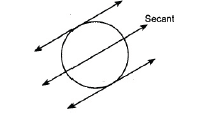
Q.- How many tangents, parallel to a secant can a circle have?
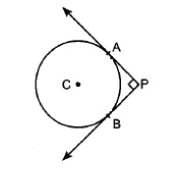
Ans- PA and PB are two tangents drawn from an external point P to a circle.

=>AP=PB=BC=4cm
Question 1. Prove that the intercept of a tangent between two parallel tangents to a circle subtends a right angle at the centre of the circle.
Answer: Let \( XY \) and \( X'Y' \) be two parallel tangents to a circle with center \( O \), touching the circle at points \( P \) and \( Q \) respectively. Let \( AB \) be another tangent line segment intercepting them, touching the circle at point \( C \).
Since \( XY \parallel X'Y' \) are parallel tangents, the line segment joining their points of contact \( P \) and \( Q \) must pass through the center \( O \), making \( PQ \) a diameter of the circle.
We need to prove that \( \angle AOB = 90^\circ \).
Join the center \( O \) to the point of contact \( C \).
In triangles \( \Delta OPA \) and \( \Delta OCA \):
1. \( OP = OC \) (radii of the same circle)
2. \( AP = AC \) (lengths of tangents from an external point \( A \) are equal)
3. \( OA = OA \) (common side)
By the Side-Side-Side (SSS) congruence criterion:
\( \Delta OPA \cong \Delta OCA \)
Therefore, by corresponding parts of congruent triangles (CPCT):
\( \angle POA = \angle COA = \theta_1 \) - (Equation 1)
Similarly, we can prove that \( \Delta OQB \cong \Delta OCB \), which gives:
\( \angle QOB = \angle COB = \theta_2 \) - (Equation 2)
Since \( PQ \) is a straight diameter line, the sum of the angles on the straight line at point \( O \) is \( 180^\circ \):
\( \angle POA + \angle COA + \angle COB + \angle QOB = 180^\circ \)
Substitute the values from Equation 1 and Equation 2:
\( 2\theta_1 + 2\theta_2 = 180^\circ \)
\( \implies \theta_1 + \theta_2 = 90^\circ \)
Since \( \angle AOB = \angle COA + \angle COB = \theta_1 + \theta_2 \):
\( \angle AOB = 90^\circ \).
Hence proved.
In simple words: The two triangles at the top are identical, and the two at the bottom are also identical. Since all four angles add up to 180 degrees along the straight diameter, the two middle angles must add up to exactly 90 degrees.
Exam Tip: Be sure to explicitly state that the line connecting the contact points of two parallel tangents is a straight diameter - this is critical for the angle sum step.
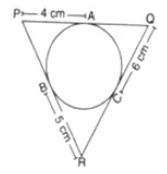
Question 2. In the given Fig. 10.1, PA and PB are tangents to the circle drawn from an external point P. If PB = 10 cm, and CQ = 2cm, Find the length of PC.
Answer: We are given that \( PA \) and \( PB \) are tangents drawn from an external point \( P \) to the circle.
Since the lengths of tangents drawn from an external point to a circle are equal:
\( PA = PB = 10 \text{ cm} \)
Similarly, \( CA \) and \( CQ \) are tangents drawn from the external point \( C \) to the circle, which means:
\( CA = CQ = 2 \text{ cm} \)
The length of \( PC \) is given by subtracting \( CA \) from the total tangent length \( PA \):
\( PC = PA - CA \)
\( \implies PC = 10 - 2 = 8 \text{ cm} \)
Therefore, the length of \( PC \) is 8 cm.
In simple words: The two main outer tangents are both 10 cm. Since the small segment at the corner is 2 cm, subtracting it from the main tangent leaves 8 cm for the remaining section.
Exam Tip: Trace the path of tangent segments from each external point (like C) to find matching values that can be subtracted from the larger segments.
Question 3. The length of the tangent from a point A at a distance of 5cm from the centre of the circle is 4cm. What will be the diameter of the circle.
Answer: Let \( O \) be the center of the circle, and let \( T \) be the point of contact of the tangent drawn from point \( A \).
Since the radius is always perpendicular to the tangent at the point of contact, \( \Delta OTA \) is a right-angled triangle with \( \angle OTA = 90^\circ \).
We are given:
\( OA = 5 \text{ cm} \) (distance from the center)
\( AT = 4 \text{ cm} \) (length of the tangent)
Using Pythagoras' theorem in \( \Delta OTA \):
\( OA^2 = OT^2 + AT^2 \)
\( \implies 5^2 = r^2 + 4^2 \)
\( \implies 25 = r^2 + 16 \)
\( \implies r^2 = 25 - 16 = 9 \)
\( \implies r = 3 \text{ cm} \)
The diameter \( d \) of the circle is twice the radius:
\( d = 2r = 2 \times 3 = 6 \text{ cm} \)
Therefore, the diameter of the circle is 6 cm.
In simple words: Use Pythagoras' theorem with the values 5 and 4 to find the circle's radius (which is 3), then double it to get the diameter.
Exam Tip: Do not stop after calculating the radius - make sure to multiply by 2 if the question specifically asks for the diameter.
Question 4. In the given Fig. 10.2: If AB = AC Prove that BD = CD.
Answer: Let the inscribed circle touch the sides \( AB, AC, \) and \( BC \) of \( \Delta ABC \) at the points \( F, E, \) and \( D \) respectively.
The lengths of tangents drawn from an external point to a circle are equal.
Therefore, we have:
\( AF = AE \) (tangents from \( A \)) - (Equation 1)
\( BF = BD \) (tangents from \( B \)) - (Equation 2)
\( CD = CE \) (tangents from \( C \)) - (Equation 3)
We are given:
\( AB = AC \)
\( \implies AF + BF = AE + CE \)
Using Equation 1 (\( AF = AE \)), we can subtract this common value from both sides:
\( BF = CE \)
Now, substituting the values from Equation 2 and Equation 3:
\( BD = CD \)
Hence proved.
In simple words: Since the two sides of the triangle are equal and the corner paths to the circle are equal, the leftover segments at the bottom corners must be equal, meaning the point of contact bisects the base.
Exam Tip: In triangles circumscribing a circle, breaking the sides into pairs of equal tangents from each corner is the key to proving relationships.
Question 5. A circle touches the side BC of ∆ABC at a point P and touches AB and AC when produced at q and R respectively. Show that AQ = 1/2 (Perimeter of ∆ABC)
Answer: The perimeter of \( \Delta ABC \) is the sum of its three sides:
\( \text{Perimeter} = AB + BC + AC = AB + (BP + CP) + AC \) - (Equation 1)
Since lengths of tangents from an external point are equal:
\( BP = BQ \) (tangents from \( B \))
\( CP = CR \) (tangents from \( C \))
\( AQ = AR \) (tangents from \( A \))
Substitute \( BP = BQ \) and \( CP = CR \) into Equation 1:
\( \text{Perimeter} = AB + BQ + AC + CR \)
\( \implies \text{Perimeter} = AQ + AR \)
Since \( AQ = AR \):
\( \text{Perimeter} = 2 AQ \)
\( \implies AQ = \frac{1}{2} (\text{Perimeter of } \Delta ABC) \)
Hence proved.
In simple words: The total border of the triangle is equal to the sum of the two long straight tangents from point A. Since those two tangents are equal, one of them is exactly half of the total perimeter.
Exam Tip: Practice this derivation as it is one of the most frequently asked proofs in CBSE Class X board exams.
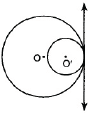
Question 6. In Fig 10.3 o and o' are centres of two circles. Prove that PP' = QQ'
Answer: Let \( R \) be the external point where the two common external tangents intersect.
From the external point \( R \):
For the larger outer circle, \( RP \) and \( RQ \) are tangents. Since lengths of tangents from an external point are equal:
\( RP = RQ \) - (Equation 1)
For the smaller inner circle, \( RP' \) and \( RQ' \) are tangents from the same point \( R \):
\( RP' = RQ' \) - (Equation 2)
Subtracting Equation 2 from Equation 1:
\( RP - RP' = RQ - RQ' \)
\( \implies PP' = QQ' \)
Hence proved.
In simple words: The total distances from the meeting point to the outer circle are equal, and the distances to the inner circle are also equal. Subtracting the smaller distances from the larger ones leaves the two intermediate segments equal.
Exam Tip: Identifying the external point \(R\) as the common vertex where the tangents originate makes this multi-circle proof short and easy to solve.
Question 7. ABC is an isosceles ∆ in which AB = Ac, circumscribing about a circle show that BC is bisected at the point of contact.
Answer: Let the inscribed circle touch the sides \( AB, AC, \) and \( BC \) of \( \Delta ABC \) at points \( F, E, \) and \( D \) respectively.
By the equal tangent theorem, we have:
\( AF = AE \) (tangents from \( A \)) - (Equation 1)
\( BF = BD \) (tangents from \( B \)) - (Equation 2)
\( CD = CE \) (tangents from \( C \)) - (Equation 3)
We are given that \( \Delta ABC \) is isosceles with:
\( AB = AC \)
\( \implies AF + BF = AE + CE \)
Subtracting Equation 1 (\( AF = AE \)) from both sides:
\( BF = CE \)
Using the relations in Equation 2 and Equation 3 to substitute these values:
\( BD = CD \)
Therefore, the base \( BC \) is bisected by the point of contact \( D \).
Hence proved.
In simple words: Since the two main sides of the triangle are identical, the segments starting from the top corner are equal. This leaves the remaining side segments equal, forcing the contact point at the bottom to sit exactly in the center.
Exam Tip: Be sure to write down the individual equal tangent pairs at each vertex before combining them to prove the final equality.
Question 8. In the given Fig 10.4 find the perimeter of ∆ ABC if AP = 10cm.
Answer: From the properties of a circle inscribed in a triangle with produced sides (as proved in Question 5):
The perimeter of \( \Delta ABC \) is equal to twice the length of the tangent \( AP \) drawn from the external vertex \( A \):
\( \text{Perimeter of } \Delta ABC = 2 \times AP \)
Given \( AP = 10 \text{ cm} \):
\( \text{Perimeter} = 2 \times 10 = 20 \text{ cm} \)
Therefore, the perimeter of \( \Delta ABC \) is 20 cm.
In simple words: The total border of the triangle is exactly twice the length of the long tangent from point A, which gives us \(2 \times 10 = 20 \text{ cm}\).
Exam Tip: Use the relation \( \text{Perimeter} = 2 \times \text{Tangent} \) to write down the solution directly and save valuable time on multiple-choice questions.
Question 9. In the Fig. 10.4, AP = 10cm and AC = 6cm. Find CR.
Answer: We are given that \( AP \) and \( AR \) are tangents drawn from the external point \( A \) to the circle.
Therefore, their lengths are equal:
\( AR = AP = 10 \text{ cm} \)
The point \( C \) lies on the line segment \( AR \), which means:
\( AR = AC + CR \)
Substitute the given values of \( AR = 10 \text{ cm} \) and \( AC = 6 \text{ cm} \):
\( 10 = 6 + CR \)
\( \implies CR = 10 - 6 = 4 \text{ cm} \)
Therefore, the length of \( CR \) is 4 cm.
In simple words: The entire length from A to the right-hand touchpoint is equal to the left-hand tangent of 10 cm. Since the part of the line from A to C is 6 cm, the remaining part from C to R must be 4 cm.
Exam Tip: Break down the segment addition \( AR = AC + CR \) carefully to avoid basic subtraction mistakes on simple problems.
Question 10. If a, b, c are the sides of a right ∆ where 'c' is the hypotenuse. Prove that the radius r of the circle which touches the sides of the ∆ is given by r = a+b-c / 2
Answer: Let the right-angled triangle have vertices \( A, B, \) and \( C \) with the right angle at \( C \). Thus, \( BC = a \), \( AC = b \), and hypotenuse \( AB = c \).
Let the incircle with center \( O \) and radius \( r \) touch \( AC \) at \( Y \), \( BC \) at \( X \), and \( AB \) at \( Z \).
Join the center \( O \) to the contact points \( X \) and \( Y \). Since the radius is perpendicular to the tangent:
\( OX \perp BC \) and \( OY \perp AC \).
Since \( \angle C = 90^\circ \), the quadrilateral \( OXCY \) has three right angles, making it a rectangle. Since its adjacent sides \( OX = OY = r \), the rectangle \( OXCY \) is a square of side \( r \).
\( \implies CX = CY = r \)
Using the equal tangent segments property from each vertex:
\( AY = AC - CY = b - r \implies AZ = b - r \) (tangents from \( A \))
\( BX = BC - CX = a - r \implies BZ = a - r \) (tangents from \( B \))
Since \( AB = c \):
\( AZ + BZ = c \)
\( \implies (b - r) + (a - r) = c \)
\( \implies a + b - 2r = c \)
\( \implies 2r = a + b - c \)
\( \implies r = \frac{a + b - c}{2} \)
Hence proved.
In simple words: Since the corner near the right angle forms a square with the circle's radius, we can write down all tangent segments in terms of \(r\). Adding the two segments that make up the hypotenuse directly gives the formula.
Exam Tip: Proving that the corner quadrilateral \(OXCY\) is a square is a necessary step in the proof to justify \(CX = CY = r\).
Question 11. In the given Fig 10.5, ABC is a right angle ∆, ∟B=90° Such that BC=6cm and AB=8cm. Find the radius of the circle
Answer: In right-angled triangle \( ABC \) with \( \angle B = 90^\circ \):
Using Pythagoras' theorem to find the hypotenuse \( AC \):
\( AC = \sqrt{AB^2 + BC^2} = \sqrt{8^2 + 6^2} = \sqrt{64 + 36} = 10 \text{ cm} \).
Using the standard right-triangle inradius formula (as proved in Question 10):
\( r = \frac{AB + BC - AC}{2} \)
\( \implies r = \frac{8 + 6 - 10}{2} = \frac{4}{2} = 2 \text{ cm} \)
Therefore, the radius of the circle is 2 cm.
In simple words: Find the hypotenuse first using Pythagoras' theorem (which is 10). Then, add the two shorter sides, subtract the hypotenuse, and divide by 2 to get the radius.
Exam Tip: Memorizing the formula \( r = \frac{a+b-c}{2} \) helps you find the inradius of any right triangle quickly on multiple-choice questions.
Question 12. If from an external point B a circle with centre o, two tangents Bc and BD are drawn such that ∟DBC =120˚. Prove that Bc + BD = Bo or, Bo = 2BC
Answer: Let \( BO \) be the line segment connecting the external point \( B \) to the center of the circle \( O \).
We know that the line segment connecting an external point to the center of the circle bisects the angle between the two tangents:
\( \angle OBC = \frac{\angle DBC}{2} = \frac{120^\circ}{2} = 60^\circ \).
Since the radius \( OC \) is perpendicular to the tangent \( BC \), \( \Delta BCO \) is a right-angled triangle with \( \angle BCO = 90^\circ \).
In right-angled triangle \( BCO \):
\( \cos(\angle OBC) = \frac{\text{Adjacent}}{\text{Hypotenuse}} = \frac{BC}{BO} \)
\( \implies \cos(60^\circ) = \frac{BC}{BO} \)
Since \( \cos(60^\circ) = \frac{1}{2} \):
\( \frac{1}{2} = \frac{BC}{BO} \)
\( \implies BO = 2BC \) - (Equation 1)
Since the lengths of tangents from an external point are equal, \( BC = BD \). We can rewrite Equation 1 as:
\( BO = BC + BC = BC + BD \)
Hence proved.
In simple words: The center line cuts the 120-degree corner angle exactly in half to make 60 degrees. Applying basic trigonometry to the right triangle shows that the center line \(BO\) is twice the tangent length \(BC\).
Exam Tip: Be sure to write out both parts of the proof - showing \(BO = 2BC\) first using cosine, and then substituting \(BD = BC\) to show \(BO = BC + BD\).
Question 13. In the given Fig., if PA and PB are tangents to the circle with centre o such that ∟APB = 50˚ then ∟OAB is equal to _________
Answer: Let \( PA \) and \( PB \) be tangents to the circle with center \( O \), where \( \angle APB = 50^\circ \).
We know that the angle between two tangents from an external point and the angle subtended by the points of contact at the center are supplementary:
\( \angle AOB + \angle APB = 180^\circ \)
\( \implies \angle AOB + 50^\circ = 180^\circ \)
\( \implies \angle AOB = 130^\circ \).
In \( \Delta OAB \), the sides \( OA \) and \( OB \) are radii of the circle, which means \( OA = OB \). Therefore, the base angles are equal:
\( \angle OAB = \angle OBA \).
In \( \Delta OAB \), the sum of all interior angles is \( 180^\circ \):
\( \angle OAB + \angle OBA + \angle AOB = 180^\circ \)
\( \implies 2 \angle OAB + 130^\circ = 180^\circ \)
\( \implies 2 \angle OAB = 50^\circ \)
\( \implies \angle OAB = 25^\circ \).
Therefore, the value of \( \angle OAB \) is \( 25^\circ \).
In simple words: The center angle is \(180 - 50 = 130 \text{ degrees}\). The remaining 50 degrees of the inner triangle are split equally between the two base angles, which gives 25 degrees for each.
Exam Tip: Use the direct shortcut formula \( \angle OAB = \frac{1}{2} \angle APB \) to verify your final angle value quickly.
Question 14. A circle is inscribed in a ∆ABC having sides 8cm, 10cm and 12cm as shown the Fig. Find AD, BE and CF.
Answer: Let the contact points of the inscribed circle with the sides \( AB, BC, \) and \( AC \) be \( D, E, \) and \( F \) respectively.
Let \( AD = AF = x \) (tangents from \( A \))
Let \( BD = BE = y \) (tangents from \( B \))
Let \( CE = CF = z \) (tangents from \( C \))
From the given side lengths of \( \Delta ABC \):
\( AB = x + y = 12 \text{ cm} \) - (Equation 1)
\( BC = y + z = 8 \text{ cm} \) - (Equation 2)
\( AC = z + x = 10 \text{ cm} \) - (Equation 3)
Adding these three equations together:
\( 2(x + y + z) = 12 + 8 + 10 = 30 \)
\( \implies x + y + z = 15 \) - (Equation 4)
Subtracting Equation 2 from Equation 4:
\( x = 15 - 8 = 7 \text{ cm} \implies AD = 7 \text{ cm} \)
Subtracting Equation 3 from Equation 4:
\( y = 15 - 10 = 5 \text{ cm} \implies BE = 5 \text{ cm} \)
Subtracting Equation 1 from Equation 4:
\( z = 15 - 12 = 3 \text{ cm} \implies CF = 3 \text{ cm} \).
Therefore, the lengths are \( AD = 7 \text{ cm} \), \( BE = 5 \text{ cm} \), and \( CF = 3 \text{ cm} \).
In simple words: The paths starting from each corner are equal. Add all the sides of the triangle and divide by 2 to get the total sum of the paths, then subtract each side's length to find the individual corner parts.
Exam Tip: This algebraic pattern is highly predictable. Adding the equations to find the sum \(x+y+z\) first is the most reliable way to avoid arithmetic errors.
Question 15. If all sides of a parallelogram touch a circle show that the parallelogram is a rhombus.
Answer: Let \( ABCD \) be a parallelogram circumscribed about a circle.
We know that for any quadrilateral circumscribed about a circle, the sum of opposite sides is equal:
\( AB + CD = AD + BC \) - (Equation 1)
Since \( ABCD \) is a parallelogram, its opposite sides are equal:
\( AB = CD \)
\( AD = BC \)
Substitute these values into Equation 1:
\( AB + AB = AD + AD \)
\( \implies 2AB = 2AD \)
\( \implies AB = AD \)
Since the adjacent sides of the parallelogram are equal, all four sides of the parallelogram must be equal.
Therefore, \( ABCD \) is a rhombus.
Hence proved.
In simple words: For any shape wrapping around a circle, opposite sides added together are equal. In a parallelogram, since opposite sides are already equal, this rule forces adjacent sides to be equal too, making it a rhombus.
Exam Tip: Be sure to write out the basic property \(AB + CD = AD + BC\) before applying the parallelogram properties to keep your proof complete.
Question 16. In the Fig: ∟B=90°. If AD=23cm, AB=29cm and DS=5cm. Find the radius (r) of the circle.
Answer: Let the circle with center \( O \) and radius \( r \) touch the sides \( AB, BC, CD, \) and \( DA \) at points \( P, Q, R, \) and \( S \) respectively.
We are given:
\( DS = 5 \text{ cm} \).
Since the tangents from an external point are equal:
\( DR = DS = 5 \text{ cm} \)
Since \( AD = 23 \text{ cm} \), we can find \( AS \):
\( AS = AD - DS = 23 - 5 = 18 \text{ cm} \)
Since \( AP = AS \):
\( AP = 18 \text{ cm} \)
We are given \( AB = 29 \text{ cm} \), so we can find \( BP \):
\( BP = AB - AP = 29 - 18 = 11 \text{ cm} \)
Now, consider the quadrilateral \( OPBQ \):
\( \angle B = 90^\circ \) (given)
\( \angle OPB = 90^\circ \) and \( \angle OQB = 90^\circ \) (radius is perpendicular to tangent)
Therefore, \( OPBQ \) is a rectangle. Since the adjacent sides \( OP = OQ = r \), the rectangle \( OPBQ \) is a square.
\( \implies r = BP = 11 \text{ cm} \).
Therefore, the radius of the circle is 11 cm.
In simple words: Work your way around the corners. Start with the known segment at corner D, subtract it to find the segment at A, subtract that to find the segment at B, which is equal to the circle's radius.
Exam Tip: Be sure to explicitly prove why \(OPBQ\) is a square (by showing three right angles and equal adjacent sides) to get full marks on this problem.
Question 17. A quadrilateral ABCD is drawn to circumscribe a circle if AB = 4 cm, CD = 7cm, BC = 3cm, then find AD.
Answer: For a quadrilateral \( ABCD \) circumscribed about a circle, the sum of opposite sides is equal:
\( AB + CD = AD + BC \)
We are given the following values:
\( AB = 4 \text{ cm} \)
\( BC = 3 \text{ cm} \)
\( CD = 7 \text{ cm} \)
Substitute these values into the equation:
\( 4 + 7 = AD + 3 \)
\( \implies 11 = AD + 3 \)
\( \implies AD = 11 - 3 = 8 \text{ cm} \)
Therefore, \( AD = 8 \text{ cm} \).
In simple words: The sum of the opposite sides must match, so \(4 + 7\) (the top and bottom) must equal \(3 + AD\) (the sides). This gives us a length of 8.
Exam Tip: This is a standard 1-mark or 2-mark question. Simply stating the relation \(AB+CD=AD+BC\) is enough to get quick points.
Question 18. In the given Fig. OD is perpendicular to the chord AB of a circle whose centre is O. If BC is a diameter, find CA.
Answer: In triangle \( ABC \), since \( BC \) is a diameter of the circle, the angle subtended by the diameter in a semicircle is a right angle:
\( \angle CAB = 90^\circ \)
We are given that \( OD \perp AB \), which means:
\( \angle ODB = 90^\circ \)
Therefore, \( \angle ODB = \angle CAB = 90^\circ \). Since these corresponding angles are equal, the lines are parallel:
\( OD \parallel CA \)
In \( \Delta ABC \), since \( O \) is the center of the circle, \( O \) is the midpoint of the side \( BC \).
By the Midpoint Theorem, since \( O \) is the midpoint of \( BC \) and \( OD \parallel CA \), the point \( D \) is the midpoint of \( AB \), and:
\( OD = \frac{1}{2} CA \)
\( \implies CA = 2 OD \).
Therefore, the length of \( CA \) is twice the length of \( OD \).
In simple words: The angle in the semi-circle is 90 degrees, making the vertical side parallel to the perpendicular line from the center. By the midpoint theorem, the outer vertical side \(CA\) is exactly twice the inner line segment \(OD\).
Exam Tip: Be sure to write down both properties - the angle in a semicircle being a right angle and the Midpoint Theorem - to justify the parallel lines and length relation.
Question 19. What is the distance between two parallel tangents to a circle of radius 10cm?
Answer: The distance between two parallel tangents to a circle is equal to the length of the diameter of that circle.
Given radius \( r = 10 \text{ cm} \):
\( \text{Distance} = \text{Diameter} = 2r = 2 \times 10 = 20 \text{ cm} \)
Therefore, the distance between the two parallel tangents is 20 cm.
In simple words: Parallel tangents touch the circle at opposite ends of a straight line through the center, so the distance between them is the full diameter, which is 20 cm.
Exam Tip: This is a standard conceptual question - write down that the perpendicular distance between parallel tangents is equal to the diameter.
Question 20. In the given Fig BD is a diameter and the tangent at P meets BA extended at T. If ∟PBD=30° then Find ∟PTA.
Answer: Join \( OP \). Since \( OB \) and \( OP \) are radii of the circle, triangle \( OBP \) is isosceles with \( OB = OP \):
\( \angle OPB = \angle OBP = 30^\circ \).
The exterior angle \( \angle AOP \) of \( \Delta OBP \) is:
\( \angle AOP = \angle OPB + \angle OBP = 30^\circ + 30^\circ = 60^\circ \).
Since the radius \( OP \) is perpendicular to the tangent \( PT \), the triangle \( OPT \) is a right-angled triangle with \( \angle OPT = 90^\circ \).
In right-angled triangle \( OPT \):
\( \angle PTA + \angle OPT + \angle AOP = 180^\circ \)
\( \implies \angle PTA + 90^\circ + 60^\circ = 180^\circ \)
\( \implies \angle PTA + 150^\circ = 180^\circ \)
\( \implies \angle PTA = 30^\circ \).
Therefore, \( \angle PTA = 30^\circ \).
In simple words: The triangle formed by the two radii is isosceles, making the corner angles both 30 degrees. This gives an exterior angle of 60 degrees at the center, which means the tangent's right-angled triangle leaves 30 degrees for the angle at T.
Exam Tip: Joining \(OP\) to construct right triangle \(OPT\) is the key auxiliary step to solving this angle-chasing problem cleanly.
Question 21. If an Two concentric circles of radii 13cm and 5cm. Find the length of the chord of outer circle which touches the inner circle.
Answer: Let \( AB \) be the chord of the outer circle of radius \( R = 13 \text{ cm} \) that is tangent to the inner circle of radius \( r = 5 \text{ cm} \) at the point \( P \).
Since the radius of the inner circle is perpendicular to the tangent chord \( AB \):
\( OP \perp AB \) and \( OP = 5 \text{ cm} \).
Since the perpendicular from the center bisects the chord, \( P \) is the midpoint of \( AB \).
Join \( OA \) to form right-angled triangle \( OPA \), where \( OA = 13 \text{ cm} \) (radius of outer circle).
In right-angled triangle \( OPA \):
\( AP^2 = OA^2 - OP^2 \)
\( \implies AP^2 = 13^2 - 5^2 = 169 - 25 = 144 \)
\( \implies AP = 12 \text{ cm} \).
The total length of the chord \( AB \) is:
\( AB = 2 \times AP = 2 \times 12 = 24 \text{ cm} \).
Therefore, the length of the chord is 24 cm.
In simple words: Draw a right-angled triangle inside using the outer radius of 13 as the diagonal and the inner radius of 5 as the vertical height. This gives a base length of 12, which we double to get a total chord length of 24.
Exam Tip: Concentric circle chord problems are extremely common. Always use the relation \( \left(\frac{\text{Chord}}{2}\right)^2 + r^2 = R^2 \) to solve them quickly.
Free study material for Mathematics
CBSE Class 10 Mathematics Worksheets for Chapter 10 Circles
Practice Exercises for Class 10 Mathematics Chapter 10 Circles
Access structured practice worksheets for Chapter 10 Circles aligned with the 2026 CBSE curriculum. These downloadable exercises for Class 10 Mathematics help students build accuracy and reinforce core concepts for upcoming school tests.
Step-by-Step Solutions and Practice Guidelines
Each worksheet draws directly from authorized standard textbooks to maintain academic accuracy. Evaluating your finished exercises against expert-verified solutions helps master the formal presentation standards expected in school evaluations.
Enhance Speed with Online Practice
Consistent engagement with these exercises builds familiarity with recurring exam themes. If specific areas within Chapter 10 Circles cause trouble, utilize our dedicated NCERT solutions for Class 10 Mathematics to clear up doubts immediately.
FAQs
You can download the latest chapter-wise printable worksheets for Class 10 Mathematics Chapter 10 Circles for free from StudiesToday.com. These have been made as per the latest CBSE curriculum for this academic year.
Yes, Class 10 Mathematics worksheets for Chapter 10 Circles focus on activity-based learning and also competency-style questions. This helps students to apply theoretical knowledge to practical scenarios.
Yes, we have provided solved worksheets for Class 10 Mathematics Chapter 10 Circles to help students verify their answers instantly.
Yes, our Class 10 Mathematics test sheets are mobile-friendly PDFs and can be printed by teachers for classroom.
For Chapter 10 Circles, regular practice with our worksheets will improve question-handling speed and help students understand all technical terms and diagrams.