

Download Class 10 Mathematics Practice Worksheets
Access comprehensive chapter-wise worksheets for Chapter 10 Circles using the CBSE Class 10 Mathematics Circles Worksheet Set 04. Designed to align with the 2026-27 academic syllabus for Class 10 Mathematics, these printable practice sets help students reinforce key concepts and improve their overall exam readiness.
Access Chapter 10 Circles Practice Papers and Solutions
Navigate directly to the solved Mathematics worksheets using the digital viewer below. Each practice set includes detailed step-by-step solutions, allowing students to instantly cross-check their work and identify areas requiring further revision.
Circles
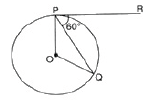

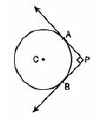
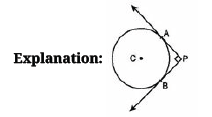

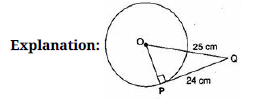
Ans- A line that interests a circle at two points in a circle is called a Secant.
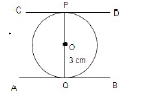
Please click the below link to access CBSE Class 10 Mathematics Circles Worksheet Set D
Maths Work Sheet: Circles
Question 1. The length of a tangent from a point P at a distance 5 cm from the centre of the circle is 4 cm. Find the radius of the circle.
Answer: Let \( O \) be the center of the circle, and let \( T \) be the point of tangency of the tangent line drawn from the point \( P \).
Since the radius is always perpendicular to the tangent at the point of contact, \( \Delta OTP \) is a right-angled triangle with \( \angle OTP = 90^\circ \).
We are given:
\( OP = 5 \text{ cm} \) (distance from the center)
\( PT = 4 \text{ cm} \) (length of the tangent)
Using Pythagoras' theorem in \( \Delta OTP \):
\( OP^2 = OT^2 + PT^2 \)
\( \implies 5^2 = r^2 + 4^2 \)
\( \implies 25 = r^2 + 16 \)
\( \implies r^2 = 25 - 16 = 9 \)
\( \implies r = 3 \text{ cm} \)
Therefore, the radius of the circle is 3 cm.
In simple words: The radius, the tangent, and the line connecting the center to the outside point form a right triangle. We use the Pythagorean formula with 5 and 4 to find that the missing radius is 3.
Exam Tip: Always remember that the tangent is perpendicular to the radius at the point of contact - this is the key to setting up right-angled triangles in circle problems.
Question 2. Prove that, in two concentric circles, the chord of the larger circle which touches the smaller circle, is bisected at the point of contact.
Answer: Let there be two concentric circles with a common center \( O \). Let \( AB \) be a chord of the larger circle that touches the smaller circle at the point \( P \).
Since \( AB \) is a tangent to the smaller circle at \( P \), the radius \( OP \) is perpendicular to the tangent \( AB \).
\( \implies OP \perp AB \)
Now, \( AB \) is a chord of the larger circle, and \( OP \) is a line segment drawn perpendicular from the center \( O \) to the chord \( AB \).
We know from basic geometry that a perpendicular drawn from the center of a circle to a chord bisects the chord.
\( \implies AP = PB \)
Thus, the chord of the larger circle is bisected at its point of contact with the smaller circle.
In simple words: Draw a straight line from the center to the point where the chord touches the smaller circle. This line is at a right angle to the chord, which automatically cuts the chord into two equal halves.
Exam Tip: State both properties clearly - first that the radius is perpendicular to the tangent, and second that the perpendicular from the center bisects a chord.
Question 3. Prove that the angle between the two tangents drawn from an external point to a circle is supplementary to the angle subtended by the line segment joining the points of contact at the centre.
Answer: Let \( PA \) and \( PB \) be two tangents drawn from an external point \( P \) to a circle with center \( O \), where \( A \) and \( B \) are the points of contact.
We need to prove that \( \angle APB + \angle AOB = 180^\circ \).
Since the radius is perpendicular to the tangent at the point of contact:
\( OA \perp PA \implies \angle OAP = 90^\circ \)
\( OB \perp PB \implies \angle OBP = 90^\circ \)
Now, in the quadrilateral \( OAPB \), the sum of all interior angles is \( 360^\circ \):
\( \angle APB + \angle OAP + \angle AOB + \angle OBP = 360^\circ \)
\( \implies \angle APB + 90^\circ + \angle AOB + 90^\circ = 360^\circ \)
\( \implies \angle APB + \angle AOB + 180^\circ = 360^\circ \)
\( \implies \angle APB + \angle AOB = 180^\circ \)
Thus, the two angles are supplementary.
In simple words: The two side angles where the radii meet the tangents are both 90 degrees. Since the four angles in a four-sided shape add up to 360 degrees, the remaining two opposite angles must add up to 180 degrees.
Exam Tip: Quadrilateral angle sum is a clean way to prove this. Write down all four angles of \(OAPB\) explicitly to show your logic.
Question 4. A circle touches all the four sides of a quadrilateral ABCD whose side AB = 6 cm, BC = 7 cm and CD = 4 cm. Find AD.
Answer: Let the circle touch the sides \( AB, BC, CD, \) and \( DA \) of the quadrilateral \( ABCD \).
We know that the lengths of tangents drawn from an external point to a circle are equal.
Using this property, we can derive the standard relation for a circumscribed quadrilateral:
\( AB + CD = AD + BC \)
We are given:
\( AB = 6 \text{ cm} \)
\( BC = 7 \text{ cm} \)
\( CD = 4 \text{ cm} \)
Substitute these values into the relation:
\( 6 + 4 = AD + 7 \)
\( \implies 10 = AD + 7 \)
\( \implies AD = 10 - 7 = 3 \text{ cm} \)
Therefore, the length of \( AD \) is 3 cm.
In simple words: When a circle is snug inside a four-sided shape, the sum of the opposite sides is equal. So, the top and bottom sides added together equal the left and right sides added together.
Exam Tip: State the relation \(AB + CD = AD + BC\) and briefly mention that it comes from the equal tangent segments property to secure full marks.
Question 5. In the given fig., if PQ = PR, prove that QS = RS.
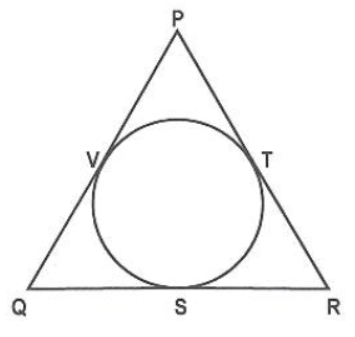
Answer: Let the inscribed circle touch the sides \( PQ, QR, \) and \( PR \) of \( \Delta PQR \) at points \( V, S, \) and \( T \) respectively.
The lengths of tangents drawn from an external point to a circle are equal.
Therefore, we have:
\( PV = PT \) (tangents from \( P \)) - (Equation 1)
\( QV = QS \) (tangents from \( Q \)) - (Equation 2)
\( RT = RS \) (tangents from \( R \)) - (Equation 3)
We are given:
\( PQ = PR \)
\( \implies PV + QV = PT + RT \)
Using Equation 1 (\( PV = PT \)), we can subtract this common value from both sides:
\( QV = RT \)
Now, substituting the values from Equation 2 and Equation 3:
\( QS = RS \)
Hence proved.
In simple words: Since the two long sides of the triangle are equal and the corner paths to the circle are equal, the leftover parts at the bottom corners must be equal too, which means the circle touches the base exactly in the middle.
Exam Tip: Be sure to write down the individual equal tangent pairs at each vertex before combining them to prove the final equality.
Question 6. Two circles touches externally at a point P and from a point T on the common tangent at P, tangent segment TQ and TR are drawn to the two circles. Prove that TQ = TR.
Answer: Let \( TP \) be the common tangent to both circles at the point of contact \( P \).
From the external point \( T \), tangents \( TQ \) and \( TP \) are drawn to the first circle.
Since the lengths of tangents from an external point are equal:
\( TQ = TP \) - (Equation 1)
Similarly, from the same external point \( T \), tangents \( TR \) and \( TP \) are drawn to the second circle:
\( TR = TP \) - (Equation 2)
From Equation 1 and Equation 2, we get:
\( TQ = TR \)
Hence proved.
In simple words: The tangent line going down the middle is shared. Because the two outside tangents each equal this middle line, they must be equal to each other.
Exam Tip: This proof is simple but common. Label the intermediate shared tangent clearly as \(TP\) to link the two equations.
Question 7. A circle is inscribed in ∆ABC having sides 8 cm, 10 cm and 12 cm as shown in fig. Find AD, BE and CF.
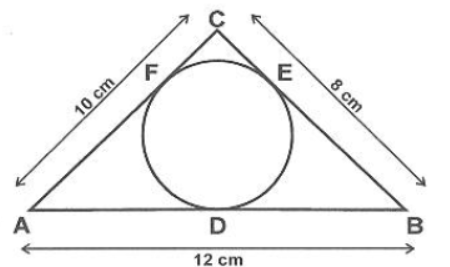
Answer: Let the circle touch the sides \( AB, BC, \) and \( AC \) of \( \Delta ABC \) at points \( D, E, \) and \( F \) respectively.
Let \( AD = AF = x \) (tangents from \( A \))
Let \( BD = BE = y \) (tangents from \( B \))
Let \( CE = CF = z \) (tangents from \( C \))
We are given the lengths of the sides of \( \Delta ABC \):
\( AB = x + y = 12 \text{ cm} \) - (Equation 1)
\( BC = y + z = 8 \text{ cm} \) - (Equation 2)
\( AC = z + x = 10 \text{ cm} \) - (Equation 3)
Adding Equations 1, 2, and 3:
\( 2(x + y + z) = 12 + 8 + 10 = 30 \)
\( \implies x + y + z = 15 \) - (Equation 4)
Now, we can solve for each variable:
\( x = (x + y + z) - (y + z) = 15 - 8 = 7 \text{ cm} \)
\( y = (x + y + z) - (z + x) = 15 - 10 = 5 \text{ cm} \)
\( z = (x + y + z) - (x + y) = 15 - 12 = 3 \text{ cm} \)
Therefore:
\( AD = 7 \text{ cm} \)
\( BE = 5 \text{ cm} \)
\( CF = 3 \text{ cm} \).
In simple words: Name the matching corner paths \(x\), \(y\), and \(z\). Add all sides together to find the sum of all paths, then subtract each side's length to find the individual corner values.
Exam Tip: This three-equation system is highly predictable. Adding them all together to get \(x+y+z\) first is the most reliable way to avoid simple mistakes.
Question 8. In the fig., a circle touches all the four sides of a quadrilateral ABCD whose sides AB = 8 cm, BC = 9 cm and CD = 6 cm. Find AD.
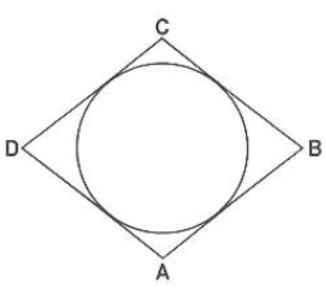
Answer: For a quadrilateral \( ABCD \) circumscribed about a circle, the sum of opposite sides is equal:
\( AB + CD = AD + BC \)
We are given the following values:
\( AB = 8 \text{ cm} \)
\( BC = 9 \text{ cm} \)
\( CD = 6 \text{ cm} \)
Substitute these values into the equation:
\( 8 + 6 = AD + 9 \)
\( \implies 14 = AD + 9 \)
\( \implies AD = 14 - 9 = 5 \text{ cm} \)
Therefore, \( AD = 5 \text{ cm} \).
In simple words: The sum of the opposite sides must match, so \(8 + 6\) (the top and bottom) must equal \(9 + AD\) (the sides). This gives us a length of 5.
Exam Tip: This is a standard 1-mark or 2-mark question. Simply stating the relation \(AB+CD=AD+BC\) is enough to get quick points.
Question 9. PQ is a chord of length 8 cm of a circle of radius 5 cm. The tangents at P and Q intersect at a point T. Find the length TP.
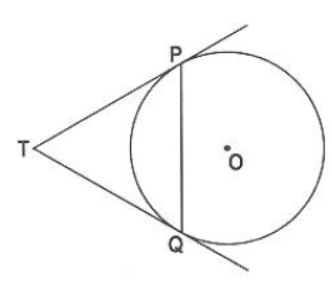
Answer: Let \( O \) be the center of the circle. Join \( OT \), and let it intersect the chord \( PQ \) at the point \( R \).
Since \( TP = TQ \) (tangents from an external point), \( \Delta TPQ \) is an isosceles triangle and \( OT \) is the perpendicular bisector of the chord \( PQ \).
\( \implies PR = RQ = \frac{8}{2} = 4 \text{ cm} \) and \( \angle PRO = 90^\circ \).
In right-angled triangle \( PRO \):
\( OP = 5 \text{ cm} \) (radius)
\( OR = \sqrt{OP^2 - PR^2} = \sqrt{5^2 - 4^2} = \sqrt{25 - 16} = 3 \text{ cm} \).
Let \( TP = x \) and \( TR = y \).
In right-angled triangle \( TRP \):
\( TP^2 = TR^2 + PR^2 \)
\( \implies x^2 = y^2 + 16 \) - (Equation 1)
In right-angled triangle \( OPT \) (since \( OP \perp TP \)):
\( OT^2 = TP^2 + OP^2 \)
\( \implies (y + 3)^2 = x^2 + 5^2 \)
\( \implies y^2 + 6y + 9 = x^2 + 25 \) - (Equation 2)
Substitute Equation 1 into Equation 2:
\( y^2 + 6y + 9 = y^2 + 16 + 25 \)
\( \implies 6y + 9 = 41 \)
\( \implies 6y = 32 \implies y = \frac{16}{3} \text{ cm} \).
Now, substitute \( y \) back into Equation 1:
\( x^2 = \left(\frac{16}{3}\right)^2 + 16 = \frac{256}{9} + 16 = \frac{256 + 144}{9} = \frac{400}{9} \)
\( \implies x = \sqrt{\frac{400}{9}} = \frac{20}{3} \approx 6.67 \text{ cm} \).
Therefore, the length of \( TP \) is \( \frac{20}{3} \text{ cm} \) (or 6.67 cm).
In simple words: Find the distance from the center to the chord using Pythagoras' theorem (which is 3). Then, set up two right triangles to solve for the unknown tangent length \(TP\).
Exam Tip: An alternative way is using similarity: \( \Delta PRO \sim \Delta OPT \), which gives \( \frac{TP}{PO} = \frac{PR}{OR} \implies \frac{TP}{5} = \frac{4}{3} \implies TP = \frac{20}{3} \text{ cm} \). This is much faster!
Question 10. The length of tangents drawn from an external point to circle are equal. Prove it. Use the result to solve the following: In the fig., AB and AC are two tangents to a circle with centre O from a point A outside the circle. Prove that PRQ is a tangent to circle at R. AP + PR = AQ + QR.
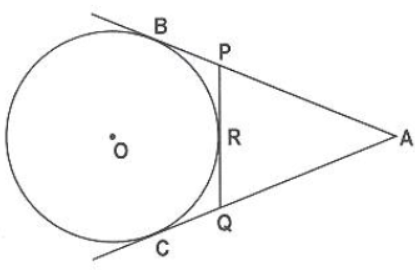
Answer: Part 1: Proof of Theorem:
Let \( PA \) and \( PB \) be two tangents drawn from an external point \( P \) to a circle with center \( O \).
Join \( OA, OB, \) and \( OP \).
In triangles \( \Delta OAP \) and \( \Delta OBP \):
1. \( OA = OB \) (radii of the same circle)
2. \( \angle OAP = \angle OBP = 90^\circ \) (tangent is perpendicular to the radius)
3. \( OP = OP \) (common hypotenuse)
By Right Angle-Hypotenuse-Side (RHS) congruence:
\( \Delta OAP \cong \Delta OBP \)
Therefore, by CPCT:
\( PA = PB \).
Part 2: Application:
We are given that \( AB \) and \( AC \) are tangents from \( A \), so:
\( AB = AC \) - (Equation 1)
Since \( PRQ \) is a tangent touching the circle at \( R \), the segments from points \( P \) and \( Q \) are also equal:
\( PR = PB \) (tangents from \( P \))
\( QR = QC \) (tangents from \( Q \))
Now, from Equation 1:
\( AB = AC \)
\( \implies AP + PB = AQ + QC \)
Replacing \( PB \) with \( PR \) and \( QC \) with \( QR \):
\( AP + PR = AQ + QR \).
Hence proved.
In simple words: First, prove that two tangents from the same point are always equal using congruent triangles. Then, use that rule to show that the perimeter paths from point A along both sides of the circle are equal.
Exam Tip: This two-part question is a favorite of examiners. Make sure your RHS congruence proof is fully written out before solving the second part.
Question 11. Prove that the lengths of tangents drawn from an external point to a circle are equal. Using the above, prove the following: ABC is an isosceles triangle in which AB = AC, circumscribed about a circle, as shown in the fig. Prove that the base is bisected by the point of contact.
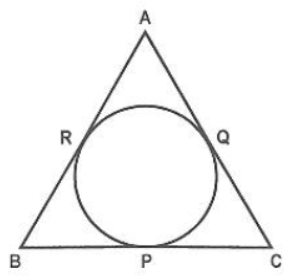
Answer: Let the inscribed circle touch the sides \( AB, AC, \) and \( BC \) of \( \Delta ABC \) at the points \( R, Q, \) and \( P \) respectively.
Using the theorem that tangent segments from an external point are equal, we have:
\( AR = AQ \) (tangents from \( A \)) - (Equation 1)
\( BR = BP \) (tangents from \( B \)) - (Equation 2)
\( CQ = CP \) (tangents from \( C \)) - (Equation 3)
We are given that \( \Delta ABC \) is isosceles with:
\( AB = AC \)
\( \implies AR + BR = AQ + CQ \)
Using Equation 1 (\( AR = AQ \)), we subtract this from both sides:
\( BR = CQ \)
Now, using Equation 2 and Equation 3 to substitute these values:
\( BP = CP \)
Since \( P \) is the point of contact on the base \( BC \), and \( BP = CP \), the base \( BC \) is bisected by the point of contact.
Hence proved.
In simple words: Since the two main sides of the triangle are equal, the paths from the top corner to the circle are equal, which leaves the remaining side segments equal. This forces the bottom point of contact to sit exactly in the middle.
Exam Tip: Clearly label your tangent points (\(P, Q, R\)) on your rough sketch so your equation steps are easy for the grader to follow.
Question 12. In the fig., a circle is inscribed in a quadrilateral ABCD in which ∠B = 90°. If AD = 23 cm, AB = 29 cm and DS = 5 cm, find the radius (r) of the circle.
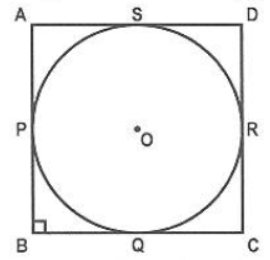
Answer: Let the circle with center \( O \) and radius \( r \) touch the sides \( AB, BC, CD, \) and \( DA \) at the points \( P, Q, R, \) and \( S \) respectively.
We are given:
\( DS = 5 \text{ cm} \).
Since the tangents from an external point are equal:
\( DR = DS = 5 \text{ cm} \)
Since \( AD = 23 \text{ cm} \), we can find \( AS \):
\( AS = AD - DS = 23 - 5 = 18 \text{ cm} \)
Since \( AP = AS \):
\( AP = 18 \text{ cm} \)
We are given \( AB = 29 \text{ cm} \), so we can find \( BP \):
\( BP = AB - AP = 29 - 18 = 11 \text{ cm} \)
Now, consider the quadrilateral \( OPBQ \):
\( \angle B = 90^\circ \) (given)
\( \angle OPB = 90^\circ \) and \( \angle OQB = 90^\circ \) (radius is perpendicular to tangent)
Therefore, \( OPBQ \) is a rectangle. Since the adjacent sides \( OP = OQ = r \), the rectangle \( OPBQ \) is a square.
\( \implies r = BP = 11 \text{ cm} \).
Therefore, the radius of the circle is 11 cm.
In simple words: Work your way around the corners. Start with the known segment at corner D, subtract it to find the segment at A, subtract that to find the segment at B, which is equal to the circle's radius.
Exam Tip: Be sure to explicitly prove why \(OPBQ\) is a square (by showing three right angles and equal adjacent sides) to get full marks on this problem.
Question 13. A circle is inscribed in a ∆ABC having sides 8 cm, 10 cm and 12 cm as shown in fig. Find AD, BE and CF.
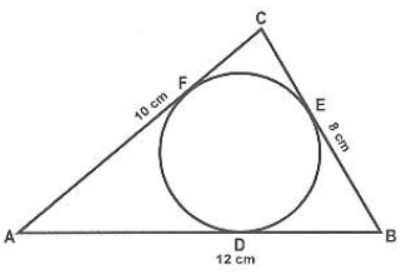
Answer: Let the points of contact of the inscribed circle with the sides \( AB, BC, \) and \( AC \) be \( D, E, \) and \( F \) respectively.
Let \( AD = AF = x \)
Let \( BD = BE = y \)
Let \( CE = CF = z \)
From the given side lengths of \( \Delta ABC \):
\( AB = x + y = 12 \text{ cm} \) - (Equation 1)
\( BC = y + z = 8 \text{ cm} \) - (Equation 2)
\( AC = z + x = 10 \text{ cm} \) - (Equation 3)
Adding these three equations together:
\( 2(x + y + z) = 12 + 8 + 10 = 30 \)
\( \implies x + y + z = 15 \) - (Equation 4)
Subtracting Equation 2 from Equation 4:
\( x = 15 - 8 = 7 \text{ cm} \implies AD = 7 \text{ cm} \)
Subtracting Equation 3 from Equation 4:
\( y = 15 - 10 = 5 \text{ cm} \implies BE = 5 \text{ cm} \)
Subtracting Equation 1 from Equation 4:
\( z = 15 - 12 = 3 \text{ cm} \implies CF = 3 \text{ cm} \).
Therefore, \( AD = 7 \text{ cm} \), \( BE = 5 \text{ cm} \), and \( CF = 3 \text{ cm} \).
In simple words: The paths starting from each corner are equal. Add all the sides of the triangle and divide by 2 to get the total sum of the paths, then subtract each side's length to find the individual corner parts.
Exam Tip: This standard algebra-based circle problem frequently appears on exams - write out the equations clearly to show your step-by-step logic.
Question 14. In the given fig., ABC is a right-angled triangle, right angled at A, with AB=6 cm and AC = 8 cm. A circle with centre O has been inscribed inside the triangle. Calculate the value of r, the radius of the inscribed circle.
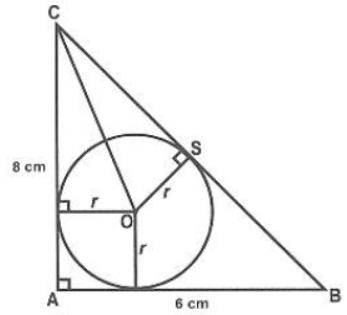
Answer: In right-angled triangle \( ABC \) with \( \angle A = 90^\circ \):
Using Pythagoras' theorem:
\( BC = \sqrt{AB^2 + AC^2} = \sqrt{6^2 + 8^2} = \sqrt{36 + 64} = 10 \text{ cm} \).
Now, we calculate the area of \( \Delta ABC \):
\( \text{Area of } \Delta ABC = \frac{1}{2} \times \text{base} \times \text{height} = \frac{1}{2} \times 6 \times 8 = 24 \text{ cm}^2 \).
The semi-perimeter \( s \) of \( \Delta ABC \) is:
\( s = \frac{AB + BC + AC}{2} = \frac{6 + 10 + 8}{2} = 12 \text{ cm} \).
The radius \( r \) of the inscribed circle is given by the formula:
\( r = \frac{\text{Area of triangle}}{\text{Semi-perimeter}} \)
\( \implies r = \frac{24}{12} = 2 \text{ cm} \).
Therefore, the radius of the inscribed circle is 2 cm.
Exam Tip: The formula \(r = \text{Area}/s\) is a huge time-saver for finding the inradius of any triangle - remember to write it out to earn method marks.
Question 15. In fig., ∆ABC is circumscribing a circle. Find the length of BC.
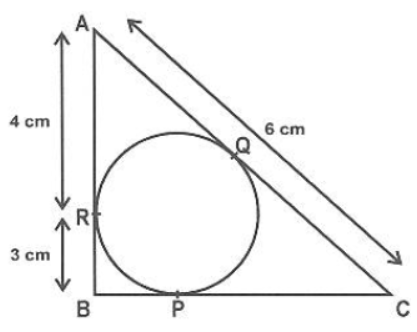
Answer: Let the circle touch the sides \( AB, AC, \) and \( BC \) of \( \Delta ABC \) at points \( R, Q, \) and \( P \) respectively.
We are given:
\( AR = 4 \text{ cm} \)
\( BR = 3 \text{ cm} \)
\( AC = 6 \text{ cm} \)
Since the lengths of tangents from an external point to a circle are equal:
\( AQ = AR = 4 \text{ cm} \)
\( BP = BR = 3 \text{ cm} \)
Now, we can find \( CQ \):
\( CQ = AC - AQ = 6 - 4 = 2 \text{ cm} \)
Since \( CP = CQ \) (tangents from \( C \)):
\( CP = 2 \text{ cm} \)
Therefore, the length of \( BC \) is:
\( BC = BP + CP = 3 \text{ cm} + 2 \text{ cm} = 5 \text{ cm} \).
In simple words: Use the equal-corner-path rule. The top left corner path is 4, so the top right is also 4. Subtracting this from the side of 6 leaves 2 for the bottom right path, which matches the base segment. Add it to the bottom left segment of 3 to get 5.
Exam Tip: Label each tangent segment on your exam sheet to prevent simple addition or subtraction errors.
Question 16. In the fig., O is the centre of the circle with radius 5 cm, AB||CD, AB = 6 cm. Find OP.
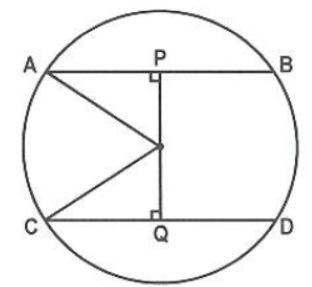
Answer: We are given that \( OP \) is the perpendicular line segment from the center \( O \) to the chord \( AB \).
Since a perpendicular from the center of a circle bisects the chord:
\( AP = \frac{AB}{2} = \frac{6}{2} = 3 \text{ cm} \).
Join \( OA \) to form a right-angled triangle \( OPA \), where \( OA \) is the radius of the circle:
\( OA = 5 \text{ cm} \).
In right-angled triangle \( OPA \) (with \( \angle OPA = 90^\circ \)):
Using Pythagoras' theorem:
\( OA^2 = OP^2 + AP^2 \)
\( \implies 5^2 = OP^2 + 3^2 \)
\( \implies 25 = OP^2 + 9 \)
\( \implies OP^2 = 25 - 9 = 16 \)
\( \implies OP = 4 \text{ cm} \).
Therefore, the length of \( OP \) is 4 cm.
In simple words: The perpendicular from the center splits the chord of 6 in half, making it 3. Using the radius of 5 and the half-chord of 3, Pythagoras' theorem gives us a distance of 4.
Exam Tip: For chord problems, always draw the right triangle formed by the radius, the perpendicular distance, and half of the chord length.
Question 17. In fig., a circle touches the side BC of ABC at P and touches AB and AC produced at Q and R respectively. If AQ = 5 cm, find the perimeter of ∆ABC.
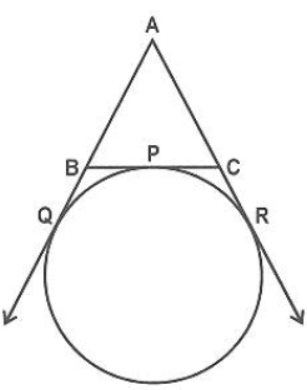
Answer: The perimeter of \( \Delta ABC \) is the sum of its three sides:
\( \text{Perimeter} = AB + BC + AC = AB + (BP + CP) + AC \) - (Equation 1)
Since the lengths of tangents from an external point to a circle are equal, we have:
\( BP = BQ \) (tangents from \( B \))
\( CP = CR \) (tangents from \( C \))
\( AQ = AR \) (tangents from \( A \))
Substitute \( BP = BQ \) and \( CP = CR \) into Equation 1:
\( \text{Perimeter} = AB + BQ + AC + CR \)
\( \implies \text{Perimeter} = AQ + AR \)
Since \( AQ = AR = 5 \text{ cm} \):
\( \text{Perimeter} = 5 + 5 = 10 \text{ cm} \).
Therefore, the perimeter of \( \Delta ABC \) is 10 cm.
In simple words: The perimeter of the triangle is exactly equal to the sum of the two long outer tangents from point A. Since both tangents are 5 cm, the total perimeter is 10 cm.
Exam Tip: Memorize this beautiful relation: \( \text{Perimeter of } \Delta ABC = 2 \times \text{tangent length from the top vertex} \). It is a highly common objective-type question.
Question 18. In the given fig., AB, AC and AD are tangents from the exterior point A to the circle which touches externally at C. If AB = 5 cm, find AD.
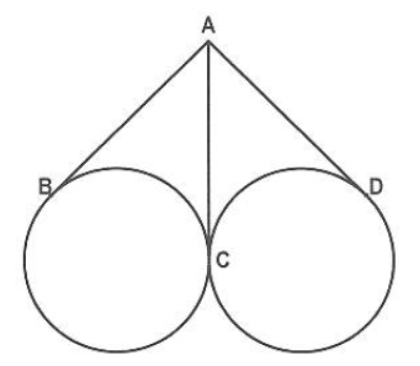
Answer: Let \( A \) be the external point from which tangents are drawn to the two circles.
For the first circle, \( AB \) and \( AC \) are tangents drawn from point \( A \).
Since lengths of tangents from an external point are equal:
\( AC = AB \)
Given \( AB = 5 \text{ cm} \), we have:
\( AC = 5 \text{ cm} \) - (Equation 1)
For the second circle, \( AD \) and \( AC \) are tangents drawn from the same point \( A \):
\( AD = AC \) - (Equation 2)
From Equation 1 and Equation 2, we get:
\( AD = 5 \text{ cm} \).
Therefore, the length of \( AD \) is 5 cm.
In simple words: The line segment in the middle is equal to both outside tangents. Since the left tangent is 5, the middle is 5, which means the right tangent must also be 5.
Exam Tip: State clearly which tangents belong to which circle to make your proof mathematically rigorous.
Question 19. In the fig. given below, find ∠QSR.
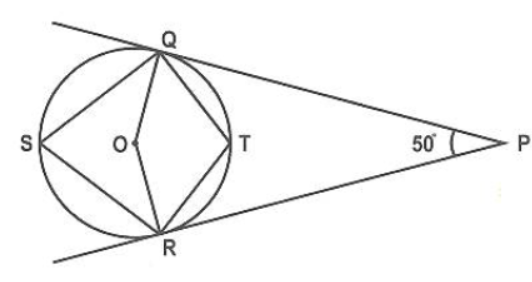
Answer: We are given that \( PQ \) and \( PR \) are tangents to the circle with center \( O \) from point \( P \), with \( \angle QPR = 50^\circ \).
Since the radius is perpendicular to the tangent at the point of contact:
\( \angle OQP = 90^\circ \) and \( \angle ORP = 90^\circ \).
In quadrilateral \( OQPR \):
\( \angle QOR + \angle OQP + \angle ORP + \angle QPR = 360^\circ \)
\( \implies \angle QOR + 90^\circ + 90^\circ + 50^\circ = 360^\circ \)
\( \implies \angle QOR + 230^\circ = 360^\circ \)
\( \implies \angle QOR = 130^\circ \).
Now, the angle subtended by an arc at the center is double the angle subtended by it at any point on the remaining part of the circle.
Since \( S \) is a point on the major arc of the circle:
\( \angle QSR = \frac{1}{2} \angle QOR = \frac{130^\circ}{2} = 65^\circ \).
Therefore, \( \angle QSR = 65^\circ \).
In simple words: The center angle and the outer corner angle add up to 180 degrees, which makes the center angle 130 degrees. The angle at the top curve is always half of the center angle, so it is 65 degrees.
Exam Tip: Be sure to write out both steps: first finding the center angle \( \angle QOR \) using quadrilateral sum, and then using the angle at the circumference theorem.
Question 20. ∆ABC is a right-angled at A. A circle is inscribed in it. The lengths of two sides containing the right angle are 12 cm and 5 cm. Find the radius of the incircle.
Answer: In right-angled triangle \( ABC \) with \( \angle A = 90^\circ \), the two sides containing the right angle are \( AB = 12 \text{ cm} \) and \( AC = 5 \text{ cm} \).
First, find the hypotenuse \( BC \):
\( BC = \sqrt{AB^2 + AC^2} = \sqrt{12^2 + 5^2} = \sqrt{144 + 25} = 13 \text{ cm} \).
Now, find the area of \( \Delta ABC \):
\( \text{Area} = \frac{1}{2} \times \text{base} \times \text{height} = \frac{1}{2} \times 12 \times 5 = 30 \text{ cm}^2 \).
Calculate the semi-perimeter \( s \) of the triangle:
\( s = \frac{AB + BC + AC}{2} = \frac{12 + 13 + 5}{2} = 15 \text{ cm} \).
The radius \( r \) of the inscribed circle is:
\( r = \frac{\text{Area}}{\text{semi-perimeter}} = \frac{30}{15} = 2 \text{ cm} \).
Therefore, the radius of the incircle is 2 cm.
In simple words: Find the hypotenuse first using Pythagoras' theorem (which is 13). Then, calculate the triangle's area and divide it by the half-perimeter to find the inradius.
Exam Tip: For right-angled triangles, you can also use the handy shortcut formula: \( r = \frac{a + b - c}{2} \), where \(c\) is the hypotenuse. Here, \( r = \frac{12 + 5 - 13}{2} = 2 \text{ cm} \). This is incredibly quick!
Question 21. Prove that the intercept of a tangent between two parallel tangents to a circle subtends a right angle at the centre.
Answer: Let \( XY \) and \( X'Y' \) be two parallel tangents to a circle with center \( O \), touching the circle at \( P \) and \( Q \) respectively. Let \( AB \) be another tangent intercepting them, touching the circle at \( C \).
We need to prove that \( \angle AOB = 90^\circ \).
Join \( OC \).
In triangles \( \Delta OPA \) and \( \Delta OCA \):
1. \( OP = OC \) (radii of the same circle)
2. \( AP = AC \) (tangents from external point \( A \))
3. \( OA = OA \) (common side)
By SSS congruence criterion:
\( \Delta OPA \cong \Delta OCA \)
\( \implies \angle POA = \angle COA = \theta_1 \) - (Corresponding parts of congruent triangles)
Similarly, by proving \( \Delta OQB \cong \Delta OCB \), we get:
\( \angle QOB = \angle COB = \theta_2 \)
Since \( PQ \) is a diameter of the circle (as the tangents at its endpoints are parallel), \( POQ \) is a straight line, so:
\( \angle POA + \angle COA + \angle COB + \angle QOB = 180^\circ \)
\( \implies 2\theta_1 + 2\theta_2 = 180^\circ \)
\( \implies \theta_1 + \theta_2 = 90^\circ \)
\( \implies \angle AOB = 90^\circ \).
Hence proved.
In simple words: Prove that the two triangles at the top corner are identical, and the two at the bottom are identical. Since all four angles together make a straight line of 180 degrees, the two middle angles must make exactly half of that, which is 90 degrees.
Exam Tip: Make sure to explain that the line segment \(PQ\) is a straight diameter line because it connects the points of contact of two parallel tangents.
Question 22. Two tangents PA and PB are drawn to the circle with centre O, such that ∠APB= 120'. Prove that OP = 2AP.
Answer: Let \( PA \) and \( PB \) be two tangents drawn from an external point \( P \) to a circle with center \( O \).
Join \( OA, OB, \) and \( OP \).
Since the line segment joining the external point to the center bisects the angle between the tangents:
\( \angle APO = \frac{\angle APB}{2} = \frac{120^\circ}{2} = 60^\circ \).
Since the radius is perpendicular to the tangent at the point of contact:
\( \angle OAP = 90^\circ \).
In the right-angled triangle \( OAP \):
\( \cos(\angle APO) = \frac{\text{Adjacent}}{\text{Hypotenuse}} \)
\( \implies \cos(60^\circ) = \frac{AP}{OP} \)
Since \( \cos(60^\circ) = \frac{1}{2} \):
\( \frac{1}{2} = \frac{AP}{OP} \)
\( \implies OP = 2AP \).
Hence proved.
In simple words: The center line cuts the 120-degree corner angle in half to make 60 degrees. Using basic trigonometry on the right triangle, we find that the hypotenuse \(OP\) is exactly twice the adjacent side \(AP\).
Exam Tip: Applying trigonometric ratios (like cosine) on right-angled triangles in circle chapters is a highly elegant and accepted proof technique.
Free study material for Mathematics
Free CBSE Practice Worksheets: Class 10 Mathematics Chapter 10 Circles
Practice Exercises for Class 10 Mathematics Chapter 10 Circles
Explore reliable practice questions for Chapter 10 Circles tailored for Class 10 Mathematics learners. Use these structured worksheets to evaluate exam preparedness and strengthen problem-solving skills throughout the 2026 academic session.
Step-by-Step Solutions and Practice Guidelines
Each worksheet draws directly from authorized standard textbooks to maintain academic accuracy. Evaluating your finished exercises against expert-verified solutions helps master the formal presentation standards expected in school evaluations.
Enhance Speed with Online Practice
Consistent engagement with these exercises builds familiarity with recurring exam themes. If specific areas within Chapter 10 Circles cause trouble, utilize our dedicated NCERT solutions for Class 10 Mathematics to clear up doubts immediately.
FAQs
You can download the latest chapter-wise printable worksheets for Class 10 Mathematics Chapter 10 Circles for free from StudiesToday.com. These have been made as per the latest CBSE curriculum for this academic year.
Yes, Class 10 Mathematics worksheets for Chapter 10 Circles focus on activity-based learning and also competency-style questions. This helps students to apply theoretical knowledge to practical scenarios.
Yes, we have provided solved worksheets for Class 10 Mathematics Chapter 10 Circles to help students verify their answers instantly.
Yes, our Class 10 Mathematics test sheets are mobile-friendly PDFs and can be printed by teachers for classroom.
For Chapter 10 Circles, regular practice with our worksheets will improve question-handling speed and help students understand all technical terms and diagrams.