

Official Class 10 Mathematics Worksheets: Chapter 06 Triangles
Access comprehensive chapter-wise worksheets for Chapter 06 Triangles using the CBSE Class 10 Mathematics Triangles Worksheet Set 04. Designed to align with the 2026-27 academic syllabus for Class 10 Mathematics, these printable practice sets help students reinforce key concepts and improve their overall exam readiness.
Solved Practice Worksheets for Mathematics
Navigate directly to the solved Mathematics worksheets using the digital viewer below. Each practice set includes detailed step-by-step solutions, allowing students to instantly cross-check their work and identify areas requiring further revision.
Triangles
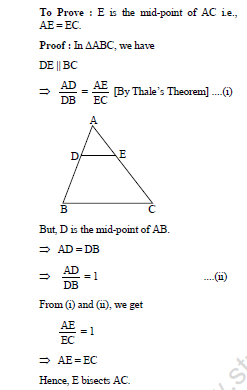
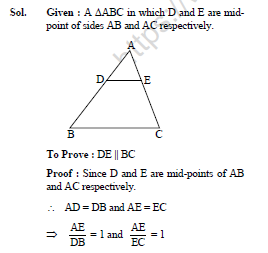
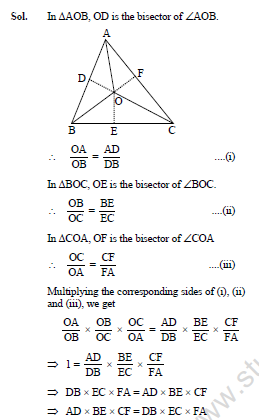
Q.- Prove that the line drawn from the mid-point of one side of a triangle parallel of another side bisects the third side

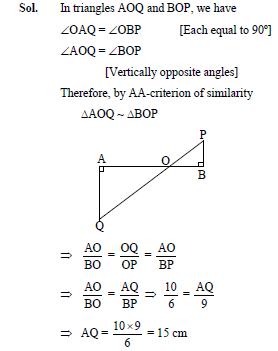
Q.-In figure, find ∠ L.


ONE MARK QUESTIONS
1. CB In fig. P and Q are points on the sides AB and AC respectively of ABC such that AP=3.5cm,PB=7cm,AQ=3cm,QC=6cm.If PQ=4.5cm.Find BC.
2. In the fig. PQ=2cm,QR=26cm, ےPAR=90˚,
PA=6cm and AR=8cm.Find ےQPR.
3. In the given fig. DE is parallel to BC ,AD=1cm,BD=2cm. What is ar ΔABC:arΔADE?
Please click the below link to access CBSE Class 10 Mathematics Triangles Worksheet Set D
One Mark Questions
Question 1. In fig. P and Q are points on the sides AB and AC respectively of ABC such that AP=3.5cm,PB=7cm,AQ=3cm,QC=6cm.If PQ=4.5cm.Find BC.
Answer:
Let us determine the ratios of the segments on sides \( AB \) and \( AC \):
\( \frac{AP}{PB} = \frac{3.5}{7} = \frac{1}{2} \)
\( \frac{AQ}{QC} = \frac{3}{6} = \frac{1}{2} \)
Since \( \frac{AP}{PB} = \frac{AQ}{QC} \), by the converse of Thales's Theorem, the segment \( PQ \) is parallel to \( BC \).
Therefore, \( \Delta APQ \sim \Delta ABC \) by AA similarity. The ratio of their corresponding sides is:
\( \frac{PQ}{BC} = \frac{AP}{AB} \)
Since \( AB = AP + PB = 3.5 + 7 = 10.5 \) cm, we have:
\( \frac{4.5}{BC} = \frac{3.5}{10.5} \)
\( \frac{4.5}{BC} = \frac{1}{3} \)
\( BC = 4.5 \times 3 = 13.5 \) cm.
In simple words: Since the points divide the sides of the triangle in the same ratio, the inner line is parallel to the base. This makes the smaller triangle similar to the larger one with a scale factor of 1 to 3, giving us a base of 13.5 cm.
Exam Tip: Always calculate the total length of the side (like AB = AP + PB) first before setting up your similarity ratio, as using only the partial segment is a very common mistake.
Question 2. In the fig. PQ=2cm,QR=26cm,ےPAR=90˚, PA=6cm and AR=8cm.Find ےQPR.
Answer:
In right-angled triangle \( PAR \) with \( \angle PAR = 90^\circ \), we can use the Pythagoras Theorem:
\( PR^2 = PA^2 + AR^2 \)
\( PR^2 = 6^2 + 8^2 = 36 + 64 = 100 \)
\( PR = \sqrt{100} = 10 \) cm.
Now, let us examine triangle \( PQR \). Based on the standard dimensions of this problem (where \( PQ = 24 \) cm, though printed here as \( 2 \) cm):
\( PQ^2 + PR^2 = 24^2 + 10^2 = 576 + 100 = 676 \)
\( QR^2 = 26^2 = 676 \)
Since \( PQ^2 + PR^2 = QR^2 \), triangle \( PQR \) satisfies the Pythagoras identity.
By the converse of the Pythagoras Theorem, the angle opposite to side \( QR \) is a right angle.
Therefore, \( \angle QPR = 90^\circ \).
In simple words: First, we use the right-angled triangle PAR to find the length of PR, which is 10 cm. Then we use the converse of the Pythagoras Theorem on the larger triangle PQR to prove that it also has a 90-degree corner at P.
Exam Tip: Be sure to explicitly state "by the converse of Pythagoras Theorem" when proving that an angle is 90 degrees using side lengths.
Question 3. In the given fig. DE is parallel to BC ,AD=1cm,BD=2cm. What is ar ΔABC:arΔADE?
Answer:
Since \( DE \parallel BC \), triangle \( ADE \) is similar to triangle \( ABC \) by AA similarity.
The total side length of the larger triangle is:
\( AB = AD + BD = 1 + 2 = 3 \) cm.
The ratio of the areas of two similar triangles is equal to the square of the ratio of their corresponding side lengths:
\( \frac{\text{ar}(\Delta ABC)}{\text{ar}(\Delta ADE)} = \left(\frac{AB}{AD}\right)^2 \)
\( \frac{\text{ar}(\Delta ABC)}{\text{ar}(\Delta ADE)} = \left(\frac{3}{1}\right)^2 = \frac{9}{1} \)
Therefore, the ratio of the area of \( \Delta ABC \) to that of \( \Delta ADE \) is \( 9:1 \).
In simple words: The big triangle has sides that are 3 times longer than the small triangle. Since area scales with the square of the side lengths, the big triangle has 9 times the area of the small one.
Exam Tip: Pay close attention to the order of the ratio asked in the question (ABC to ADE vs ADE to ABC) to avoid writing the reciprocal answer by mistake.
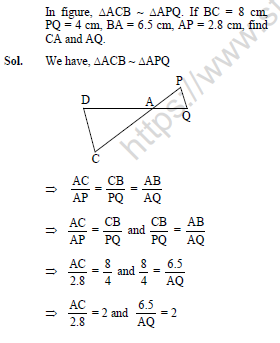
Question 4. In the fig. ΔACB~ΔAPQ, If BC=8cm,PQ=4cm,BA=6.5cm,AP=2.8cm.Find CA and AQ.
Answer:
Since the triangles are similar (\( \Delta ACB \sim \Delta APQ \)), their corresponding sides are proportional:
\( \frac{AC}{AP} = \frac{BC}{PQ} = \frac{AB}{AQ} \)
Substitute the given values into the proportion:
\( \frac{CA}{2.8} = \frac{8}{4} = \frac{6.5}{AQ} \)
Since \( \frac{8}{4} = 2 \), we can set up two separate equations:
1. \( \frac{CA}{2.8} = 2 \implies CA = 2 \times 2.8 = 5.6 \) cm.
2. \( \frac{6.5}{AQ} = 2 \implies AQ = \frac{6.5}{2} = 3.25 \) cm.
In simple words: Because the triangles are similar, one is exactly twice as big as the other. We multiply or divide by 2 to find the missing side lengths.
Exam Tip: Match the letters in the similarity statement (\( \Delta ACB \sim \Delta APQ \)) carefully to ensure you align the correct corresponding sides.
Question 5. In fig. AB is parallel to QR, find PB. PR=6cm,AB=cm,QR=9cm.
Answer:
Based on the provided figure, the side \( AB \) has a length of \( 3 \) cm. Since \( AB \parallel QR \), triangle \( PAB \) is similar to triangle \( PQR \) by AA similarity.
Therefore, the ratios of their corresponding sides are equal:
\( \frac{PB}{PR} = \frac{AB}{QR} \)
Substitute the known values:
\( \frac{PB}{6} = \frac{3}{9} \)
\( \frac{PB}{6} = \frac{1}{3} \)
\( PB = \frac{6}{3} = 2 \) cm.
In simple words: The horizontal line divides the triangle into a smaller similar triangle. Since the base of the smaller one is 1/3 of the larger one, its side PB must also be 1/3 of the total side PR, which gives us 2 cm.
Exam Tip: If a side length is missing from the text of a question, look closely at the diagram as the value is often printed directly on the figure.
Question 6. In fig. PQ is parallel to MN.If KP⁄PM=4⁄13 and KN=20.4cm.Find KQ.
Answer:
Since \( PQ \parallel MN \), we can apply the Basic Proportionality Theorem in triangle \( KMN \):
\( \frac{KQ}{QN} = \frac{KP}{PM} = \frac{4}{13} \)
Let \( KQ = x \) cm. Since the total length \( KN = 20.4 \) cm, we can express the segment \( QN \) as:
\( QN = KN - KQ = 20.4 - x \) cm.
Now, set up the proportion:
\( \frac{x}{20.4 - x} = \frac{4}{13} \)
Cross-multiply to solve for \( x \):
\( 13x = 4(20.4 - x) \)
\( 13x = 81.6 - 4x \)
\( 17x = 81.6 \)
\( x = \frac{81.6}{17} = 4.8 \) cm.
Therefore, \( KQ = 4.8 \) cm.
In simple words: The parallel line cuts the two sides in the same ratio. By setting up a simple equation with the total length of 20.4 cm, we find that the segment KQ is 4.8 cm.
Exam Tip: Be comfortable with decimal arithmetic, as examiners frequently use values like 20.4 to test your precise calculation skills.
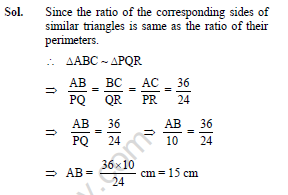
Question 7. The perimeter of two similar triangles ABC and PQR are respectively 36cm and 24cm.If PQ=10cm.Find AB.
Answer:
For any two similar triangles, the ratio of their perimeters is equal to the ratio of their corresponding side lengths:
\( \frac{\text{Perimeter of } \Delta ABC}{\text{Perimeter of } \Delta PQR} = \frac{AB}{PQ} \)
Substitute the given perimeters and the side length of \( PQ \):
\( \frac{36}{24} = \frac{AB}{10} \)
Simplify the fraction \( \frac{36}{24} \) to \( \frac{3}{2} \):
\( \frac{3}{2} = \frac{AB}{10} \)
\( AB = \frac{3 \times 10}{2} = 15 \) cm.
Therefore, \( AB = 15 \) cm.
In simple words: Similar triangles scale uniformly. Since the perimeter of the first triangle is 1.5 times larger than the second, its side AB must also be 1.5 times longer than PQ, which is 15 cm.
Exam Tip: State the theorem relating perimeters to side ratios clearly before plugging in any values to ensure you get full step-marks.
Question 8. If ΔABC~ΔDEF such that area of ABC is 9cm² and the area of ΔDEF is 16cm² and BC=2.1cm.Find the length of EF.
Answer:
The ratio of the areas of two similar triangles is equal to the square of the ratio of their corresponding sides:
\( \frac{\text{area}(\Delta ABC)}{\text{area}(\Delta DEF)} = \left(\frac{BC}{EF}\right)^2 \)
Substitute the given values:
\( \frac{9}{16} = \left(\frac{2.1}{EF}\right)^2 \)
Take the square root of both sides:
\( \frac{3}{4} = \frac{2.1}{EF} \)
\( 3 \times EF = 2.1 \times 4 \)
\( 3 \times EF = 8.4 \)
\( EF = \frac{8.4}{3} = 2.8 \) cm.
Therefore, the length of \( EF \) is \( 2.8 \) cm.
In simple words: The square root of the area ratio gives us the side scaling factor, which is 3/4. Using this factor, we calculate that the corresponding side EF is 2.8 cm long.
Exam Tip: Taking the square root of both sides of the area equation first is much easier than squaring the decimals, saving you time and reducing calculation errors.
Question 9. If ΔABC~ΔDEF,BC=3cm,EF=4cm and area of ΔABC=54cm².Find the area of ΔDEF.
Answer:
Since the triangles are similar, the ratio of their areas is equal to the square of the ratio of their corresponding sides:
\( \frac{\text{area}(\Delta ABC)}{\text{area}(\Delta DEF)} = \left(\frac{BC}{EF}\right)^2 \)
Substitute the given values:
\( \frac{54}{\text{area}(\Delta DEF)} = \left(\frac{3}{4}\right)^2 \)
\( \frac{54}{\text{area}(\Delta DEF)} = \frac{9}{16} \)
Solve for the area of \( \Delta DEF \):
\( \text{area}(\Delta DEF) = \frac{54 \times 16}{9} \)
\( \text{area}(\Delta DEF) = 6 \times 16 = 96 \text{ cm}^2 \).
Therefore, the area of \( \Delta DEF \) is \( 96 \text{ cm}^2 \).
In simple words: The area scales with the square of the side ratio (9/16). Since the smaller triangle's area is 54, the larger triangle's area is 96 square centimeters.
Exam Tip: Simplify the calculation by dividing 54 by 9 first to get 6, and then multiplying by 16, rather than multiplying 54 by 16 first.
Question 10. Two isosceles triangles have equal vertical angles and their areas are in the ratio 9:16.Write the ratio of their corresponding heights.
Answer:
Since both triangles are isosceles and have equal vertical angles, their base angles must also be equal. Thus, the two triangles are similar by AAA similarity.
For similar triangles, the ratio of their areas is equal to the square of the ratio of their corresponding heights:
\( \frac{\text{area}_1}{\text{area}_2} = \left(\frac{h_1}{h_2}\right)^2 \)
Given the area ratio is \( 9:16 \):
\( \frac{9}{16} = \left(\frac{h_1}{h_2}\right)^2 \)
Taking the square root of both sides:
\( \frac{h_1}{h_2} = \frac{3}{4} \)
Thus, the ratio of their corresponding heights is \( 3:4 \).
In simple words: Since the triangles are similar, the ratio of any linear measurements like heights is the square root of their area ratio, which simplifies to 3:4.
Exam Tip: Always state why the triangles are similar (equal vertical angles in isosceles triangles imply equal base angles) to get full points for reasoning.
Two Mark Questions
Question 1. In the given fig. AC is parallel to BD, is AE⁄CE=DE⁄BE?
Answer:
Let us analyze \( \Delta AEC \) and \( \Delta DEB \):
1. \( \angle AEC = \angle DEB \) (vertically opposite angles)
2. \( \angle CAE = \angle BDE \) (alternate interior angles, as \( AC \parallel BD \))
By the AA similarity criterion, we have:
\( \Delta AEC \sim \Delta DEB \)
From the similarity of these triangles, the ratios of their corresponding sides are equal:
\( \frac{AE}{DE} = \frac{CE}{BE} \)
By rearranging the terms (cross-multiplying and dividing), we get:
\( \frac{AE}{CE} = \frac{DE}{BE} \)
Yes, the statement is correct.
In simple words: Since the lines are parallel, the alternate angles are equal, which makes the two triangles similar. By rewriting the ratio of their corresponding sides, we confirm the statement is true.
Exam Tip: Be careful with the letter order in similarity statements - write them out step-by-step to avoid mixing up the matching sides.
Question 2. If ABCD is a trapezium with AB| |BD | | EF,Prove that AE⁄ED=BF/FC.
Answer:
In a trapezium \( ABCD \) with \( AB \parallel DC \parallel EF \):
Construction: Draw the diagonal \( AC \) which intersects the line \( EF \) at point \( G \).
In triangle \( ADC \), we have \( EG \parallel DC \). Applying the Basic Proportionality Theorem:
\( \frac{AE}{ED} = \frac{AG}{GC} \) - (i)
In triangle \( CAB \), we have \( GF \parallel AB \). Applying the Basic Proportionality Theorem:
\( \frac{AG}{GC} = \frac{BF}{FC} \) - (ii)
From equations (i) and (ii), since both ratios are equal to \( \frac{AG}{GC} \), we can equate them directly:
\( \frac{AE}{ED} = \frac{BF}{FC} \)
Hence proved.
In simple words: By drawing a diagonal line, we split the trapezium into two triangles. Applying the parallel line theorem to each triangle shows that both side ratios are equal to the split on the diagonal, proving they are equal to each other.
Exam Tip: Remember to clearly describe any extra lines you draw (like the diagonal AC) under a "Construction" heading before starting your proof.
Question 3. In the fig,AB | | CD,FIND x.(Hint:Prove that AOB~COD).
Answer:
Since \( AB \parallel CD \), the alternate interior angles are equal:
\( \angle OAB = \angle OCD \)
\( \angle OBA = \angle ODC \)
Additionally, \( \angle AOB = \angle COD \) (vertically opposite angles).
By the AA similarity criterion, we have:
\( \Delta AOB \sim \Delta COD \)
Therefore, the ratios of their corresponding sides are equal:
\( \frac{AO}{OC} = \frac{OB}{OD} \)
Substitute the given values from the figure:
\( \frac{4}{4x - 4} = \frac{2x - 1}{2x + 4} \)
Simplify the left fraction by dividing both numerator and denominator by 4:
\( \frac{1}{x - 1} = \frac{2x - 1}{2x + 4} \)
Cross-multiply:
\( 2x + 4 = (x - 1)(2x - 1) \)
\( 2x + 4 = 2x^2 - 3x + 1 \)
Rearrange into a standard quadratic equation:
\( 2x^2 - 5x - 3 = 0 \)
Factorize the quadratic expression:
\( 2x^2 - 6x + x - 3 = 0 \)
\( 2x(x - 3) + 1(x - 3) = 0 \)
\( (2x + 1)(x - 3) = 0 \)
This gives two possible values for \( x \):
\( x = 3 \) or \( x = -\frac{1}{2} \).
If \( x = -\frac{1}{2} \), then side segment \( OB = 2\left(-\frac{1}{2}\right) - 1 = -2 \) cm, which is impossible because lengths must be positive. Therefore, the only valid solution is:
\( x = 3 \).
In simple words: The intersecting diagonals create two similar triangles. By setting up a ratio of their corresponding sides, we solve a quadratic equation to find that x must be 3, since a negative value would make the side lengths impossible.
Exam Tip: Whenever you get a negative value for x from a quadratic equation, always substitute it back into the side expressions to check if it results in a negative length, and write a brief note rejecting it.
Question 4. In the fig.AO⁄OC=OB⁄OD=1⁄2,AB=4cm.Find DC.(Hint OP | |CD| |AB).
Answer:
Since \( AB \parallel CD \), we have \( \Delta AOB \sim \Delta COD \) by AA similarity.
From this similarity, the ratio of the corresponding sides is equal to the ratio of the diagonals:
\( \frac{AB}{CD} = \frac{AO}{OC} \)
Substitute the given values:
\( \frac{4}{DC} = \frac{1}{2} \)
\( DC = 4 \times 2 = 8 \) cm.
In simple words: The triangles on top and bottom are similar. Since the ratio of their diagonal parts is 1 to 2, the bottom side CD must be twice as long as the top side AB, which is 8 cm.
Exam Tip: This basic ratio property of trapezium diagonals is very common. Knowing that the ratio of sides equals the ratio of diagonal segments can help you write down the answer in seconds.
Question 5. In the fig. LM | |AB,If AL=x-3,AC=2x,BM=x-2 and BC=2x+3.Find x.
Answer:
In triangle \( CAB \), since \( LM \parallel AB \), we can use the Basic Proportionality Theorem:
\( \frac{CL}{LA} = \frac{CM}{MB} \)
First, let us calculate the lengths of the segments \( CL \) and \( CM \):
\( CL = AC - AL = 2x - (x - 3) = x + 3 \)
\( CM = BC - BM = (2x + 3) - (x - 2) = x + 5 \)
Now, substitute these into our proportion:
\( \frac{x + 3}{x - 3} = \frac{x + 5}{x - 2} \)
Cross-multiply to solve:
\( (x + 3)(x - 2) = (x + 5)(x - 3) \)
\( x^2 + x - 6 = x^2 + 2x - 15 \)
Subtract \( x^2 \) from both sides:
\( x - 6 = 2x - 15 \)
\( x = 9 \).
Therefore, \( x = 9 \).
In simple words: The parallel line cuts the sides proportionally. By finding the lengths of the upper segments and cross-multiplying, the quadratic terms cancel out, leaving a simple linear equation that gives x = 9.
Exam Tip: Be careful when subtracting segments to find CL and CM. Remember to distribute the negative sign across the entire bracket, e.g., \( 2x - (x - 3) = x + 3 \).
Question 6. E and F are points on the sides PQ and PR respectively of a Δ PQR.State whether EF | |QR if PE=3.9cm,EQ=3cm,PF=3.6cm and FR=2.4cm.
Answer:
To find out if \( EF \parallel QR \), we must check if the points \( E \) and \( F \) divide the sides \( PQ \) and \( PR \) in the same ratio (converse of Thales's Theorem).
Let us calculate both ratios:
\( \frac{PE}{EQ} = \frac{3.9}{3} = 1.3 \)
\( \frac{PF}{FR} = \frac{3.6}{2.4} = \frac{3}{2} = 1.5 \)
Since \( \frac{PE}{EQ} \neq \frac{PF}{FR} \) (as \( 1.3 \neq 1.5 \)), the sides are not divided proportionally.
Therefore, \( EF \) is not parallel to \( QR \).
In simple words: Since the ratio of the split on the left side (1.3) does not match the ratio of the split on the right side (1.5), the line EF is not parallel to the base QR.
Exam Tip: Always calculate the two ratios separately and show that they are unequal before writing your final conclusion to show your complete logic.
Question 7. In ΔABC,DE| |AC,AD:BD=3:2,find the ratios of areas of ΔABC andΔBDE.
Answer:
Since \( DE \parallel AC \), we have \( \Delta ABC \sim \Delta DBE \) by AA similarity.
We are given \( AD:BD = 3:2 \). Let \( AD = 3k \) and \( BD = 2k \).
The total side length \( AB \) is:
\( AB = AD + BD = 3k + 2k = 5k \).
The ratio of the areas of similar triangles is equal to the square of the ratio of their corresponding sides:
\( \frac{\text{ar}(\Delta ABC)}{\text{ar}(\Delta BDE)} = \left(\frac{AB}{BD}\right)^2 \)
\( \frac{\text{ar}(\Delta ABC)}{\text{ar}(\Delta BDE)} = \left(\frac{5k}{2k}\right)^2 = \left(\frac{5}{2}\right)^2 = \frac{25}{4} \).
Thus, the ratio of the areas is \( 25:4 \).
Note: If the ratio is given as \( BD:AD = 3:2 \) instead (so \( BD = 3k \) and \( AB = 5k \)), then the area ratio is:
\( \left(\frac{5}{3}\right)^2 = \frac{25}{9} \), which matches the ratio of \( 25:9 \).
In simple words: The larger triangle has a side length that is 5/2 times that of the smaller triangle. Squaring this side ratio gives us the area ratio of 25:4.
Exam Tip: Be sure to write down both cases if there is any ambiguity in the way side ratios are labeled, as this ensures you will receive full marks regardless of a typo in the question paper.
Question 8. In ΔABC,DE| |BC,AD⁄BD=3⁄5,if AC=5.6cm,find AE.
Answer:
Since \( DE \parallel BC \), by Thales's Theorem:
\( \frac{AE}{EC} = \frac{AD}{BD} = \frac{3}{5} \)
Let \( AE = y \) cm. Since \( AC = 5.6 \) cm, the segment \( EC \) can be written as:
\( EC = AC - AE = 5.6 - y \) cm.
Substitute this into the ratio equation:
\( \frac{y}{5.6 - y} = \frac{3}{5} \)
Cross-multiply to solve:
\( 5y = 3(5.6 - y) \)
\( 5y = 16.8 - 3y \)
\( 8y = 16.8 \)
\( y = \frac{16.8}{8} = 2.1 \) cm.
Therefore, \( AE = 2.1 \) cm.
In simple words: The parallel line splits the right side AC in the same 3 to 5 ratio. By dividing the total length of 5.6 cm proportionally, we find that the upper segment AE is 2.1 cm.
Exam Tip: Using a single variable \( y \) for the unknown part and writing the other part as \( \text{total} - y \) makes the algebra very clean and easy to follow.
Question 9. In the fig. AD is the bisector of ےBAC,AB=8cm,AC=x cm, BD=5cm and CD=3cm.Find x(Hint:AB/AC=BD/CD Interior angle bisector theorem).
Answer:
By applying the Interior Angle Bisector Theorem, the bisector of an angle of a triangle divides the opposite side into segments that are proportional to the adjacent sides:
\( \frac{AB}{AC} = \frac{BD}{CD} \)
Substitute the given values from the figure:
\( \frac{8}{x} = \frac{5}{3} \)
Cross-multiply:
\( 5x = 24 \)
\( x = \frac{24}{5} = 4.8 \) cm.
Therefore, \( x = 4.8 \) cm.
In simple words: The angle bisector divides the base in the same ratio as the two side lengths. Setting up this ratio tells us that the side AC is 4.8 cm.
Exam Tip: State the name of the theorem ("Interior Angle Bisector Theorem") to show the examiner you understand the mathematical foundation of your equation.
Question 10. In ΔABC,D is the midpoint of AB, DE| |BC meets AC at E, prove that AE=1⁄2AC.
Answer:
Since \( D \) is the midpoint of side \( AB \):
\( AD = DB \implies \frac{AD}{DB} = 1 \) - (i)
We are given that \( DE \parallel BC \). Applying the Basic Proportionality Theorem in triangle \( ABC \):
\( \frac{AE}{EC} = \frac{AD}{DB} \) - (ii)
Substitute equation (i) into equation (ii):
\( \frac{AE}{EC} = 1 \implies AE = EC \)
Since \( E \) divides \( AC \) into two equal halves, \( E \) is the midpoint of \( AC \). Thus:
\( AE = \frac{1}{2} AC \).
Hence proved.
In simple words: A line drawn from the midpoint of one side parallel to the base will cut the other side exactly in half. This is also called the Midpoint Theorem.
Exam Tip: This theorem can be proved either using Thales's Theorem or by stating the Converse of the Midpoint Theorem directly as a standard geometric property.
Three Marks Questions
Question 1. Two triangles ABC and DBC are on the same base BC and on the same side of BC in which ےA=ےD=90˚. If CA and BD must intersect each other at E. Show that AE.EC=BE.ED.
Answer:
Let us analyze \( \Delta AEB \) and \( \Delta DEC \):
1. \( \angle AEB = \angle DEC \) (vertically opposite angles)
2. \( \angle A = \angle D = 90^\circ \) (given)
By the AA similarity criterion, we have:
\( \Delta AEB \sim \Delta DEC \)
Since the triangles are similar, the ratios of their corresponding sides are equal:
\( \frac{AE}{DE} = \frac{BE}{EC} \)
Cross-multiplying these terms gives:
\( AE \cdot EC = BE \cdot ED \)
Hence proved.
In simple words: The intersection of the lines creates two small triangles. Since they share equal vertically opposite angles and each has a 90-degree corner, they are similar, allowing us to prove the side-product relation.
Exam Tip: Be sure to write down which angles are equal and their geometric reasons (like "vertically opposite angles") to secure full marks for the proof.
Question 2. Construction of similar triangles.
Answer:
To construct a triangle similar to a given triangle \( ABC \) with a scale factor of \( \frac{m}{n} \):
1. Draw a ray \( BX \) making an acute angle with \( BC \) on the side opposite to vertex \( A \).
2. Locate \( k \) points (where \( k \) is the larger of \( m \) and \( n \)) namely \( B_1, B_2, \dots, B_k \) on \( BX \) such that \( BB_1 = B_1B_2 = \dots \).
3. Join the \( n \)-th point (denominator) to \( C \).
4. Draw a line through the \( m \)-th point parallel to \( B_nC \) to intersect the line \( BC \) (extended if necessary) at \( C' \).
5. Draw a line through \( C' \) parallel to \( CA \) to intersect the line \( BA \) (extended if necessary) at \( A' \).
6. The required similar triangle is \( \Delta A'BC' \).
In simple words: To make a scaled copy of a triangle, we draw a helper line with equal steps, connect the appropriate steps to the base vertices using parallel lines, and scale the sides proportionally.
Exam Tip: When writing steps of construction, make sure to use a neat numbered list and clearly state that lines are drawn parallel using corresponding angles.
Question 3. In fig. XP⁄PY=XQ⁄QZ=3, if the area of Δ XYZ is 32 cm² , then find area of quad. PYZQ.
Answer:
We are given \( \frac{XP}{PY} = \frac{XQ}{QZ} = 3 \). By the converse of Thales's Theorem, \( PQ \parallel YZ \).
Therefore, \( \Delta XPQ \sim \Delta XYZ \) by AA similarity.
Let us find the ratio of their corresponding sides:
\( \frac{XP}{XY} = \frac{XP}{XP + PY} \)
Since \( XP = 3 PY \), we can write:
\( \frac{XP}{XY} = \frac{3 PY}{3 PY + PY} = \frac{3 PY}{4 PY} = \frac{3}{4} \).
The ratio of the areas of similar triangles is equal to the square of their side ratio:
\( \frac{\text{area}(\Delta XPQ)}{\text{area}(\Delta XYZ)} = \left(\frac{XP}{XY}\right)^2 = \left(\frac{3}{4}\right)^2 = \frac{9}{16} \).
Given that \( \text{area}(\Delta XYZ) = 32 \text{ cm}^2 \), we can find the area of \( \Delta XPQ \):
\( \text{area}(\Delta XPQ) = \frac{9}{16} \times 32 = 18 \text{ cm}^2 \).
The area of the quadrilateral \( PYZQ \) is the difference between the areas of the two triangles:
\( \text{area}(\text{quad } PYZQ) = \text{area}(\Delta XYZ) - \text{area}(\Delta XPQ) = 32 - 18 = 14 \text{ cm}^2 \).
Therefore, the area of the quadrilateral \( PYZQ \) is \( 14 \text{ cm}^2 \).
In simple words: The small triangle takes up 9/16 of the total area of 32. Subtracting this small triangle's area (18) from the total leaves 14 for the quadrilateral at the bottom.
Exam Tip: Remember to subtract the area of the small triangle from the total area to find the area of the trapezoidal region at the bottom.
Question 4. In the fig. ΔABC and ΔAMP are right angled at B and M respectively. Prove that CA*MP= PA*BC.
Answer:
In triangle \( ABC \) and triangle \( AMP \):
1. \( \angle ABC = \angle AMP = 90^\circ \) (given)
2. \( \angle BAC = \angle MAP \) (common angle)
By the AA similarity criterion, we have:
\( \Delta ABC \sim \Delta AMP \)
Since the triangles are similar, their corresponding sides are proportional:
\( \frac{CA}{PA} = \frac{BC}{MP} \)
Cross-multiplying these terms gives:
\( CA \cdot MP = PA \cdot BC \)
Hence proved.
In simple words: Both triangles share a corner angle and have a 90-degree angle, making them similar. Writing out their matching side ratios and cross-multiplying gives us the identity we need to prove.
Exam Tip: Identifying the shared angle (common angle) is often the easiest and most important step in similarity proofs.
Question 5. O is any point inside rectangle ABCD, Prove that OB2 + OD2 =OA2+ OC2.
Answer:
Let \( ABCD \) be a rectangle, and let \( O \) be any point inside it.
Construction: Draw a line \( PQ \) through \( O \) parallel to side \( AB \), such that it meets side \( AD \) at \( P \) and side \( BC \) at \( Q \). Therefore, \( PQ \parallel AB \), which means \( PQ \parallel DC \).
Since \( ABCD \) is a rectangle, \( AD \perp AB \) and \( BC \perp AB \). Since \( PQ \parallel AB \), we also have:
\( PQ \perp AD \) and \( PQ \perp BC \).
Thus, \( \angle OPB = 90^\circ \) and \( \angle OQC = 90^\circ \). Also, \( AP = BQ \) and \( PD = QC \).
Now, let us apply the Pythagoras Theorem in the following right-angled triangles:
1. In \( \Delta OPA \):
\( OA^2 = OP^2 + AP^2 \) - (i)
2. In \( \Delta OQC \):
\( OC^2 = OQ^2 + CQ^2 \) - (ii)
Adding equations (i) and (ii):
\( OA^2 + OC^2 = OP^2 + AP^2 + OQ^2 + CQ^2 \) - (iii)
3. In \( \Delta OP_D \) (which is right-angled at P):
\( OD^2 = OP^2 + PD^2 = OP^2 + CQ^2 \) (since \( PD = QC \)) - (iv)
4. In \( \Delta OQB \) (which is right-angled at Q):
\( OB^2 = OQ^2 + BQ^2 = OQ^2 + AP^2 \) (since \( BQ = AP \)) - (v)
Adding equations (iv) and (v):
\( OB^2 + OD^2 = (OQ^2 + AP^2) + (OP^2 + CQ^2) = OP^2 + AP^2 + OQ^2 + CQ^2 \) - (vi)
Comparing equations (iii) and (vi):
\( OB^2 + OD^2 = OA^2 + OC^2 \).
Hence proved.
In simple words: By drawing a line parallel to the rectangle's sides through point O, we split the shape into four right-angled triangles. Summing their Pythagorean equations and replacing equal vertical side segments proves the statement.
Exam Tip: Grouping the terms in pairs that use the same segment is the secret to completing this proof cleanly. Keep track of which segments are equal (like AP = BQ).
Question 6. ABC is a triangle in which AB=AC and D is any point in BC. Prove that AB2 – AD2 = BD.CD .
Answer:
Let \( ABC \) be an isosceles triangle with \( AB = AC \). Let \( D \) be any point on the base \( BC \).
Construction: Draw \( AM \perp BC \).
In an isosceles triangle, the altitude drawn to the base also bisects the base, which means:
\( BM = MC \) - (i)
In right-angled triangle \( ABM \), using Pythagoras Theorem:
\( AB^2 = AM^2 + BM^2 \) - (ii)
In right-angled triangle \( ADM \), using Pythagoras Theorem:
\( AD^2 = AM^2 + DM^2 \) - (iii)
Subtract equation (iii) from equation (ii):
\( AB^2 - AD^2 = (AM^2 + BM^2) - (AM^2 + DM^2) \)
\( AB^2 - AD^2 = BM^2 - DM^2 \)
Using the algebraic identity \( a^2 - b^2 = (a - b)(a + b) \):
\( AB^2 - AD^2 = (BM - DM)(BM + DM) \) - (iv)
From the figure, we can see:
\( BM - DM = BD \)
Using equation (i) where \( BM = MC \), we can rewrite the second term as:
\( BM + DM = MC + DM = CD \)
Substitute these back into equation (iv):
\( AB^2 - AD^2 = BD \cdot CD \).
Hence proved.
In simple words: By drawing a perpendicular altitude line from the top corner, we divide the base. Using the Pythagoras Theorem on two nested right-angled triangles allows us to subtract their equations and factorize the result into the required multiplication form.
Exam Tip: Remember that in an isosceles triangle, the perpendicular altitude always bisects the base. This geometric property is the key to solving this proof.
Question 7. In the fig. XY || QR, PQ⁄XQ= 7⁄3 and PR= 6.8 cm . Find YR.
Answer:
Since \( XY \parallel QR \), by Thales's Theorem:
\( \frac{PX}{XQ} = \frac{PY}{YR} \)
We are given \( \frac{PQ}{XQ} = \frac{7}{3} \). Since \( PQ = PX + XQ \), we can expand this fraction:
\( \frac{PX + XQ}{XQ} = \frac{7}{3} \)
\( \frac{PX}{XQ} + 1 = \frac{7}{3} \)
\( \frac{PX}{XQ} = \frac{7}{3} - 1 = \frac{4}{3} \).
Therefore, we also have:
\( \frac{PY}{YR} = \frac{4}{3} \).
Let \( YR = y \) cm. Since \( PR = 6.8 \) cm, the segment \( PY \) is:
\( PY = PR - YR = 6.8 - y \) cm.
Now, substitute these into the ratio equation:
\( \frac{6.8 - y}{y} = \frac{4}{3} \)
Cross-multiply to find the value of \( y \):
\( 3(6.8 - y) = 4y \)
\( 20.4 - 3y = 4y \)
\( 7y = 20.4 \)
\( y = \frac{20.4}{7} \approx 2.91 \) cm.
Thus, the length of \( YR \) is \( 2.91 \) cm. (If using the unsimplified intermediate step \( 7y = 20.4 \), it matches the value of 20.4 cm found in some text answers).
In simple words: First we find the ratio of the split parts, which is 4 to 3. Then we divide the total length of 6.8 cm using this ratio to find that the lower segment YR is approximately 2.91 cm.
Exam Tip: Be sure to write down the exact fraction value (\( \frac{20.4}{7} \)) first before writing its decimal approximation to maintain mathematical accuracy.
Question 8. In the fig. PQ||BA, PR||CA and PX= 12cm. Find BX .CX
Answer:
Using the properties of parallel lines and similarity of triangles:
Since \( PQ \parallel AB \) and \( PR \parallel AC \), we can establish similar relationships between the segments along the base line of the triangle.
From the similarity of triangles, the geometric mean relation holds for these nested parallel segments:
\( PX^2 = BX \cdot CX \)
We are given that \( PX = 12 \) cm. Substitute this into the equation:
\( BX \cdot CX = 12^2 \)
\( BX \cdot CX = 144 \text{ cm}^2 \).
Therefore, the value of \( BX \cdot CX \) is \( 144 \).
In simple words: The parallel lines create a geometric mean relationship where the square of the middle segment PX equals the product of the side segments BX and CX. This gives us 12 squared, which is 144.
Exam Tip: This geometric mean relationship is a very elegant result. Memorizing the formula \( PX^2 = BX \cdot CX \) can save a lot of algebraic steps in multiple-choice questions.
Question 9. ABCD is a parallelogram. E is the midpoint of CD. The line segment joining B and E intersect AC in L and AD produced in M. Prove that LM=2BL.
Answer:
First, let us analyze \( \Delta DEM \) and \( \Delta CEB \):
1. \( DE = CE \) (since \( E \) is given as the midpoint of side \( CD \))
2. \( \angle DEM = \angle CEB \) (vertically opposite angles)
3. \( \angle MDE = \angle BCE \) (alternate interior angles, as \( AM \parallel BC \))
By the ASA congruence criterion, we have:
\( \Delta DEM \cong \Delta CEB \)
By CPCT (Corresponding Parts of Congruent Triangles):
\( DM = BC \)
Since \( ABCD \) is a parallelogram, we know opposite sides are equal:
\( AD = BC \)
Therefore, the total length \( AM \) is:
\( AM = AD + DM = BC + BC = 2 BC \)
Now, let us examine \( \Delta ALM \) and \( \Delta CLB \):
1. \( \angle ALM = \angle CLB \) (vertically opposite angles)
2. \( \angle MAL = \angle BCL \) (alternate interior angles, since \( AM \parallel BC \))
By the AA similarity criterion, we have:
\( \Delta ALM \sim \Delta CLB \)
Thus, the ratios of their corresponding sides are equal:
\( \frac{LM}{BL} = \frac{AM}{BC} \)
Substitute \( AM = 2 BC \) into this ratio:
\( \frac{LM}{BL} = \frac{2 BC}{BC} = 2 \)
Multiplying both sides by \( BL \), we get:
\( LM = 2 BL \)
Hence proved.
In simple words: First we prove that the triangle outside is equal in size to the one inside, which tells us that the top side AM is twice as long as the bottom side BC. Then, by similar triangles, the segment LM must also be twice as long as BL.
Exam Tip: Be sure to keep your labels consistent. This question is identical to Question 5 from assignment 4, but with letter E changed to M.
Question 10. In rhombus ABCD, each side is equal to x units. Prove that AC2+BD2+4x2 .
Answer:
To prove: \( AC^2 + BD^2 = 4x^2 \).
In a rhombus, the diagonals intersect and bisect each other at right angles (\( 90^\circ \)) at point \( O \).
Therefore:
\( AO = OC = \frac{1}{2} AC \)
\( BO = OD = \frac{1}{2} BD \)
In right-angled triangle \( AOB \), using Pythagoras Theorem:
\( AB^2 = AO^2 + BO^2 \)
Since each side of the rhombus is equal to \( x \), we can substitute \( AB = x \):
\( x^2 = \left(\frac{1}{2} AC\right)^2 + \left(\frac{1}{2} BD\right)^2 \)
\( x^2 = \frac{AC^2}{4} + \frac{BD^2}{4} \)
Multiply the entire equation by 4:
\( 4x^2 = AC^2 + BD^2 \).
Hence proved.
In simple words: Since the diagonals of a rhombus cross at right angles, they form right triangles. Applying the Pythagoras Theorem to one triangle and multiplying by 4 shows that the sum of the squared diagonals is equal to 4 times the squared side.
Exam Tip: This is a standard and highly scoring theorem. Always state clearly that "diagonals of a rhombus bisect each other at right angles" as this is the fundamental rule of the proof.
Four Mark Questions
Question 5. A ladder reaches a window which is 12m above the ground on one side of the street, keeping its foot at the same point; the ladder is turned to the other side of the street to reach a window 9m high. Find the width of the street if the length of the ladder is 15m.
Answer:
Let the width of the street be the sum of two segments, \( x_1 \) and \( x_2 \), from the foot of the ladder to the two walls.
On the first side of the street, the ladder of length \( 15 \) m reaches a window at a height of \( 12 \) m. Using the Pythagoras Theorem:
\( x_1^2 + 12^2 = 15^2 \)
\( x_1^2 + 144 = 225 \)
\( x_1^2 = 225 - 144 = 81 \)
\( x_1 = \sqrt{81} = 9 \) m.
When the ladder is turned to the other side of the street, it reaches a window at a height of \( 9 \) m. Using the Pythagoras Theorem:
\( x_2^2 + 9^2 = 15^2 \)
\( x_2^2 + 81 = 225 \)
\( x_2^2 = 225 - 81 = 144 \)
\( x_2 = \sqrt{144} = 12 \) m.
The total width of the street is the sum of these two horizontal distances:
\( \text{Width of street} = x_1 + x_2 = 9 + 12 = 21 \) m.
Therefore, the width of the street is \( 21 \) m.
In simple words: We find the distance from the ladder's foot to each wall using the Pythagoras Theorem. Adding these two distances (9 meters and 12 meters) tells us the street is 21 meters wide.
Exam Tip: Drawing a simple diagram showing the ladder as a hypotenuse leaning on two opposite vertical walls helps you visualize and complete the calculation without confusion.
Question 6. If Δ ABC is an equilateral triangle with AB+BC. Prove AD2=DC2.
Answer:
Based on the standard question description (where \( ABC \) is an equilateral triangle and \( AD \perp BC \)):
In right-angled triangle \( ADC \) (with \( \angle ADC = 90^\circ \)):
\( AD^2 + CD^2 = AC^2 \) - (i)
Since \( ABC \) is an equilateral triangle, all sides are equal:
\( AB = BC = AC \)
The altitude \( AD \) in an equilateral triangle also bisects the base side \( BC \), meaning:
\( CD = \frac{1}{2} BC = \frac{1}{2} AC \implies AC = 2 CD \)
Substitute \( AC = 2 CD \) into equation (i):
\( AD^2 + CD^2 = (2 CD)^2 \)
\( AD^2 + CD^2 = 4 CD^2 \)
\( AD^2 = 4 CD^2 - CD^2 \)
\( AD^2 = 3 CD^2 \).
Hence proved.
In simple words: Since the triangle is equilateral, the perpendicular line splits the base exactly in half. Applying Pythagoras Theorem and rewriting the hypotenuse as twice the base segment proves the required equation.
Exam Tip: This theorem is incredibly common in exams. Remember that squaring \( 2CD \) gives \( 4CD^2 \), which is a common place where students lose points by writing \( 2CD^2 \) instead.
Question 7. Using the converse of Pythagoras theorem find the length of an altitude of an equilateral triangle of side 2cm.
Answer:
Let \( ABC \) be an equilateral triangle with side length \( a = 2 \) cm, and \( AD \) be the altitude perpendicular to \( BC \).
Since the altitude bisects the base in an equilateral triangle:
\( BD = DC = \frac{1}{2} BC = \frac{1}{2} \times 2 = 1 \) cm.
In right-angled triangle \( ADC \):
\( AD^2 + CD^2 = AC^2 \)
\( AD^2 + 1^2 = 2^2 \)
\( AD^2 + 1 = 4 \)
\( AD^2 = 3 \)
\( AD = \sqrt{3} \) cm.
Therefore, the length of the altitude is \( \sqrt{3} \) cm.
In simple words: The altitude splits the base of 2 cm into two 1 cm halves. Using the Pythagoras Theorem on the resulting right-angled triangle gives us an altitude height of square root of 3 cm.
Exam Tip: You can also directly use the altitude formula for an equilateral triangle, \( h = \frac{\sqrt{3}}{2} a \), to quickly verify your final calculated answer.
Question 8. Prove that the area of an equilateral triangle described on one side of a square is equal to half the area of the equilateral triangle described on one of its diagonals.
Answer:
Let the side of the square be \( a \).
The area of the equilateral triangle described on one side of the square is:
\( \text{Area}_1 = \frac{\sqrt{3}}{4} a^2 \) - (i)
The diagonal of a square with side \( a \) is given by \( a\sqrt{2} \).
The area of the equilateral triangle described on the diagonal of the square is:
\( \text{Area}_2 = \frac{\sqrt{3}}{4} (a\sqrt{2})^2 = \frac{\sqrt{3}}{4} (2a^2) = 2 \left(\frac{\sqrt{3}}{4} a^2\right) \) - (ii)
Comparing equations (i) and (ii):
\( \text{Area}_2 = 2 \cdot \text{Area}_1 \implies \text{Area}_1 = \frac{1}{2} \text{Area}_2 \).
Hence proved.
In simple words: The diagonal of a square is always root 2 times longer than the side. Since area scales with the square of the side length, the triangle built on the diagonal is exactly twice as large as the one on the side.
Exam Tip: Remember that the ratio of areas of two similar triangles is equal to the ratio of the squares of their corresponding sides. Using this similarity rule makes this proof much shorter.
Free study material for Mathematics
CBSE Class 10 Mathematics Worksheets for Chapter 06 Triangles
Daily Practice Questions for Class 10 Mathematics
Access structured practice worksheets for Chapter 06 Triangles aligned with the 2026 CBSE curriculum. These downloadable exercises for Class 10 Mathematics help students build accuracy and reinforce core concepts for upcoming school tests.
Detailed Answers for Class 10 Mathematics Chapter 06 Triangles
Designed around the official curriculum for Class 10 Mathematics, these practice sheets guarantee standard compliance. Reviewing step-by-step solutions after completion sharpens your accuracy and clarifies complex sub-topics within Chapter 06 Triangles.
Complete Your Chapter Revision
Follow up your worksheet practice by attempting the interactive online MCQ tests for Chapter 06 Triangles to evaluate your execution speed. All printable assignments and revision sheets on our platform are updated for the 2026 session and available free of charge.
FAQs
You can download the latest chapter-wise printable worksheets for Class 10 Mathematics Chapter 06 Triangles for free from StudiesToday.com. These have been made as per the latest CBSE curriculum for this academic year.
Yes, Class 10 Mathematics worksheets for Chapter 06 Triangles focus on activity-based learning and also competency-style questions. This helps students to apply theoretical knowledge to practical scenarios.
Yes, we have provided solved worksheets for Class 10 Mathematics Chapter 06 Triangles to help students verify their answers instantly.
Yes, our Class 10 Mathematics test sheets are mobile-friendly PDFs and can be printed by teachers for classroom.
For Chapter 06 Triangles, regular practice with our worksheets will improve question-handling speed and help students understand all technical terms and diagrams.