

Class 10 Mathematics Practice Sheet: CBSE Class 10 Mathematics Triangles Worksheet Set 03
Review targeted academic worksheets with the CBSE Class 10 Mathematics Triangles Worksheet Set 03. Built according to official educational standards for the 2026-27 term, these downloadable Class 10 Mathematics resources support effective daily practice and detailed self-evaluation for Chapter 06 Triangles.
Download Chapter 06 Triangles Worksheet PDF with Answers
Access the complete worksheet PDF for Class 10 Mathematics below. Regular practice with these targeted academic tasks builds familiarity with standard question patterns and helps secure higher marks in final school examinations.
TRIANGLES
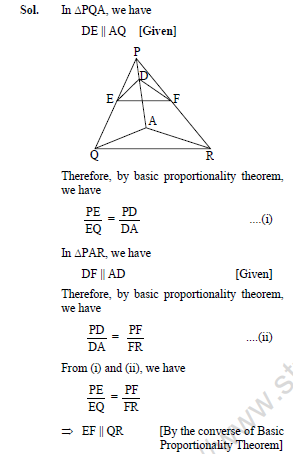
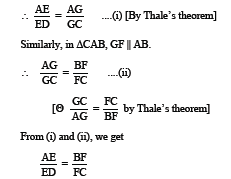
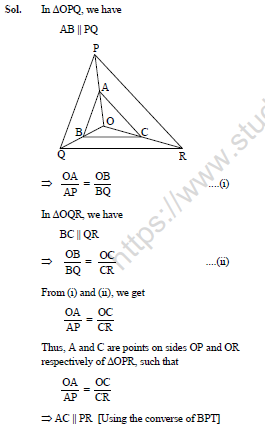
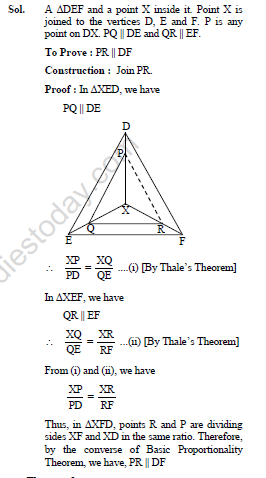
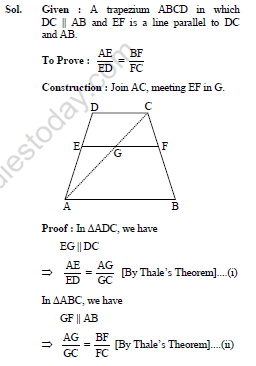
Q.- In fig., if DE || AQ and DF || AR. Prove that EF || QR.
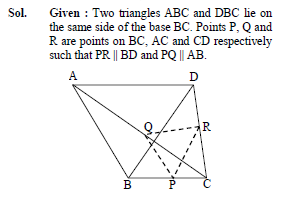
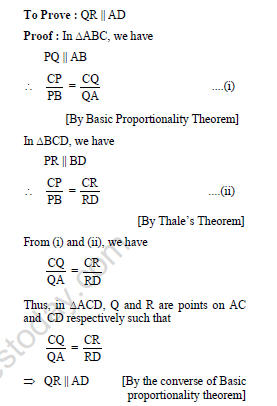
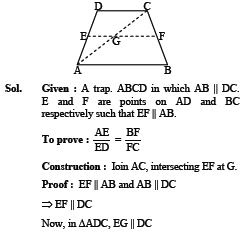
Question 1. Let X be any point on the side BC of a triangle ABC. If XM, XN are drawn parallel to BA and CA, BA in M and N resprctively, MN meets BC produced in T.
Answer:
To prove: \( TX^2 = TB \times TC \)
In \( \Delta TXM \), since \( BN \parallel XM \), we apply the Basic Proportionality Theorem to obtain:
\( \frac{TB}{TX} = \frac{TN}{TM} \) - (i)
In \( \Delta TMC \), as \( XN \parallel MC \), using the Basic Proportionality Theorem gives:
\( \frac{TX}{TC} = \frac{TN}{TM} \) - (ii)
Equating both expressions from (i) and (ii), we get:
\( \frac{TB}{TX} = \frac{TX}{TC} \)
On cross-multiplying, this results in the required relation:
\( TX^2 = TB \times TC \)
Hence proved.
In simple words: By using the Basic Proportionality Theorem in two different triangles that share a common ratio of segments on the line TM, we can set their equal ratios against each other to prove the required relationship.
Exam Tip: Be sure to clearly identify the parallel lines and state which triangles you are applying the Basic Proportionality Theorem to in your proof.
Question 2. If PQ II BC and PR II CD Prove that AR/AD = AQ / AB
Answer:
In \( \Delta ABC \), we are given \( PQ \parallel BC \). Applying the Basic Proportionality Theorem (Thales's Theorem):
\( \frac{AQ}{AB} = \frac{AP}{AC} \) - (i)
Similarly, in \( \Delta ADC \), it is given that \( PR \parallel CD \). Applying the Basic Proportionality Theorem:
\( \frac{AR}{AD} = \frac{AP}{AC} \) - (ii)
Comparing equations (i) and (ii), since both ratios equal \( \frac{AP}{AC} \), we can equate them directly:
\( \frac{AQ}{AB} = \frac{AR}{AD} \)
Which gives the required relation:
\( \frac{AR}{AD} = \frac{AQ}{AB} \)
Hence proved.
In simple words: Since the parallel lines divide the sides of both triangles in the exact same ratio as the shared diagonal AC, the ratio on one side must equal the ratio on the other.
Exam Tip: When writing proofs involving Thales's Theorem, write down the corresponding ratios carefully, ensuring the vertices match up in the correct order.
Question 3. ABCD is a quadrilateral, P, Q, R and S are the points of trisection of sides AB, BC, CD and DA respectively and are adjacent to A and C; Prove that PQRS is a parallelogram.
Answer:
Let us connect the diagonal \( AC \).
In \( \Delta ABC \), we are given that \( P \) and \( Q \) are points of trisection of sides \( AB \) and \( BC \) respectively, positioned near \( A \) and \( C \):
\( AP = \frac{1}{3} AB \implies \frac{BP}{PA} = \frac{2}{1} \)
\( CQ = \frac{1}{3} BC \implies \frac{BQ}{QC} = \frac{2}{1} \)
Since \( \frac{BP}{PA} = \frac{BQ}{QC} = 2 \), by the converse of Thales's Theorem, we have:
\( PQ \parallel AC \) - (i)
In \( \Delta DAC \), \( S \) and \( R \) are the trisection points of sides \( DA \) and \( CD \) respectively, adjacent to \( A \) and \( C \):
\( AS = \frac{1}{3} DA \implies \frac{DS}{SA} = \frac{2}{1} \)
\( CR = \frac{1}{3} CD \implies \frac{DR}{RC} = \frac{2}{1} \)
Since \( \frac{DS}{SA} = \frac{DR}{RC} = 2 \), by the converse of Thales's Theorem, we have:
\( SR \parallel AC \) - (ii)
From equations (i) and (ii), both \( PQ \) and \( SR \) are parallel to the same diagonal line \( AC \), which gives:
\( PQ \parallel SR \)
By connecting the other diagonal \( BD \), we can similarly prove that:
\( SP \parallel RQ \)
Since both pairs of opposite sides in the quadrilateral \( PQRS \) are parallel, \( PQRS \) must be a parallelogram.
Hence proved.
In simple words: The trisection points divide the sides in a 2:1 ratio. By the converse of Thales's Theorem, opposite sides of the inner shape PQRS are parallel to the diagonals of the outer quadrilateral, making PQRS a parallelogram.
Exam Tip: Remember to state clearly that you are using the converse of the Basic Proportionality Theorem, as this is the key justification for proving the lines are parallel.
Question 4. In the given figure , P is the mid point of BC and Q is the mid point of AP. If BQ when produced meets AC at R. Prove that RA = 1/3 CA
Answer:
Construction: Draw a straight line \( PS \) parallel to \( BR \), which meets the side \( AC \) at \( S \).
In \( \Delta BCR \), we are given that \( P \) is the midpoint of \( BC \), and by construction, \( PS \parallel BR \). Applying the Converse of the Midpoint Theorem, the point \( S \) must be the midpoint of \( CR \).
\( RS = SC \) - (i)
In \( \Delta APS \), \( Q \) is given as the midpoint of the side \( AP \), and \( QR \parallel PS \) (since segment \( QR \) lies on the line \( BR \)). Applying the Converse of the Midpoint Theorem, we find that \( R \) is the midpoint of \( AS \).
\( AR = RS \) - (ii)
Combining equations (i) and (ii), we can establish:
\( AR = RS = SC \)
The total diagonal length \( AC \) is the sum of these three collinear segments:
\( AC = AR + RS + SC \)
\( AC = AR + AR + AR \)
\( AC = 3 AR \)
\( AR = \frac{1}{3} AC \)
Therefore, we have:
\( RA = \frac{1}{3} CA \)
Hence proved.
In simple words: By drawing an auxiliary parallel line, we divide the side AC into three equal parts. Since all three segments are of the same length, RA is exactly one-third of the total length of CA.
Exam Tip: Drawing the helper parallel line is a crucial step in this proof. Be sure to write down the construction explicitly and justify why you are applying the converse of the midpoint theorem.
Question 5. Through the mid point M of the side CD of a parallelogram ABCD, the line BM is drawn intersecting AC in L and AD produced in E. Prove that EL = 2 BL
Answer:
First, let us examine \( \Delta DME \) and \( \Delta CMB \):
1. \( DM = CM \) (since \( M \) is given as the midpoint of side \( CD \))
2. \( \angle DME = \angle CMB \) (vertically opposite angles)
3. \( \angle MDE = \angle MCB \) (alternate interior angles, as \( AE \parallel BC \))
By the ASA congruence criterion, we have:
\( \Delta DME \cong \Delta CMB \)
Thus, by CPCT (Corresponding Parts of Congruent Triangles):
\( DE = BC \)
Since \( ABCD \) is a parallelogram, we know opposite sides are equal:
\( AD = BC \)
Therefore, the total extended segment \( AE \) has a length of:
\( AE = AD + DE = BC + BC = 2 BC \)
Next, let us consider \( \Delta ALE \) and \( \Delta CLB \):
1. \( \angle ALE = \angle CLB \) (vertically opposite angles)
2. \( \angle EAL = \angle BCL \) (alternate interior angles, since \( AE \parallel BC \))
By the AA similarity criterion, we have:
\( \Delta ALE \sim \Delta CLB \)
From the properties of similar triangles, the ratio of their corresponding sides must be equal:
\( \frac{EL}{BL} = \frac{AE}{BC} \)
Substituting the relationship \( AE = 2 BC \) into this ratio, we get:
\( \frac{EL}{BL} = \frac{2 BC}{BC} = 2 \)
Multiplying both sides by \( BL \) gives:
\( EL = 2 BL \)
Hence proved.
In simple words: First, we prove that the triangle created outside the parallelogram is identical in size to the one inside, which shows that AE is twice as long as BC. Then, by using similar triangles, we find that EL must also be twice as long as BL.
Exam Tip: A common mistake is to try to prove similarity directly without first showing congruence. Always prove \( \Delta DME \cong \Delta CMB \) first to establish the relation \( AE = 2 BC \).
Question 6. Through the vertex D of a parallelogram ABCD, a line is drawn to intersect the sides BA and BC produced at E and F respectively. Prove that DA/AE = FB/BE = FC/ CD.
Answer:
In parallelogram \( ABCD \), opposite sides are parallel. Thus, we have \( AD \parallel BC \) (which means \( AD \parallel BF \)) and \( AB \parallel CD \) (which means \( AE \parallel CD \)).
First, let us examine \( \Delta EAD \) and \( \Delta EBF \):
Since \( AD \parallel BF \), their corresponding angles are equal:
\( \angle EAD = \angle EBF \)
\( \angle EDA = \angle EFB \)
Additionally, the angle \( \angle E \) is common to both triangles.
By the AA similarity criterion, we have:
\( \Delta EAD \sim \Delta EBF \)
Thus, the ratios of their corresponding sides are equal:
\( \frac{EA}{EB} = \frac{AD}{BF} \)
Taking the reciprocal of both sides gives:
\( \frac{EB}{EA} = \frac{BF}{AD} \)
Which we can write as:
\( \frac{BE}{AE} = \frac{FB}{DA} \)
Rearranging these terms, we get:
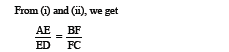
\( \frac{DA}{AE} = \frac{FB}{BE} \) - (i)
Next, let us consider \( \Delta FCD \) and \( \Delta FBE \):
Since \( CD \parallel AE \) (as \( CD \parallel AB \)), their corresponding angles are equal:
\( \angle FCD = \angle FBE \)
\( \angle FDC = \angle FEB \)
Also, the angle \( \angle F \) is common to both triangles.
By the AA similarity criterion, we have:
\( \Delta FCD \sim \Delta FBE \)
Thus, the ratios of their corresponding sides are equal:
\( \frac{FC}{FB} = \frac{CD}{BE} \)
Rearranging these terms, we get:
\( \frac{FB}{BE} = \frac{FC}{CD} \) - (ii)
By comparing equations (i) and (ii), we establish that:
\( \frac{DA}{AE} = \frac{FB}{BE} = \frac{FC}{CD} \)
Hence proved.
In simple words: Since the sides of the parallelogram are parallel, the line drawn through vertex D creates two sets of similar triangles. By comparing the side ratios from these two similarity relationships, we prove that all three fractions are equal.
Exam Tip: Clearly state which pairs of parallel lines you are using to justify the similarity of the triangles. AA similarity is the most direct way to get these side ratios.
Question 7. ABC is a right triangle right angled at B. Let D and E be any points on AB and BC respectively. Prove that AE2 + CD2 = AC2 + DE2.
Answer:
Since \( \Delta ABC \) is right-angled at \( B \), any smaller triangle sharing the vertex \( B \) with sides along \( AB \) and \( BC \) will also be a right-angled triangle.
Applying the Pythagoras Theorem in the following right-angled triangles:
1. In right-angled \( \Delta ABE \):
\( AE^2 = AB^2 + BE^2 \) - (i)
2. In right-angled \( \Delta DBC \):
\( CD^2 = BD^2 + BC^2 \) - (ii)
Adding equations (i) and (ii) gives:
\( AE^2 + CD^2 = (AB^2 + BE^2) + (BD^2 + BC^2) \)
\( AE^2 + CD^2 = (AB^2 + BC^2) + (BD^2 + BE^2) \) - (iii)
Now, let us apply the Pythagoras Theorem to the remaining right-angled triangles in the figure:
3. In right-angled \( \Delta ABC \):
\( AC^2 = AB^2 + BC^2 \) - (iv)
4. In right-angled \( \Delta DBE \):
\( DE^2 = BD^2 + BE^2 \) - (v)
Substituting equations (iv) and (v) into equation (iii), we obtain the desired identity:
\( AE^2 + CD^2 = AC^2 + DE^2 \)
Hence proved.
In simple words: By applying the Pythagoras Theorem to four different right triangles that all share the 90-degree corner at B, we can group the squared side terms together to easily prove the identity.
Exam Tip: This is a very popular exam question. Success relies on identifying all four right-angled triangles centered at vertex B and adding the equations for the two hypotenuses on the left-hand side.
Free study material for Mathematics
Free CBSE Practice Worksheets: Class 10 Mathematics Chapter 06 Triangles
Daily Practice Questions for Class 10 Mathematics
Access structured practice worksheets for Chapter 06 Triangles aligned with the 2026 CBSE curriculum. These downloadable exercises for Class 10 Mathematics help students build accuracy and reinforce core concepts for upcoming school tests.
Detailed Answers for Class 10 Mathematics Chapter 06 Triangles
Built using official NCERT guidelines for Class 10 Mathematics, these practice sheets provide reliable academic support. Cross-reference your completed work with our detailed solutions to learn standard answer-writing formats for CBSE exams.
Complete Your Chapter Revision
Wrap up your chapter revision by testing your knowledge against standard objective question formats. Explore our full library of free, up-to-date printable assignments to maximize your academic results in upcoming CBSE evaluations.
FAQs
You can download the latest chapter-wise printable worksheets for Class 10 Mathematics Chapter 06 Triangles for free from StudiesToday.com. These have been made as per the latest CBSE curriculum for this academic year.
Yes, Class 10 Mathematics worksheets for Chapter 06 Triangles focus on activity-based learning and also competency-style questions. This helps students to apply theoretical knowledge to practical scenarios.
Yes, we have provided solved worksheets for Class 10 Mathematics Chapter 06 Triangles to help students verify their answers instantly.
Yes, our Class 10 Mathematics test sheets are mobile-friendly PDFs and can be printed by teachers for classroom.
For Chapter 06 Triangles, regular practice with our worksheets will improve question-handling speed and help students understand all technical terms and diagrams.