

Download Class 10 Mathematics Practice Worksheets
Review targeted academic worksheets with the CBSE Class 10 Mathematics Coordinate Geometry Worksheet Set 04. Built according to official educational standards for the 2026-27 term, these downloadable Class 10 Mathematics resources support effective daily practice and detailed self-evaluation for Chapter 07 Coordinate Geometry.
Access Chapter 07 Coordinate Geometry Practice Papers and Solutions
View or download the dedicated CBSE Class 10 Mathematics Coordinate Geometry Worksheet Set 04 resource below. Engaging with these practice papers under focused study conditions ensures continuous academic progress and mastery of the 2026-27 curriculum for Chapter 07 Coordinate Geometry.
Case Study Based Questions
I. To conduct sports day activities, in your rectangular shaped school ground ABCD, lines have been drawn with chalk powder at a distance of 1 m each. 100 flower pots have been placed at a distance of 1 m from each other along AD, as shown in figure given below. Niharika runs (1/4)th the distance
AD on the 2nd line and posts a green flag. Preet runs (1/5)th the distance AD on eighth line and posts a red flag
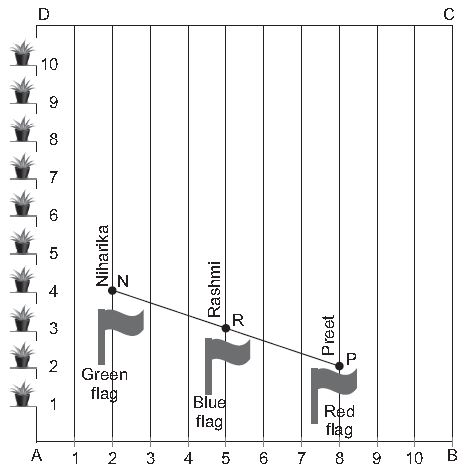
Answer questions (1) to (5)
Question. Write the coordinates of point N.
(a) (1, 25)
(b) (2, 25)
(c) (4, 25)
(d) (3, 25)
Answer : B
Question. Write the coordinates of point P.
(a) (2, 80)
(b) (8, 2)
(c) (8, 20)
(d) (2, 8)
Answer : C
Question. What is the distance between green and red flags?
(a) √63 m
(b) √26 m
(c) √62 m
(d) √61m
Answer : D
Question. What is the coordinates of R?
(a) (5, 22)
(b) (5, 22.5)
(c) (22.5, 5)
(d) (22, 5)
Answer : B
Question. Distance between Niharika and Rashmi is
(a) 3.90 m
(b) 4.01 m
(c) 3.06 m
(d) 5.10 m
Answer : A
II. In a classroom, 4 friends are seated at the points A, B, C and D as shown is given fig.
Rupa and Rupali walk into the class and after observing for a few minutes Rupa asks Rupali, Some questions which are as follows:
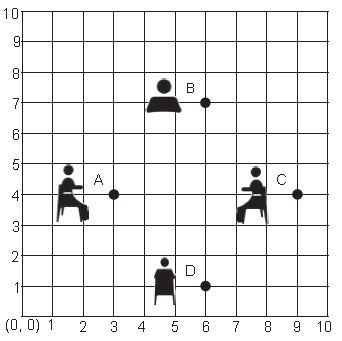
Question. Coordinate of A is
(a) (4, 3)
(b) (3, 0)
(c) (1, 4)
(d) (3, 4)
Answer : D
Question. Coordinate of D is
(a) (6, 1)
(b) (1, 6)
(c) (2, 6)
(d) (6, 2)
Answer : A
Question. Distance AB is
(a) 3+√2
(b) √2
(c) 2√2
(d) 3√2
Answer : D
Question. Diagonal AC is
(a) 3
(b) 4
(c) 6
(d) 5
Answer : C
Question. ABCD is a
(a) rectangle
(b) square
(c) rhombus
(d) trapezium
Answer : B
III. In a classroom, 4 friends are seated at the points A, B, C and D as shown in figure. Champa and Chameli walk into the class and after observing for a few minutes Champa asks Chameli, few questions, which you are required to answer. They are as follows:
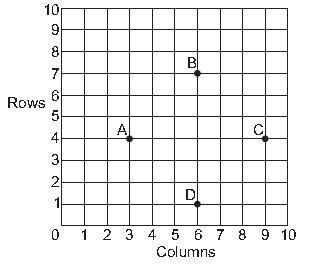
Question. What are the coordinates of A and B respectively?
(a) (3, 4) and (6, 7)
(b) (4, 3) and (7, 6)
(c) (–3, 4) and (–6, 7)
(d) (4, –3) and (–7, 6)
Answer : A
Question. What are the coordinates of C and D respectively?
(a) (9, 4) and (6, 1)
(b) (4, 9) and (1, 9)
(c) (–9, –4) and (–6, –1)
(d) (–9, 4) and (–6, 1)
Answer : A
Question. What is the distance between AB and CD?
(a) 4√2 units
(b) 3√2units
(c) 5√2 units
(d) 2√2 units
Answer : B
Question. Distance between BC and AD is
(a) 2√2 units
(b) 4√2 units
(c) 3√2 units
(d) 5√2 units
Answer : C
Question. What is the distance between A and C?
(a) 4 units
(b) 5 units
(c) 8 units
(d) 6 units
Answer : D
1) Show that the points (a, a), (-a, - a) and (- √3a, √3a) are the vertices of an equilateral Δ
2) Show that four points (0,-1), (6, 7), (-2, 3) and (8, 3) are the vertices of a rectangle
3) Prove that (4, -1), (6, 0), (7, 2) and (5, 1) are the vertices of a rhombus. Is it a square?
4) Show that the following points are the vertices of a right angled isosceles triangle: (1, 2), (1, 5) and (4, 2)
5) Find a relation between x and y such that the point (x, y) is equidistant from the points (7, 1) and (3, 5) (x - y = 2)
6) If the distance of P(x, y) from the points A (3, 6) and B (-3, 4) are equal, prove that 3x + y = 5
7) Find the values of x for which the distance between the points P (2, -3) and Q (x, 5) is 10 units (8 or -4)
8) Given A (-2, 3) and AB = 10 units .If ordinate of B is 9, find abscissa of B (-10, 6)
9) Find the coordinates of the point equidistant from three given points A (5, 1), B (-3, -7) and C (7, -1) (2,-4) 10) If the point p(x, y) is equidistant from the points A (a + b, b - a) and B (a - b, a + b), prove that b x = a y
11) Find the point on y- axis which is equidistant from the point (5, -2) and (-3, 2) (0, -2)
12) Find the point on x- axis which is equidistant from the points (2, -5) and (-2, 9) (-7, 0)
13) If the points A (4, 3), and B(x, 5) are on the circle with the centre. O (2, 3), find the value of x (x=2)
14) The three consecutive vertices of a parallelogram are (-2, 1), (1, 0) and (4, 3). Find the Coordinates of the fourth vertex (1, 4)
15) Find the value of k for which the points (7, -2), (5, 1), and (3, k) are collinear. (k = 4)
16) Find the value of m, for which the points with co-ordinates (3, 5), (m, 6) and [1/2, 15/2] are collinear (m = 2)
17) Find a relation between x and y, if (x, y), (1, 3) and (8, 0) are collinear (3x +7y = 24)
18) If the points (-2, 1), (a, b) and (4,-1) are collinear and a - b = 1, then find the values of a and b (a =1, b = 0)
19) Check whether the points (4, 5), (7, 6) and (6, 3) are collinear.
20) If A (-5, 7), B (-4, -5), C (-1, -6) and D (4, 5) are the vertices of a quadrilateral, find the area of the quadrilateral ABCD.
21) ABCDE is polygon whose vertices are A (-1, 0), B (4, 0), C (4, 4), D (0, 7) and E (-6, 2). Find the area of the polygon
22) Using A (4, -6), B (3, -2) and C (5, 2), verify that a median of the ΔABC divides it into two triangles of equal areas
23) The coordinates of A, B, C are (3, 4), (5, 2), (x, y) respectively. If area of ΔABC = 3, show that x + y = 10
24) The coordinates of the vertices of ΔABC are A (4, 1), B (-3, 2) and C (0, k).Given that the area of ΔABC is 12 unit2, Find the Value of k (k = - 13/ 7)
25) Find the ratio in which the point (2, y) divides the line segment joining the points A (-2, 2) and B (3, 7) (4: 1)
26) If P divides the join of A (-2, -2) and B (2, -4) such that AP/AB = 3/7, find the coordinates of P (-2/7, -20/7)
27) Find the ratio in which the line 2x + y – 5 = 0 divides the line segment joining A (2,-3) and B (3, 9) (2:5)
28) Determine the ratio in which the line 3x + 4y – 9 = 0 divides the line segment joining the points (1, 3) and (2, 7) (k = - 6/25)
29) Find the length of medians of triangle whose vertices are A (-1, 3), B (1, -1), and C (5, 1)
30) If the midpoint of of the segment joining A (a, b +1), and B (a +1, b +2) is C (3/2, 5/2) Find a and b (a=1, b=1)
31 The coordinates of one end point of a diameter of a circle are (4, -1) and the coordinates of the centre of the circle are (1, -3)
Find the coordinates of the other end of the diameter (-2, -5)
32) If P(x, y) is any point on the line joining the points A (a, 0), B (0, b), then show that x + y a b
33) The centre of a circle is (2a – 1, 7) and it passes through the point (-3, -1). If the diameter of the circle is 20 units, then find
the value of a (-4, 2)
34) Determine the value of a if AB = BC, where A, B, C are the points (-5, 1), (0, 5) and (a, 1) respectively (±5)
35) A (5, -1), B (-1, 8) and C (-3, -2) are the vertices of triangle ABC. E and F are the midpoints of the sides AB and AC Respectively.Show that EF = ½ BC
PREPARED BY MAHABOOB PASHA ] X – X BOYS
Please click the below link to access CBSE Class 10 Mathematics Worksheet - Coordinate Geometry (4)
Question 1. Show that the points (a, a), (-a, - a) and (- √3a, √3a) are the vertices of an equilateral Δ
Answer: Let us label the given coordinate points as \( A(a, a) \), \( B(-a, -a) \), and \( C(-\sqrt{3}a, \sqrt{3}a) \).
Using the distance formula, we calculate the lengths of all three sides of the triangle:
\( AB = \sqrt{(-a - a)^2 + (-a - a)^2} \)
\( \implies AB = \sqrt{(-2a)^2 + (-2a)^2} = \sqrt{4a^2 + 4a^2} = \sqrt{8a^2} = 2\sqrt{2}a \)
\( BC = \sqrt{(-\sqrt{3}a - (-a))^2 + (\sqrt{3}a - (-a))^2} \)
\( \implies BC = \sqrt{(a - \sqrt{3}a)^2 + (a + \sqrt{3}a)^2} \)
\( \implies BC = \sqrt{a^2(1 - 2\sqrt{3} + 3) + a^2(1 + 2\sqrt{3} + 3)} \)
\( \implies BC = \sqrt{a^2(4 - 2\sqrt{3} + 4 + 2\sqrt{3})} = \sqrt{8a^2} = 2\sqrt{2}a \)
\( CA = \sqrt{(a - (-\sqrt{3}a))^2 + (a - \sqrt{3}a)^2} \)
\( \implies CA = \sqrt{(a + \sqrt{3}a)^2 + (a - \sqrt{3}a)^2} \)
\( \implies CA = \sqrt{a^2(1 + 2\sqrt{3} + 3) + a^2(1 - 2\sqrt{3} + 3)} \)
\( \implies CA = \sqrt{8a^2} = 2\sqrt{2}a \)
Since the three sides are of equal length (\( AB = BC = CA \)), the triangle is equilateral.
In simple words: We find the length of each side using the distance formula. Because all three sides are exactly equal, the triangle is equilateral.
Exam Tip: Be comfortable with algebraic identities like \( (x+y)^2 + (x-y)^2 = 2(x^2 + y^2) \) to quickly simplify calculations with square roots.
Question 2. Show that four points (0,-1), (6, 7), (-2, 3) and (8, 3) are the vertices of a rectangle
Answer: Let the vertices be represented by \( A(0, -1) \), \( B(6, 7) \), \( C(8, 3) \), and \( D(-2, 3) \).
We calculate the lengths of the four sides using the coordinate distance formula:
\( AB = \sqrt{(6-0)^2 + (7 - (-1))^2} = \sqrt{6^2 + 8^2} = \sqrt{36 + 64} = 10 \)
\( BC = \sqrt{(8-6)^2 + (3-7)^2} = \sqrt{2^2 + (-4)^2} = \sqrt{4 + 16} = \sqrt{20} \)
\( CD = \sqrt{(-2-8)^2 + (3-3)^2} = \sqrt{(-10)^2 + 0^2} = 10 \)
\( DA = \sqrt{(0 - (-2))^2 + (-1-3)^2} = \sqrt{2^2 + (-4)^2} = \sqrt{4 + 16} = \sqrt{20} \)
The opposite sides are equal in length (\( AB = CD = 10 \) and \( BC = DA = \sqrt{20} \)), indicating a parallelogram.
Now we find the lengths of both diagonals \( AC \) and \( BD \):
\( AC = \sqrt{(8-0)^2 + (3 - (-1))^2} = \sqrt{8^2 + 4^2} = \sqrt{64 + 16} = \sqrt{80} \)
\( BD = \sqrt{(-2-6)^2 + (3-7)^2} = \sqrt{(-8)^2 + (-4)^2} = \sqrt{64 + 16} = \sqrt{80} \)
Since the opposite sides are equal and the diagonals are equal (\( AC = BD = \sqrt{80} \)), the given points form a rectangle.
In simple words: Opposite sides are equal, which makes the shape a parallelogram. Because the corner-to-corner diagonals are also equal, the shape is a rectangle.
Exam Tip: To prove a shape is a rectangle, you must calculate both the four sides and the two diagonals to ensure the angles are indeed ninety degrees.
Question 3. Prove that (4, -1), (6, 0), (7, 2) and (5, 1) are the vertices of a rhombus. Is it a square?
Answer: Let the coordinates of the vertices be \( A(4, -1) \), \( B(6, 0) \), \( C(7, 2) \), and \( D(5, 1) \).
First, we find the lengths of the sides of the quadrilateral:
\( AB = \sqrt{(6-4)^2 + (0 - (-1))^2} = \sqrt{2^2 + 1^2} = \sqrt{5} \)
\( BC = \sqrt{(7-6)^2 + (2-0)^2} = \sqrt{1^2 + 2^2} = \sqrt{5} \)
\( CD = \sqrt{(5-7)^2 + (1-2)^2} = \sqrt{(-2)^2 + (-1)^2} = \sqrt{5} \)
\( DA = \sqrt{(4-5)^2 + (-1-1)^2} = \sqrt{(-1)^2 + (-2)^2} = \sqrt{5} \)
Since all sides are equal in length (\( AB = BC = CD = DA = \sqrt{5} \)), the shape is a rhombus.
Now, let us calculate the diagonal lengths \( AC \) and \( BD \):
\( AC = \sqrt{(7-4)^2 + (2 - (-1))^2} = \sqrt{3^2 + 3^2} = \sqrt{18} = 3\sqrt{2} \)
\( BD = \sqrt{(5-6)^2 + (1-0)^2} = \sqrt{(-1)^2 + 1^2} = \sqrt{2} \)
Because the diagonals are unequal (\( 3\sqrt{2} \neq \sqrt{2} \)), the given coordinates do not form a square.
In simple words: All four outer edges of the shape are equal, proving it is a rhombus. However, since the internal diagonal lines are not the same length, it is not a square.
Exam Tip: Remember that a square is a specific type of rhombus where the diagonals must be equal. If the diagonals are unequal, it remains a regular rhombus.
Question 4. Show that the following points are the vertices of a right angled isosceles triangle: (1, 2), (1, 5) and (4, 2)
Answer: Let us label the points as \( A(1, 2) \), \( B(1, 5) \), and \( C(4, 2) \).
Using the distance formula, we determine the side lengths of this triangle:
\( AB = \sqrt{(1-1)^2 + (5-2)^2} = \sqrt{0 + 3^2} = 3 \)
\( BC = \sqrt{(4-1)^2 + (2-5)^2} = \sqrt{3^2 + (-3)^2} = \sqrt{9 + 9} = \sqrt{18} = 3\sqrt{2} \)
\( CA = \sqrt{(1-4)^2 + (2-2)^2} = \sqrt{(-3)^2 + 0} = 3 \)
Since two side lengths are equal (\( AB = CA = 3 \)), the triangle is isosceles.
Next, checking the Pythagorean relation:
\( AB^2 + CA^2 = 3^2 + 3^2 = 9 + 9 = 18 \)
\( BC^2 = (\sqrt{18})^2 = 18 \)
Since \( AB^2 + CA^2 = BC^2 \), the triangle is right-angled.
Therefore, the given points are the vertices of a right-angled isosceles triangle.
In simple words: Two sides are of equal length, making the triangle isosceles. Additionally, the sum of the squares of these two sides equals the square of the longest side, proving there is a right angle.
Exam Tip: When evaluating coordinates for a right-angled triangle, verify the converse of the Pythagorean theorem using squared values directly to bypass working with square roots.
Question 5. Find a relation between x and y such that the point (x, y) is equidistant from the points (7, 1) and (3, 5) (x - y = 2)
Answer: Let the point be \( P(x, y) \), which is equidistant from \( A(7, 1) \) and \( B(3, 5) \).
Since \( PA = PB \), we have \( PA^2 = PB^2 \).
Using the distance formula:
\( (x-7)^2 + (y-1)^2 = (x-3)^2 + (y-5)^2 \)
\( \implies x^2 - 14x + 49 + y^2 - 2y + 1 = x^2 - 6x + 9 + y^2 - 10y + 25 \)
Cancel \( x^2 \) and \( y^2 \) on both sides:
\( \implies -14x - 2y + 50 = -6x - 10y + 34 \)
\( \implies -14x + 6x - 2y + 10y = 34 - 50 \)
\( \implies -8x + 8y = -16 \)
Dividing by \( -8 \):
\( \implies x - y = 2 \).
This is the required relation.
In simple words: Setting the squared distances equal and cancelling common terms gives a linear relationship between the variables, resulting in \( x - y = 2 \).
Exam Tip: Geometrically, the locus of a point equidistant from two given coordinates represents the perpendicular bisector of the line segment joining those points.
Question 6. If the distance of P(x, y) from the points A (3, 6) and B (-3, 4) are equal, prove that 3x + y = 5
Answer: We are given that \( PA = PB \), which means \( PA^2 = PB^2 \).
Using the distance formula with the coordinates \( P(x, y) \), \( A(3, 6) \), and \( B(-3, 4) \):
\( (x-3)^2 + (y-6)^2 = (x - (-3))^2 + (y-4)^2 \)
\( \implies (x-3)^2 + (y-6)^2 = (x+3)^2 + (y-4)^2 \)
\( \implies x^2 - 6x + 9 + y^2 - 12y + 36 = x^2 + 6x + 9 + y^2 - 8y + 16 \)
Cancel \( x^2 \) and \( y^2 \) on both sides:
\( \implies -6x - 12y + 45 = 6x - 8y + 25 \)
\( \implies -6x - 6x - 12y + 8y = 25 - 45 \)
\( \implies -12x - 4y = -20 \)
Dividing the entire equation by \( -4 \):
\( \implies 3x + y = 5 \).
Hence proved.
In simple words: Since the point is equally far from both coordinates, we set their squared distances equal. Simplifying the resulting equation directly yields \( 3x + y = 5 \).
Exam Tip: Be meticulous with minus signs during expansion, particularly when subtracting coordinates with negative values like \( -(-3) = 3 \).
Question 7. Find the values of x for which the distance between the points P (2, -3) and Q (x, 5) is 10 units (8 or -4)
Answer: We are given that the distance \( PQ = 10 \).
Using the distance formula:
\( \sqrt{(x-2)^2 + (5 - (-3))^2} = 10 \)
\( \implies \sqrt{(x-2)^2 + 8^2} = 10 \)
Squaring both sides of the equation:
\( \implies (x-2)^2 + 64 = 100 \)
\( \implies (x-2)^2 = 36 \)
Taking the square root:
\( \implies x-2 = \pm 6 \)
This gives us two possibilities:
Case 1: \( x-2 = 6 \implies x = 8 \)
Case 2: \( x-2 = -6 \implies x = -4 \).
Therefore, the values of \( x \) are \( 8 \) or \( -4 \).
In simple words: We set up the distance formula equal to 10. After squaring and rearranging, we find two possible numbers for \( x \) that satisfy the horizontal distance, which are 8 and -4.
Exam Tip: Don't forget that a squared quantity has both positive and negative roots. Omitting the negative root will result in losing one of the correct solutions.
Question 8. Given A (-2, 3) and AB = 10 units .If ordinate of B is 9, find abscissa of B (-10, 6)
Answer: The ordinate of \( B \) is \( y = 9 \). Let the coordinates of point \( B \) be \( (x, 9) \). We are given that the distance \( AB = 10 \) units.
Using the distance formula with \( A(-2, 3) \) and \( B(x, 9) \):
\( \sqrt{(x - (-2))^2 + (9 - 3)^2} = 10 \)
\( \implies \sqrt{(x + 2)^2 + 6^2} = 10 \)
Squaring both sides:
\( \implies (x + 2)^2 + 36 = 100 \)
\( \implies (x + 2)^2 = 64 \)
Taking the square root on both sides:
\( \implies x + 2 = \pm 8 \)
This leads to two cases:
Case 1: \( x + 2 = 8 \implies x = 6 \)
Case 2: \( x + 2 = -8 \implies x = -10 \).
Hence, the possible abscissa values of \( B \) are \( -10 \) or \( 6 \).
In simple words: Given the vertical height of point \( B \) is 9, we use the distance formula with the other endpoint to calculate its horizontal coordinates, yielding 6 or -10.
Exam Tip: Abscissa refers to the x-coordinate and ordinate refers to the y-coordinate. Swapping these definitions will lead to an incorrect coordinate setup.
Question 9. Find the coordinates of the point equidistant from three given points A (5, 1), B (-3, -7) and C (7, -1) (2,-4)
Answer: Let the required point be \( P(x, y) \). Since \( P \) is equidistant from \( A, B, \) and \( C \), we have \( PA^2 = PB^2 = PC^2 \).
First, equating \( PA^2 = PB^2 \):
\( (x-5)^2 + (y-1)^2 = (x - (-3))^2 + (y - (-7))^2 \)
\( \implies (x-5)^2 + (y-1)^2 = (x+3)^2 + (y+7)^2 \)
\( \implies x^2 - 10x + 25 + y^2 - 2y + 1 = x^2 + 6x + 9 + y^2 + 14y + 49 \)
\( \implies -10x - 2y + 26 = 6x + 14y + 58 \)
\( \implies -16x - 16y = 32 \)
Dividing by \( -16 \):
\( \implies x + y = -2 \) - - - (Eq 1)
Next, equating \( PA^2 = PC^2 \):
\( (x-5)^2 + (y-1)^2 = (x-7)^2 + (y - (-1))^2 \)
\( \implies (x-5)^2 + (y-1)^2 = (x-7)^2 + (y+1)^2 \)
\( \implies x^2 - 10x + 25 + y^2 - 2y + 1 = x^2 - 14x + 49 + y^2 + 2y + 1 \)
\( \implies -10x - 2y + 26 = -14x + 2y + 50 \)
\( \implies 4x - 4y = 24 \)
Dividing by 4:
\( \implies x - y = 6 \) - - - (Eq 2)
Adding (Eq 1) and (Eq 2):
\( (x+y) + (x-y) = -2 + 6 \)
\( \implies 2x = 4 \implies x = 2 \).
Substituting \( x = 2 \) into (Eq 1):
\( 2 + y = -2 \implies y = -4 \).
Thus, the coordinates of the point are \( (2, -4) \).
In simple words: Since the point is equally distant from all three vertices, we write distance equations for two pairs. Solving these linear equations gives the point \( (2, -4) \).
Exam Tip: This equidistant point is the circumcentre of the triangle. Ensure you simplify the linear equations fully before attempting to solve them simultaneously.
Question 10. If the point p(x, y) is equidistant from the points A (a + b, b - a) and B (a - b, a + b), prove that b x = a y
Answer: Since point \( P(x, y) \) is equidistant from \( A \) and \( B \), we have \( PA^2 = PB^2 \).
Using the distance formula:
\( [x - (a+b)]^2 + [y - (b-a)]^2 = [x - (a-b)]^2 + [y - (a+b)]^2 \)
Expanding the terms:
\( \implies x^2 - 2x(a+b) + (a+b)^2 + y^2 - 2y(b-a) + (b-a)^2 = x^2 - 2x(a-b) + (a-b)^2 + y^2 - 2y(a+b) + (a+b)^2 \)
Subtracting common terms \( x^2, y^2, (a+b)^2 \), and since \( (b-a)^2 = (a-b)^2 \), we get:
\( \implies -2x(a+b) - 2y(b-a) = -2x(a-b) - 2y(a+b) \)
Divide by \( -2 \):
\( \implies x(a+b) + y(b-a) = x(a-b) + y(a+b) \)
\( \implies ax + bx + by - ay = ax - bx + ay + by \)
Cancelling \( ax \) and \( by \) from both sides:
\( \implies bx - ay = -bx + ay \)
\( \implies 2bx = 2ay \)
\( \implies bx = ay \).
Hence proved.
In simple words: Equating the squared distances removes many complex algebraic terms. Expanding and regrouping the remaining terms leads directly to the relation \( bx = ay \).
Exam Tip: In complex coordinate proofs, identify and cancel out matching expressions on both sides of the equation early to prevent the math from becoming too complicated.
Question 11. Find the point on y- axis which is equidistant from the point (5, -2) and (-3, 2) (0, -2)
Answer: Any point on the y-axis is represented as \( P(0, y) \). Since \( P \) is equidistant from \( A(5, -2) \) and \( B(-3, 2) \), we have \( PA^2 = PB^2 \).
Using the distance formula:
\( (0-5)^2 + (y - (-2))^2 = (0 - (-3))^2 + (y-2)^2 \)
\( \implies 25 + (y+2)^2 = 9 + (y-2)^2 \)
\( \implies 25 + y^2 + 4y + 4 = 9 + y^2 - 4y + 4 \)
Cancelling \( y^2 \) and \( 4 \) from both sides:
\( \implies 25 + 4y = 9 - 4y \)
\( \implies 8y = 9 - 25 \)
\( \implies 8y = -16 \)
\( \implies y = -2 \).
Thus, the point is \( (0, -2) \).
In simple words: Since the point lies on the y-axis, its horizontal position is 0. Equating the distances from this point to both coordinate positions yields a vertical coordinate of -2, giving us the point \( (0, -2) \).
Exam Tip: Remember that any point on the y-axis has a zero x-coordinate. Start the problem by defining the coordinates as \( (0, y) \).
Question 12. Find the point on x- axis which is equidistant from the points (2, -5) and (-2, 9) (-7, 0)
Answer: Any point on the x-axis is represented as \( P(x, 0) \). Since it is equidistant from \( A(2, -5) \) and \( B(-2, 9) \), we have \( PA^2 = PB^2 \).
Using the distance formula:
\( (x-2)^2 + (0 - (-5))^2 = (x - (-2))^2 + (0-9)^2 \)
\( \implies (x-2)^2 + 25 = (x+2)^2 + 81 \)
\( \implies x^2 - 4x + 4 + 25 = x^2 + 4x + 4 + 81 \)
Cancelling \( x^2 \) and \( 4 \) on both sides:
\( \implies -4x + 25 = 4x + 81 \)
\( \implies -8x = 56 \)
\( \implies x = -7 \).
Thus, the required point on the x-axis is \( (-7, 0) \).
In simple words: The point is on the horizontal line, so its height is 0. Setting the distance to both points equal reveals its horizontal coordinate is -7, resulting in \( (-7, 0) \).
Exam Tip: A point on the x-axis always has a y-coordinate of 0. Write the point as \( (x, 0) \) before setting up the distance equations.
Question 13. If the points A (4, 3), and B(x, 5) are on the circle with the centre. O (2, 3), find the value of x (x=2)
Answer: Since both \( A(4, 3) \) and \( B(x, 5) \) are on the circle with centre \( O(2, 3) \), the distance from the centre to both points is equal to the radius of the circle.
Hence, \( OA^2 = OB^2 \).
Using the distance formula:
\( (4-2)^2 + (3-3)^2 = (x-2)^2 + (5-3)^2 \)
\( \implies 2^2 + 0 = (x-2)^2 + 2^2 \)
\( \implies 4 = (x-2)^2 + 4 \)
\( \implies (x-2)^2 = 0 \)
\( \implies x - 2 = 0 \)
\( \implies x = 2 \).
The value of \( x \) is 2.
In simple words: The distance from the center to any boundary point of the circle is the same. Equating the distances of both coordinates to the center shows that \( x = 2 \).
Exam Tip: Keep in mind that coordinate points on a circle are always equidistant from the center. Set up your equality using the radius definition.
Question 14. The three consecutive vertices of a parallelogram are (-2, 1), (1, 0) and (4, 3). Find the Coordinates of the fourth vertex (1, 4)
Answer: Let the coordinates of the consecutive vertices be \( A(-2, 1) \), \( B(1, 0) \), and \( C(4, 3) \). Let the fourth vertex be \( D(x, y) \).
In a parallelogram, the diagonals bisect each other, meaning the midpoint of diagonal \( AC \) is the same as the midpoint of diagonal \( BD \).
Midpoint of \( AC \) is:
\( \left( \frac{-2 + 4}{2}, \frac{1 + 3}{2} \right) = (1, 2) \)
Midpoint of \( BD \) is:
\( \left( \frac{1 + x}{2}, \frac{0 + y}{2} \right) \)
Equating the coordinates:
\( \frac{1+x}{2} = 1 \implies 1+x = 2 \implies x = 1 \).
And,
\( \frac{y}{2} = 2 \implies y = 4 \).
Thus, the coordinates of the fourth vertex are \( (1, 4) \).
In simple words: Since the diagonals of a parallelogram intersect exactly at their midpoints, the midpoint calculated from \( AC \) equals that of \( BD \). Equating these gives the fourth corner as (1, 4).
Exam Tip: Using the midpoint of diagonals is the most efficient method to find a missing vertex of a parallelogram, much faster than using side lengths.
Question 15. Find the value of k for which the points (7, -2), (5, 1), and (3, k) are collinear. (k = 4)
Answer: Let the points be \( A(7, -2) \), \( B(5, 1) \), and \( C(3, k) \).
If these points are collinear, the slope of \( AB \) must equal the slope of \( BC \).
\( \text{Slope of } AB = \frac{1 - (-2)}{5 - 7} = \frac{3}{-2} \)
\( \text{Slope of } BC = \frac{k - 1}{3 - 5} = \frac{k - 1}{-2} \)
Equating the slopes:
\( \frac{3}{-2} = \frac{k-1}{-2} \)
Since the denominators are equal:
\( \implies 3 = k - 1 \)
\( \implies k = 4 \).
Therefore, the value of \( k \) is 4.
In simple words: Because the three points lie on the same straight line, the slope from the first point to the second is equal to the slope from the second to the third, proving that \( k = 4 \).
Exam Tip: Equating slopes is a quicker way to solve for unknown collinear variables than setting the area formula to zero.
Question 16. Find the value of m, for which the points with co-ordinates (3, 5), (m, 6) and [1/2, 15/2] are collinear (m = 2)
Answer: Let the coordinates of the points be \( A(3, 5) \), \( B(m, 6) \), and \( C(1/2, 15/2) \).
Since these points are collinear, we can equate the slopes:
\( \text{Slope of } AB = \frac{6 - 5}{m - 3} = \frac{1}{m - 3} \)
\( \text{Slope of } AC = \frac{15/2 - 5}{1/2 - 3} = \frac{5/2}{-5/2} = -1 \)
Equating the slopes:
\( \frac{1}{m - 3} = -1 \)
\( \implies 1 = -(m-3) \)
\( \implies 1 = -m + 3 \)
\( \implies m = 2 \).
Thus, the value of \( m \) is 2.
In simple words: Since the points are on the same line, the slope between any two pairs is identical. Setting these slopes equal yields \( m = 2 \).
Exam Tip: Be careful when simplifying fractions within fractions (like \( 15/2 \) and \( 1/2 \)) to avoid minor arithmetic errors.
Question 17. Find a relation between x and y, if (x, y), (1, 3) and (8, 0) are collinear (3x +7y = 24)
Answer: Let the points be \( A(x, y) \), \( B(1, 3) \), and \( C(8, 0) \).
Since the points are collinear, the slope of \( AB \) must equal the slope of \( BC \).
\( \text{Slope of } AB = \frac{3 - y}{1 - x} \)
\( \text{Slope of } BC = \frac{0 - 3}{8 - 1} = \frac{-3}{7} \)
Equating the slopes:
\( \frac{3 - y}{1 - x} = -\frac{3}{7} \)
Cross-multiplying:
\( \implies 7(3 - y) = -3(1 - x) \)
\( \implies 21 - 7y = -3 + 3x \)
\( \implies 3x + 7y = 24 \).
This is the required relationship.
In simple words: Since the three points are on the same line, they have a constant slope. Setting the slope equations equal and simplifying yields \( 3x + 7y = 24 \).
Exam Tip: Write down the slope formula first before plugging in the values to keep your algebraic signs organized.
Question 18. If the points (-2, 1), (a, b) and (4,-1) are collinear and a - b = 1, then find the values of a and b (a =1, b = 0)
Answer: Let the points be \( A(-2, 1) \), \( B(a, b) \), and \( C(4, -1) \).
Since the points are collinear, the slope of \( AB \) is equal to the slope of \( AC \).
\( \frac{b - 1}{a - (-2)} = \frac{-1 - 1}{4 - (-2)} \)
\( \implies \frac{b - 1}{a + 2} = \frac{-2}{6} = -\frac{1}{3} \)
Cross-multiplying:
\( \implies 3(b - 1) = -(a + 2) \)
\( \implies 3b - 3 = -a - 2 \)
\( \implies a + 3b = 1 \) - - - (Eq 1)
We are given that:
\( a - b = 1 \implies a = b + 1 \) - - - (Eq 2)
Substituting (Eq 2) in (Eq 1):
\( (b + 1) + 3b = 1 \)
\( \implies 4b + 1 = 1 \)
\( \implies 4b = 0 \implies b = 0 \)
Substituting \( b = 0 \) into (Eq 2):
\( a = 0 + 1 = 1 \).
Therefore, \( a = 1 \) and \( b = 0 \).
In simple words: The collinear condition gives us one equation, and combining it with the given relationship \( a - b = 1 \) lets us solve for \( a = 1 \) and \( b = 0 \).
Exam Tip: Substituting one variable in terms of the other is the simplest way to solve coordinate-based simultaneous equations.
Question 19. Check whether the points (4, 5), (7, 6) and (6, 3) are collinear.
Answer: Let the points be \( A(4, 5) \), \( B(7, 6) \), and \( C(6, 3) \).
We calculate the slopes of line segments \( AB \) and \( BC \):
\( \text{Slope of } AB = \frac{6 - 5}{7 - 4} = \frac{1}{3} \)
\( \text{Slope of } BC = \frac{3 - 6}{6 - 7} = \frac{-3}{-1} = 3 \)
Since the slope of \( AB \) is not equal to the slope of \( BC \) (\( \frac{1}{3} \neq 3 \)), the points do not lie on a single line.
Therefore, the given points are not collinear.
In simple words: The slope between the first and second points is different from the slope between the second and third points, meaning they do not lie on the same straight line.
Exam Tip: If the slopes of adjacent segments are unequal, the points are non-collinear and will form a triangle.
Question 20. If A (-5, 7), B (-4, -5), C (-1, -6) and D (4, 5) are the vertices of a quadrilateral, find the area of the quadrilateral ABCD.
Answer: Let us divide the quadrilateral \( ABCD \) into two triangles, \( \triangle ABC \) and \( \triangle ACD \), by drawing diagonal \( AC \).
The total area is the sum of the areas of these two triangles.
Area of \( \triangle ABC \) with vertices \( A(-5, 7) \), \( B(-4, -5) \), and \( C(-1, -6) \):
\( \text{Area}_1 = \frac{1}{2} | -5(-5 - (-6)) + (-4)(-6 - 7) + (-1)(7 - (-5)) | \)
\( \implies \text{Area}_1 = \frac{1}{2} | -5(1) - 4(-13) - 1(12) | = \frac{1}{2} | -5 + 52 - 12 | = \frac{1}{2} | 35 | = 17.5 \) sq. units.
Area of \( \triangle ACD \) with vertices \( A(-5, 7) \), \( C(-1, -6) \), and \( D(4, 5) \):
\( \text{Area}_2 = \frac{1}{2} | -5(-6 - 5) + (-1)(5 - 7) + 4(7 - (-6)) | \)
\( \implies \text{Area}_2 = \frac{1}{2} | -5(-11) - 1(-2) + 4(13) | = \frac{1}{2} | 55 + 2 + 52 | = \frac{1}{2} | 109 | = 54.5 \) sq. units.
Total Area \( = \text{Area}_1 + \text{Area}_2 = 17.5 + 54.5 = 72 \) sq. units.
In simple words: We split the quadrilateral into two triangles, compute the area of each triangle, and add them together to find the total area of 72 square units.
Exam Tip: Be consistent with the sign operations inside absolute value brackets when finding areas of triangles.
Question 21. ABCDE is polygon whose vertices are A (-1, 0), B (4, 0), C (4, 4), D (0, 7) and E (-6, 2). Find the area of the polygon
Answer: We can find the area of the pentagon \( ABCDE \) using the Shoelace formula. Let the coordinates in cyclic order be:
\( (-1, 0), (4, 0), (4, 4), (0, 7), (-6, 2) \) and repeat the first vertex at the end: \( (-1, 0) \).
Sum of products of forward diagonals:
\( S_1 = (-1 \times 0) + (4 \times 4) + (4 \times 7) + (0 \times 2) + (-6 \times 0) = 0 + 16 + 28 + 0 + 0 = 44 \)
Sum of products of backward diagonals:
\( S_2 = (0 \times 4) + (0 \times 4) + (4 \times 0) + (7 \times -6) + (2 \times -1) = 0 + 0 + 0 - 42 - 2 = -44 \)
The area is:
Area \( = \frac{1}{2} | S_1 - S_2 | = \frac{1}{2} | 44 - (-44) | = \frac{1}{2} \times 88 = 44 \) sq. units.
In simple words: Using the coordinate formula for polygons, we diagonally multiply the values. Subtracting these diagonal sums gives the final area of 44 square units.
Exam Tip: The Shoelace formula is highly efficient for polygons of more than four sides. Ensure you repeat the first coordinate at the end of the lists.
Question 22. Using A (4, -6), B (3, -2) and C (5, 2), verify that a median of the ΔABC divides it into two triangles of equal areas
Answer: Let \( D \) be the midpoint of side \( BC \).
\( D = \left( \frac{3 + 5}{2}, \frac{-2 + 2}{2} \right) = (4, 0) \).
The median is \( AD \). We calculate the areas of \( \triangle ABD \) and \( \triangle ACD \) to verify:
Area of \( \triangle ABD \) with vertices \( A(4, -6) \), \( B(3, -2) \), and \( D(4, 0) \):
\( \text{Area}_1 = \frac{1}{2} | 4(-2 - 0) + 3(0 - (-6)) + 4(-6 - (-2)) | \)
\( \implies \text{Area}_1 = \frac{1}{2} | 4(-2) + 3(6) + 4(-4) | = \frac{1}{2} | -8 + 18 - 16 | = \frac{1}{2} | -6 | = 3 \) sq. units.
Area of \( \triangle ACD \) with vertices \( A(4, -6) \), \( C(5, 2) \), and \( D(4, 0) \):
\( \text{Area}_2 = \frac{1}{2} | 4(2 - 0) + 5(0 - (-6)) + 4(-6 - 2) | \)
\( \implies \text{Area}_2 = \frac{1}{2} | 4(2) + 5(6) + 4(-8) | = \frac{1}{2} | 8 + 30 - 32 | = \frac{1}{2} | 6 | = 3 \) sq. units.
Since \( \text{Area}_1 = \text{Area}_2 = 3 \) sq. units, we have verified that the median divides the triangle into two equal areas.
In simple words: The line connecting a corner to the opposite side's midpoint splits the triangle into two smaller triangles. Calculating their areas shows both are exactly 3 square units.
Exam Tip: A median always bisects the area of a triangle. Start by writing the midpoint of the base coordinates before finding the two areas.
Question 23. The coordinates of A, B, C are (3, 4), (5, 2), (x, y) respectively. If area of ∆ABC = 3, show that x + y = 10
Answer: We are given the vertices \( A(3, 4) \), \( B(5, 2) \), and \( C(x, y) \), and the area is 3.
Using the triangle area formula:
\( \frac{1}{2} | 3(2 - y) + 5(y - 4) + x(4 - 2) | = 3 \)
\( \implies | 6 - 3y + 5y - 20 + 2x | = 6 \)
\( \implies | 2x + 2y - 14 | = 6 \)
Taking the positive case for the absolute value to show the given equation:
\( \implies 2x + 2y - 14 = 6 \)
\( \implies 2x + 2y = 20 \)
Dividing by 2:
\( \implies x + y = 10 \).
Hence shown.
In simple words: Setting the area formula equal to 3 and simplifying gives us the absolute value equation. Solving the positive case directly yields \( x + y = 10 \).
Exam Tip: Absolute value equations yield two possibilities. In "show that" questions, solve the case that matches the target expression.
Question 24. The coordinates of the vertices of ΔABC are A (4, 1), B (-3, 2) and C (0, k).Given that the area of ΔABC is 12 unit^2, Find the Value of k (k = - 13/ 7)
Answer: The area of \( \triangle ABC \) is 12.
Using the area formula with \( A(4, 1) \), \( B(-3, 2) \), and \( C(0, k) \):
\( \frac{1}{2} | 4(2 - k) + (-3)(k - 1) + 0(1 - 2) | = 12 \)
\( \implies | 8 - 4k - 3k + 3 | = 24 \)
\( \implies | 11 - 7k | = 24 \)
This leads to two cases:
Case 1: \( 11 - 7k = 24 \implies -7k = 13 \implies k = -\frac{13}{7} \).
Case 2: \( 11 - 7k = -24 \implies -7k = -35 \implies k = 5 \).
Therefore, the possible values of \( k \) are \( -\frac{13}{7} \) or \( 5 \). The printed sheet highlights \( k = -\frac{13}{7} \).
In simple words: Setting the area formula to 12 leads to an absolute value equation. Solving it yields two valid vertical values, \( -\frac{13}{7} \) and 5.
Exam Tip: Unless specified otherwise, present both possible solutions in your answer when solving absolute value equations in coordinate geometry.
Question 25. Find the ratio in which the point (2, y) divides the line segment joining the points A (-2, 2) and B (3, 7) (4: 1)
Answer: Let the point \( P(2, y) \) divide the line segment joining \( A(-2, 2) \) and \( B(3, 7) \) in the ratio \( k : 1 \).
Using the section formula for the x-coordinate:
\( x_P = \frac{k x_2 + x_1}{k + 1} \)
\( \implies 2 = \frac{k(3) + 1(-2)}{k + 1} \)
\( \implies 2(k + 1) = 3k - 2 \)
\( \implies 2k + 2 = 3k - 2 \)
\( \implies k = 4 \).
Thus, the ratio is \( 4 : 1 \).
In simple words: Since we know the horizontal coordinate of the dividing point is 2, we use the section formula to find that the segment is divided in a 4 to 1 ratio.
Exam Tip: Always use the coordinate with the known value (in this case, x = 2) to find the ratio first, before calculating the other unknown variables.
Question 26. If P divides the join of A (-2, -2) and B (2, -4) such that AP/AB = 3/7, find the coordinates of P (-2/7, -20/7)
Answer: We are given \( \frac{AP}{AB} = \frac{3}{7} \). Since \( AB = AP + PB \), we have:
\( \frac{AP}{AP + PB} = \frac{3}{7} \implies 7AP = 3AP + 3PB \implies 4AP = 3PB \implies \frac{AP}{PB} = \frac{3}{4} \).
Thus, point \( P \) divides the segment internally in the ratio \( 3 : 4 \).
Using the section formula with \( A(-2, -2) \) and \( B(2, -4) \):
\( x = \frac{3(2) + 4(-2)}{3 + 4} = \frac{6 - 8}{7} = -\frac{2}{7} \)
\( y = \frac{3(-4) + 4(-2)}{3 + 4} = \frac{-12 - 8}{7} = -\frac{20}{7} \).
So, the coordinates of \( P \) are \( \left( -\frac{2}{7}, -\frac{20}{7} \right) \).
In simple words: The given fractional ratio of the segment parts means the line is divided in a 3 to 4 ratio. Applying the section formula gives the point's coordinates as \( \left( -\frac{2}{7}, -\frac{20}{7} \right) \).
Exam Tip: Don't make the mistake of using the raw ratio \( 3 : 7 \). You must convert the ratio from part-to-whole into part-to-part (\( 3 : 4 \)) first.
Question 27. Find the ratio in which the line 2x + y – 5 = 0 divides the line segment joining A (2,-3) and B (3, 9) (2:5)
Answer: Let the line \( 2x + y - 5 = 0 \) divide the line segment joining \( A(2, -3) \) and \( B(3, 9) \) in the ratio \( k : 1 \).
The coordinates of the dividing point are:
\( P = \left( \frac{3k + 2}{k + 1}, \frac{9k - 3}{k + 1} \right) \).
Since this point lies on the line, substitute these coordinates into the line equation:
\( 2\left( \frac{3k + 2}{k + 1} \right) + \frac{9k - 3}{k + 1} - 5 = 0 \)
Multiply the entire equation by \( k + 1 \):
\( \implies 2(3k + 2) + (9k - 3) - 5(k + 1) = 0 \)
\( \implies 6k + 4 + 9k - 3 - 5k - 5 = 0 \)
\( \implies 10k - 4 = 0 \)
\( \implies 10k = 4 \implies k = \frac{2}{5} \).
Thus, the line divides the segment in the ratio \( 2 : 5 \).
In simple words: We find the general coordinates of the dividing point using the ratio \( k : 1 \). Substituting these into the line equation and solving shows the ratio is 2 to 5.
Exam Tip: Multiplying the entire equation by the denominator \( k+1 \) is the easiest way to clear fractions and simplify line division problems.
Question 28. Determine the ratio in which the line 3x + 4y – 9 = 0 divides the line segment joining the points (1, 3) and (2, 7) (k = - 6/25)
Answer: Let the line \( 3x + 4y - 9 = 0 \) divide the line segment joining \( A(1, 3) \) and \( B(2, 7) \) in the ratio \( k : 1 \).
The coordinates of the dividing point are:
\( P = \left( \frac{2k + 1}{k + 1}, \frac{7k + 3}{k + 1} \right) \).
Substituting these coordinates into the line equation:
\( 3\left( \frac{2k + 1}{k + 1} \right) + 4\left( \frac{7k + 3}{k + 1} \right) - 9 = 0 \)
Multiply through by \( k + 1 \):
\( \implies 3(2k + 1) + 4(7k + 3) - 9(k + 1) = 0 \)
\( \implies 6k + 3 + 28k + 12 - 9k - 9 = 0 \)
\( \implies 25k + 6 = 0 \)
\( \implies k = -\frac{6}{25} \).
Since \( k \) is negative, the line divides the segment externally in the ratio \( 6 : 25 \).
In simple words: Using the section formula with the ratio \( k : 1 \), we substitute the coordinates into the line equation. This yields \( k = -\frac{6}{25} \), indicating external division.
Exam Tip: A negative value for \( k \) always indicates external division, while a positive value represents internal division.
Question 29. Find the length of medians of triangle whose vertices are A (-1, 3), B (1, -1), and C (5, 1)
Answer: First, let us find the midpoints of the sides of the triangle:
1) Midpoint of side \( BC \), denoted as \( D \):
\( D = \left( \frac{1 + 5}{2}, \frac{-1 + 1}{2} \right) = (3, 0) \).
2) Midpoint of side \( AC \), denoted as \( E \):
\( E = \left( \frac{-1 + 5}{2}, \frac{3 + 1}{2} \right) = (2, 2) \).
3) Midpoint of side \( AB \), denoted as \( F \):
\( F = \left( \frac{-1 + 1}{2}, \frac{3 - 1}{2} \right) = (0, 1) \).
Now, we calculate the lengths of the medians using the distance formula:
- Length of median \( AD \):
\( AD = \sqrt{(3 - (-1))^2 + (0 - 3)^2} = \sqrt{4^2 + (-3)^2} = \sqrt{16 + 9} = 5 \) units.
- Length of median \( BE \):
\( BE = \sqrt{(2 - 1)^2 + (2 - (-1))^2} = \sqrt{1^2 + 3^2} = \sqrt{1 + 9} = \sqrt{10} \) units.
- Length of median \( CF \):
\( CF = \sqrt{(0 - 5)^2 + (1 - 1)^2} = \sqrt{(-5)^2 + 0} = 5 \) units.
The lengths of the medians are \( 5 \) units, \( \sqrt{10} \) units, and \( 5 \) units.
In simple words: We find the midpoints of each of the sides. We then measure the straight-line distance from each vertex to the opposite side's midpoint, yielding the median lengths.
Exam Tip: Organize your answer clearly by calculating the midpoints first, and then finding each median length in separate steps.
Question 30. If the midpoint of of the segment joining A (a, b +1), and B (a +1, b +2) is C (3/2, 5/2) Find a and b (a=1, b=1)
Answer: We are given the midpoint \( C(3/2, 5/2) \) for the line segment joining \( A(a, b+1) \) and \( B(a+1, b+2) \).
Using the midpoint formula:
\( \left( \frac{a + (a + 1)}{2}, \frac{(b + 1) + (b + 2)}{2} \right) = \left( \frac{3}{2}, \frac{5}{2} \right) \)
\( \implies \left( \frac{2a + 1}{2}, \frac{2b + 3}{2} \right) = \left( \frac{3}{2}, \frac{5}{2} \right) \)
Equating the x-coordinates:
\( \frac{2a + 1}{2} = \frac{3}{2} \implies 2a + 1 = 3 \implies 2a = 2 \implies a = 1 \).
Equating the y-coordinates:
\( \frac{2b + 3}{2} = \frac{5}{2} \implies 2b + 3 = 5 \implies 2b = 2 \implies b = 1 \).
Thus, \( a = 1 \) and \( b = 1 \).
In simple words: Since we know the midpoint, we equate the average of the coordinates of \( A \) and \( B \) to the coordinates of \( C \), which gives \( a = 1 \) and \( b = 1 \).
Exam Tip: When the denominators on both sides of a coordinate equation are equal, you can equate the numerators directly to save calculation time.
Question 31 The coordinates of one end point of a diameter of a circle are (4, -1) and the coordinates of the centre of the circle are (1, -3) Find the coordinates of the other end of the diameter (-2, -5)
Answer: Let the other end point of the diameter be \( B(x, y) \). The given end point is \( A(4, -1) \), and the centre is \( O(1, -3) \).
Since the centre of a circle is the midpoint of its diameter, we use the midpoint formula:
\( \left( \frac{4 + x}{2}, \frac{-1 + y}{2} \right) = (1, -3) \)
Equating the x-coordinates:
\( \frac{4 + x}{2} = 1 \implies 4 + x = 2 \implies x = -2 \).
Equating the y-coordinates:
\( \frac{-1 + y}{2} = -3 \implies -1 + y = -6 \implies y = -5 \).
Therefore, the coordinates of the other end of the diameter are \( (-2, -5) \).
In simple words: The center of the circle is the exact middle of the diameter line. Using the midpoint formula, we find that the coordinates of the other end are \( (-2, -5) \).
Exam Tip: Midpoint questions are highly scoring. Remember that the center of the circle is always the midpoint of any of its diameters.
Question 32) If P(x, y) is any point on the line joining the points A (a, 0), B (0, b), then show that \( \frac{x}{a} + \frac{y}{b} = 1 \)
Answer: The equation of a straight line passing through the points \( A(a, 0) \) and \( B(0, b) \) can be written using intercept form as:
\( \frac{x}{a} + \frac{y}{b} = 1 \)
Alternatively, using the two-point form:
\( y - 0 = \frac{b - 0}{0 - a}(x - a) \)
\( \implies y = -\frac{b}{a}(x - a) \)
\( \implies ay = -b(x - a) \)
\( \implies ay = -bx + ab \)
\( \implies bx + ay = ab \)
Dividing by \( ab \):
\( \implies \frac{x}{a} + \frac{y}{b} = 1 \).
Since point \( P(x, y) \) lies on the line joining \( A \) and \( B \), its coordinates must satisfy this equation.
Hence shown.
In simple words: We find the equation of the line passing through both points. Dividing by the product of the intercepts directly yields the standard relation \( \frac{x}{a} + \frac{y}{b} = 1 \).
Exam Tip: This equation represents the intercept form of a straight line, where \( a \) and \( b \) are the x-intercept and y-intercept respectively.
Question 33) The centre of a circle is (2a – 1, 7) and it passes through the point (-3, -1). If the diameter of the circle is 20 units, then find the value of a (-4, 2)
Answer: We are given that the diameter of the circle is 20 units, which means the radius of the circle is:
Radius \( R = \frac{20}{2} = 10 \) units.
The distance between the centre \( C(2a - 1, 7) \) and the point \( P(-3, -1) \) is equal to the radius.
Using the distance formula:
\( \sqrt{(-3 - (2a - 1))^2 + (-1 - 7)^2} = 10 \)
\( \implies \sqrt{(-3 - 2a + 1)^2 + (-8)^2} = 10 \)
\( \implies \sqrt{(-2a - 2)^2 + 64} = 10 \)
Squaring both sides of the equation:
\( \implies (-2a - 2)^2 + 64 = 100 \)
\( \implies (2a + 2)^2 = 36 \)
Taking square root on both sides:
\( \implies 2a + 2 = \pm 6 \)
This leads to two cases:
Case 1: \( 2a + 2 = 6 \implies 2a = 4 \implies a = 2 \).
Case 2: \( 2a + 2 = -6 \implies 2a = -8 \implies a = -4 \).
Therefore, the values of \( a \) are \( 2 \) or \( -4 \).
In simple words: The radius of the circle is 10 units. Using the distance formula between the center and the given boundary point yields two possible values for \( a \), which are 2 and -4.
Exam Tip: Always make sure to divide the diameter by 2 to get the radius before using it in any distance calculations.
Question 34) Determine the value of a if AB = BC, where A, B, C are the points (-5, 1), (0, 5) and (a, 1) respectively (±5)
Answer: We are given that \( AB = BC \), which implies \( AB^2 = BC^2 \).
Using the distance formula with the coordinates \( A(-5, 1) \), \( B(0, 5) \), and \( C(a, 1) \):
\( (0 - (-5))^2 + (5 - 1)^2 = (a - 0)^2 + (1 - 5)^2 \)
\( \implies 5^2 + 4^2 = a^2 + (-4)^2 \)
\( \implies 25 + 16 = a^2 + 16 \)
Subtracting 16 from both sides:
\( \implies a^2 = 25 \)
\( \implies a = \pm 5 \).
Thus, the value of \( a \) is \( \pm 5 \).
In simple words: Setting the squared distances equal simplifies the equation. We find that \( a^2 = 25 \), meaning \( a \) can be either 5 or -5.
Exam Tip: Simplifying both sides of the equation can save you from doing unnecessary calculations. Notice how the \( 16 \) on both sides cancels out directly.
Question 35) A (5, -1), B (-1, 8) and C (-3, -2) are the vertices of triangle ABC. E and F are the midpoints of the sides AB and AC Respectively. Show that EF = ½ BC
Answer: First, let us find the coordinates of midpoints \( E \) and \( F \):
Midpoint of side \( AB \), denoted as \( E \):
\( E = \left( \frac{5 + (-1)}{2}, \frac{-1 + 8}{2} \right) = \left( 2, \frac{7}{2} \right) \).
Midpoint of side \( AC \), denoted as \( F \):
\( F = \left( \frac{5 + (-3)}{2}, \frac{-1 + (-2)}{2} \right) = \left( 1, -\frac{3}{2} \right) \).
Now, we find the length of \( EF \) using the distance formula:
\( EF = \sqrt{(1 - 2)^2 + \left( -\frac{3}{2} - \frac{7}{2} \right)^2} \)
\( \implies EF = \sqrt{(-1)^2 + \left( -\frac{10}{2} \right)^2} \)
\( \implies EF = \sqrt{1 + (-5)^2} = \sqrt{1 + 25} = \sqrt{26} \) units.
Next, we calculate the length of side \( BC \):
\( BC = \sqrt{(-3 - (-1))^2 + (-2 - 8)^2} \)
\( \implies BC = \sqrt{(-2)^2 + (-10)^2} = \sqrt{4 + 100} = \sqrt{104} \)
Since \( \sqrt{104} = \sqrt{4 \times 26} = 2\sqrt{26} \) units, we have:
\( \frac{1}{2} BC = \frac{1}{2}(2\sqrt{26}) = \sqrt{26} \) units.
Since \( EF = \sqrt{26} \) and \( \frac{1}{2} BC = \sqrt{26} \), it is shown that \( EF = \frac{1}{2} BC \).
In simple words: We find the midpoints \( E \) and \( F \) and calculate the length of \( EF \) as \( \sqrt{26} \). Since the base \( BC \) has a length of \( \sqrt{104} \) (which is \( 2\sqrt{26} \)), \( EF \) is exactly half of \( BC \).
Exam Tip: This is the coordinate verification of the Midpoint Theorem. Make sure to simplify the square root of \( BC \) to show the exact relation clearly.
Free study material for Mathematics
CBSE Class 10 Mathematics Worksheets for Chapter 07 Coordinate Geometry
Practice Exercises for Class 10 Mathematics Chapter 07 Coordinate Geometry
Access structured practice worksheets for Chapter 07 Coordinate Geometry aligned with the 2026 CBSE curriculum. These downloadable exercises for Class 10 Mathematics help students build accuracy and reinforce core concepts for upcoming school tests.
Step-by-Step Solutions and Practice Guidelines
Each worksheet draws directly from authorized standard textbooks to maintain academic accuracy. Evaluating your finished exercises against expert-verified solutions helps master the formal presentation standards expected in school evaluations.
Enhance Speed with Online Practice
Consistent engagement with these exercises builds familiarity with recurring exam themes. If specific areas within Chapter 07 Coordinate Geometry cause trouble, utilize our dedicated NCERT solutions for Class 10 Mathematics to clear up doubts immediately.
FAQs
You can download the latest chapter-wise printable worksheets for Class 10 Mathematics Chapter 07 Coordinate Geometry for free from StudiesToday.com. These have been made as per the latest CBSE curriculum for this academic year.
Yes, Class 10 Mathematics worksheets for Chapter 07 Coordinate Geometry focus on activity-based learning and also competency-style questions. This helps students to apply theoretical knowledge to practical scenarios.
Yes, we have provided solved worksheets for Class 10 Mathematics Chapter 07 Coordinate Geometry to help students verify their answers instantly.
Yes, our Class 10 Mathematics test sheets are mobile-friendly PDFs and can be printed by teachers for classroom.
For Chapter 07 Coordinate Geometry, regular practice with our worksheets will improve question-handling speed and help students understand all technical terms and diagrams.