

Class 10 Mathematics Practice Sheet: CBSE Class 10 Mathematics Coordinate Geometry Worksheet Set 03
Explore structured practice materials through the CBSE Class 10 Mathematics Coordinate Geometry Worksheet Set 03. Tailored for Class 10 learners, utilizing these Mathematics worksheets ensures thorough preparation and strengthens problem-solving accuracy before final school evaluations.
Download Chapter 07 Coordinate Geometry Worksheet PDF with Answers
Access the complete worksheet PDF for Class 10 Mathematics below. Regular practice with these targeted academic tasks builds familiarity with standard question patterns and helps secure higher marks in final school examinations.
CASE STUDY - 1
Two friends Dalvin and Alice works in the same office in Toronto. In the Christmas vacation, they both decided to go to their home towns represented by Town X and Town Y. Town X and Town Y are connected by trains from the same station C in Toronto. The situation of Town X, Town Y and station A is shown on the coordinate axis.
Based on the given situation, answer the following questions:
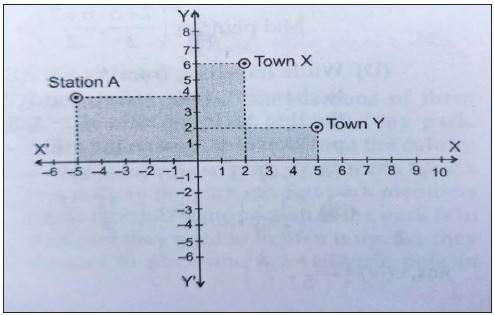
Question. What is the distance that Dalvin have to travel to reach his hometown X ?
(a) √51 units
(b) √53 units
(c) √35 units
(d) √47 units
Answer : B
Question. What is the distance that Alice has to travel to reach her hometown Y?
(a) 2√26 units
(b) √107 units
(c) 2√10 units
(d) √51 units
Answer : A
Question. Now, both of them plan to meet at a place between Town X and Town Y, such that it is a mid-point between both. Calculate the coordinates of the mid-point of X and Y.
(a) (1, 3)
(b) (2, - 4)
(c) (2.5,3)
(d) (3.5, 4)
Answer : D
Question. While travelling from A to Y, Alice had to change the train, at a station, it divides the line AY in the ratio of 2: 3, find the position of station on the grid.
(a) (0,79)
(b) ( − 115,245)
(c) (118,173)
(d) (12, 7)
Answer : B
Very Short Answer type Questions
Question. A (5,1), B (1,5) and C (-3, -1) are the vertices of 𝛥ABC. Find the length of median AD.
Answer : √37 units
Question. Find the point on the x-axis which is equidistant from the points (2, -5) and (-2, 9)
Answer : (-7, 0)
Question. Find the distance of the point P (2, 3) from the x-axis.
Answer : 3
Question. Find the perimeter of a triangle with vertices (0,4), (0,0) and (3,0).
Answer : 12
Question. In what ratio does the point P (2, -5) divide the line segment joining A (-3, 5) and B (4, -9).
Answer : k = 5/2 or k = 5 : 2
Question. In a seating arrangement of desks in a classroom, three students are seated at A (3, 1), B (6,4) and C (8, 6) respectively. Are they seated in line?
Answer : Yes
Question. If the point P (x, y) is equidistant from the points A (a + b, b - a) and B (a - b, a + b), then prove that 𝑏𝑥 = 𝑎𝑦.
Answer : bx = ay.
Question. If the mid-point of the line segment joining A ( 𝑥/2, 𝑦 + 1/2 ) and B ( 𝑥 + 1,𝑦 − 3) is C (5, -2), find x, y.
Answer : y = -1
Question. Find the ratio in which the line segment joining the points P (3, -6) and Q (5,3) is divided by the x -axis.
Answer : 2 : 1
Question. Find the perpendicular distance of A (5, 12) from the y -axis.
Answer : 5 units
Short Answer type Questions
Question. The vertices of quadrilateral ABCD are A (5, -1), B (8,3), C (4, 0) and D (1, -4). Prove that ABCD is a rhombus.
Answer : The sides of the quadrilateral AB = BC = CD = AD = 5 units & the
diagonals AC = √2 units and BD = 7√2 units
As the length of all the sides are equal and the length of the diagonals are not equal.
⇒ ABCD is a rhombus
Question. The base QR of an equilateral triangle PQR lies on x-axis. The co-ordinates of point Q are (-4, 0) and the origin is the mid-point of the base. Find the co-ordinates of the point P and R.
Answer : Coordinates of P are (0, 4√3 ) or (0, − 4√3 )
Question. Find the centre and radius of the circumcircle (i.e., circumcentre and circum-radius) of the triangle whose vertices are (-2, 3), (2, -1) and (4, 0).
Answer : Circumcentre of the 𝛥ABC is (3/2 , 5/2) and Circumradius of 𝛥ABC is 5√2/2
Question. The three vertices of a parallelogram ABCD are A (3, -4), B (-1, -3) and C (-6, 2). Find the coordinates of vertex D and find the area of ABCD.
Answer : 15 square units
Question. Find the coordinates of the points of trisection (i.e., Points dividing in three equal parts) of the line segment joining the points A (2, -2) and B (-7, 4).
Answer : The coordinates of the points of trisection of the line segment joining A and B are (-1, 0) and (-4, 2)
Question. An equilateral triangle has one vertex at (3, 4) and another at (-2, 3). Find the co-ordinates of the third vertex.
Answer : Third vertex has the coordinates (1+√3/2, 7 − 5√3/2) or (1 − √3/2, 7 + 5√3/2)
Question. Find the ratio in which the point P (x, 2) divides the line segment joining the points A (12, 5) and B (4, -3). Also find x.
Answer : Ratio is 3 :5 and x = 9
Question 1. Show that the points (a, a), (-a, - a) and (- √3a, √3a) are the vertices of an equilateral Δ
Answer: Let the given points be \( A(a, a) \), \( B(-a, -a) \), and \( C(-\sqrt{3}a, \sqrt{3}a) \). We can calculate the lengths of the sides of the triangle using the distance formula:
\[ d = \sqrt{(x_2 - x_1)^2 + (y_2 - y_1)^2} \]
First, let's find the length of side \( AB \):
\[ AB = \sqrt{(-a - a)^2 + (-a - a)^2} \]
\[ AB = \sqrt{(-2a)^2 + (-2a)^2} \]
\[ AB = \sqrt{4a^2 + 4a^2} = \sqrt{8a^2} = 2\sqrt{2}a \]
Next, let's find the length of side \( BC \):
\[ BC = \sqrt{(-\sqrt{3}a - (-a))^2 + (\sqrt{3}a - (-a))^2} \]
\[ BC = \sqrt{(a - \sqrt{3}a)^2 + (a + \sqrt{3}a)^2} \]
\[ BC = \sqrt{a^2(1 - 2\sqrt{3} + 3) + a^2(1 + 2\sqrt{3} + 3)} \]
\[ BC = \sqrt{a^2(4 - 2\sqrt{3} + 4 + 2\sqrt{3})} = \sqrt{8a^2} = 2\sqrt{2}a \]
Finally, let's find the length of side \( CA \):
\[ CA = \sqrt{(a - (-\sqrt{3}a))^2 + (a - \sqrt{3}a)^2} \]
\[ CA = \sqrt{(a + \sqrt{3}a)^2 + (a - \sqrt{3}a)^2} \]
\[ CA = \sqrt{a^2(1 + 2\sqrt{3} + 3) + a^2(1 - 2\sqrt{3} + 3)} \]
\[ CA = \sqrt{a^2(4 + 2\sqrt{3} + 4 - 2\sqrt{3})} = \sqrt{8a^2} = 2\sqrt{2}a \]
Since \( AB = BC = CA \), all three sides are equal in length.
\( \implies \) Therefore, the points are the vertices of an equilateral triangle.
In simple words: We find the distance between each pair of points using the distance formula. Since all three side lengths turn out to be exactly equal, the points form an equilateral triangle.
Exam Tip: Be careful while expanding terms with square roots, like \( (1 \pm \sqrt{3})^2 \), to avoid calculation errors.
Question 2. Show that four points (0,-1), (6, 7), (-2, 3) and (8, 3) are the vertices of a rectangle
Answer: Let the points be \( A(0, -1) \), \( B(6, 7) \), \( C(8, 3) \), and \( D(-2, 3) \). Let's calculate the lengths of the four sides using the distance formula:
\[ AB = \sqrt{(6-0)^2 + (7 - (-1))^2} = \sqrt{36 + 64} = \sqrt{100} = 10 \]
\[ BC = \sqrt{(8-6)^2 + (3-7)^2} = \sqrt{4 + 16} = \sqrt{20} = 2\sqrt{5} \]
\[ CD = \sqrt{(-2-8)^2 + (3-3)^2} = \sqrt{(-10)^2 + 0} = \sqrt{100} = 10 \]
\[ DA = \sqrt{(0 - (-2))^2 + (-1-3)^2} = \sqrt{4 + 16} = \sqrt{20} = 2\sqrt{5} \]
Since \( AB = CD = 10 \) and \( BC = DA = 2\sqrt{5} \), the opposite sides are equal.
Now, let's find the lengths of the diagonals \( AC \) and \( BD \):
\[ AC = \sqrt{(8-0)^2 + (3 - (-1))^2} = \sqrt{64 + 16} = \sqrt{80} = 4\sqrt{5} \]
\[ BD = \sqrt{(-2-6)^2 + (3-7)^2} = \sqrt{64 + 16} = \sqrt{80} = 4\sqrt{5} \]
Since the opposite sides are equal (\( AB = CD \) and \( BC = DA \)) and the diagonals are also equal (\( AC = BD \)), the quadrilateral \( ABCD \) is a rectangle.
In simple words: To prove a shape is a rectangle, we show that opposite sides are equal and that the two diagonal lines have the same length as well.
Exam Tip: Simply showing opposite sides are equal only proves a parallelogram. You must show the diagonals are equal to confirm it is a rectangle.
Question 3. Prove that the diagonals of a rectangle with vertices (0, 0), (a, 0), (a, b) and (0, b) bisect each each other and are equal.
Answer: Let the vertices of the rectangle be \( A(0, 0) \), \( B(a, 0) \), \( C(a, b) \), and \( D(0, b) \).
The diagonals are \( AC \) and \( BD \). Let's calculate their lengths:
\[ AC = \sqrt{(a - 0)^2 + (b - 0)^2} = \sqrt{a^2 + b^2} \]
\[ BD = \sqrt{(0 - a)^2 + (b - 0)^2} = \sqrt{(-a)^2 + b^2} = \sqrt{a^2 + b^2} \]
Since \( AC = BD \), the diagonals are equal.
Now, let's find the midpoints of the two diagonals using the midpoint formula \( \left(\frac{x_1+x_2}{2}, \frac{y_1+y_2}{2}\right) \):
\[ \text{Midpoint of } AC = \left( \frac{0 + a}{2}, \frac{0 + b}{2} \right) = \left( \frac{a}{2}, \frac{b}{2} \right) \]
\[ \text{Midpoint of } BD = \left( \frac{a + 0}{2}, \frac{0 + b}{2} \right) = \left( \frac{a}{2}, \frac{b}{2} \right) \]
Since the midpoint of both diagonals is the same point \( \left( \frac{a}{2}, \frac{b}{2} \right) \), the diagonals bisect each other.
In simple words: We find the lengths of the diagonals and see they are the same. Then, we find their midpoints and find that they cross at the exact same middle point.
Exam Tip: Using the midpoint formula is the easiest way to show that diagonals bisect each other.
Question 4. Prove that (4, -1), (6, 0), (7, 2) and (5, 1) are the vertices of a rhombus. Is it a square?
Answer: Let the points be \( A(4, -1) \), \( B(6, 0) \), \( C(7, 2) \), and \( D(5, 1) \). Let's calculate the lengths of the four sides:
\[ AB = \sqrt{(6 - 4)^2 + (0 - (-1))^2} = \sqrt{2^2 + 1^2} = \sqrt{5} \]
\[ BC = \sqrt{(7 - 6)^2 + (2 - 0)^2} = \sqrt{1^2 + 2^2} = \sqrt{5} \]
\[ CD = \sqrt{(5 - 7)^2 + (1 - 2)^2} = \sqrt{(-2)^2 + (-1)^2} = \sqrt{5} \]
\[ DA = \sqrt{(4 - 5)^2 + (-1 - 1)^2} = \sqrt{(-1)^2 + (-2)^2} = \sqrt{5} \]
Since all four sides are equal (\( AB = BC = CD = DA = \sqrt{5} \)), the quadrilateral is a rhombus.
To check if it is a square, let's find the lengths of the diagonals \( AC \) and \( BD \):
\[ AC = \sqrt{(7 - 4)^2 + (2 - (-1))^2} = \sqrt{3^2 + 3^2} = \sqrt{18} = 3\sqrt{2} \]
\[ BD = \sqrt{(5 - 6)^2 + (1 - 0)^2} = \sqrt{(-1)^2 + 1^2} = \sqrt{2} \]
Since the diagonals are not equal (\( AC \neq BD \)), it is not a square.
In simple words: All four sides are equal, which proves it is a rhombus. However, since the diagonals are not equal, it cannot be a square.
Exam Tip: A square is a special type of rhombus. To show a shape is a rhombus but not a square, prove all sides are equal but the diagonals are not.
Question 5. Show that the points A(3 , 5), B( 6 , 0) ,C( 1 ,-3) and D(-2 , 2) are the vertices of a square ABCD
Answer: Let's find the lengths of the sides \( AB \), \( BC \), \( CD \), and \( DA \):
\[ AB = \sqrt{(6 - 3)^2 + (0 - 5)^2} = \sqrt{3^2 + (-5)^2} = \sqrt{9 + 25} = \sqrt{34} \]
\[ BC = \sqrt{(1 - 6)^2 + (-3 - 0)^2} = \sqrt{(-5)^2 + (-3)^2} = \sqrt{25 + 9} = \sqrt{34} \]
\[ CD = \sqrt{(-2 - 1)^2 + (2 - (-3))^2} = \sqrt{(-3)^2 + 5^2} = \sqrt{9 + 25} = \sqrt{34} \]
\[ DA = \sqrt{(3 - (-2))^2 + (5 - 2)^2} = \sqrt{5^2 + 3^2} = \sqrt{25 + 9} = \sqrt{34} \]
Since \( AB = BC = CD = DA = \sqrt{34} \), all four sides are equal.
Now, let's calculate the lengths of the diagonals \( AC \) and \( BD \):
\[ AC = \sqrt{(1 - 3)^2 + (-3 - 5)^2} = \sqrt{(-2)^2 + (-8)^2} = \sqrt{4 + 64} = \sqrt{68} \]
\[ BD = \sqrt{(-2 - 6)^2 + (2 - 0)^2} = \sqrt{(-8)^2 + 2^2} = \sqrt{64 + 4} = \sqrt{68} \]
Since all sides are equal and both diagonals are equal (\( AC = BD = \sqrt{68} \)), the points are the vertices of a square.
In simple words: We calculate the length of all four sides and find they are all \( \sqrt{34} \). We also find both diagonal lengths are \( \sqrt{68} \). This proves it is a square.
Exam Tip: Proving both equal sides and equal diagonals is necessary to get full marks for showing a quadrilateral is a square.
Question 6. Show that the following points are the vertices of a right angled isosceles triangle: (1, 2), (1, 5) and (4, 2)
Answer: Let the vertices be \( A(1, 2) \), \( B(1, 5) \), and \( C(4, 2) \). Let's find the lengths of the sides:
\[ AB = \sqrt{(1 - 1)^2 + (5 - 2)^2} = \sqrt{0 + 9} = 3 \]
\[ BC = \sqrt{(4 - 1)^2 + (2 - 5)^2} = \sqrt{9 + 9} = \sqrt{18} = 3\sqrt{2} \]
\[ CA = \sqrt{(4 - 1)^2 + (2 - 2)^2} = \sqrt{9 + 0} = 3 \]
Since \( AB = CA = 3 \), two sides are equal, which means the triangle is isosceles.
Now let's check the right-angle property:
\[ AB^2 + CA^2 = 3^2 + 3^2 = 9 + 9 = 18 \]
\[ BC^2 = (3\sqrt{2})^2 = 18 \]
Since \( AB^2 + CA^2 = BC^2 \), the triangle satisfies Pythagoras' theorem.
\( \implies \) Thus, \( \triangle ABC \) is a right-angled isosceles triangle with the right angle at vertex \( A \).
In simple words: Two sides of the triangle are equal to 3, so it is isosceles. Since the squares of these two sides add up to the square of the third side, it is also right-angled.
Exam Tip: Clearly state that the converse of Pythagoras' theorem is being used to establish the right-angle property.
Question 7. Find a relation between x and y such that the point (x, y) is equidistant from the points (7, 1) and (3, 5) (x - y = 2)
Answer: Let the point be \( P(x, y) \), and the given points be \( A(7, 1) \) and \( B(3, 5) \).
Since \( P \) is equidistant from \( A \) and \( B \):
\[ PA = PB \]
Squaring both sides:
\[ PA^2 = PB^2 \]
Using the distance formula:
\[ (x - 7)^2 + (y - 1)^2 = (x - 3)^2 + (y - 5)^2 \]
Expanding the squares:
\[ x^2 - 14x + 49 + y^2 - 2y + 1 = x^2 - 6x + 9 + y^2 - 10y + 25 \]
Simplifying by canceling \( x^2 \) and \( y^2 \) on both sides:
\[ -14x - 2y + 50 = -6x - 10y + 34 \]
Bringing terms to one side:
\[ -14x + 6x - 2y + 10y = 34 - 50 \]
\[ -8x + 8y = -16 \]
Dividing the entire equation by \( -8 \):
\[ x - y = 2 \]
\( \implies \) This is the required relation.
In simple words: We set the distance from \( (x, y) \) to both points equal and square them. Simplifying the algebra gives the straight-line equation.
Exam Tip: Squaring both sides first eliminates the square root symbol, making the equation much easier to solve.
Question 8. If the distance of P(x, y) from the points A (3, 6) and B (-3, 4) are equal, prove that 3x + y = 5
Answer: Since \( P(x, y) \) is equidistant from \( A(3, 6) \) and \( B(-3, 4) \):
\[ PA = PB \]
\[ PA^2 = PB^2 \]
Using the coordinate distance formula:
\[ (x - 3)^2 + (y - 6)^2 = (x - (-3))^2 + (y - 4)^2 \]
\[ (x - 3)^2 + (y - 6)^2 = (x + 3)^2 + (y - 4)^2 \]
Expanding both sides:
\[ x^2 - 6x + 9 + y^2 - 12y + 36 = x^2 + 6x + 9 + y^2 - 8y + 16 \]
Cancel \( x^2 \), \( y^2 \), and \( 9 \) from both sides:
\[ -6x - 12y + 36 = 6x - 8y + 16 \]
Rearranging the terms:
\[ -6x - 6x - 12y + 8y = 16 - 36 \]
\[ -12x - 4y = -20 \]
Dividing by \( -4 \):
\[ 3x + y = 5 \]
Hence proved.
In simple words: Since the distance to both points is equal, setting their squared distances equal and simplifying gives the relation.
Exam Tip: Be careful with negative signs when setting up the distance for B, changing \( (x - (-3))^2 \) to \( (x + 3)^2 \).
Question 9. Find the values of x for which the distance between the points P (2, -3) and Q (x, 5) is 10 units (8 or -4)
Answer: We are given that the distance \( PQ = 10 \).
\[ PQ^2 = 100 \]
Using the distance formula:
\[ (x - 2)^2 + (5 - (-3))^2 = 100 \]
\[ (x - 2)^2 + (8)^2 = 100 \]
\[ (x - 2)^2 + 64 = 100 \]
\[ (x - 2)^2 = 36 \]
Taking the square root on both sides:
\[ x - 2 = \pm 6 \]
This gives two cases:
Case 1:
\[ x - 2 = 6 \implies x = 8 \]
Case 2:
\[ x - 2 = -6 \implies x = -4 \]
\( \implies \) Therefore, the values of \( x \) are \( 8 \) or \( -4 \).
In simple words: Use the distance formula to find \( x \) when the distance is 10. Taking the square root gives two possible values.
Exam Tip: Always remember that square rooting a number yields both positive and negative solutions, which leads to two valid answers.
Question 10. Given A (-2, 3) and AB = 10 units .If ordinate of B is 9, find abscissa of B (-10, 6)
Answer: Let the abscissa (x-coordinate) of \( B \) be \( x \). Since the ordinate (y-coordinate) of \( B \) is \( 9 \), the coordinates of \( B \) are \( (x, 9) \).
We are given \( AB = 10 \), which means:
\[ AB^2 = 100 \]
Using the distance formula:
\[ (x - (-2))^2 + (9 - 3)^2 = 100 \]
\[ (x + 2)^2 + (6)^2 = 100 \]
\[ (x + 2)^2 + 36 = 100 \]
\[ (x + 2)^2 = 64 \]
Taking the square root on both sides:
\[ x + 2 = \pm 8 \]
This gives two cases:
Case 1:
\[ x + 2 = 8 \implies x = 6 \]
Case 2:
\[ x + 2 = -8 \implies x = -10 \]
\( \implies \) Therefore, the abscissa of \( B \) is \( 6 \) or \( -10 \).
In simple words: Ordinate means the y-coordinate, and abscissa is the x-coordinate. Setting up the distance equation with y = 9 gives us two possible x-coordinates.
Exam Tip: Knowing the definitions of "abscissa" (\( x \)-coordinate) and "ordinate" (\( y \)-coordinate) is essential for solving such problems correctly.
Question 11. Find the coordinates of the point equidistant from three given points A (5, 1), B (-3, -7) and C (7, -1) (2,-4)
Answer: Let the required point be \( P(x, y) \). Since \( P \) is equidistant from \( A \), \( B \), and \( C \), we have \( PA^2 = PB^2 \) and \( PA^2 = PC^2 \).
First, let's use \( PA^2 = PB^2 \):
\[ (x - 5)^2 + (y - 1)^2 = (x + 3)^2 + (y + 7)^2 \]
\[ x^2 - 10x + 25 + y^2 - 2y + 1 = x^2 + 6x + 9 + y^2 + 14y + 49 \]
\[ -10x - 2y + 26 = 6x + 14y + 58 \]
\[ -16x - 16y = 32 \]
Dividing by \( -16 \):
\[ x + y = -2 \implies x = -y - 2 \quad \text{--- (Equation 1)} \]
Next, let's use \( PA^2 = PC^2 \):
\[ (x - 5)^2 + (y - 1)^2 = (x - 7)^2 + (y + 1)^2 \]
\[ x^2 - 10x + 25 + y^2 - 2y + 1 = x^2 - 14x + 49 + y^2 + 2y + 1 \]
\[ -10x - 2y + 26 = -14x + 2y + 50 \]
\[ 4x - 4y = 24 \]
Dividing by \( 4 \):
\[ x - y = 6 \quad \text{--- (Equation 2)} \]
Substitute Equation 1 into Equation 2:
\[ (-y - 2) - y = 6 \]
\[ -2y - 2 = 6 \]
\[ -2y = 8 \implies y = -4 \]
Now substitute \( y = -4 \) back into Equation 1:
\[ x = -(-4) - 2 = 2 \]
\( \implies \) The coordinates of the point are \( (2, -4) \).
In simple words: We find a point that is the same distance from all three points. This gives us two simple equations that we solve to find \( x = 2 \) and \( y = -4 \).
Exam Tip: This point is the circumcentre of the triangle. Solving the linear equations systematically will prevent calculation errors.
Question 12. If the point p(x, y) is equidistant from the points A (a + b, b - a) and B (a - b, a + b), prove that b x = a y
Answer: Since \( p(x, y) \) is equidistant from \( A \) and \( B \), we have \( pA^2 = pB^2 \).
\[ (x - (a + b))^2 + (y - (b - a))^2 = (x - (a - b))^2 + (y - (a + b))^2 \]
Expanding the terms:
\[ x^2 - 2x(a+b) + (a+b)^2 + y^2 - 2y(b-a) + (b-a)^2 = x^2 - 2x(a-b) + (a-b)^2 + y^2 - 2y(a+b) + (a+b)^2 \]
Subtracting \( x^2 \), \( y^2 \), and \( (a+b)^2 \) from both sides:
\[ -2x(a+b) - 2y(b-a) + (b-a)^2 = -2x(a-b) - 2y(a+b) + (a-b)^2 \]
Since \( (b-a)^2 = (a-b)^2 \), we can cancel these terms as well:
\[ -2x(a+b) - 2y(b-a) = -2x(a-b) - 2y(a+b) \]
Dividing the entire equation by \( -2 \):
\[ x(a+b) + y(b-a) = x(a-b) + y(a+b) \]
Expanding the brackets:
\[ ax + bx + by - ay = ax - bx + ay + by \]
Canceling \( ax \) and \( by \) from both sides:
\[ bx - ay = -bx + ay \]
\[ 2bx = 2ay \]
\[ bx = ay \]
Hence proved.
In simple words: By writing down the equal distance equation and canceling out similar terms, we easily arrive at the proof.
Exam Tip: Grouping terms and canceling \( (a+b)^2 \) and \( (a-b)^2 \) early avoids tedious and long algebraic expansions.
Question 13. Find the point on y- axis which is equidistant from the point (5, -2) and (-3, 2) (0, -2)
Answer: Any point on the y-axis has coordinates of the form \( P(0, y) \). Let the given points be \( A(5, -2) \) and \( B(-3, 2) \).
Since \( P \) is equidistant from \( A \) and \( B \):
\[ PA^2 = PB^2 \]
\[ (0 - 5)^2 + (y - (-2))^2 = (0 - (-3))^2 + (y - 2)^2 \]
\[ 25 + (y + 2)^2 = 9 + (y - 2)^2 \]
\[ 25 + y^2 + 4y + 4 = 9 + y^2 - 4y + 4 \]
Canceling \( y^2 \) and \( 4 \) from both sides:
\[ 25 + 4y = 9 - 4y \]
\[ 8y = 9 - 25 \]
\[ 8y = -16 \implies y = -2 \]
\( \implies \) Therefore, the point on the y-axis is \( (0, -2) \).
In simple words: A point on the y-axis has \( x = 0 \). Setting up the distance equation allows us to find the y-coordinate.
Exam Tip: Always set the x-coordinate of a point on the y-axis to 0 before starting your calculations.
Question 14. Find the point on x- axis which is equidistant from the points (2, -5) and (-2, 9) (-7, 0)
Answer: Any point on the x-axis has coordinates of the form \( P(x, 0) \). Let the given points be \( A(2, -5) \) and \( B(-2, 9) \).
Since \( P \) is equidistant from \( A \) and \( B \):
\[ PA^2 = PB^2 \]
\[ (x - 2)^2 + (0 - (-5))^2 = (x - (-2))^2 + (0 - 9)^2 \]
\[ (x - 2)^2 + 25 = (x + 2)^2 + 81 \]
\[ x^2 - 4x + 4 + 25 = x^2 + 4x + 4 + 81 \]
Canceling \( x^2 \) and \( 4 \) from both sides:
\[ -4x + 25 = 4x + 81 \]
\[ -8x = 56 \implies x = -7 \]
\( \implies \) Therefore, the point on the x-axis is \( (-7, 0) \).
In simple words: A point on the x-axis has \( y = 0 \). Setting the distance to both points equal gives us the coordinate \( x = -7 \).
Exam Tip: For any point on the x-axis, always set the y-coordinate to 0.
Question 15. If the points A (4, 3), and B(x, 5) are on the circle with the centre. O (2, 3), find the value of x (x=2)
Answer: Since points \( A \) and \( B \) lie on a circle with centre \( O \), their distances from \( O \) are equal to the radius of the circle:
\[ OA = OB \]
\[ OA^2 = OB^2 \]
Using the distance formula:
\[ (4 - 2)^2 + (3 - 3)^2 = (x - 2)^2 + (5 - 3)^2 \]
\[ (2)^2 + 0 = (x - 2)^2 + (2)^2 \]
\[ 4 = (x - 2)^2 + 4 \]
\[ (x - 2)^2 = 0 \implies x - 2 = 0 \implies x = 2 \]
\( \implies \) Therefore, the value of \( x \) is \( 2 \).
In simple words: The distance from any point on a circle to its center is the radius. Setting these distances equal helps us find the value of \( x \).
Exam Tip: Recognize that the radius of a circle is constant, so the distance from the center to any boundary point is always the same.
Question 16. The three consecutive vertices of a parallelogram are (-2, 1), (1, 0) and (4, 3). Find the Coordinates of the fourth vertex (1, 4)
Answer: Let the consecutive vertices of the parallelogram be \( A(-2, 1) \), \( B(1, 0) \), \( C(4, 3) \), and the fourth vertex be \( D(x, y) \).
In a parallelogram, the diagonals \( AC \) and \( BD \) bisect each other, meaning they share the same midpoint.
Using the midpoint formula:
\[ \text{Midpoint of } AC = \left( \frac{-2 + 4}{2}, \frac{1 + 3}{2} \right) = (1, 2) \]
\[ \text{Midpoint of } BD = \left( \frac{1 + x}{2}, \frac{0 + y}{2} \right) = \left( \frac{1 + x}{2}, \frac{y}{2} \right) \]
Equating the coordinates:
\[ \frac{1 + x}{2} = 1 \implies 1 + x = 2 \implies x = 1 \]
\[ \frac{y}{2} = 2 \implies y = 4 \]
\( \implies \) Therefore, the coordinates of the fourth vertex are \( (1, 4) \).
In simple words: The diagonals of a parallelogram meet at their exact midpoints. We find the middle of \( AC \) and use it to find the coordinates of the fourth point \( D \).
Exam Tip: Using the midpoint of diagonals property is much faster and less error-prone than using distance or slope formulas.
Question 17. If (1,2) (4, y), (x,6) and (3,5) are the vertices of a parallelogram taken in order , find the value of x and y (x =6, y = 3)
Answer: Let the vertices in order be \( A(1, 2) \), \( B(4, y) \), \( C(x, 6) \), and \( D(3, 5) \).
Since \( ABCD \) is a parallelogram, the midpoint of diagonal \( AC \) is equal to the midpoint of diagonal \( BD \).
\[ \text{Midpoint of } AC = \left( \frac{1 + x}{2}, \frac{2 + 6}{2} \right) = \left( \frac{1 + x}{2}, 4 \right) \]
\[ \text{Midpoint of } BD = \left( \frac{4 + 3}{2}, \frac{y + 5}{2} \right) = \left( \frac{7}{2}, \frac{y + 5}{2} \right) \]
Equating the coordinates:
For the x-coordinate:
\[ \frac{1 + x}{2} = \frac{7}{2} \implies 1 + x = 7 \implies x = 6 \]
For the y-coordinate:
\[ \frac{y + 5}{2} = 4 \implies y + 5 = 8 \implies y = 3 \]
\( \implies \) Thus, the values are \( x = 6 \) and \( y = 3 \).
In simple words: In any parallelogram, the diagonals cross at the exact same middle point. Equating their midpoints helps us solve for both unknowns.
Exam Tip: Always make sure to take the vertices "in order" so you form the correct diagonals (which are \( AC \) and \( BD \)).
Question 18. Find the value of k for which the points (7, -2), (5, 1), and (3, k) are collinear. (k = 4)
Answer: Let the given points be \( A(7, -2) \), \( B(5, 1) \), and \( C(3, k) \).
For three points to be collinear, the area of the triangle formed by them must be \( 0 \):
\[ \frac{1}{2} | x_1(y_2 - y_3) + x_2(y_3 - y_1) + x_3(y_1 - y_2) | = 0 \]
\[ | 7(1 - k) + 5(k - (-2)) + 3(-2 - 1) | = 0 \]
\[ 7 - 7k + 5(k + 2) + 3(-3) = 0 \]
\[ 7 - 7k + 5k + 10 - 9 = 0 \]
\[ -2k + 8 = 0 \]
\[ 2k = 8 \implies k = 4 \]
\( \implies \) Therefore, the value of \( k \) is \( 4 \).
In simple words: When three points lie on a single straight line, the area of the triangle they form is zero. Using this concept, we find \( k = 4 \).
Exam Tip: You can also solve this by showing that the slope of \( AB \) equals the slope of \( BC \), which is often quicker.
Question 19. Find the value of m, for which the points with co-ordinates (3, 5), (m, 6) and [1/2, 15/2] are collinear (m = 2)
Answer: Let the points be \( A(3, 5) \), \( B(m, 6) \), and \( C\left(\frac{1}{2}, \frac{15}{2}\right) \).
Since these points are collinear, the slope of line segment \( AB \) must equal the slope of line segment \( AC \).
\[ \text{Slope} = \frac{y_2 - y_1}{x_2 - x_1} \]
\[ \text{Slope of } AB = \frac{6 - 5}{m - 3} = \frac{1}{m - 3} \]
\[ \text{Slope of } AC = \frac{\frac{15}{2} - 5}{\frac{1}{2} - 3} = \frac{\frac{5}{2}}{-\frac{5}{2}} = -1 \]
Equating the two slopes:
\[ \frac{1}{m - 3} = -1 \]
\[ m - 3 = -1 \]
\[ m = 2 \]
\( \implies \) Therefore, the value of \( m \) is \( 2 \).
In simple words: If points are on the same line, the slope between any two pairs of points must be equal. This helps us find the value of \( m \).
Exam Tip: Equating slopes is a very clean method when dealing with fractional coordinates, as it keeps the equations simpler.
Question 20. Find a relation between x and y, if (x, y), (1, 3) and (8, 0) are collinear (3x +7y = 24)
Answer: Let the points be \( A(x, y) \), \( B(1, 3) \), and \( C(8, 0) \).
Since the points are collinear, the area of the triangle formed by them is \( 0 \):
\[ \frac{1}{2} | x(3 - 0) + 1(0 - y) + 8(y - 3) | = 0 \]
\[ | 3x - y + 8y - 24 | = 0 \]
\[ 3x + 7y - 24 = 0 \]
\[ 3x + 7y = 24 \]
\( \implies \) This is the required relation.
In simple words: Since the three points lie on a straight line, we set the area formula of the triangle to zero and simplify to get the equation of the line.
Exam Tip: Always make sure to write the final equation in its simplest standard form: \( Ax + By = C \).
Question 21. If the points (-2, 1), (a, b) and (4,-1) are collinear and a - b = 1, then find the values of a and b (a =1, b = 0)
Answer: Let the points be \( A(-2, 1) \), \( B(a, b) \), and \( C(4, -1) \).
For these points to be collinear, the area of the triangle must be \( 0 \):
\[ \frac{1}{2} | -2(b - (-1)) + a(-1 - 1) + 4(1 - b) | = 0 \]
\[ | -2(b + 1) - 2a + 4 - 4b | = 0 \]
\[ -2b - 2 - 2a + 4 - 4b = 0 \]
\[ -2a - 6b + 2 = 0 \]
Dividing by \( -2 \):
\[ a + 3b = 1 \quad \text{--- (Equation 1)} \]
We are also given:
\[ a - b = 1 \quad \text{--- (Equation 2)} \]
Subtracting Equation 2 from Equation 1:
\[ (a + 3b) - (a - b) = 1 - 1 \]
\[ 4b = 0 \implies b = 0 \]
Substitute \( b = 0 \) into Equation 2:
\[ a - 0 = 1 \implies a = 1 \]
\( \implies \) Therefore, the values are \( a = 1 \) and \( b = 0 \).
In simple words: The condition of collinearity gives us one linear equation. Solving this along with the given equation \( a - b = 1 \) gives the values of \( a \) and \( b \).
Exam Tip: Always verify your answers by substituting the values of \( a \) and \( b \) back into both equations to check if they hold true.
Question 22. Check whether the points (4, 5), (7, 6) and (6, 3) are collinear.
Answer: Let the points be \( A(4, 5) \), \( B(7, 6) \), and \( C(6, 3) \).
Let's calculate the area of the triangle formed by these three points:
\[ \text{Area} = \frac{1}{2} | x_1(y_2 - y_3) + x_2(y_3 - y_1) + x_3(y_1 - y_2) | \]
\[ \text{Area} = \frac{1}{2} | 4(6 - 3) + 7(3 - 5) + 6(5 - 6) | \]
\[ \text{Area} = \frac{1}{2} | 4(3) + 7(-2) + 6(-1) | \]
\[ \text{Area} = \frac{1}{2} | 12 - 14 - 6 | \]
\[ \text{Area} = \frac{1}{2} | -8 | = 4 \text{ sq units} \]
Since the area of the triangle is \( 4 \text{ sq units} \) (which is not equal to \( 0 \)), the three points do not lie on a straight line.
\( \implies \) Therefore, the points are not collinear.
In simple words: Since the area of the triangle formed by these points is not zero, they cannot lie on the same straight line.
Exam Tip: Clearly state that since the area is non-zero, the points are not collinear.
Question 23. Show that the point P ( - 4, 2 ) lies on the line segment joining the points A( -4, 6) and B( -4 ,-6)
Answer: Let's check the x-coordinates of the points:
The x-coordinate of \( A \) is \( -4 \).
The x-coordinate of \( B \) is \( -4 \).
Since both endpoints have the same x-coordinate, the line segment joining \( A \) and \( B \) lies entirely on the vertical line \( x = -4 \).
The point \( P(-4, 2) \) also has an x-coordinate of \( -4 \). Thus, it lies on the line \( x = -4 \).
To confirm it lies on the segment \( AB \), we check the y-coordinates:
The y-coordinate of \( P \) is \( 2 \), which lies in the range \( [-6, 6] \) defined by the y-coordinates of \( B \) and \( A \).
\( \implies \) Thus, the point \( P \) lies on the line segment joining \( A \) and \( B \).
In simple words: All three points have the exact same x-coordinate, meaning they are on a straight vertical line. Since the y-value of \( P \) is between the y-values of \( A \) and \( B \), it sits on the segment between them.
Exam Tip: This type of question can be solved quickly by observing that the x-coordinates are identical, which describes a vertical line segment.
Question 24. If P(x, y) is any point on the line joining the points A (a, 0), B (0, b), then show that \( \frac{x}{a} + \frac{y}{b} = 1 \)
Answer: Since \( P(x, y) \), \( A(a, 0) \), and \( B(0, b) \) lie on the same straight line, they are collinear. Thus, the area of the triangle formed by them must be \( 0 \):
\[ \frac{1}{2} | x(0 - b) + a(b - y) + 0(y - 0) | = 0 \]
\[ | -bx + ab - ay | = 0 \]
\[ -bx - ay + ab = 0 \]
\[ bx + ay = ab \]
Dividing both sides of the equation by \( ab \):
\[ \frac{bx}{ab} + \frac{ay}{ab} = \frac{ab}{ab} \]
\[ \frac{x}{a} + \frac{y}{b} = 1 \]
Hence proved.
In simple words: Setting the area of the triangle to zero gives us the equation \( bx + ay = ab \). Dividing every term by \( ab \) gives us the final equation.
Exam Tip: Remember to state that \( a \neq 0 \) and \( b \neq 0 \) to justify dividing the equation by \( ab \).
Question 25. If A (-5, 7), B (-4, -5), C (-1, -6) and D (4, 5) are the vertices of a quadrilateral, find the area of the quadrilateral ABCD.
Answer: We can find the area of the quadrilateral \( ABCD \) by dividing it into two triangles, \( \triangle ABC \) and \( \triangle ACD \), and summing their areas.
First, let's find the area of \( \triangle ABC \) with vertices \( A(-5, 7) \), \( B(-4, -5) \), and \( C(-1, -6) \):
\[ \text{Area}(\triangle ABC) = \frac{1}{2} | -5(-5 - (-6)) + (-4)(-6 - 7) + (-1)(7 - (-5)) | \]
\[ = \frac{1}{2} | -5(1) - 4(-13) - 1(12) | \]
\[ = \frac{1}{2} | -5 + 52 - 12 | = \frac{1}{2} | 35 | = 17.5 \text{ sq units} \]
Next, let's find the area of \( \triangle ACD \) with vertices \( A(-5, 7) \), \( C(-1, -6) \), and \( D(4, 5) \):
\[ \text{Area}(\triangle ACD) = \frac{1}{2} | -5(-6 - 5) + (-1)(5 - 7) + 4(7 - (-6)) | \]
\[ = \frac{1}{2} | -5(-11) - 1(-2) + 4(13) | \]
\[ = \frac{1}{2} | 55 + 2 + 52 | = \frac{1}{2} | 109 | = 54.5 \text{ sq units} \]
The total area of the quadrilateral \( ABCD \) is:
\[ \text{Area}(ABCD) = \text{Area}(\triangle ABC) + \text{Area}(\triangle ACD) \]
\[ \text{Area}(ABCD) = 17.5 + 54.5 = 72 \text{ sq units} \]
In simple words: We split the quadrilateral into two triangles. By calculating the area of both triangles and adding them together, we get the total area of 72.
Exam Tip: Always sketch a rough diagram to ensure you split the quadrilateral into two non-overlapping triangles properly.
Question 26. ABCDE is polygon whose vertices are A (-1, 0), B (4, 0), C (4, 4), D (0, 7) and E (-6, 2). Find the area of the polygon
Answer: We can divide the 5-sided polygon (pentagon) \( ABCDE \) into three triangles: \( \triangle ABC \), \( \triangle ACD \), and \( \triangle ADE \).
1. Let's find the area of \( \triangle ABC \) with vertices \( A(-1, 0) \), \( B(4, 0) \), and \( C(4, 4) \):
\[ \text{Area}(\triangle ABC) = \frac{1}{2} | -1(0 - 4) + 4(4 - 0) + 4(0 - 0) | \]
\[ = \frac{1}{2} | 4 + 16 + 0 | = 10 \text{ sq units} \]
2. Let's find the area of \( \triangle ACD \) with vertices \( A(-1, 0) \), \( C(4, 4) \), and \( D(0, 7) \):
\[ \text{Area}(\triangle ACD) = \frac{1}{2} | -1(4 - 7) + 4(7 - 0) + 0(0 - 4) | \]
\[ = \frac{1}{2} | 3 + 28 + 0 | = 15.5 \text{ sq units} \]
3. Let's find the area of \( \triangle ADE \) with vertices \( A(-1, 0) \), \( D(0, 7) \), and \( E(-6, 2) \):
\[ \text{Area}(\triangle ADE) = \frac{1}{2} | -1(7 - 2) + 0(2 - 0) + (-6)(0 - 7) | \]
\[ = \frac{1}{2} | -5 + 0 + 42 | = \frac{37}{2} = 18.5 \text{ sq units} \]
Adding the areas of all three triangles:
\[ \text{Total Area} = \text{Area}(\triangle ABC) + \text{Area}(\triangle ACD) + \text{Area}(\triangle ADE) \]
\[ \text{Total Area} = 10 + 15.5 + 18.5 = 44 \text{ sq units} \]
In simple words: Any polygon can be divided into simple triangles. We find the area of each triangle and sum them up to find the total area of the polygon, which is 44.
Exam Tip: Be methodical and list out the coordinates of each sub-triangle carefully to avoid mixing up the vertices.
Question 27. Using A (4, -6), B (3, -2) and C (5, 2), verify that a median of the ΔABC divides it into two triangles of equal areas
Answer: Let \( D \) be the midpoint of side \( BC \) of \( \triangle ABC \).
The coordinates of \( D \) are:
\[ D = \left( \frac{3 + 5}{2}, \frac{-2 + 2}{2} \right) = (4, 0) \]
The median is \( AD \), which divides \( \triangle ABC \) into two smaller triangles, \( \triangle ABD \) and \( \triangle ACD \).
Let's calculate the area of \( \triangle ABD \) with vertices \( A(4, -6) \), \( B(3, -2) \), and \( D(4, 0) \):
\[ \text{Area}(\triangle ABD) = \frac{1}{2} | 4(-2 - 0) + 3(0 - (-6)) + 4(-6 - (-2)) | \]
\[ = \frac{1}{2} | 4(-2) + 3(6) + 4(-4) | \]
\[ = \frac{1}{2} | -8 + 18 - 16 | = \frac{1}{2} | -6 | = 3 \text{ sq units} \]
Now let's find the area of \( \triangle ACD \) with vertices \( A(4, -6) \), \( C(5, 2) \), and \( D(4, 0) \):
\[ \text{Area}(\triangle ACD) = \frac{1}{2} | 4(2 - 0) + 5(0 - (-6)) + 4(-6 - 2) | \]
\[ = \frac{1}{2} | 4(2) + 5(6) + 4(-8) | \]
\[ = \frac{1}{2} | 8 + 30 - 32 | = \frac{1}{2} | 6 | = 3 \text{ sq units} \]
Since \( \text{Area}(\triangle ABD) = \text{Area}(\triangle ACD) = 3 \text{ sq units} \), the median \( AD \) indeed divides \( \triangle ABC \) into two triangles of equal areas.
In simple words: The median starts from a vertex and meets the midpoint of the opposite side. Calculating the area of both resulting triangles gives 3, which proves they are equal.
Exam Tip: Remember that area calculations can result in negative numbers mathematically, but since area is physical, you must always take the absolute (positive) value.
Question 28. The coordinates of A, B, C are (3, 4), (5, 2), (x, y) respectively. If area of ∆ABC = 3, show that x + y = 10
Answer: The area of \( \triangle ABC \) is given as \( 3 \). Using the triangle area formula:
\[ \text{Area} = \frac{1}{2} | x_1(y_2 - y_3) + x_2(y_3 - y_1) + x_3(y_1 - y_2) | \]
Substitute the given coordinates \( A(3, 4) \), \( B(5, 2) \), and \( C(x, y) \):
\[ 3 = \frac{1}{2} | 3(2 - y) + 5(y - 4) + x(4 - 2) | \]
\[ 6 = | 6 - 3y + 5y - 20 + 2x | \]
\[ 6 = | 2x + 2y - 14 | \]
Dividing by \( 2 \) inside the absolute value:
\[ 3 = | x + y - 7 | \]
This absolute equation leads to two possible cases:
Case 1:
\[ x + y - 7 = 3 \implies x + y = 10 \]
Case 2:
\[ x + y - 7 = -3 \implies x + y = 4 \]
Using the positive branch (Case 1), we get \( x + y = 10 \).
Hence proved.
In simple words: Substituting the coordinates into the area formula gives a basic absolute value equation. Solving the positive case directly gives \( x + y = 10 \).
Exam Tip: Always show both cases that result from the absolute value brackets, then focus on the specific branch requested by the question.
Question 29. The coordinates of the vertices of ΔABC are A (4, 1), B (-3, 2) and C (0, k).Given that the area of ΔABC is 12 unit2, Find the Value of k (k = - 13/ 7)
Answer: The area of \( \triangle ABC \) is \( 12 \text{ sq units} \).
Using the area formula:
\[ \text{Area} = \frac{1}{2} | x_1(y_2 - y_3) + x_2(y_3 - y_1) + x_3(y_1 - y_2) | \]
\[ 12 = \frac{1}{2} | 4(2 - k) + (-3)(k - 1) + 0(1 - 2) | \]
\[ 24 = | 8 - 4k - 3k + 3 | \]
\[ 24 = | 11 - 7k | \]
This gives two cases:
Case 1:
\[ 11 - 7k = 24 \]
\[ -7k = 13 \implies k = -\frac{13}{7} \]
Case 2:
\[ 11 - 7k = -24 \]
\[ -7k = -35 \implies k = 5 \]
\( \implies \) Therefore, the possible values of \( k \) are \( -\frac{13}{7} \) or \( 5 \).
In simple words: Plug the coordinates into the area formula and set it equal to 12. Solving the absolute value equation gives two possible answers.
Exam Tip: Be sure to write down both solutions from the positive and negative cases of the absolute value, even if only one is highlighted in your worksheet key.
Question 30. The points A(2,9), B(a,5) , C(5,5) are the vertices of a triangle ABC right angled at B . Find the valueof a and hence the area of ∆ABC (a =2, area = 6sq units)
Answer: Since the triangle is right-angled at \( B \), by Pythagoras' theorem we have:
\[ AC^2 = AB^2 + BC^2 \]
Let's compute the squared lengths of the sides:
\[ AC^2 = (5 - 2)^2 + (5 - 9)^2 = 3^2 + (-4)^2 = 9 + 16 = 25 \]
\[ AB^2 = (a - 2)^2 + (5 - 9)^2 = (a - 2)^2 + 16 \]
\[ BC^2 = (5 - a)^2 + (5 - 5)^2 = (5 - a)^2 \]
Substitute these into the Pythagoras relation:
\[ 25 = (a - 2)^2 + 16 + (5 - a)^2 \]
\[ 9 = (a^2 - 4a + 4) + (25 - 10a + a^2) \]
\[ 9 = 2a^2 - 14a + 29 \]
\[ 2a^2 - 14a + 20 = 0 \]
Dividing by \( 2 \):
\[ a^2 - 7a + 10 = 0 \]
\[ (a - 2)(a - 5) = 0 \implies a = 2 \text{ or } a = 5 \]
If \( a = 5 \), vertex \( B(5, 5) \) becomes identical to vertex \( C(5, 5) \), which is impossible for a triangle.
Thus, \( a = 2 \).
With \( a = 2 \), the vertices are \( A(2, 9) \), \( B(2, 5) \), and \( C(5, 5) \).
The base and height are:
\[ BC = \sqrt{(5 - 2)^2 + (5 - 5)^2} = 3 \]
\[ AB = \sqrt{(2 - 2)^2 + (5 - 9)^2} = 4 \]
Now, calculate the area of the right-angled triangle:
\[ \text{Area} = \frac{1}{2} \times \text{base} \times \text{height} = \frac{1}{2} \times 3 \times 4 = 6 \text{ sq units} \]
\( \implies \) Thus, \( a = 2 \) and the area is \( 6 \text{ sq units} \).
In simple words: We apply Pythagoras' theorem to find \( a \). We ignore the value 5 because it would overlap two vertices, then calculate the area using the formula.
Exam Tip: Remember to check if any solved value of a variable makes two vertices identical, as that value must be discarded.
Question 31. If point P (1/2, y) lies on the line segment joining two points A (3, -2) and B (-7, 9), then find the ratio in which P divides AB. Also find the value of y
Answer: Let the point \( P\left(\frac{1}{2}, y\right) \) divide the line segment \( AB \) internally in the ratio \( k : 1 \).
Using the section formula, the x-coordinate of \( P \) is:
\[ x = \frac{m_1 x_2 + m_2 x_1}{m_1 + m_2} \]
\[ \frac{1}{2} = \frac{k(-7) + 1(3)}{k + 1} \]
\[ \frac{1}{2} = \frac{-7k + 3}{k + 1} \]
Cross-multiplying:
\[ k + 1 = 2(-7k + 3) \]
\[ k + 1 = -14k + 6 \]
\[ 15k = 5 \implies k = \frac{5}{15} = \frac{1}{3} \]
So, \( P \) divides the segment \( AB \) in the ratio \( 1 : 3 \).
Now, let's find the y-coordinate of \( P \) using \( k = \frac{1}{3} \):
\[ y = \frac{k(9) + 1(-2)}{k + 1} \]
\[ y = \frac{\frac{1}{3}(9) - 2}{\frac{1}{3} + 1} = \frac{3 - 2}{\frac{4}{3}} = \frac{1}{\frac{4}{3}} = \frac{3}{4} \]
\( \implies \) Thus, the ratio is \( 1 : 3 \) and \( y = \frac{3}{4} \).
In simple words: We use the x-coordinate to find the division ratio of \( 1:3 \). Once we have the ratio, we plug it in to find the y-value, which is \( \frac{3}{4} \).
Exam Tip: Using the ratio \( k:1 \) simplifies section formula calculations compared to using \( m_1:m_2 \).
Question 32. Find the ratio in which the point (2, y) divides the line segment joining the points A (-2, 2) and B (3, 7) (4: 1)
Answer: Let the ratio in which the point \( P(2, y) \) divides the segment \( AB \) be \( k : 1 \).
Using the section formula for the x-coordinate:
\[ 2 = \frac{k(3) + 1(-2)}{k + 1} \]
\[ 2 = \frac{3k - 2}{k + 1} \]
Cross-multiplying:
\[ 2(k + 1) = 3k - 2 \]
\[ 2k + 2 = 3k - 2 \]
\[ k = 4 \]
So, the ratio is \( 4 : 1 \).
Let's also find the value of \( y \):
\[ y = \frac{k(7) + 1(2)}{k + 1} \]
Substitute \( k = 4 \):
\[ y = \frac{4(7) + 2}{4 + 1} = \frac{30}{5} = 6 \]
\( \implies \) Therefore, the ratio is \( 4 : 1 \) and \( y = 6 \).
In simple words: Equating the x-coordinate from the section formula to 2 lets us solve for the ratio, which is \( 4:1 \). Using this, we find \( y = 6 \).
Exam Tip: Always write the final ratio in its simplest form, such as \( 4:1 \), instead of keeping it fractional.
Question 33. Find the ratio in which the line 2x + y – 5 = 0 divides the line segment joining A (2,-3) and B (3, 9) (2:5)
Answer: Let the line \( 2x + y - 5 = 0 \) divide the line segment joining \( A(2, -3) \) and \( B(3, 9) \) in the ratio \( k : 1 \).
The coordinates of the dividing point \( P \) are:
\[ P\left( \frac{3k + 2}{k + 1}, \frac{9k - 3}{k + 1} \right) \]
Since this point \( P \) lies on the line \( 2x + y - 5 = 0 \), its coordinates must satisfy the line equation:
\[ 2\left(\frac{3k + 2}{k + 1}\right) + \frac{9k - 3}{k + 1} - 5 = 0 \]
Multiplying the entire equation by \( k + 1 \):
\[ 2(3k + 2) + (9k - 3) - 5(k + 1) = 0 \]
\[ 6k + 4 + 9k - 3 - 5k - 5 = 0 \]
\[ 10k - 4 = 0 \]
\[ 10k = 4 \implies k = \frac{4}{10} = \frac{2}{5} \]
\( \implies \) Therefore, the line divides the segment in the ratio of \( 2 : 5 \).
In simple words: Find the point of division using the section formula and substitute it into the line's equation to solve for the ratio \( 2:5 \).
Exam Tip: Clearing the denominator \( k + 1 \) by multiplying the whole equation is the fastest way to solve line-division problems.
Question 34. Determine the ratio in which the line 3x + 4y – 9 = 0 divides the line segment joining the points (1, 3) and (2, 7) (k = - 6/25)
Answer: Let the ratio in which the line divides the segment joining \( (1, 3) \) and \( (2, 7) \) be \( k : 1 \).
The coordinates of the division point are:
\[ P\left( \frac{2k + 1}{k + 1}, \frac{7k + 3}{k + 1} \right) \]
Since this point lies on the line \( 3x + 4y - 9 = 0 \):
\[ 3\left(\frac{2k + 1}{k + 1}\right) + 4\left(\frac{7k + 3}{k + 1}\right) - 9 = 0 \]
Multiplying by \( k + 1 \):
\[ 3(2k + 1) + 4(7k + 3) - 9(k + 1) = 0 \]
\[ 6k + 3 + 28k + 12 - 9k - 9 = 0 \]
\[ 25k + 6 = 0 \]
\[ 25k = -6 \implies k = -\frac{6}{25} \]
Since the value of \( k \) is negative, the line divides the segment externally in the ratio \( 6 : 25 \).
In simple words: We find the division ratio, which comes out as \( -6/25 \). The minus sign tells us that the division is external.
Exam Tip: A negative ratio represents external division. Make sure to specify this in your final written answer.
Question 35. Find the ratio in which the line segment joining the points (1, -3) and (4, 5) is divided by x - axis
Answer: Let the x-axis divide the segment joining \( A(1, -3) \) and \( B(4, 5) \) in the ratio \( k : 1 \).
Any point on the x-axis has a y-coordinate of \( 0 \), i.e., \( P(x, 0) \).
Using the section formula for the y-coordinate:
\[ 0 = \frac{k(5) + 1(-3)}{k + 1} \]
\[ 0 = \frac{5k - 3}{k + 1} \]
\[ 5k - 3 = 0 \]
\[ 5k = 3 \implies k = \frac{3}{5} \]
\( \implies \) Therefore, the ratio in which the line segment is divided by the x-axis is \( 3 : 5 \).
In simple words: Because any point on the x-axis has a y-value of 0, we set the y-part of our section formula to 0 and solve for the ratio.
Exam Tip: Remember: division by the x-axis means \( y = 0 \), and division by the y-axis means \( x = 0 \).
Question 36. If P divides the join of A (-2, -2) and B (2, -4) such that AP/AB = 3/7, find the coordinates of P (-2/7, -20/7)
Answer: We are given:
\[ \frac{AP}{AB} = \frac{3}{7} \]
Since \( AB = AP + PB \):
\[ \frac{AP}{AP + PB} = \frac{3}{7} \]
\[ 7AP = 3AP + 3PB \]
\[ 4AP = 3PB \implies \frac{AP}{PB} = \frac{3}{4} \]
So, \( P \) divides the segment \( AB \) internally in the ratio \( 3 : 4 \).
Using the section formula:
\[ x = \frac{3(2) + 4(-2)}{3 + 4} = \frac{6 - 8}{7} = -\frac{2}{7} \]
\[ y = \frac{3(-4) + 4(-2)}{3 + 4} = \frac{-12 - 8}{7} = -\frac{20}{7} \]
\( \implies \) Therefore, the coordinates of \( P \) are \( \left(-\frac{2}{7}, -\frac{20}{7}\right) \).
In simple words: First, find the actual division ratio of the segments, which is \( 3:4 \). Then, apply the section formula to calculate the coordinates.
Exam Tip: Do not directly use \( 3 \) and \( 7 \) in the section formula. Always convert the part-to-whole ratio \( AP/AB \) to the part-to-part ratio \( AP/PB \) first.
Question 37. Find the coordinates of the points which divide the line segment joining A (2, -3) and B (-4, -6) into three equal parts
Answer: Let \( P \) and \( Q \) be the points of trisection of the line segment \( AB \).
\( P \) divides \( AB \) in the ratio \( 1 : 2 \).
Using the section formula for \( P(x_1, y_1) \):
\[ x_1 = \frac{1(-4) + 2(2)}{1 + 2} = \frac{-4 + 4}{3} = 0 \]
\[ y_1 = \frac{1(-6) + 2(-3)}{1 + 2} = \frac{-6 - 6}{3} = \frac{-12}{3} = -4 \]
So, the coordinates of \( P \) are \( (0, -4) \).
Now, \( Q \) is the midpoint of \( PB \), where \( P \) is \( (0, -4) \) and \( B \) is \( (-4, -6) \).
Using the midpoint formula for \( Q(x_2, y_2) \):
\[ x_2 = \frac{0 + (-4)}{2} = -2 \]
\[ y_2 = \frac{-4 + (-6)}{2} = -5 \]
So, the coordinates of \( Q \) are \( (-2, -5) \).
\( \implies \) Therefore, the coordinates of the trisection points are \( (0, -4) \) and \( (-2, -5) \).
In simple words: To split the segment into three equal pieces, we need two points. One divides the line in a \( 1:2 \) ratio, and the other is the midpoint of the remaining segment.
Exam Tip: Once you find the first point \( P \), using the midpoint formula to find the second point \( Q \) is faster and prevents calculation mistakes.
Question 38. Find the length of medians of triangle whose vertices are A (-1, 3), B (1, -1), and C (5, 1)
Answer: Let \( D \), \( E \), and \( F \) be the midpoints of the sides \( BC \), \( CA \), and \( AB \) respectively.
1. Let's find midpoint \( D \) of side \( BC \):
\[ D = \left(\frac{1 + 5}{2}, \frac{-1 + 1}{2}\right) = (3, 0) \]
The length of median \( AD \):
\[ AD = \sqrt{(3 - (-1))^2 + (0 - 3)^2} = \sqrt{4^2 + (-3)^2} = \sqrt{16 + 9} = 5 \]
2. Let's find midpoint \( E \) of side \( CA \):
\[ E = \left(\frac{5 + (-1)}{2}, \frac{1 + 3}{2}\right) = (2, 2) \]
The length of median \( BE \):
\[ BE = \sqrt{(2 - 1)^2 + (2 - (-1))^2} = \sqrt{1^2 + 3^2} = \sqrt{1 + 9} = \sqrt{10} \]
3. Let's find midpoint \( F \) of side \( AB \):
\[ F = \left(\frac{-1 + 1}{2}, \frac{3 + (-1)}{2}\right) = (0, 1) \]
The length of median \( CF \):
\[ CF = \sqrt{(0 - 5)^2 + (1 - 1)^2} = \sqrt{(-5)^2 + 0} = 5 \]
\( \implies \) Therefore, the lengths of the medians are \( 5 \), \( \sqrt{10} \), and \( 5 \).
In simple words: A median links a corner of a triangle to the middle of the opposite side. We calculate the midpoints first, then find the lengths using the distance formula.
Exam Tip: Write down each median calculation as a separate step to keep your work organized and easy to read.
Question 39. If the midpoint of of the segment joining A (a, b +1), and B (a +1, b +2) is C (3/2, 5/2) Find a and b (a=1, b=1)
Answer: The midpoint of the segment joining \( A(a, b + 1) \) and \( B(a + 1, b + 2) \) is calculated as:
\[ \text{Midpoint} = \left( \frac{a + (a + 1)}{2}, \frac{(b + 1) + (b + 2)}{2} \right) = \left( \frac{2a + 1}{2}, \frac{2b + 3}{2} \right) \]
We are given that this midpoint is \( C\left(\frac{3}{2}, \frac{5}{2}\right) \).
Equating the corresponding coordinates:
For the x-coordinate:
\[ \frac{2a + 1}{2} = \frac{3}{2} \implies 2a + 1 = 3 \implies 2a = 2 \implies a = 1 \]
For the y-coordinate:
\[ \frac{2b + 3}{2} = \frac{5}{2} \implies 2b + 3 = 5 \implies 2b = 2 \implies b = 1 \]
\( \implies \) Thus, the values are \( a = 1 \) and \( b = 1 \).
In simple words: Find the midpoint coordinates and set them equal to the given values. Solving these simple equations gives \( a = 1 \) and \( b = 1 \).
Exam Tip: Set up and solve the x and y coordinate equations separately to keep things simple.
Question 40. The coordinates of one end point of a diameter of a circle are (4, -1) and the coordinates of the centre of the circle are (1, -3) Find the coordinates of the other end of the diameter (-2, -5)
Answer: Let the given endpoint of the diameter be \( A(4, -1) \), and the centre of the circle be \( C(1, -3) \). Let the coordinates of the other endpoint be \( B(x, y) \).
Since the centre of a circle is the midpoint of its diameter:
\[ \text{Midpoint of } AB = C \]
Using the midpoint formula:
\[ \left( \frac{4 + x}{2}, \frac{-1 + y}{2} \right) = (1, -3) \]
Equating the coordinates:
For the x-coordinate:
\[ \frac{4 + x}{2} = 1 \implies 4 + x = 2 \implies x = -2 \]
For the y-coordinate:
\[ \frac{-1 + y}{2} = -3 \implies -1 + y = -6 \implies y = -5 \]
\( \implies \) Therefore, the coordinates of the other endpoint of the diameter are \( (-2, -5) \).
In simple words: The center is always in the exact middle of the diameter. We can use the midpoint formula to work backwards and find the missing endpoint.
Exam Tip: Be careful not to use the distance formula here. The midpoint formula is the correct and fastest way to solve this.
Question 41. The centre of a circle is (2a – 1, 7) and it passes through the point (-3, -1). If the diameter of the circle is 20 units, then find the value of a (-4, 2)
Answer: We are given that the diameter of the circle is \( 20 \text{ units} \).
The radius \( r \) is half of the diameter:
\[ r = \frac{20}{2} = 10 \text{ units} \]
The distance between the centre \( C(2a - 1, 7) \) and the point \( P(-3, -1) \) on the circle is equal to the radius:
\[ CP = 10 \implies CP^2 = 100 \]
Using the distance formula:
\[ (-3 - (2a - 1))^2 + (-1 - 7)^2 = 100 \]
\[ (-3 - 2a + 1)^2 + (-8)^2 = 100 \]
\[ (-2a - 2)^2 + 64 = 100 \]
\[ (-(2a + 2))^2 = 36 \]
\[ (2a + 2)^2 = 36 \]
Taking the square root on both sides:
\[ 2a + 2 = \pm 6 \]
This gives two cases:
Case 1:
\[ 2a + 2 = 6 \implies 2a = 4 \implies a = 2 \]
Case 2:
\[ 2a + 2 = -6 \implies 2a = -8 \implies a = -4 \]
\( \implies \) Therefore, the values of \( a \) are \( 2 \) or \( -4 \).
In simple words: The radius is 10. The distance from the center to a point on the circle is the radius. Solving the squared distance equation gives us the two possible values of \( a \).
Exam Tip: Always convert diameter to radius first, since the distance from the centre to any point on the boundary is the radius.
Question 42. Determine the value of a if AB = BC, where A, B, C are the points (-5, 1), (0, 5) and (a, 1) respectively (±5)
Answer: We are given \( AB = BC \).
Squaring both sides:
\[ AB^2 = BC^2 \]
Using the distance formula:
\[ (0 - (-5))^2 + (5 - 1)^2 = (a - 0)^2 + (1 - 5)^2 \]
\[ (5)^2 + (4)^2 = a^2 + (-4)^2 \]
\[ 25 + 16 = a^2 + 16 \]
Subtracting \( 16 \) from both sides:
\[ a^2 = 25 \]
Taking the square root:
\[ a = \pm 5 \]
\( \implies \) Thus, the value of \( a \) is \( \pm 5 \).
In simple words: Setting the squared distances equal simplifies the equation to \( a^2 = 25 \), which gives both \( 5 \) and \( -5 \) as answers.
Exam Tip: Do not forget the \( \pm \) sign when taking the square root, as both \( 5 \) and \( -5 \) are correct coordinates.
Question 43. A (5, -1), B (-1, 8) and C (-3, -2) are the vertices of triangle ABC. E and F are the midpoints of the sides AB and AC Respectively. Show that EF = ½ BC
Answer: Let's first find the coordinates of the midpoints \( E \) and \( F \).
\( E \) is the midpoint of \( AB \):
\[ E = \left( \frac{5 + (-1)}{2}, \frac{-1 + 8}{2} \right) = \left( 2, \frac{7}{2} \right) \]
\( F \) is the midpoint of \( AC \):
\[ F = \left( \frac{5 + (-3)}{2}, \frac{-1 + (-2)}{2} \right) = \left( 1, -\frac{3}{2} \right) \]
Now, let's find the length of \( EF \):
\[ EF = \sqrt{(1 - 2)^2 + \left(-\frac{3}{2} - \frac{7}{2}\right)^2} \]
\[ EF = \sqrt{(-1)^2 + \left(-\frac{10}{2}\right)^2} \]
\[ EF = \sqrt{1 + (-5)^2} = \sqrt{1 + 25} = \sqrt{26} \]
Next, let's find the length of side \( BC \):
\[ BC = \sqrt{(-3 - (-1))^2 + (-2 - 8)^2} \]
\[ BC = \sqrt{(-2)^2 + (-10)^2} = \sqrt{4 + 100} = \sqrt{104} \]
We can simplify \( \sqrt{104} \):
\[ BC = \sqrt{4 \times 26} = 2\sqrt{26} \]
Comparing the two lengths:
\[ EF = \sqrt{26} = \frac{1}{2} (2\sqrt{26}) = \frac{1}{2} BC \]
Hence proved.
In simple words: Find the coordinates of midpoints \( E \) and \( F \). The length of segment \( EF \) is \( \sqrt{26} \) and \( BC \) is \( 2\sqrt{26} \), which shows \( EF \) is exactly half of \( BC \).
Exam Tip: This is the coordinate geometry proof of the Midpoint Theorem. Be careful when working with fractional coordinates like \( \frac{7}{2} \).
Question 44. The area of the∆ formed by the points A( a, 0), O(0 ,0) and B( 0, b) is
(a) ab
(b) ½ ab
(c) ½ a2 b2
(d) ½ b2
Answer: (b) ½ ab
In simple words: The triangle sits on the axes with its base along the x-axis of length \( a \) and height along the y-axis of length \( b \). Its area is half of base times height.
Exam Tip: For any right-angled triangle with vertices at the origin and on both axes, the area is simply \( \frac{1}{2} |ab| \).
Question 45. The line segment joining the points A(-2, -3) and B( 2, -1) is divided by the y axis in the ratio
(a) 1 : 2
(b) 2 : 1
(c) 1 : 1
(d) 1 : 3
Answer: (c) 1 : 1
In simple words: On the y-axis, the x-coordinate is 0. Using this in our section formula shows that the line is cut exactly in half, which is a \( 1:1 \) ratio.
Exam Tip: The ratio in which the y-axis divides a segment is given by \( -x_1 : x_2 \). Here, \( -(-2) : 2 = 2 : 2 = 1 : 1 \).
Question 46. If P (a/2, 4) is the midpoint of the line segment joining the points A( -6, 5 ) and B( -2, 3), then the value of a
(a) – 8
(b) 3
(c) – 4
(d) 4
Answer: (a) – 8
In simple words: Find the middle of the x-values of \( A \) and \( B \), which is \( -4 \). Setting \( a/2 = -4 \) tells us that \( a \) must be \( -8 \).
Exam Tip: Find the midpoint of the coordinates first, and then equate it to the variable expression to solve.
Question 47. If A and B are the points ( - 6 , 7) and ( - 1, - 5) , then the distance 2AB is equal to
(a) 13
(b) 26
(c) 169
(d) 238
Answer: (b) 26
In simple words: We find the distance \( AB \), which is 13. Since the question asks for double that distance, we multiply 13 by 2 to get 26.
Exam Tip: Make sure to read the question carefully. It asks for \( 2AB \), not just the distance \( AB \).
Question 48. The midpoint of segment AB is the point P(0,4) . If the coordinates of B are (-2, 3) then the coordinates of A are
(a) (2, 5)
(b) (-2, -5)
(c) (2 , 9)
(d) ( -2 , 11)
Answer: (a) (2, 5)
In simple words: By using the midpoint formula backwards with the known midpoint \( P \) and point \( B \), we calculate the other end to be \( (2, 5) \).
Exam Tip: If the midpoint is \( P \) and one point is \( B \), then \( A = 2P - B \). This is a helpful shortcut for coordinate calculations.
Question 49. If A( 1, 3) , B( - 1, 2) ,C(2 , 5) and D( x, 4) are the vertices of a parallelogram ABCD, then the value of x is
(a) 3
(b) 4
(c) 0
(d) 3/2
Answer: (b) 4
In simple words: Since the diagonals of a parallelogram bisect each other, the midpoints must align. Equating the x-coordinates of both midpoints gives us \( x = 4 \).
Exam Tip: Equating the midpoints of diagonals is the standard way to find a missing coordinate in parallelogram questions.
Free study material for Mathematics
Chapter 07 Coordinate Geometry Printable Worksheets and Exercises for Class 10 Mathematics
Practice Exercises for Class 10 Mathematics Chapter 07 Coordinate Geometry
Explore reliable practice questions for Chapter 07 Coordinate Geometry tailored for Class 10 Mathematics learners. Use these structured worksheets to evaluate exam preparedness and strengthen problem-solving skills throughout the 2026 academic session.
Step-by-Step Solutions and Practice Guidelines
Designed around the official curriculum for Class 10 Mathematics, these practice sheets guarantee standard compliance. Reviewing step-by-step solutions after completion sharpens your accuracy and clarifies complex sub-topics within Chapter 07 Coordinate Geometry.
Enhance Speed with Online Practice
Consistent engagement with these exercises builds familiarity with recurring exam themes. If specific areas within Chapter 07 Coordinate Geometry cause trouble, utilize our dedicated NCERT solutions for Class 10 Mathematics to clear up doubts immediately.
FAQs
You can download the latest chapter-wise printable worksheets for Class 10 Mathematics Chapter 07 Coordinate Geometry for free from StudiesToday.com. These have been made as per the latest CBSE curriculum for this academic year.
Yes, Class 10 Mathematics worksheets for Chapter 07 Coordinate Geometry focus on activity-based learning and also competency-style questions. This helps students to apply theoretical knowledge to practical scenarios.
Yes, we have provided solved worksheets for Class 10 Mathematics Chapter 07 Coordinate Geometry to help students verify their answers instantly.
Yes, our Class 10 Mathematics test sheets are mobile-friendly PDFs and can be printed by teachers for classroom.
For Chapter 07 Coordinate Geometry, regular practice with our worksheets will improve question-handling speed and help students understand all technical terms and diagrams.