

Download Class 10 Mathematics Practice Worksheets
Explore structured practice materials through the CBSE Class 10 Mathematics Polynomials Worksheet Set 04. Tailored for Class 10 learners, utilizing these Mathematics worksheets ensures thorough preparation and strengthens problem-solving accuracy before final school evaluations.
Access Chapter 02 Polynomials Practice Papers and Solutions
View or download the dedicated CBSE Class 10 Mathematics Polynomials Worksheet Set 04 resource below. Engaging with these practice papers under focused study conditions ensures continuous academic progress and mastery of the 2026-27 curriculum for Chapter 02 Polynomials.
POLYNOMIALS
Please click the below link to access CBSE Class 10 Mathematics Polynomials Worksheet Set D
Exercise: Polynomials
Question 1. Find the value for K for which \( x^4 + 10x^3 + 25x^2 + 15x + K \) exactly divisible by \( x + 7 \).
Answer: Let \( p(x) = x^4 + 10x^3 + 25x^2 + 15x + K \) and \( g(x) = x + 7 \).
Since \( p(x) \) is exactly divisible by \( g(x) \), the remainder must be zero when we evaluate \( p(-7) \) using the Remainder Theorem:
\( p(-7) = (-7)^4 + 10(-7)^3 + 25(-7)^2 + 15(-7) + K = 0 \)
\( \implies 2401 + 10(-343) + 25(49) - 105 + K = 0 \)
\( \implies 2401 - 3430 + 1225 - 105 + K = 0 \)
\( \implies 3626 - 3535 + K = 0 \)
\( \implies 91 + K = 0 \)
\( \implies K = -91 \)
Thus, the value of \( K \) is \( -91 \).
In simple words: According to the remainder theorem, we substitute \( x = -7 \) into the polynomial and set the entire expression to 0 to solve for \( K \).
Exam Tip: Using the Remainder Theorem for linear divisors is much quicker and less prone to calculation errors than performing long polynomial division.
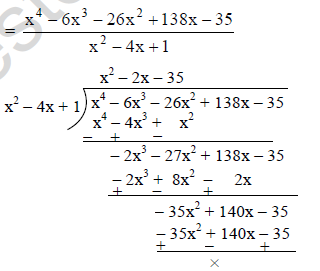
Question 2. If two zeros of the polynomial \( f(x) = x^4 - 6x^3 - 26x^2 + 138x - 35 \) are \( 2 \pm \sqrt{3} \).Find the other zeros.
Answer: Let the two given zeroes be \( \alpha = 2 + \sqrt{3} \) and \( \beta = 2 - \sqrt{3} \).
The sum of these zeroes is:
\( \alpha + \beta = (2 + \sqrt{3}) + (2 - \sqrt{3}) = 4 \)
The product of these zeroes is:
\( \alpha\beta = (2 + \sqrt{3})(2 - \sqrt{3}) = 4 - 3 = 1 \)
Therefore, the quadratic factor is \( x^2 - 4x + 1 \).
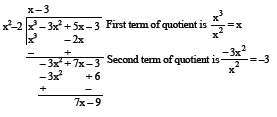
Dividing \( f(x) \) by \( x^2 - 4x + 1 \) using long division:
- First term: \( x^4 / x^2 = x^2 \). Subtracting \( x^2(x^2 - 4x + 1) \) leaves \( -2x^3 - 27x^2 + 138x - 35 \).
- Second term: \( -2x^3 / x^2 = -2x \). Subtracting \( -2x(x^2 - 4x + 1) \) leaves \( -35x^2 + 140x - 35 \).
- Third term: \( -35x^2 / x^2 = -35 \). Subtracting \( -35(x^2 - 4x + 1) \) leaves 0.
The remaining quadratic quotient is \( x^2 - 2x - 35 \).
To find the other zeroes, we set this quotient to zero:
\( x^2 - 2x - 35 = 0 \)
\( \implies (x - 7)(x + 5) = 0 \)
\( \implies x = 7 \) or \( x = -5 \)
So, the other zeroes are 7 and -5.
In simple words: Find the quadratic equation corresponding to the two given zeroes. Divide the main polynomial by this quadratic equation to get a second quadratic equation. Factor it to find the other two zeroes.
Exam Tip: Ensure that the product of the constant terms of your final factored binomials matches the constant term of the quotient to check your work.
Question 3. Find the Quadratic polynomial whose sum and product of zeros are \( \sqrt{2} + 1, \frac{1}{\sqrt{2} + 1} \).
Answer: Let the two zeroes be \( \alpha = \sqrt{2} + 1 \) and \( \beta = \frac{1}{\sqrt{2} + 1} \).
Rationalizing the denominator of \( \beta \):
\( \beta = \frac{1}{\sqrt{2} + 1} \times \frac{\sqrt{2} - 1}{\sqrt{2} - 1} = \frac{\sqrt{2} - 1}{2 - 1} = \sqrt{2} - 1 \)
The sum of the zeroes is:
\( \text{Sum} = \alpha + \beta = (\sqrt{2} + 1) + (\sqrt{2} - 1) = 2\sqrt{2} \)
The product of the zeroes is:
\( \text{Product} = \alpha\beta = (\sqrt{2} + 1)(\sqrt{2} - 1) = 2 - 1 = 1 \)
The quadratic polynomial is:
\( x^2 - (\text{sum})x + \text{product} = x^2 - 2\sqrt{2}x + 1 \)
In simple words: Convert the second zero to \( \sqrt{2} - 1 \) by rationalizing. Find the sum and product of the two values to easily write down the polynomial.
Exam Tip: If the question mentions "sum and product" but lists two reciprocal expressions, it is a common typo where the listed values are actually the individual zeroes.
Question 4. If \( \alpha,\beta \) are the zeros of the polynomial \( 2x^2 - 4x + 5 \) find the value of a) \( \alpha^2 + \beta^2 \) b) \( (\alpha - \beta)^2 \).
Answer: For the quadratic polynomial \( 2x^2 - 4x + 5 \), the coefficients are \( a = 2 \), \( b = -4 \), and \( c = 5 \).
The sum of the zeroes is \( \alpha + \beta = -\frac{b}{a} = 2 \)
The product of the zeroes is \( \alpha\beta = \frac{c}{a} = \frac{5}{2} \)
(a) For \( \alpha^2 + \beta^2 \):
\( \alpha^2 + \beta^2 = (\alpha + \beta)^2 - 2\alpha\beta \)
\( \implies \alpha^2 + \beta^2 = (2)^2 - 2\left(\frac{5}{2}\right) = 4 - 5 = -1 \)
(b) For \( (\alpha - \beta)^2 \):
\( (\alpha - \beta)^2 = (\alpha + \beta)^2 - 4\alpha\beta \)
\( \implies (\alpha - \beta)^2 = (2)^2 - 4\left(\frac{5}{2}\right) = 4 - 10 = -6 \)
In simple words: Use the sum and product formulas first. Then use algebraic identities to substitute these values and find the required expressions.
Exam Tip: The value of \( \alpha^2 + \beta^2 \) can be negative if the zeroes are imaginary, which is normal and correct.
Question 5. If \( \alpha,\beta \) are the zeros of the polynomial \( x^2 + 8x + 6 \) frame a Quadratic polynomial whose zeros are a) \( \frac{1}{\alpha} \) and \( \frac{1}{\beta} \) b) \( 1 + \frac{\beta}{\alpha}, 1 + \frac{\alpha}{\beta} \).
Answer: For \( x^2 + 8x + 6 \), we have \( \alpha + \beta = -8 \) and \( \alpha\beta = 6 \).
(a) For the zeroes \( \frac{1}{\alpha} \) and \( \frac{1}{\beta} \):
\( \text{Sum} = \frac{1}{\alpha} + \frac{1}{\beta} = \frac{\alpha + \beta}{\alpha\beta} = \frac{-8}{6} = -\frac{4}{3} \)
\( \text{Product} = \frac{1}{\alpha} \times \frac{1}{\beta} = \frac{1}{\alpha\beta} = \frac{1}{6} \)
The quadratic polynomial is:
\( x^2 - (\text{sum})x + \text{product} = x^2 + \frac{4}{3}x + \frac{1}{6} \)
(b) For the zeroes \( 1 + \frac{\beta}{\alpha} \) and \( 1 + \frac{\alpha}{\beta} \):
\( \text{Sum} = \left(1 + \frac{\beta}{\alpha}\right) + \left(1 + \frac{\alpha}{\beta}\right) = 2 + \frac{\alpha^2 + \beta^2}{\alpha\beta} \)
Since \( \alpha^2 + \beta^2 = (\alpha + \beta)^2 - 2\alpha\beta = 64 - 12 = 52 \):
\( \text{Sum} = 2 + \frac{52}{6} = 2 + \frac{26}{3} = \frac{32}{3} \)
\( \text{Product} = \left(1 + \frac{\beta}{\alpha}\right)\left(1 + \frac{\alpha}{\beta}\right) = 1 + \frac{\alpha}{\beta} + \frac{\beta}{\alpha} + 1 = 2 + \frac{\alpha^2 + \beta^2}{\alpha\beta} = \frac{32}{3} \)
The quadratic polynomial is:
\( x^2 - \frac{32}{3}x + \frac{32}{3} \)
In simple words: Find the sum and product of the new roots using the relationships from the old roots, then write the quadratic expression.
Exam Tip: Expressing the final polynomial in fractional form is standard, but you can also multiply by the denominator to write it with integer coefficients.
Question 6. On dividing the polynomial \( 4x^4 - 5x^3 - 39x^2 - 46x - 2 \) by the polynomial g(x) the quotient is \( x^2 - 3x - 5 \) and the remainder is -5x + 8.Find the polynomial g(x).
Answer: According to the division algorithm:
\( p(x) = g(x) \cdot q(x) + r(x) \)
\( \implies 4x^4 - 5x^3 - 39x^2 - 46x - 2 = g(x) \cdot (x^2 - 3x - 5) + (-5x + 8) \)
\( \implies g(x) \cdot (x^2 - 3x - 5) = (4x^4 - 5x^3 - 39x^2 - 46x - 2) - (-5x + 8) \)
\( \implies g(x) \cdot (x^2 - 3x - 5) = 4x^4 - 5x^3 - 39x^2 - 41x - 10 \)
\( \implies g(x) = \frac{4x^4 - 5x^3 - 39x^2 - 41x - 10}{x^2 - 3x - 5} \)
Dividing by \( x^2 - 3x - 5 \) using long division:
- First term: \( 4x^4 / x^2 = 4x^2 \). Subtracting \( 4x^2(x^2 - 3x - 5) \) leaves \( 7x^3 - 19x^2 - 41x - 10 \).
- Second term: \( 7x^3 / x^2 = 7x \). Subtracting \( 7x(x^2 - 3x - 5) \) leaves \( 2x^2 - 6x - 10 \).
- Third term: \( 2x^2 / x^2 = 2 \). Subtracting \( 2(x^2 - 3x - 5) \) leaves 0.
Thus, the divisor \( g(x) = 4x^2 + 7x + 2 \).
In simple words: Subtract the remainder from the dividend first, and then divide that result by the quotient to obtain \( g(x) \).
Exam Tip: Be extra careful with signs when subtracting the remainder, as \( -(-5x + 8) \) becomes \( +5x - 8 \).
Question 7. If the squared difference of the zeros of the quadratic polynomial \( x^2 + px + 45 \) is equal to 144 , find the value of p.
Answer: Let the zeroes be \( \alpha \) and \( \beta \).
We are given \( (\alpha - \beta)^2 = 144 \).
From the polynomial \( x^2 + px + 45 \), the sum is \( \alpha + \beta = -p \) and the product is \( \alpha\beta = 45 \).
Using the algebraic identity:
\( (\alpha - \beta)^2 = (\alpha + \beta)^2 - 4\alpha\beta \)
\( \implies 144 = (-p)^2 - 4(45) \)
\( \implies 144 = p^2 - 180 \)
\( \implies p^2 = 324 \)
\( \implies p = \pm 18 \)
Thus, the value of \( p \) is \( \pm 18 \).
In simple words: Set up the relationship \( p^2 - 4(45) = 144 \). Solve for \( p \) by taking the square root on both sides.
Exam Tip: Never forget to write the \( \pm \) sign when taking a square root of an algebraic variable.
Question 8. If \( \alpha,\beta \) are the zeros of a Quadratic polynomial such that \( \alpha + \beta = 24, \alpha - \beta = 8 \). Find a Quadratic polynomial having \( \alpha \) and \( \beta \) as its zeros.
Answer: We are given:
\( \alpha + \beta = 24 \)
\( \alpha - \beta = 8 \)
Adding the two equations:
\( 2\alpha = 32 \implies \alpha = 16 \)
Substituting \( \alpha = 16 \) in the first equation:
\( 16 + \beta = 24 \implies \beta = 8 \)
The sum of the zeroes is \( \alpha + \beta = 24 \).
The product of the zeroes is \( \alpha\beta = 16 \times 8 = 128 \).
The quadratic polynomial is:
\( k(x^2 - (\text{sum})x + \text{product}) = k(x^2 - 24x + 128) \)
In simple words: Solve the linear equations to find the individual zeroes (16 and 8), then write the polynomial using their sum and product.
Exam Tip: Including the constant factor \( k \) represents the general family of polynomials with those specific zeroes.
Question 9. If \( \alpha \) & \( \beta \) are the zeroes of the polynomial \( 2x^2 - 4x + 5 \), then find the value of a. \( \alpha^2 + \beta^2 \) b. \( 1/\alpha + 1/\beta \) c. \( (\alpha - \beta)^2 \) d. \( 1/\alpha^2 + 1/\beta^2 \) e. \( \alpha^3 + \beta^3 \)
Answer: For \( 2x^2 - 4x + 5 \), the sum of zeroes is \( \alpha + \beta = 2 \) and the product is \( \alpha\beta = \frac{5}{2} \).
a. \( \alpha^2 + \beta^2 = (\alpha + \beta)^2 - 2\alpha\beta = 2^2 - 2\left(\frac{5}{2}\right) = 4 - 5 = -1 \)
b. \( \frac{1}{\alpha} + \frac{1}{\beta} = \frac{\alpha + \beta}{\alpha\beta} = \frac{2}{5/2} = \frac{4}{5} \)
c. \( (\alpha - \beta)^2 = (\alpha + \beta)^2 - 4\alpha\beta = 2^2 - 4\left(\frac{5}{2}\right) = 4 - 10 = -6 \)
d. \( \frac{1}{\alpha^2} + \frac{1}{\beta^2} = \frac{\alpha^2 + \beta^2}{(\alpha\beta)^2} = \frac{-1}{(5/2)^2} = -\frac{4}{25} \)
e. \( \alpha^3 + \beta^3 = (\alpha + \beta)(\alpha^2 + \beta^2 - \alpha\beta) = 2\left(-1 - \frac{5}{2}\right) = 2\left(-\frac{7}{2}\right) = -7 \)
In simple words: Find sum and product from the polynomial coefficients, then use basic algebraic identities to find the value of each part.
Exam Tip: Expressing \( \alpha^3 + \beta^3 \) as \( (\alpha + \beta)(\alpha^2 + \beta^2 - \alpha\beta) \) is often the quickest way to calculate it.
Question 10. Obtain all the zeros of the polynomial \( p(x) = 3x^4 - 15x^3 + 17x^2 + 5x - 6 \) if two zeroes are \( -1/\sqrt{3} \) and \( 1/\sqrt{3} \).
Answer: Since the two given zeroes are \( \pm \frac{1}{\sqrt{3}} \), the corresponding quadratic factor is:
\( \left(x + \frac{1}{\sqrt{3}}\right)\left(x - \frac{1}{\sqrt{3}}\right) = x^2 - \frac{1}{3} \implies 3x^2 - 1 \text{ is a factor} \)
Dividing \( p(x) \) by \( 3x^2 - 1 \) using long division:
- First term: \( 3x^4 / 3x^2 = x^2 \). Subtracting \( x^2(3x^2 - 1) \) leaves \( -15x^3 + 18x^2 + 5x - 6 \).
- Second term: \( -15x^3 / 3x^2 = -5x \). Subtracting \( -5x(3x^2 - 1) \) leaves \( 18x^2 - 6 \).
- Third term: \( 18x^2 / 3x^2 = 6 \). Subtracting \( 6(3x^2 - 1) \) leaves 0.
The other factor is \( x^2 - 5x + 6 \).
Setting this factor to zero:
\( x^2 - 5x + 6 = 0 \implies (x - 3)(x - 2) = 0 \implies x = 3 \) or \( x = 2 \)
The other zeroes are 3 and 2.
In simple words: Use the known roots to form the divisor \( 3x^2 - 1 \). Divide the main polynomial by this to get \( x^2 - 5x + 6 \), then factor it to get the remaining roots.
Exam Tip: When dividing by \( 3x^2 - 1 \), remember that there is no \( x \) term in the divisor, so align columns carefully during subtraction.
Question 11. Give examples of polynomials \( p(x) \), \( g(x) \), \( q(x) \) and \( r(x) \) which satisfy the division algorithm. a. deg \( p(x) \) = deg \( q(x) \) b. deg \( q(x) \) = deg \( r(x) \) c. deg \( q(x) \) = 0.
Answer: The division algorithm is \( p(x) = g(x) \cdot q(x) + r(x) \).
a. For \( \text{deg } p(x) = \text{deg } q(x) \), the divisor \( g(x) \) must be a constant.
Let \( p(x) = 2x^2 - 4x + 6 \) and \( g(x) = 2 \).
Then \( q(x) = x^2 - 2x + 3 \) and \( r(x) = 0 \).
b. For \( \text{deg } q(x) = \text{deg } r(x) \):
Let \( p(x) = x^3 + x^2 + x + 1 \) and \( g(x) = x^2 \).
Then \( q(x) = x + 1 \) and \( r(x) = x + 1 \).
c. For \( \text{deg } q(x) = 0 \):
Let \( p(x) = x^2 + 3 \) and \( g(x) = x^2 + 1 \).
Then \( q(x) = 1 \) and \( r(x) = 2 \).
In simple words: Choose simple algebraic terms that satisfy the requirements of the division algorithm for each case.
Exam Tip: Ensure that the degree of the remainder \( r(x) \) is always strictly less than the degree of the divisor \( g(x) \).
Question 12. If the ratios of the polynomial \( ax^3 + 3bx^2 + 3cx + d \) are in AP, Prove that \( 2b^3 - 3abc + a^2d = 0 \)
Answer: Let the zeroes of the cubic polynomial be \( \alpha, \beta, \gamma \).
Since the zeroes are in AP, let them be \( m - n \), \( m \), and \( m + n \).
The sum of the zeroes is:
\( (m - n) + m + (m + n) = -\frac{3b}{a} \)
\( \implies 3m = -\frac{3b}{a} \implies m = -\frac{b}{a} \)
Since \( m \) is a zero of the polynomial, substituting \( x = m \) into the polynomial must give 0:
\( a\left(-\frac{b}{a}\right)^3 + 3b\left(-\frac{b}{a}\right)^2 + 3c\left(-\frac{b}{a}\right) + d = 0 \)
\( \implies -\frac{b^3}{a^2} + \frac{3b^3}{a^2} - \frac{3bc}{a} + d = 0 \)
\( \implies \frac{2b^3}{a^2} - \frac{3bc}{a} + d = 0 \)
Multiplying the entire equation by \( a^2 \):
\( 2b^3 - 3abc + a^2d = 0 \)
Hence Proved.
In simple words: Since the zeroes are in AP, their sum simplifies to \( 3m \), which gives \( m = -b/a \). Substituting this zero back into the original cubic equation proves the identity.
Exam Tip: In AP zero questions, substituting the middle term \( m \) as a root is always the most direct and elegant way to prove the identity.
Question 13. Find the number of zeros of the polynomial from the graph given.
Answer: The number of zeroes is the number of times the graph intersects the \( x \)-axis. Looking at the graph, the curve cuts the \( x \)-axis exactly once. Thus, the number of zeroes is 1.
In simple words: The graph crosses the horizontal line (x-axis) only once, meaning it has exactly 1 zero.
Exam Tip: Only count intersections with the horizontal \( x \)-axis, and ignore where the curve crosses the vertical \( y \)-axis.
Question 14. If one zero of the polynomial \( 3x^2 - 8x + 2k + 1 \) is seven times the other, find the zeros and the value of k
Answer: Let the zeroes be \( \alpha \) and \( 7\alpha \).
From the polynomial:
\( \text{Sum of zeroes} = \alpha + 7\alpha = -\frac{-8}{3} \implies 8\alpha = \frac{8}{3} \implies \alpha = \frac{1}{3} \)
Thus, the zeroes are \( \frac{1}{3} \) and \( \frac{7}{3} \).
\( \text{Product of zeroes} = \alpha \times 7\alpha = \frac{2k + 1}{3} \)
\( \implies 7\left(\frac{1}{3}\right)^2 = \frac{2k + 1}{3} \implies \frac{7}{9} = \frac{2k + 1}{3} \)
\( \implies 2k + 1 = \frac{7}{3} \implies 2k = \frac{4}{3} \implies k = \frac{2}{3} \)
Thus, the zeroes are \( \frac{1}{3}, \frac{7}{3} \) and the value of \( k \) is \( \frac{2}{3} \).
In simple words: Using the sum of zeroes gives the value of the root \( \alpha = 1/3 \). Substituting this into the product formula yields \( k = 2/3 \).
Exam Tip: Be careful when simplifying fractions during the product stage to avoid minor calculation errors.
Question 15. If (n-k) is a factor of the polynomials \( x^2+px+q \) & \( x^2 + m x+n \). Prove that \( k = n + \frac{n-q}{m-p} \)
Answer: Let \( y = n - k \). Since \( y \) is a common zero of both polynomials, we can write:
\( y^2 + py + q = 0 \) -- (Equation 1)
\( y^2 + my + n = 0 \) -- (Equation 2)
Subtracting Equation 1 from Equation 2:
\( (my - py) + (n - q) = 0 \)
\( \implies y(m - p) = q - n \implies y = \frac{q - n}{m - p} = -\frac{n - q}{m - p} \)
Substituting \( y = n - k \):
\( n - k = -\frac{n - q}{m - p} \implies k = n + \frac{n - q}{m - p} \)
Hence Proved.
In simple words: Treat \( n-k \) as a common variable root for both equations, subtract them to eliminate the squared term, and solve for \( k \).
Exam Tip: Subtracting two quadratic equations with the same leading coefficient is a standard method to find their common root.
Question 16. If 2, \( \frac{1}{2} \) are the zeros of \( px^2 + 5x + r \), prove that \( p = r \).
Answer: Let the zeroes be \( \alpha = 2 \) and \( \beta = \frac{1}{2} \).
The product of the zeroes is:
\( \alpha\beta = 2 \times \frac{1}{2} = 1 \)
From the polynomial \( px^2 + 5x + r \):
\( \text{Product of zeroes} = \frac{r}{p} \)
Therefore:
\( \frac{r}{p} = 1 \implies p = r \)
Hence Proved.
In simple words: Since the roots are 2 and its reciprocal \( 1/2 \), their product must be 1. This means the first coefficient and the constant term must be equal.
Exam Tip: Always remember that when the zeroes are reciprocals of each other, the coefficient of \( x^2 \) is equal to the constant term.
Question 17. If m, n are zeroes of \( ax^2 - 5x + c \), find the value of a and c if \( m + n = m \cdot n = 10 \)
Answer: From the polynomial \( ax^2 - 5x + c \), we have:
\( m + n = \frac{5}{a} \)
\( m \cdot n = \frac{c}{a} \)
Since \( m + n = 10 \):
\( \frac{5}{a} = 10 \implies a = \frac{1}{2} \)
Since \( m \cdot n = 10 \):
\( \frac{c}{a} = 10 \implies c = 10a = 10\left(\frac{1}{2}\right) = 5 \)
Thus, the values are \( a = \frac{1}{2} \) and \( c = 5 \).
In simple words: Use the sum formula to find \( a = 0.5 \), then substitute it into the product formula to find \( c = 5 \).
Exam Tip: Set up the relations separately and solve for the denominators first to avoid simple division errors.
Question 18. What must be subtracted from \( 8x^4 + 14x^3 - 2x^2 + 7x - 8 \) so that the resulting polynomial is exactly divisible by \( 4x^2 + 3x - 2 \).
Answer: Let us divide \( 8x^4 + 14x^3 - 2x^2 + 7x - 8 \) by \( 4x^2 + 3x - 2 \) using long division:
- First term: \( 8x^4 / 4x^2 = 2x^2 \). Subtracting \( 2x^2(4x^2 + 3x - 2) \) leaves \( 8x^3 + 2x^2 + 7x - 8 \).
- Second term: \( 8x^3 / 4x^2 = 2x \). Subtracting \( 2x(4x^2 + 3x - 2) \) leaves \( -4x^2 + 11x - 8 \).
- Third term: \( -4x^2 / 4x^2 = -1 \). Subtracting \( -1(4x^2 + 3x - 2) \) leaves \( 14x - 10 \).
The remainder is \( 14x - 10 \).
Thus, the polynomial that must be subtracted is \( 14x - 10 \).
In simple words: The leftover remainder after dividing is the term we must subtract to ensure perfect division.
Exam Tip: Subtracting the remainder always makes the resulting polynomial perfectly divisible by the divisor.
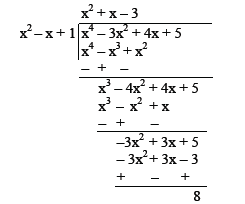
Question 19. What must be added to the polynomial p(x)= \( x^4 + 2x^3 - 2x^2 + x - 1 \) so that the resulting polynomial is exactly divisible by \( x^2+2x-3 \).
Answer: Let us divide \( x^4 + 2x^3 - 2x^2 + x - 1 \) by \( x^2 + 2x - 3 \):
- First term: \( x^4 / x^2 = x^2 \). Subtracting \( x^2(x^2 + 2x - 3) \) leaves \( x^2 + x - 1 \).
- Second term: \( x^2 / x^2 = 1 \). Subtracting \( 1(x^2 + 2x - 3) \) leaves \( -x + 2 \).
The remainder is \( -x + 2 \).
The polynomial that must be added is the negative of this remainder:
\( \text{Polynomial to be added} = -(-x + 2) = x - 2 \)
In simple words: The polynomial to be added is the negative of the remainder, which is \( x - 2 \).
Exam Tip: Pay attention to whether the question asks what must be "subtracted" (the remainder itself) or "added" (the negative of the remainder).
Free study material for Mathematics
Free CBSE Practice Worksheets: Class 10 Mathematics Chapter 02 Polynomials
Download Chapter Worksheets: Class 10 Mathematics
Review targeted practice exercises for Class 10 Mathematics Chapter 02 Polynomials. Curated to match official CBSE guidelines, these printable problem sets support daily revision and improve overall test readiness.
Concept Clarification for Chapter 02 Polynomials
Built using official NCERT guidelines for Class 10 Mathematics, these practice sheets provide reliable academic support. Cross-reference your completed work with our detailed solutions to learn standard answer-writing formats for CBSE exams.
Effective Revision Strategies for School Exams
Consistent engagement with these exercises builds familiarity with recurring exam themes. If specific areas within Chapter 02 Polynomials cause trouble, utilize our dedicated NCERT solutions for Class 10 Mathematics to clear up doubts immediately.
FAQs
You can download the latest chapter-wise printable worksheets for Class 10 Mathematics Chapter 02 Polynomials for free from StudiesToday.com. These have been made as per the latest CBSE curriculum for this academic year.
Yes, Class 10 Mathematics worksheets for Chapter 02 Polynomials focus on activity-based learning and also competency-style questions. This helps students to apply theoretical knowledge to practical scenarios.
Yes, we have provided solved worksheets for Class 10 Mathematics Chapter 02 Polynomials to help students verify their answers instantly.
Yes, our Class 10 Mathematics test sheets are mobile-friendly PDFs and can be printed by teachers for classroom.
For Chapter 02 Polynomials, regular practice with our worksheets will improve question-handling speed and help students understand all technical terms and diagrams.