

Chapter-wise Worksheets for Class 10 Mathematics: Chapter 02 Polynomials
Access comprehensive chapter-wise worksheets for Chapter 02 Polynomials using the CBSE Class 10 Mathematics Polynomials Worksheet Set 03. Designed to align with the 2026-27 academic syllabus for Class 10 Mathematics, these printable practice sets help students reinforce key concepts and improve their overall exam readiness.
Practice Class 10 Mathematics Worksheets: Chapter 02 Polynomials
Navigate directly to the solved Mathematics worksheets using the digital viewer below. Each practice set includes detailed step-by-step solutions, allowing students to instantly cross-check their work and identify areas requiring further revision.
Case Study Based Questions
IV. A student of class Xth are interested in drawing so he draw some mathematical shape on the ground with chalk. He has some questions in his mind which he wants to know. Answer the following questions:
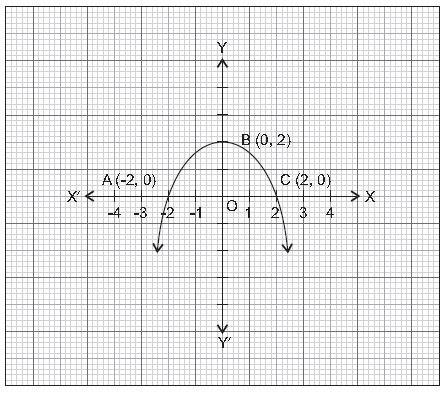
Question. What is the name of the shape of the figure?
(a) Ellipse
(b) parabola
(c) linear
(d) spiral
Answer : B
Question. How many zeroes are there for the polynomial?
(a) 1
(b) 2
(c) 3
(d) 4
Answer : B
Question. The zeroes of the polynomial are
(a) –2, 0
(b) 0, 2
(c) –1, 2
(d) –2, 2
Answer : D
Question. The expression of the polynomial is
(a) x2 + 4x + 4
(b) x2 – 4x + 4
(c) x2 – 4
(d) x2 – 4x – 4
Answer : C
Question. The value of the polynomial if x = –2 is
(a) 16
(b) 12
(c) 8
(d) 0
Answer : D
V. In a game to entertain themselves, students of class-10th have drawn following figure with chalk on the ground. They have some questions in their mind which they want to solve.
Please answer and solve their question.
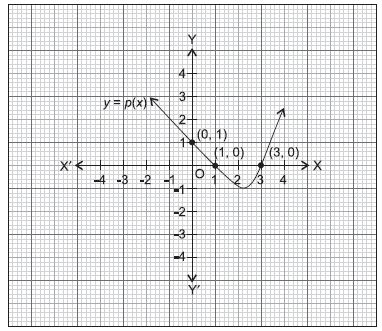
Question. The number of zeroes of the polynomial P(x) is
(a) 1
(b) 2
(c) 3
(d) 4
Answer : B
Question. The zeroes of the polynomial are
(a) 1, 3
(b) –1, 3
(c) 1, –3
(d) –1, –3
Answer : A
Question. The expression of the polynomial is
(a) x2 + 4x + 3
(b) x2 – 4x + 3
(c) x2 + 4x – 3
(d) x2 – 4x – 3
Answer : B
Question. The value of the polynomial if x = 3 i
(a) 24
(b) 0
(c) 18
(d) –6
Answer : B
Question. What is the degree of the polynomial?
(a) 0
(b) 1
(c) 2
(d) 3
Answer : C
VI. To scare his friends in a street, a naughty boy spread a rope which looks in some mathematical shape.
Now few questions arises in his mind which he wants you to answer.

Question. Name the shape between points A and B.
(a) linear
(b) parabola
(c) ellipse
(d) spiral
Answer : B
Question. The number of zeroes of the polynomial y = p(x) is
(a) 1
(b) 2
(c) 3
(d) 4
Answer : D
Question. The zeroes of the polynomial are
(a) –4, –2, 2, 4
(b) –4, –1, 2, 4
(c) –4, –2, 0, 4
(d) –2, 0, 2, 4
Answer : A
Question. The expression of the polynomial is
(a) x4 + 20x2 + 64
(b) x4 – 20x2 + 64
(c) x4 – 20x2 – 64
(d) x4 + 20x2 – 64
Answer : B
Question. The value of the polynomial when x = 2 is
(a) 144
(b) –128
(c) 0
(d) 32
Answer : C
Q.- Find the zero of the polynomial in each of the following cases :

Please click the below link to access CBSE Class 10 Mathematics Polynomials Worksheet Set C
Polynomials Worksheet
Question Q01. Find the Zeroes of the following quadratic polynomials and verify the relationship between the zeroes and the coefficients:-
a) \( 5x^2 - 29x + 20 \)
b) \( 2\sqrt{2}x^2 - 9x + 5\sqrt{2} \)
c) \( 3\sqrt{3}x^2 - 19x + 10\sqrt{3} \)
d) \( x^2 - x - 72 \)
e) \( x^2 - 2 \)
f) \( x^2 - 5x \)
g) \( x^2 - 9 \)
Answer:
a) For \( 5x^2 - 29x + 20 \):
Factorising by splitting the middle term:
\( 5x^2 - 25x - 4x + 20 = 0 \)
\( \implies 5x(x - 5) - 4(x - 5) = 0 \)
\( \implies (5x - 4)(x - 5) = 0 \)
So, the zeroes are \( \alpha = \frac{4}{5} \) and \( \beta = 5 \).
Verification:
Sum of zeroes: \( \alpha + \beta = \frac{4}{5} + 5 = \frac{29}{5} \). Also, \( -\frac{b}{a} = -\frac{-29}{5} = \frac{29}{5} \). (Verified)
Product of zeroes: \( \alpha\beta = \frac{4}{5} \cdot 5 = 4 \). Also, \( \frac{c}{a} = \frac{20}{5} = 4 \). (Verified)
b) For \( 2\sqrt{2}x^2 - 9x + 5\sqrt{2} \):
Factorising by splitting the middle term:
\( 2\sqrt{2}x^2 - 4x - 5x + 5\sqrt{2} = 0 \)
\( \implies 2\sqrt{2}x(x - \sqrt{2}) - 5(x - \sqrt{2}) = 0 \)
\( \implies (2\sqrt{2}x - 5)(x - \sqrt{2}) = 0 \)
So, the zeroes are \( \alpha = \frac{5}{2\sqrt{2}} \) and \( \beta = \sqrt{2} \).
Verification:
Sum of zeroes: \( \alpha + \beta = \frac{5}{2\sqrt{2}} + \sqrt{2} = \frac{5 + 4}{2\sqrt{2}} = \frac{9}{2\sqrt{2}} \). Also, \( -\frac{b}{a} = -\frac{-9}{2\sqrt{2}} = \frac{9}{2\sqrt{2}} \). (Verified)
Product of zeroes: \( \alpha\beta = \frac{5}{2\sqrt{2}} \cdot \sqrt{2} = \frac{5}{2} \). Also, \( \frac{c}{a} = \frac{5\sqrt{2}}{2\sqrt{2}} = \frac{5}{2} \). (Verified)
c) For \( 3\sqrt{3}x^2 - 19x + 10\sqrt{3} \):
Factorising by splitting the middle term:
\( 3\sqrt{3}x^2 - 9x - 10x + 10\sqrt{3} = 0 \)
\( \implies 3\sqrt{3}x(x - \sqrt{3}) - 10(x - \sqrt{3}) = 0 \)
\( \implies (3\sqrt{3}x - 10)(x - \sqrt{3}) = 0 \)
So, the zeroes are \( \alpha = \frac{10}{3\sqrt{3}} \) and \( \beta = \sqrt{3} \).
Verification:
Sum of zeroes: \( \alpha + \beta = \frac{10}{3\sqrt{3}} + \sqrt{3} = \frac{10 + 9}{3\sqrt{3}} = \frac{19}{3\sqrt{3}} \). Also, \( -\frac{b}{a} = -\frac{-19}{3\sqrt{3}} = \frac{19}{3\sqrt{3}} \). (Verified)
Product of zeroes: \( \alpha\beta = \frac{10}{3\sqrt{3}} \cdot \sqrt{3} = \frac{10}{3} \). Also, \( \frac{c}{a} = \frac{10\sqrt{3}}{3\sqrt{3}} = \frac{10}{3} \). (Verified)
d) For \( x^2 - x - 72 \):
\( (x - 9)(x + 8) = 0 \)
So, the zeroes are \( \alpha = 9 \) and \( \beta = -8 \).
Verification:
Sum of zeroes: \( \alpha + \beta = 9 + (-8) = 1 \). Also, \( -\frac{b}{a} = -\frac{-1}{1} = 1 \). (Verified)
Product of zeroes: \( \alpha\beta = 9 \cdot (-8) = -72 \). Also, \( \frac{c}{a} = -\frac{72}{1} = -72 \). (Verified)
e) For \( x^2 - 2 \):
\( (x - \sqrt{2})(x + \sqrt{2}) = 0 \)
So, the zeroes are \( \alpha = \sqrt{2} \) and \( \beta = -\sqrt{2} \).
Verification:
Sum of zeroes: \( \alpha + \beta = 0 \). Also, \( -\frac{b}{a} = 0 \). (Verified)
Product of zeroes: \( \alpha\beta = -2 \). Also, \( \frac{c}{a} = -2 \). (Verified)
f) For \( x^2 - 5x \):
\( x(x - 5) = 0 \)
So, the zeroes are \( \alpha = 0 \) and \( \beta = 5 \).
Verification:
Sum of zeroes: \( \alpha + \beta = 5 \). Also, \( -\frac{b}{a} = 5 \). (Verified)
Product of zeroes: \( \alpha\beta = 0 \). Also, \( \frac{c}{a} = 0 \). (Verified)
g) For \( x^2 - 9 \):
\( (x - 3)(x + 3) = 0 \)
So, the zeroes are \( \alpha = 3 \) and \( \beta = -3 \).
Verification:
Sum of zeroes: \( \alpha + \beta = 0 \). Also, \( -\frac{b}{a} = 0 \). (Verified)
Product of zeroes: \( \alpha\beta = -9 \). Also, \( \frac{c}{a} = -9 \). (Verified)
In simple words: Find the roots of each equation by using factoring methods. Afterward, verify that the sum of these roots equals \( -b/a \) and their product matches the constant over leading coefficient (\( c/a \)).
Exam Tip: Be very careful when factoring quadratic equations with radical coefficients. Calculate the product of the first and last terms first to figure out how to split the middle term.
Question Q02. Form the Quadratic polynomials whose zeros are:-
a) \( 3 \pm \sqrt{2} \)
b) \( -\sqrt{2} \) and \( \sqrt{2} \)
c) \( \frac{1}{3} \) and \( \frac{1}{4} \)
d) \( -5 \) and \( -3 \)
e) \( 3 \) and \( \frac{1}{5} \)
f) \( \frac{1}{a} , \frac{1}{b} \)
Answer:
a) For \( 3 \pm \sqrt{2} \):
Sum of zeroes, \( S = (3 + \sqrt{2}) + (3 - \sqrt{2}) = 6 \)
Product of zeroes, \( P = (3 + \sqrt{2})(3 - \sqrt{2}) = 9 - 2 = 7 \)
The polynomial is \( x^2 - Sx + P = x^2 - 6x + 7 \).
b) For \( -\sqrt{2} \) and \( \sqrt{2} \):
Sum of zeroes, \( S = -\sqrt{2} + \sqrt{2} = 0 \)
Product of zeroes, \( P = (-\sqrt{2})(\sqrt{2}) = -2 \)
The polynomial is \( x^2 - Sx + P = x^2 - 2 \).
c) For \( \frac{1}{3} \) and \( \frac{1}{4} \):
Sum of zeroes, \( S = \frac{1}{3} + \frac{1}{4} = \frac{7}{12} \)
Product of zeroes, \( P = \frac{1}{3} \cdot \frac{1}{4} = \frac{1}{12} \)
The polynomial is \( x^2 - \frac{7}{12}x + \frac{1}{12} \), which can be written as \( 12x^2 - 7x + 1 \).
d) For \( -5 \) and \( -3 \):
Sum of zeroes, \( S = -5 + (-3) = -8 \)
Product of zeroes, \( P = (-5)(-3) = 15 \)
The polynomial is \( x^2 - Sx + P = x^2 + 8x + 15 \).
e) For \( 3 \) and \( \frac{1}{5} \):
Sum of zeroes, \( S = 3 + \frac{1}{5} = \frac{16}{5} \)
Product of zeroes, \( P = 3 \cdot \frac{1}{5} = \frac{3}{5} \)
The polynomial is \( x^2 - \frac{16}{5}x + \frac{3}{5} \), which can be written as \( 5x^2 - 16x + 3 \).
f) For \( \frac{1}{a} \) and \( \frac{1}{b} \):
Sum of zeroes, \( S = \frac{1}{a} + \frac{1}{b} = \frac{a+b}{ab} \)
Product of zeroes, \( P = \frac{1}{a} \cdot \frac{1}{b} = \frac{1}{ab} \)
The polynomial is \( x^2 - \left(\frac{a+b}{ab}\right)x + \frac{1}{ab} \), which can be written as \( abx^2 - (a+b)x + 1 \).
In simple words: First find the sum and product of the two given zeroes. Then, plug those values into the formula \( x^2 - (\text{Sum})x + \text{Product} \) to form the quadratic expression.
Exam Tip: If the coefficients in the polynomial contain fractions, it is generally preferred to multiply the entire expression by the denominator to express it with integer values.
Question Q03. Find all the Zeroes of \( x^3 + 6x^2 + 11x + 6 \) if \( (x + 1) \) is a factor.
Answer: Since \( (x + 1) \) is a factor, \( x = -1 \) is one of the zeroes.
We divide the polynomial \( x^3 + 6x^2 + 11x + 6 \) by \( x + 1 \) using long division:
\[ \begin{array}{rll}
x^2 + 5x + 6 & \text{(Quotient)} \\
x + 1 \ \overline{\big) \ x^3 + 6x^2 + 11x + 6} \\
\underline{-\left(x^3 + \phantom{0}x^2\right)} \phantom{+ 11x + 6} \\
5x^2 + 11x + 6 \\
\underline{-\left(5x^2 + \phantom{0}5x\right)} \phantom{+ 6} \\
6x + 6 \\
\underline{-\left(6x + 6\right)} \\
0 & \text{(Remainder)}
\end{array} \]
The quadratic quotient is \( x^2 + 5x + 6 \). Finding its roots:
\( x^2 + 5x + 6 = 0 \)
\( \implies (x + 2)(x + 3) = 0 \)
\( \implies x = -2 \) or \( x = -3 \).
Therefore, the zeroes of the given cubic polynomial are \( -1 \), \( -2 \), and \( -3 \).
In simple words: Since \( x + 1 \) is a known factor, dividing the cubic equation by it gives us a quadratic equation, \( x^2 + 5x + 6 \). Factoring this gives the other two roots as \( -2 \) and \( -3 \).
Exam Tip: Always state "all the zeroes" in the final sentence of your answer, ensuring that the given root is also listed along with the new roots.
Question Q04. Find all the Zeroes of \( x^3 - 10x^2 + 31x - 30 \) if 2 is a zero of it.
Answer: Since 2 is a zero, \( x - 2 \) is a factor of the given polynomial.
Let us divide \( x^3 - 10x^2 + 31x - 30 \) by \( x - 2 \) using long division:
\[ \begin{array}{rll}
x^2 - 8x + 15 & \text{(Quotient)} \\
x - 2 \ \overline{\big) \ x^3 - 10x^2 + 31x - 30} \\
\underline{-\left(x^3 - \phantom{0}2x^2\right)} \phantom{+ 31x - 30} \\
-8x^2 + 31x - 30 \\
\underline{-\left(-8x^2 + 16x\right)} \phantom{- 30} \\
15x - 30 \\
\underline{-\left(15x - 30\right)} \\
0 & \text{(Remainder)}
\end{array} \]
The other quadratic factor is \( x^2 - 8x + 15 \). Factoring this quadratic quotient:
\( x^2 - 8x + 15 = 0 \)
\( \implies (x - 3)(x - 5) = 0 \)
\( \implies x = 3 \) or \( x = 5 \).
Therefore, all the zeroes are \( 2 \), \( 3 \), and \( 5 \).
In simple words: We divide the main cubic expression by the factor \( x - 2 \). Factoring the resulting quadratic quotient \( x^2 - 8x + 15 \) yields the remaining roots, which are \( 3 \) and \( 5 \).
Exam Tip: When splitting the middle term of \( x^2 - 8x + 15 \), look for two numbers that multiply to 15 and add up to -8. These are -3 and -5.
Question Q05. Find the values of a and b, if 2 and 3 are zeroes of \( x^3 + ax^2 + bx - 30 \).
Answer: Let \( p(x) = x^3 + ax^2 + bx - 30 \). Since 2 and 3 are roots of this polynomial:
1. Substituting \( x = 2 \):
\( p(2) = 0 \)
\( \implies (2)^3 + a(2)^2 + b(2) - 30 = 0 \)
\( \implies 8 + 4a + 2b - 30 = 0 \)
\( \implies 4a + 2b = 22 \)
\( \implies 2a + b = 11 \) (Equation 1)
2. Substituting \( x = 3 \):
\( p(3) = 0 \)
\( \implies (3)^3 + a(3)^2 + b(3) - 30 = 0 \)
\( \implies 27 + 9a + 3b - 30 = 0 \)
\( \implies 9a + 3b = 3 \)
\( \implies 3a + b = 1 \) (Equation 2)
Subtracting Equation 1 from Equation 2:
\( (3a + b) - (2a + b) = 1 - 11 \)
\( \implies a = -10 \)
Substituting the value of \( a = -10 \) into Equation 1:
\( 2(-10) + b = 11 \)
\( \implies -20 + b = 11 \)
\( \implies b = 31 \).
Therefore, the values are \( a = -10 \) and \( b = 31 \).
In simple words: Since 2 and 3 are zeroes, putting them into the polynomial must give zero. This creates a system of two equations. Solving them tells us that \( a = -10 \) and \( b = 31 \).
Exam Tip: Simplify the equations by dividing by any common factors (e.g., dividing \( 4a + 2b = 22 \) by 2) to make subtraction much easier and reduce mistakes.
Question Q06. Divide \( x^4 - 4x^3 + 8x^2 + 7x + 10 \) by \( (x - 2) \) and verify the division algorithm.
Answer: Let us perform the polynomial division of \( x^4 - 4x^3 + 8x^2 + 7x + 10 \) by \( x - 2 \):
\[ \begin{array}{rll}
x^3 - 2x^2 + 4x + 15 & \text{(Quotient)} \\
x - 2 \ \overline{\big) \ x^4 - 4x^3 + 8x^2 + \phantom{0}7x + 10} \\
\underline{-\left(x^4 - 2x^3\right)} \phantom{+ 8x^2 + 7x + 10} \\
-2x^3 + 8x^2 + \phantom{0}7x + 10 \\
\underline{-\left(-2x^3 + 4x^2\right)} \phantom{+ 7x + 10} \\
4x^2 + \phantom{0}7x + 10 \\
\underline{-\left(4x^2 - \phantom{0}8x\right)} \phantom{+ 10} \\
15x + 10 \\
\underline{-\left(15x - 30\right)} \\
40 & \text{(Remainder)}
\end{array} \]
The quotient \( q(x) = x^3 - 2x^2 + 4x + 15 \) and the remainder \( r(x) = 40 \).
Verification of the Division Algorithm:
We must check if \( \text{Dividend} = \text{Divisor} \times \text{Quotient} + \text{Remainder} \).
\( \text{RHS} = (x - 2)(x^3 - 2x^2 + 4x + 15) + 40 \)
\( = x(x^3 - 2x^2 + 4x + 15) - 2(x^3 - 2x^2 + 4x + 15) + 40 \)
\( = x^4 - 2x^3 + 4x^2 + 15x - 2x^3 + 4x^2 - 8x - 30 + 40 \)
\( = x^4 - 4x^3 + 8x^2 + 7x + 10 \)
Since the result is equal to the original dividend, the division algorithm is verified.
In simple words: Dividing the expression gives a quotient of \( x^3 - 2x^2 + 4x + 15 \) and leaves a remainder of 40. Multiplying the divisor by our quotient and adding 40 gets us back to our original polynomial, verifying the result.
Exam Tip: A useful way to check your division remainder is to apply the Remainder Theorem: simply calculate \( p(2) \) to verify if it equals 40.
Question Q07. Find the value of k if \( (x - 2) \) is a factor of \( x^2 - kx + 10 \).
Answer: Let \( p(x) = x^2 - kx + 10 \).
According to the Factor Theorem, if \( x - 2 \) is a factor of the polynomial, then:
\( p(2) = 0 \)
\( \implies (2)^2 - k(2) + 10 = 0 \)
\( \implies 4 - 2k + 10 = 0 \)
\( \implies 14 - 2k = 0 \)
\( \implies 2k = 14 \)
\( \implies k = 7 \).
Therefore, the value of k is 7.
In simple words: Since \( x - 2 \) is a factor, putting 2 into the expression must make the final result equal to 0. Solving this simple equation gives us \( k = 7 \).
Exam Tip: Keep your algebraic steps clear and explicitly state that you are applying the Factor Theorem to secure full marks.
Question Q08. Find the value of k if 2 is zero of \( 3x^2 - 17x + k \).
Answer: Let \( p(x) = 3x^2 - 17x + k \).
Since 2 is a zero of this quadratic expression:
\( p(2) = 0 \)
\( \implies 3(2)^2 - 17(2) + k = 0 \)
\( \implies 3(4) - 34 + k = 0 \)
\( \implies 12 - 34 + k = 0 \)
\( \implies -22 + k = 0 \)
\( \implies k = 22 \).
Therefore, the value of k is 22.
In simple words: Substituting the root value 2 in place of x makes the entire equation equal to zero. Solving this gives us a value of 22 for k.
Exam Tip: Be mindful of basic arithmetic rules when handling negative numbers during subtraction steps.
Question Q09. Find all the zeroes of \( 4x^4 - 20x^3 + 23x^2 + 5x - 6 \) if two of its zeroes are 2 & 3.
Answer: Since 2 and 3 are zeroes of the given polynomial, we can form the quadratic factor:
\( (x - 2)(x - 3) = x^2 - 5x + 6 \).
Dividing the given polynomial by \( x^2 - 5x + 6 \) using long division:
\[ \begin{array}{rll}
4x^2 - 1 & \text{(Quotient)} \\
x^2 - 5x + 6 \ \overline{\big) \ 4x^4 - 20x^3 + 23x^2 + 5x - 6} \\
\underline{-\left(4x^4 - 20x^3 + 24x^2\right)} \phantom{+ 5x - 6} \\
-x^2 + 5x - 6 \\
\underline{-\left(-x^2 + 5x - 6\right)} \\
0 & \text{(Remainder)}
\end{array} \]
The quadratic quotient obtained is \( 4x^2 - 1 \). Setting it equal to zero to find the other zeroes:
\( 4x^2 - 1 = 0 \)
\( \implies (2x - 1)(2x + 1) = 0 \)
\( \implies x = \frac{1}{2} \) or \( x = -\frac{1}{2} \).
Therefore, the complete set of zeroes for the polynomial is \( 2 \), \( 3 \), \( \frac{1}{2} \), and \( -\frac{1}{2} \).
In simple words: The roots 2 and 3 give us the divisor \( x^2 - 5x + 6 \). Dividing our polynomial by it leaves us with \( 4x^2 - 1 \), which yields the final two roots: \( \frac{1}{2} \) and \( -\frac{1}{2} \).
Exam Tip: Using the difference of squares identity \( a^2 - b^2 = (a-b)(a+b) \) is the cleanest way to factorise the quadratic quotient \( 4x^2 - 1 \).
Question Q10. If \( \alpha \) and \( \beta \) are the zeroes of \( x^2 + 5x + 6 \) find the value of \( \alpha^{-1} + \beta^{-1} \).
Answer: For the quadratic polynomial \( x^2 + 5x + 6 \):
\( a = 1, b = 5, c = 6 \)
Using the relationship between zeroes and coefficients:
\( \alpha + \beta = -\frac{b}{a} = -5 \)
\( \alpha\beta = \frac{c}{a} = 6 \)
We need to evaluate:
\( \alpha^{-1} + \beta^{-1} = \frac{1}{\alpha} + \frac{1}{\beta} = \frac{\alpha + \beta}{\alpha\beta} \)
Substituting our values:
\( = -\frac{5}{6} \).
Thus, the value of the expression is \( -\frac{5}{6} \).
In simple words: Writing the expression with a common denominator gives us the sum of the roots divided by their product. Substituting our values gives the final answer of \( -\frac{5}{6} \).
Exam Tip: Recall that \( x^{-1} \) is the algebraic representation of its reciprocal \( \frac{1}{x} \). Always simplify the algebraic variables first before inserting coefficient numbers.
Question Q11. If \( \frac{1}{2} \) and 1 are zeroes of \( 2x^4 - 3x^3 - 3x^2 + 6x - 2 \), find the other zeroes.
Answer: Since \( \frac{1}{2} \) and \( 1 \) are zeroes of the polynomial, we know that:
\( \left(x - \frac{1}{2}\right)(x - 1) = x^2 - \frac{3}{2}x + \frac{1}{2} \)
Multiplying by 2 to clear fractions, we obtain the factor \( 2x^2 - 3x + 1 \).
Now, we divide our polynomial by \( 2x^2 - 3x + 1 \) using long division:
\[ \begin{array}{rll}
x^2 - 2 & \text{(Quotient)} \\
2x^2 - 3x + 1 \ \overline{\big) \ 2x^4 - 3x^3 - 3x^2 + 6x - 2} \\
\underline{-\left(2x^4 - 3x^3 + \phantom{0}x^2\right)} \phantom{+ 6x - 2} \\
-4x^2 + 6x - 2 \\
\underline{-\left(-4x^2 + 6x - 2\right)} \\
0 & \text{(Remainder)}
\end{array} \]
The other quadratic factor is the quotient \( x^2 - 2 \). Setting it equal to zero:
\( x^2 - 2 = 0 \)
\( \implies x = \pm\sqrt{2} \).
Therefore, the other zeroes of the polynomial are \( \sqrt{2} \) and \( -\sqrt{2} \).
In simple words: The given zeroes let us build a dividing quadratic factor, \( 2x^2 - 3x + 1 \). Dividing our polynomial by it leaves the quotient \( x^2 - 2 \), which has roots at \( \pm\sqrt{2} \).
Exam Tip: Multiply the factored term by its denominator before beginning division to avoid dealing with fraction terms in your long division steps.
Question Q12. If \( -5 \) and 7 are zeroes of \( x^4 - 6x^3 - 26x^2 + 138x - 35 \) find the other zeroes.
Answer: Since \( -5 \) and \( 7 \) are zeroes, we can form the quadratic factor:
\( (x + 5)(x - 7) = x^2 - 2x - 35 \).
Dividing the given polynomial by \( x^2 - 2x - 35 \):
\[ \begin{array}{rll}
x^2 - 4x + 1 & \text{(Quotient)} \\
x^2 - 2x - 35 \ \overline{\big) \ x^4 - 6x^3 - 26x^2 + 138x - 35} \\
\underline{-\left(x^4 - 2x^3 - 35x^2\right)} \phantom{+ 138x - 35} \\
-4x^3 + \phantom{0}9x^2 + 138x - 35 \\
\underline{-\left(-4x^3 + \phantom{0}8x^2 + 140x\right)} \phantom{- 35} \\
x^2 - \phantom{0}2x - 35 \\
\underline{-\left(x^2 - \phantom{0}2x - 35\right)} \\
0 & \text{(Remainder)}
\end{array} \]
The other factor is the quotient, \( x^2 - 4x + 1 \). Setting it equal to zero to find the remaining zeroes:
\( x^2 - 4x + 1 = 0 \)
Using the quadratic formula:
\( x = \frac{-(-4) \pm \sqrt{(-4)^2 - 4(1)(1)}}{2} \)
\( \implies x = \frac{4 \pm \sqrt{16 - 4}}{2} \)
\( \implies x = \frac{4 \pm \sqrt{12}}{2} \)
\( \implies x = \frac{4 \pm 2\sqrt{3}}{2} = 2 \pm \sqrt{3} \).
Therefore, the other zeroes of the polynomial are \( 2 + \sqrt{3} \) and \( 2 - \sqrt{3} \).
In simple words: The roots \( -5 \) and \( 7 \) give us a divisor of \( x^2 - 2x - 35 \). Dividing by this factor leaves us with \( x^2 - 4x + 1 \), which we solve using the quadratic formula to get \( 2 \pm \sqrt{3} \).
Exam Tip: If the quadratic quotient cannot be factored using rational numbers, use the quadratic formula to find the irrational roots.
Question Q13. If one of the zeroes of the polynomial \( 5z^2 + 13z - p \) is the reciprocal of the other, find p.
Answer: Let the zeroes of the quadratic polynomial be \( \alpha \) and \( \frac{1}{\alpha} \).
The product of the zeroes is:
\( \text{Product} = \alpha \cdot \frac{1}{\alpha} = 1 \)
According to the relationship between coefficients and zeroes, the product of zeroes is \( \frac{c}{a} \):
\( \frac{-p}{5} = 1 \)
\( \implies -p = 5 \)
\( \implies p = -5 \).
Thus, the value of p is -5.
In simple words: Reciprocal roots multiply to exactly 1. Comparing this to the formula \( c/a \) tells us that \( -p/5 = 1 \), which gives \( p = -5 \).
Exam Tip: When one root is the reciprocal of the other, the coefficient of the squared term must always equal the constant term (\( a = c \)).
Question Q14. On dividing the polynomial \( 4x^4 - 3x^3 - 42x^2 - 55x - 17 \) by the polynomial g(x) the quotient is \( x^2 - 3x - 5 \) and the remainder is \( 5x + 8 \). Find g(x).
Answer: According to the division algorithm:
\( p(x) = g(x) \cdot q(x) + r(x) \)
\( \implies g(x) \cdot q(x) = p(x) - r(x) \)
\( \implies g(x) = \frac{p(x) - r(x)}{q(x)} \)
First, find the numerator \( p(x) - r(x) \):
\( p(x) - r(x) = (4x^4 - 3x^3 - 42x^2 - 55x - 17) - (5x + 8) \)
\( = 4x^4 - 3x^3 - 42x^2 - 60x - 25 \delta \)
Now, we divide this resulting expression by \( q(x) = x^2 - 3x - 5 \) to find \( g(x) \):
\[ \begin{array}{rll}
4x^2 + 9x + 5 & \text{(g(x))} \\
x^2 - 3x - 5 \ \overline{\big) \ 4x^4 - 3x^3 - 42x^2 - 60x - 25} \\
\underline{-\left(4x^4 - 12x^3 - 20x^2\right)} \phantom{- 60x - 25} \\
9x^3 - 22x^2 - 60x - 25 \\
\underline{-\left(9x^3 - 27x^2 - 45x\right)} \phantom{- 25} \\
5x^2 - 15x - 25 \\
\underline{-\left(5x^2 - 15x - 25\right)} \\
0 & \text{(Remainder)}
\end{array} \]
Thus, the polynomial \( g(x) = 4x^2 + 9x + 5 \).
In simple words: We subtract the remainder from our main polynomial first. Then we divide that result by the given quotient using long division to find \( g(x) = 4x^2 + 9x + 5 \).
Exam Tip: Correctly performing the subtraction step is essential before starting the long division, as any small error will prevent the division from having a remainder of zero.
Question Q15. If \( \frac{1}{2} \) and 1 are zeroes of \( 2x^4 - 3x^3 - 3x^2 + 6x - 2 \), find the other zeroes.
Answer: Since \( \frac{1}{2} \) and \( 1 \) are zeroes of the polynomial, we know that:
\( \left(x - \frac{1}{2}\right)(x - 1) = x^2 - \frac{3}{2}x + \frac{1}{2} \)
Multiplying by 2 to clear fractions, we obtain the factor \( 2x^2 - 3x + 1 \).
Now, we divide our polynomial by \( 2x^2 - 3x + 1 \) using long division:
\[ \begin{array}{rll}
x^2 - 2 & \text{(Quotient)} \\
2x^2 - 3x + 1 \ \overline{\big) \ 2x^4 - 3x^3 - 3x^2 + 6x - 2} \\
\underline{-\left(2x^4 - 3x^3 + \phantom{0}x^2\right)} \phantom{+ 6x - 2} \\
-4x^2 + 6x - 2 \\
\underline{-\left(-4x^2 + 6x - 2\right)} \\
0 & \text{(Remainder)}
\end{array} \]
The other quadratic factor is the quotient \( x^2 - 2 \). Setting it equal to zero:
\( x^2 - 2 = 0 \)
\( \implies x = \pm\sqrt{2} \).
Therefore, the other zeroes of the polynomial are \( \sqrt{2} \) and \( -\sqrt{2} \).
In simple words: This is a repeat of Question 11 from the worksheet. Using the given roots, we divide the polynomial by \( 2x^2 - 3x + 1 \) and find the remaining roots to be \( \sqrt{2} \) and \( -\sqrt{2} \).
Exam Tip: Always make sure your divisor terms are simplified to avoid fraction errors during subtraction steps in long division.
Question Q16. Verify that 1, \( -2 \) and \( \frac{1}{2} \) are zeroes of \( 2x^3 + x^2 - 5x + 2 \). Also verify the relationship between the zeroes and the coefficients.
Answer: Let \( p(x) = 2x^3 + x^2 - 5x + 2 \).
First, let us verify each number by substituting it in place of x:
1. For \( x = 1 \):
\( p(1) = 2(1)^3 + (1)^2 - 5(1) + 2 = 2 + 1 - 5 + 2 = 0 \). (Verified)
2. For \( x = -2 \):
\( p(-2) = 2(-2)^3 + (-2)^2 - 5(-2) + 2 = -16 + 4 + 10 + 2 = 0 \). (Verified)
3. For \( x = \frac{1}{2} \):
\( p\left(\frac{1}{2}\right) = 2\left(\frac{1}{8}\right) + \frac{1}{4} - 5\left(\frac{1}{2}\right) + 2 = \frac{1}{4} + \frac{1}{4} - \frac{5}{2} + 2 = \frac{1}{2} - \frac{5}{2} + 2 = -2 + 2 = 0 \). (Verified)
Verification of Relationships:
Let \( \alpha = 1 \), \( \beta = -2 \), and \( \gamma = \frac{1}{2} \). Comparing the polynomial with the standard cubic form, we have \( A = 2, B = 1, C = -5, D = 2 \).
1. Sum of zeroes:
\( \alpha + \beta + \gamma = 1 + (-2) + \frac{1}{2} = -\frac{1}{2} \)
Also, \( -\frac{B}{A} = -\frac{1}{2} \). (Verified)
2. Sum of products of zeroes taken two at a time:
\( \alpha\beta + \beta\gamma + \gamma\alpha = (1)(-2) + (-2)\left(\frac{1}{2}\right) + \left(\frac{1}{2}\right)(1) = -2 - 1 + \frac{1}{2} = -\frac{5}{2} \)
Also, \( \frac{C}{A} = -\frac{5}{2} \). (Verified)
3. Product of zeroes:
\( \alpha\beta\gamma = (1)(-2)\left(\frac{1}{2}\right) = -1 \)
Also, \( -\frac{D}{A} = -\frac{2}{2} = -1 \). (Verified)
In simple words: First we plug 1, -2, and 1/2 into the expression to show they all make it zero. Then, we calculate their sum, pairwise sum, and product, showing they match the ratios of the coefficients.
Exam Tip: Be precise when evaluating \( p(1/2) \) with fractions. Show the step-by-step simplification to avoid any calculation slip-ups.
Question Q17. If \( \alpha \) and \( \beta \) are the zeroes of quadratic polynomial \( x^2 - kx + 15 \) such that \( (\alpha + \beta)^2 - 2\alpha\beta = 34 \), find k.
Answer: For the quadratic polynomial \( x^2 - kx + 15 \):
Sum of zeroes, \( \alpha + \beta = -\frac{-k}{1} = k \)
Product of zeroes, \( \alpha\beta = \frac{15}{1} = 15 \)
We are given the condition:
\( (\alpha + \beta)^2 - 2\alpha\beta = 34 \)
Substituting our sum and product values:
\( (k)^2 - 2(15) = 34 \)
\( \implies k^2 - 30 = 34 \)
\( \implies k^2 = 64 \)
\( \implies k = \pm 8 \).
Therefore, the value of k is \( \pm 8 \).
In simple words: The sum of the roots is 'k' and their product is 15. Substituting these into the given formula yields \( k^2 - 30 = 34 \), which simplifies to \( k = \pm 8 \).
Exam Tip: Remember to write both positive and negative signs when taking the square root of a number, as both \( +8 \) and \( -8 \) are valid mathematical solutions.
Question Q18. If one zero of polynomial \( 2x^2 - 3x + p \) is 3, then find the other root(zero). Also find the value of p.
Answer: Let the zeroes of the quadratic polynomial be \( \alpha = 3 \) and \( \beta \).
The coefficients are \( a = 2, b = -3, c = p \).
Using the sum of zeroes relationship:
\( \alpha + \beta = -\frac{b}{a} \)
\( \implies 3 + \beta = -\frac{-3}{2} \)
\( \implies 3 + \beta = \frac{3}{2} \)
\( \implies \beta = \frac{3}{2} - 3 = -\frac{3}{2} \).
Thus, the other zero is \( -\frac{3}{2} \).
Now, using the product of zeroes relationship to find p:
\( \alpha\beta = \frac{c}{a} \)
\( \implies (3)\left(-\frac{3}{2}\right) = \frac{p}{2} \)
\( \implies -\frac{9}{2} = \frac{p}{2} \)
\( \implies p = -9 \).
Therefore, the other root is \( -\frac{3}{2} \) and the value of p is -9.
In simple words: Since the sum of the roots is \( 3/2 \) and one root is 3, the other root must be \( -3/2 \). Multiplying these two roots together and comparing with \( p/2 \) tells us that \( p = -9 \).
Exam Tip: Using the sum of zeroes formula first is a very elegant way to find the other root without needing to calculate the value of \( p \) beforehand.
Question Q19. If one zero of polynomial \( 2x^2 + px + 4 \) is 2, find the other zero. Also find p.
Answer: Let the zeroes of the polynomial be \( \alpha = 2 \) and \( \beta \).
Comparing with standard quadratic coefficients: \( a = 2, b = p, c = 4 \).
Using the product of zeroes relationship:
\( \alpha\beta = \frac{c}{a} \)
\( \implies 2\beta = \frac{4}{2} \)
\( \implies 2\beta = 2 \)
\( \implies \beta = 1 \).
Thus, the other zero is 1.
Now, using the sum of zeroes relationship to find p:
\( \alpha + \beta = -\frac{b}{a} \)
\( \implies 2 + 1 = -\frac{p}{2} \)
\( \implies 3 = -\frac{p}{2} \)
\( \implies p = -6 \).
Therefore, the other zero is 1 and the value of p is -6.
In simple words: Since the product of the roots is 2 and one root is 2, the other root must be 1. Adding these roots together shows their sum is 3, which helps us calculate that \( p = -6 \).
Exam Tip: When the constant term is known, use the product of zeroes relationship first to find the other root directly.
Question Q20. If \( \alpha \) and \( \beta \) are the zeroes of the quadratic polynomial \( ax^2 + bx + c \), find the value of \( \frac{1}{\alpha} + \frac{1}{\beta} \).
Answer: For the quadratic polynomial \( ax^2 + bx + c \):
Sum of zeroes, \( \alpha + \beta = -\frac{b}{a} \)
Product of zeroes, \( \alpha\beta = \frac{c}{a} \)
Combining the fractions:
\( \frac{1}{\alpha} + \frac{1}{\beta} = \frac{\alpha + \beta}{\alpha\beta} \)
Substituting our sum and product formulas:
\( = \frac{-b/a}{c/a} = -\frac{b}{c} \).
Thus, the value of the expression is \( -\frac{b}{c} \).
In simple words: Writing the expression with a common denominator gives sum over product. Dividing \( -b/a \) by \( c/a \) simplifies down to the clean formula \( -\frac{b}{c} \).
Exam Tip: This is a standard algebraic result. Memorising that \( \frac{1}{\alpha} + \frac{1}{\beta} = -\frac{b}{c} \) is highly useful for quick calculations in other problems.
Question Q21. If one zero of the polynomial \( (a^2 + 9)x^2 + 13x + 6a \) is the reciprocal of the other, find a.
Answer: Let the zeroes be \( \alpha \) and \( \frac{1}{\alpha} \).
The product of the zeroes is:
\( \text{Product} = \alpha \cdot \frac{1}{\alpha} = 1 \)
According to the product of zeroes relationship \( \frac{c}{a} \):
\( \frac{6a}{a^2 + 9} = 1 \)
\( \implies a^2 + 9 = 6a \)
\( \implies a^2 - 6a + 9 = 0 \)
\( \implies (a - 3)^2 = 0 \)
\( \implies a = 3 \).
Thus, the value of a is 3.
In simple words: Reciprocal roots multiply to exactly 1. Comparing this to the formula \( c/a \) tells us that \( a^2 + 9 = 6a \), which solves to give \( a = 3 \).
Exam Tip: This question is identical to Question 21 on the previous page. Always follow the same consistent step-by-step logic.
Question Q22. If \( \alpha \) and \( \beta \) are the zeroes of \( 2x^2 - 9x + 10 \), form the polynomial whose zeroes are \( \frac{1}{\alpha} \) and \( \frac{1}{\beta} \).
Answer: For the polynomial \( 2x^2 - 9x + 10 \):
Sum of zeroes, \( \alpha + \beta = -\frac{-9}{2} = \frac{9}{2} \)
Product of zeroes, \( \alpha\beta = \frac{10}{2} = 5 \)
For the new polynomial, let the zeroes be \( \alpha' = \frac{1}{\alpha} \) and \( \beta' = \frac{1}{\beta} \).
Sum of new zeroes:
\( S' = \frac{1}{\alpha} + \frac{1}{\beta} = \frac{\alpha + \beta}{\alpha\beta} = \frac{9/2}{5} = \frac{9}{10} \)
Product of new zeroes:
\( P' = \frac{1}{\alpha} \cdot \frac{1}{\beta} = \frac{1}{\alpha\beta} = \frac{1}{5} \)
The required quadratic polynomial is:
\( P(x) = x^2 - S'x + P' \)
\( = x^2 - \frac{9}{10}x + \frac{1}{5} \)
We can multiply by 10 to write it with integer coefficients:
\( P(x) = 10x^2 - 9x + 2 \).
In simple words: From the original polynomial, we find that the sum of new zeroes is \( 9/10 \) and their product is \( 1/5 \). Placing these into our standard formula gives us the quadratic polynomial \( 10x^2 - 9x + 2 \).
Exam Tip: To find the polynomial with reciprocal zeroes quickly, simply swap the coefficients of the first and last terms: \( ax^2 + bx + c \implies cx^2 + bx + a \).
Question Q23. Divide \( 2x^2 + 4x^3 + 5x - 6 \) by \( 2x^2 + 1 + 3x \) and verify the division algorithm.
Answer: Let us write both polynomials in standard descending order of their exponents:
Dividend, \( p(x) = 4x^3 + 2x^2 + 5x - 6 \)
Divisor, \( g(x) = 2x^2 + 3x + 1 \)
Dividing \( p(x) \) by \( g(x) \) using long division:
\[ \begin{array}{rll}
2x - 2 & \text{(Quotient)} \\
2x^2 + 3x + 1 \ \overline{\big) \ 4x^3 + 2x^2 + 5x - 6} \\
\underline{-\left(4x^3 + 6x^2 + 2x\right)} \phantom{- 6} \\
-4x^2 + 3x - 6 \\
\underline{-\left(-4x^2 - 6x - 2\right)} \\
9x - 4 & \text{(Remainder)}
\end{array} \]
The quotient \( q(x) = 2x - 2 \) and the remainder \( r(x) = 9x - 4 \).
Verification of the Division Algorithm:
We must verify that \( \text{Dividend} = \text{Divisor} \times \text{Quotient} + \text{Remainder} \).
\( \text{RHS} = (2x^2 + 3x + 1)(2x - 2) + (9x - 4) \)
\( = 2x^2(2x - 2) + 3x(2x - 2) + 1(2x - 2) + 9x - 4 \)
\( = 4x^3 - 4x^2 + 6x^2 - 6x + 2x - 2 + 9x - 4 \)
\( = 4x^3 + 2x^2 + 5x - 6 \)
Since this is equal to the Dividend, the division algorithm is verified.
In simple words: First we rearrange the equations in standard order. Then we divide to find a quotient of \( 2x - 2 \) and a remainder of \( 9x - 4 \). Multiplying and adding them back together confirms our division is correct.
Exam Tip: This is identical to Question 2 from the previous page. Always rearrange the terms of polynomials in descending order of powers before starting division.
Question Q24. The curve which represents a quadratic polynomial meets the x axis at \( (2, 0) \) and \( (-2, 0) \). Form the quadratic polynomial.
Answer: The points where the curve meets the x-axis represent the zeroes of the quadratic polynomial. Therefore, the zeroes are \( \alpha = 2 \) and \( \beta = -2 \).
Sum of zeroes, \( S = \alpha + \beta = 2 + (-2) = 0 \)
Product of zeroes, \( P = \alpha\beta = (2)(-2) = -4 \)
The quadratic polynomial is given by:
\( p(x) = x^2 - Sx + P \)
Substituting the values:
\( p(x) = x^2 - 4 \).
Thus, the quadratic polynomial is \( x^2 - 4 \).
In simple words: The graph crossing the x-axis at 2 and -2 means these are the roots. Using our sum (0) and product (-4) formulas, we get the polynomial \( x^2 - 4 \).
Exam Tip: Since the roots are symmetric about zero, the linear term of the quadratic polynomial is 0, leaving only \( x^2 - a^2 \).
Question Q25. What must be subtracted from \( 8x^4 + 14x^3 - 2x^2 + 7x - 8 \), so that the difference is exactly divisible by \( 4x^2 + 3x - 2 \)?
Answer: We divide \( 8x^4 + 14x^3 - 2x^2 + 7x - 8 \) by \( 4x^2 + 3x - 2 \) using long division to find the remainder:
\[ \begin{array}{rll}
2x^2 + 2x - 1 & \text{(Quotient)} \\
4x^2 + 3x - 2 \ \overline{\big) \ 8x^4 + 14x^3 - 2x^2 + 7x - 8} \\
\underline{-\left(8x^4 + \phantom{0}6x^3 - 4x^2\right)} \phantom{+ 7x - 8} \\
8x^3 + \phantom{0}2x^2 + 7x - 8 \\
\underline{-\left(8x^3 + \phantom{0}6x^2 - 4x\right)} \phantom{- 8} \\
-4x^2 + 11x - 8 \\
\underline{-\left(-4x^2 - \phantom{0}3x + 2\right)} \\
14x - 10 & \text{(Remainder)}
\end{array} \]
The remainder is \( 14x - 10 \).
Therefore, \( 14x - 10 \) must be subtracted from the given polynomial so that the result is exactly divisible.
In simple words: Dividing the expression leaves us with a remainder of \( 14x - 10 \). Subtracting this remainder from the original expression makes it perfectly divisible.
Exam Tip: Always state clearly that "the polynomial to be subtracted is equal to the remainder" before writing down the final answer.
Question Q26. Find the values of a and b such that \( x^4 + x^3 + 8x^2 + ax + b \) is exactly divisible by \( x^2 + 1 \)?
Answer: Since the polynomial is exactly divisible by \( x^2 + 1 \), the remainder must be 0.
Let us perform polynomial division:
\[ \begin{array}{rll}
x^2 + x + 7 & \text{(Quotient)} \\
x^2 + 1 \ \overline{\big) \ x^4 + x^3 + 8x^2 + ax + b} \\
\underline{-\left(x^4 \phantom{+ x^3} + x^2\right)} \phantom{+ ax + b} \\
x^3 + 7x^2 + ax + b \\
\underline{-\left(x^3 \phantom{+ 7x^2} + x\right)} \phantom{+ b} \\
7x^2 + (a - 1)x + b \\
\underline{-\left(7x^2 \phantom{+ (a - 1)x} + 7\right)} \\
(a - 1)x + (b - 7) & \text{(Remainder)}
\end{array} \]
The remainder is \( (a - 1)x + (b - 7) \).
Since the remainder must be 0:
1. \( a - 1 = 0 \implies a = 1 \)
2. \( b - 7 = 0 \implies b = 7 \)
Thus, the values are \( a = 1 \) and \( b = 7 \).
In simple words: We divide the polynomial by \( x^2 + 1 \). Setting the leftover remainder terms to zero gives us \( a = 1 \) and \( b = 7 \).
Exam Tip: Align your divisor terms correctly; since \( x^2 + 1 \) has no linear term, leave a gap when multiplying to keep subtraction steps clean.
Question Q27. If the polynomial \( P(x) = x^4 - 6x^3 + 16x^2 - 25x + 10 \) divided by \( x^2 - 2x + k \), the remainder is \( x + a \). Find k and a.
Answer: Let us divide \( x^4 - 6x^3 + 16x^2 - 25x + 10 \) by \( x^2 - 2x + k \) using polynomial division:
\[ \begin{array}{rll}
x^2 - 4x + (8 - k) & \text{(Quotient)} \\
x^2 - 2x + k \ \overline{\big) \ x^4 - 6x^3 + 16x^2 - 25x + 10} \\
\underline{-\left(x^4 - 2x^3 + kx^2\right)} \phantom{- 25x + 10} \\
-4x^3 + (16 - k)x^2 - 25x + 10 \\
\underline{-\left(-4x^3 + 8x^2 - 4kx\right)} \phantom{+ 10} \\
(8 - k)x^2 + (4k - 25)x + 10 \\
\underline{-\left[(8 - k)x^2 - 2(8 - k)x + k(8 - k)\right]} \\
\left[2k - 9\right]x + \left[k^2 - 8k + 10\right] & \text{(Remainder)}
\end{array} \]
The remainder is \( (2k - 9)x + (k^2 - 8k + 10) \).
Since the remainder is given as \( x + a \), we equate the coefficients of like terms:
1. Coefficient of x:
\( 2k - 9 = 1 \)
\( \implies 2k = 10 \)
\( \implies k = 5 \)
2. Constant term:
\( a = k^2 - 8k + 10 \)
Substituting \( k = 5 \):
\( a = (5)^2 - 8(5) + 10 \)
\( = 25 - 40 + 10 = -5 \).
Thus, \( k = 5 \) and \( a = -5 \).
In simple words: This is a repeat of Question 6 from the previous page. We carry out division with the variable 'k' included. Comparing our variable remainder with the given \( x+a \) lets us solve for \( k=5 \) and \( a=-5 \).
Exam Tip: Review standard division properties to make sure you expand perfect squares like \( (8-k) \) correctly during coefficient comparisons.
Question Q28. The zeroes of \( x^2 - kx + 6 \) are in the ratio 3: 2, find k.
Answer: Let the zeroes of the quadratic polynomial be \( 3m \) and \( 2m \).
Comparing with the standard quadratic form \( x^2 - kx + 6 \), we have:
Sum of zeroes, \( S = 3m + 2m = 5m = k \)
Product of zeroes, \( P = (3m)(2m) = 6m^2 = 6 \)
From the product relationship:
\( 6m^2 = 6 \)
\( \implies m^2 = 1 \)
\( \implies m = \pm 1 \)
Now, substitute the value of m into the sum relationship:
For \( m = 1 \):
\( k = 5(1) = 5 \)
For \( m = -1 \):
\( k = 5(-1) = -5 \).
Therefore, the value of k is \( \pm 5 \).
In simple words: We assume the roots are \( 3m \) and \( 2m \). Their product is \( 6m^2 = 6 \), which gives \( m = \pm 1 \). Substituting this back into the sum formula shows that \( k = \pm 5 \).
Exam Tip: Be sure to write \( \pm 5 \) because both positive and negative values are mathematically correct solutions for the variable \( k \).
Free study material for Mathematics
Chapter 02 Polynomials Printable Worksheets and Exercises for Class 10 Mathematics
Download Chapter Worksheets: Class 10 Mathematics
Review targeted practice exercises for Class 10 Mathematics Chapter 02 Polynomials. Curated to match official CBSE guidelines, these printable problem sets support daily revision and improve overall test readiness.
Concept Clarification for Chapter 02 Polynomials
Designed around the official curriculum for Class 10 Mathematics, these practice sheets guarantee standard compliance. Reviewing step-by-step solutions after completion sharpens your accuracy and clarifies complex sub-topics within Chapter 02 Polynomials.
Effective Revision Strategies for School Exams
Wrap up your chapter revision by testing your knowledge against standard objective question formats. Explore our full library of free, up-to-date printable assignments to maximize your academic results in upcoming CBSE evaluations.
FAQs
You can download the latest chapter-wise printable worksheets for Class 10 Mathematics Chapter 02 Polynomials for free from StudiesToday.com. These have been made as per the latest CBSE curriculum for this academic year.
Yes, Class 10 Mathematics worksheets for Chapter 02 Polynomials focus on activity-based learning and also competency-style questions. This helps students to apply theoretical knowledge to practical scenarios.
Yes, we have provided solved worksheets for Class 10 Mathematics Chapter 02 Polynomials to help students verify their answers instantly.
Yes, our Class 10 Mathematics test sheets are mobile-friendly PDFs and can be printed by teachers for classroom.
For Chapter 02 Polynomials, regular practice with our worksheets will improve question-handling speed and help students understand all technical terms and diagrams.