

Class 10 Mathematics Practice Sheet: CBSE Class 10 Mathematics Some Applications of Trigonometry Worksheet Set 05
Explore structured practice materials through the CBSE Class 10 Mathematics Some Applications of Trigonometry Worksheet Set 05. Tailored for Class 10 learners, utilizing these Mathematics worksheets ensures thorough preparation and strengthens problem-solving accuracy before final school evaluations.
Download Chapter 09 Some Applications of Trigonometry Worksheet PDF with Answers
Access the complete worksheet PDF for Class 10 Mathematics below. Regular practice with these targeted academic tasks builds familiarity with standard question patterns and helps secure higher marks in final school examinations.
SOME APPLICATIONS OF TRIGONOMETRY
KEY POINTS
Line of sight
Line segment joining the object to the eye of the observer is called the line of sight.
Angle of elevation
When an observer sees an object situated in upward direction, the angle formed by line of sight with horizontal line is called angle of elevation.
Angle of depression
When an observer sees an object situated in downward direction the angle formed by line of sight with horizontal line is called angle of depression.
LEVEL- I
1. A pole 6cm high casts a shadow 2
m long on the ground, then find the sun’s elevation?
2. If length of the shadow and height of a tower are in the ratio 1:1. Then find the angle of elevation.
3. An observer 1.5m tall is 20.5 metres away from a tower 22m high. Determine the angle of elevation of the top of the tower from the eye of the observer.
4. A ladder 15m long just reaches the top of vertical wall. If the ladder makes an angle 600 with the wall, find the height of the wall
5. In a rectangle ABCD, AB =20cm BAC=600 then find the length of the side AD.
6. Find the angle of elevation of the sun’s altitude when the height of the shadow of a vertical pole is equal to its height:
7. From a point 20m away from the foot of a tower, the angle of elevation of top of the tower is 30°, find the height of the tower.
8. In the adjacent figure, what are the angles of elevation and depression of the top and bottom of
a pole from the top of a tower h m high:
Ans450, 600
LEVEL -II
9. The length of the shadow of a pillar is √3 times its height. Find the angle of elevation of the source of light.
10. A vertical pole 10m long casts a shadow 10√3m long. At the same time tower casts a shadow 90m long. Determine the height of the tower.
11. A ladder 50m long just reaches the top of a vertical wall. If the ladder makes an angle of 600 with the wall, find the height of the wall.
12. Two poles of height 6m and 11m stands vertically on the ground. If the distance between their feet is 12m. Find the distance between their tops.
13. The shadow of tower, when the angle of elevation of the sun is 45o is found to be 10m longer than when it is 60o. Find the height of the tower.
LEVEL –III
14. The angle of depression of the top and bottom of a tower as seen from the top of a 100m high cliff are 300 and 600 respectively. Find the height of the tower.
15. From a window (9m above ground) of a house in a street, the angles of elevation and depression of the top and foot of another house on the opposite side of the street are 300 and 600 respectively. Find the height of the opposite house and width of the street.
16. From the top of a hill, the angle of depression of two consecutive kilometer stones due east are found to be 300 and 450. Find the height of the hill.
17. Two poles of equal heights are standing opposite each other on either side of the road, which is 80m wide. From a point between them on the road the angles of elevation of the top of the poles are 60◦ and 30◦. Find the heights of pole and the distance of the point from the poles.
18. The angle of elevation of a jet fighter from a point A on the ground is 600. After a flight of 15 seconds, the angle of elevation changes to 30◦. If the jet is flying at a speed of 720km/ hr, find the constant height at which the jet is flying.
19. A window in a building is at a height of 10m above the ground. The angle of depression of a point P on the ground from the window is 300. The angle of elevation of the top of the building from the point P is 600. Find the height of the building.
20. A boy, whose eye level is 1.3m from the ground, spots a balloon moving with the wind in a horizontal line at same height from the ground. The angle of elevation of the balloon from the eyes of the boy at any instant is 600. After 2 seconds, the angle of elevation reduces to 300 if the speed of the wind at that moment is 29 m/s, then find the height of the balloon from the ground.
21. A man on the deck on a ship 14m above water level observes that the angle of elevation of the top of a cliff is 600and the angle of depression of the base of the cliff is 300. Calculate the distance of the cliff from the ship and the height of the cliff.
22. A tower is 50m high. It’s shadow is x m shorter when the sun’s altitude is 45o than when it is 30o . Find x correct to the nearest 10.
SELF EVALUATION/HOTS
23. An airplane when flying at a height of 3125m from the ground passes vertically below another Plane at an instant when the angle of elevation of the two planes from the same point on the ground are 30°and 60° respectively. Find the distance between the two planes at that instant.
24. From the top of a building 60m high, the angels of depression of the top and bottom of a vertical lamp post are observed to be 30° and 60°respectively. Find [I] horizontal distance between the building and the lamp post [ii] height of the lamp post.
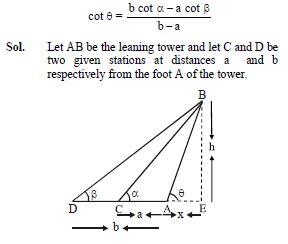
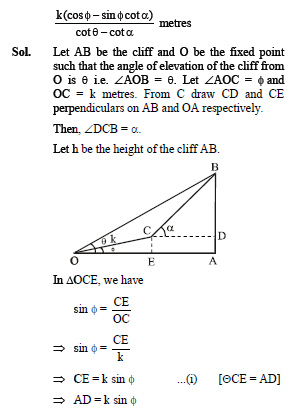
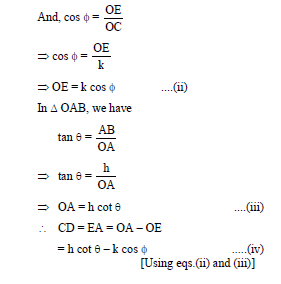
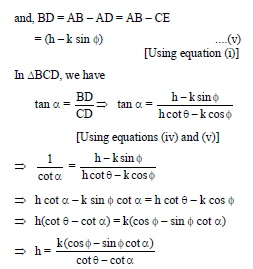
25. A vertical tower stands on a horizontal plane and is surmounted by a vertical flag staff of height h m.At a point on the plane, the angles of elevation of the bottom and the top of the flag staff are, respectively. Prove that the height of the tower is
26. The angle of elevation of a cloud from a point 60m above a lake is 30◦ and the angle of depression of the reflection of the cloud in the lake is 60°. Find the height of the cloud from the surface of the lake.
27. A round balloon of radius r subtends on angle α at the eye of the observer whose angle of elevation of centre is β . Prove that the height of the Centre of the balloon is (r sin β. Cosec α/2)
28. . A person standing on the bank of a river observes that the angle of elevation of top of building of an organization working for conservation of wild life. Standing on the opposite bank is 60o. When he moves 40m away from the bank, he finds the angle of elevation to be 30o. Find the height of the building and width of the river.
(a) Why do we need to conserve the wild life?
(b) Suggest some steps that can be taken to conserve wild life.
Activities
a. To make mathematical instrument eliminator ( or Sextant) for measuring the angle of elevation and depression of an object
b. To Calculate the height of an object making use of Clinometer ( or Sextant)
Key Points
Line of Sight
The line of sight is defined as the straight line segment that connects the eye of an observer to the object being viewed.
Angle of Elevation
When an observer looks upwards to view an object situated above the horizontal level, the angle formed between the line of sight and the horizontal line of reference is called the angle of elevation.
Angle of Depression
When an observer looks downwards to view an object situated below the horizontal level, the angle formed between the line of sight and the horizontal line of reference is called the angle of depression.
LEVEL- I
Question 1. A pole 6cm high casts a shadow 2√3m long on the ground, then find the sun’s elevation?
Answer: Let the angle of elevation of the sun be \( \theta \).
Using the trigonometric ratio for tangent:
\[ \tan \theta = \frac{\text{Height of the pole}}{\text{Length of the shadow}} \]
Substitute the given values (assuming both are in consistent units):
\[ \tan \theta = \frac{6}{2\sqrt{3}} \]
\[ \tan \theta = \frac{3}{\sqrt{3}} = \sqrt{3} \]
Since \( \tan(60^\circ) = \sqrt{3} \), we have:
\[ \theta = 60^\circ \]
Therefore, the sun's elevation is \( 60^\circ \).
In simple words: The ratio of the pole's height to its shadow's length gives the tangent of the angle of elevation. Since this ratio simplifies to \( \sqrt{3} \), the angle of elevation of the sun is 60 degrees.
Exam Tip: Always make sure to write down the trigonometric formula used before substituting the values to ensure full credit for steps.
Question 2. If length of the shadow and height of a tower are in the ratio 1:1. Then find the angle of elevation.
Answer: Let the height of the tower be \( h \) and the length of its shadow be \( s \).
We are given the ratio:
\[ \frac{s}{h} = \frac{1}{1} \implies s = h \]
Let the angle of elevation be \( \theta \).
Using the tangent ratio:
\[ \tan \theta = \frac{\text{Height of the tower}}{\text{Length of the shadow}} \]
\[ \tan \theta = \frac{h}{h} = 1 \]
Since \( \tan(45^\circ) = 1 \), we have:
\[ \theta = 45^\circ \]
Therefore, the angle of elevation is \( 45^\circ \).
In simple words: When the height of an object and the length of its shadow are equal, the angle of elevation of the sun is always exactly 45 degrees.
Exam Tip: A 1:1 ratio forms an isosceles right-angled triangle, where the acute angles are always \( 45^\circ \).
Question 3. An observer 1.5m tall is 20.5 metres away from a tower 22m high. Determine the angle of elevation of the top of the tower from the eye of the observer.
Answer: Let the angle of elevation of the top of the tower from the observer's eye level be \( \theta \).
- Height of the tower above the observer's eye level = \( 22\text{ m} - 1.5\text{ m} = 20.5\text{ m} \)
- Horizontal distance from the observer to the tower = \( 20.5\text{ m} \)
Using the tangent ratio:
\[ \tan \theta = \frac{\text{Height of tower above eye level}}{\text{Horizontal distance}} \]
\[ \tan \theta = \frac{20.5}{20.5} = 1 \]
Since \( \tan(45^\circ) = 1 \), we have:
\[ \theta = 45^\circ \]
Therefore, the angle of elevation of the top of the tower is \( 45^\circ \).
In simple words: Since the observer's height reduces the effective height of the tower to 20.5 meters, the remaining height is equal to the distance from the tower. This makes the angle of elevation 45 degrees.
Exam Tip: Always subtract the observer's height from the total height of the building or tower to find the correct perpendicular distance for the trigonometric calculations.
Question 4. A ladder 15m long just reaches the top of vertical wall. If the ladder makes an angle 600 with the wall, find the height of the wall
Answer: Let the height of the wall be \( h \).
The ladder of length 15 m acts as the hypotenuse of a right-angled triangle, and the angle it makes with the vertical wall is \( 60^\circ \).
Using the cosine ratio:
\[ \cos(60^\circ) = \frac{\text{Height of the wall (Adjacent)}}{\text{Length of the ladder (Hypotenuse)}} \]
\[ \cos(60^\circ) = \frac{h}{15} \]
Since \( \cos(60^\circ) = \frac{1}{2} \):
\[ \frac{1}{2} = \frac{h}{15} \]
\[ h = \frac{15}{2} = 7.5\text{ m} \]
Therefore, the height of the wall is 7.5 m.
In simple words: Using the angle of 60 degrees that the ladder makes with the wall, we apply the cosine ratio to find that the wall is 7.5 meters high.
Exam Tip: Pay close attention to whether the angle is made "with the wall" (use cosine) or "with the ground" (use sine) to find the height.
Question 5. In a rectangle ABCD, AB =20cm ∟BAC=600 then find the length of the side AD.
Answer: In rectangle \( ABCD \), we know that opposite sides are equal, so \( AD = BC \).
In right-angled triangle \( ABC \) (right-angled at \( B \)):
\[ \tan(\angle BAC) = \frac{\text{Opposite side (BC)}}{\text{Adjacent side (AB)}} \]
\[ \tan(60^\circ) = \frac{BC}{20} \]
Since \( \tan(60^\circ) = \sqrt{3} \):
\[ \sqrt{3} = \frac{BC}{20} \implies BC = 20\sqrt{3}\text{ cm} \]
Since \( AD = BC \), we have \( AD = 20\sqrt{3}\text{ cm} \).
Therefore, the length of the side \( AD \) is \( 20\sqrt{3}\text{ cm} \).
In simple words: Using the tangent ratio for the given 60-degree angle in the right triangle ABC, we find side BC is \( 20\sqrt{3} \) cm, which is equal to the side AD.
Exam Tip: Remember to use properties of rectangles (opposite sides are equal) to relate your calculated side to the requested side.
Question 6. Find the angle of elevation of the sun’s altitude when the height of the shadow of a vertical pole is equal to its height:
Answer: Let the height of the vertical pole be \( h \) and the length of its shadow be \( s \).
According to the problem, the height of the shadow is equal to the height of the pole:
\[ s = h \]
Let \( \theta \) be the angle of elevation of the sun.
Using the tangent ratio:
\[ \tan \theta = \frac{\text{Height of the pole}}{\text{Length of the shadow}} \]
\[ \tan \theta = \frac{h}{h} = 1 \]
Since \( \tan(45^\circ) = 1 \):
\[ \theta = 45^\circ \]
Therefore, the angle of elevation of the sun is \( 45^\circ \).
In simple words: When the shadow of a vertical pole has the same length as the pole itself, the angle of elevation of the sun is exactly 45 degrees.
Exam Tip: This basic concept is a frequent 1-mark question; remember that equal sides in a right triangle always form \( 45^\circ \) angles.
Question 7. From a point 20m away from the foot of a tower, the angle of elevation of top of the tower is 30°, find the height of the tower.
Answer: Let the height of the tower be \( h \).
In the right-angled triangle formed by the tower and the ground:
- Horizontal distance to the point = 20 m
- Angle of elevation = \( 30^\circ \)
Using the tangent ratio:
\[ \tan(30^\circ) = \frac{\text{Height of the tower}}{\text{Distance from foot}} \]
\[ \tan(30^\circ) = \frac{h}{20} \]
Since \( \tan(30^\circ) = \frac{1}{\sqrt{3}} \):
\[ \frac{1}{\sqrt{3}} = \frac{h}{20} \]
\[ h = \frac{20}{\sqrt{3}}\text{ m} \]
Rationalizing the denominator:
\[ h = \frac{20\sqrt{3}}{3}\text{ m} \approx 11.55\text{ m} \]
Therefore, the height of the tower is \( \frac{20\sqrt{3}}{3}\text{ m} \).
In simple words: Setting up the tangent ratio for a 30-degree angle with a base of 20 meters gives us a tower height of \( \frac{20}{\sqrt{3}} \) meters, which is approximately 11.55 meters.
Exam Tip: Always rationalize the denominator of your final answer to present it in standard mathematical form.
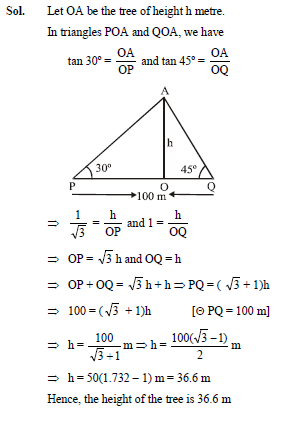
Question 8. In the adjacent figure, what are the angles of elevation and depression of the top and bottom of a pole from the top of a tower h m high:
Answer: Based on the provided geometric diagram:
- The line of sight from the top of the tower \( O \) to the top of the pole \( A \) is directed downwards relative to the horizontal, making the angle of depression of the top of the pole \( 45^\circ \) (as shown by alternate interior angles).
- The line of sight from the top of the tower \( O \) to the bottom of the pole \( B \) is directed further downwards, making the angle of depression of the bottom of the pole \( 60^\circ \).
Therefore, the angle of elevation of the top of the tower from the top of the pole is \( 45^\circ \) and the angle of depression of the bottom of the pole from the top of the tower is \( 60^\circ \).
In simple words: Looking down from the top of the tower, the angle of depression to the top of the pole is 45 degrees, and the angle of depression to the bottom of the pole is 60 degrees.
Exam Tip: Remember that the angle of depression from \( O \) to \( A \) is equal to the angle of elevation from \( A \) to \( O \) due to alternate interior angles.
LEVEL -II
Question 9. The length of the shadow of a pillar is √3 times its height. Find the angle of elevation of the source of light.
Answer: Let the height of the pillar be \( h \).
According to the problem, the length of the shadow is \( \sqrt{3} \) times the height:
\[ \text{Length of the shadow} = \sqrt{3}h \]
Let the angle of elevation of the sun be \( \theta \).
Using the tangent ratio:
\[ \tan \theta = \frac{\text{Height of the pillar}}{\text{Length of the shadow}} \]
\[ \tan \theta = \frac{h}{\sqrt{3}h} = \frac{1}{\sqrt{3}} \]
Since \( \tan(30^\circ) = \frac{1}{\sqrt{3}} \):
\[ \theta = 30^\circ \]
Therefore, the angle of elevation of the sun is \( 30^\circ \).
In simple words: The ratio of height to shadow is \( \frac{1}{\sqrt{3}} \). This matches the tangent of 30 degrees, meaning the sun's elevation angle is 30 degrees.
Exam Tip: Be familiar with standard values of trigonometric ratios (like \( 30^\circ \), \( 45^\circ \), and \( 60^\circ \)) as they are used in almost all height and distance problems.
Question 10. A vertical pole 10m long casts a shadow 10√3m long. At the same time tower casts a shadow 90m long. Determine the height of the tower.
Answer: Let the height of the tower be \( H \) meters.
Since both shadows are cast at the same time, the angle of elevation of the sun (\( \theta \)) is identical for both the pole and the tower.
For the vertical pole:
\[ \tan \theta = \frac{\text{Height of the pole}}{\text{Length of its shadow}} \]
\[ \tan \theta = \frac{10}{10\sqrt{3}} = \frac{1}{\sqrt{3}} \]
Since \( \tan \theta = \frac{1}{\sqrt{3}} \), the angle of elevation of the sun is \( 30^\circ \).
Now, for the tower:
\[ \tan(30^\circ) = \frac{\text{Height of the tower}}{\text{Length of its shadow}} \]
\[ \frac{1}{\sqrt{3}} = \frac{H}{90} \]
\[ H = \frac{90}{\sqrt{3}}\text{ m} \]
Rationalizing the denominator:
\[ H = 30\sqrt{3}\text{ m} \approx 51.96\text{ m} \]
Therefore, the height of the tower is \( 30\sqrt{3}\text{ m} \).
In simple words: Since the sun's angle of 30 degrees is the same for both, we apply it to the tower with its 90-meter shadow to find that the tower is \( 30\sqrt{3} \) meters (about 51.96 meters) tall.
Exam Tip: The phrase "at the same time" is a key indicator that the angle of elevation is constant for all objects in the scenario.
Question 11. A ladder 50m long just reaches the top of a vertical wall. If the ladder makes an angle of 600 with the wall, find the height of the wall.
Answer: Let the height of the vertical wall be \( h \).
The ladder of length 50 m represents the hypotenuse, and the angle it makes with the vertical wall at the top is \( 60^\circ \).
Using the cosine ratio:
\[ \cos(60^\circ) = \frac{\text{Height of the wall (Adjacent)}}{\text{Length of the ladder (Hypotenuse)}} \]
\[ \cos(60^\circ) = \frac{h}{50} \]
Since \( \cos(60^\circ) = \frac{1}{2} \):
\[ \frac{1}{2} = \frac{h}{50} \]
\[ h = \frac{50}{2} = 25\text{ m} \]
Therefore, the height of the wall is 25 m.
In simple words: The ladder makes a 60-degree angle with the wall. Using the cosine ratio with the 50-meter length of the ladder shows that the wall is 25 meters tall.
Exam Tip: Be careful not to assume the angle is always with the ground; reading the text carefully prevents substituting the wrong trigonometric ratio.
Question 12. Two poles of height 6m and 11m stands vertically on the ground. If the distance between their feet is 12m. Find the distance between their tops.
Answer: Let the distance between the tops of the poles be \( d \).
The difference in the heights of the two poles is:
\[ \Delta h = 11\text{ m} - 6\text{ m} = 5\text{ m} \]
The horizontal distance between the poles is 12 m.
These segments form a right-angled triangle where the legs are 5 m and 12 m, and the hypotenuse is the distance between the tops.
Using Pythagoras' theorem:
\[ d = \sqrt{5^2 + 12^2} \]
\[ d = \sqrt{25 + 144} = \sqrt{169} = 13\text{ m} \]
Therefore, the distance between their tops is 13 m.
In simple words: Drawing a horizontal line from the top of the shorter pole creates a right-angled triangle with sides of 5 meters and 12 meters. The distance between the tops is the hypotenuse, which is 13 meters.
Exam Tip: This problem is easily solved by using the standard Pythagorean triplet (5, 12, 13) to save time on calculations.
Question 13. The shadow of tower, when the angle of elevation of the sun is 45o is found to be 10m longer than when it is 60o. Find the height of the tower.
Answer: Let the height of the tower be \( h \) meters.
Let the length of the shadow when the angle of elevation is \( 60^\circ \) be \( x \) meters.
In the right-angled triangle with a \( 60^\circ \) angle of elevation:
\[ \tan(60^\circ) = \frac{h}{x} \implies \sqrt{3} = \frac{h}{x} \implies x = \frac{h}{\sqrt{3}} \tag{Equation 1} \]
In the right-angled triangle with a \( 45^\circ \) angle of elevation:
The shadow is \( 10\text{ m} \) longer, so the total shadow length is \( x + 10 \) meters.
\[ \tan(45^\circ) = \frac{h}{x + 10} \]
Since \( \tan(45^\circ) = 1 \):
\[ 1 = \frac{h}{x + 10} \implies h = x + 10 \tag{Equation 2} \]
Substitute Equation 1 into Equation 2:
\[ h = \frac{h}{\sqrt{3}} + 10 \]
\[ h - \frac{h}{\sqrt{3}} = 10 \]
\[ h\left(1 - \frac{1}{\sqrt{3}}\right) = 10 \implies h\left(\frac{\sqrt{3} - 1}{\sqrt{3}}\right) = 10 \]
\[ h = \frac{10\sqrt{3}}{\sqrt{3} - 1} \]
Rationalizing the denominator:
\[ h = \frac{10\sqrt{3}(\sqrt{3} + 1)}{(\sqrt{3} - 1)(\sqrt{3} + 1)} = \frac{30 + 10\sqrt{3}}{2} = 15 + 5\sqrt{3}\text{ m} \]
Using \( \sqrt{3} \approx 1.732 \):
\[ h \approx 15 + 5(1.732) = 15 + 8.66 = 23.66\text{ m} \]
Therefore, the height of the tower is \( 15 + 5\sqrt{3}\text{ m} \) (approximately 23.66 m).
In simple words: We set up equations for both angles of elevation. Solving for the tower's height yields \( 15 + 5\sqrt{3} \) meters, which is approximately 23.66 meters.
Exam Tip: Always show the rationalization steps for the denominator to ensure you receive full marks for algebraic working.
LEVEL –III
Question 14. The angle of depression of the top and bottom of a tower as seen from the top of a 100m high cliff are 300 and 600 respectively. Find the height of the tower.
Answer: Let the height of the tower be \( h \) meters and the horizontal distance between the cliff and the tower be \( d \) meters.
The cliff has a height of 100 m.
1. **For the bottom of the tower (angle of depression of \( 60^\circ \)):**
\[ \tan(60^\circ) = \frac{100}{d} \]
\[ \sqrt{3} = \frac{100}{d} \implies d = \frac{100}{\sqrt{3}}\text{ m} \]
2. **For the top of the tower (angle of depression of \( 30^\circ \)):**
The height of the cliff above the top of the tower is \( 100 - h \).
\[ \tan(30^\circ) = \frac{100 - h}{d} \]
\[ \frac{1}{\sqrt{3}} = \frac{100 - h}{\frac{100}{\sqrt{3}}} \]
\[ \frac{1}{\sqrt{3}} \times \frac{100}{\sqrt{3}} = 100 - h \]
\[ \frac{100}{3} = 100 - h \]
\[ h = 100 - 33.33 = 66.67\text{ m} \]
Therefore, the height of the tower is 66.67 m.
In simple words: The angle of depression to the bottom of the tower gives the horizontal distance between them. Using this distance with the angle to the top of the tower, we find the tower's height is 66.67 meters.
Exam Tip: Drawing a neat, labeled diagram showing the horizontal levels from the top of the cliff is essential for setting up these multi-angle equations.
Question 15. From a window (9m above ground) of a house in a street, the angles of elevation and depression of the top and foot of another house on the opposite side of the street are 300 and 600 respectively. Find the height of the opposite house and width of the street.
Answer: Let the width of the street be \( w \) meters.
From the window which is 9 m above the ground, the angle of depression of the foot of the opposite house is \( 60^\circ \).
Using the tangent ratio:
\[ \tan(60^\circ) = \frac{\text{Height of the window}}{\text{Width of the street}} \]
\[ \sqrt{3} = \frac{9}{w} \implies w = \frac{9}{\sqrt{3}} = 3\sqrt{3}\text{ m} \approx 5.20\text{ m} \]
Now, let the height of the opposite house above the window level be \( y \) meters.
The angle of elevation of the top of the opposite house is \( 30^\circ \).
\[ \tan(30^\circ) = \frac{y}{w} \]
\[ \frac{1}{\sqrt{3}} = \frac{y}{3\sqrt{3}} \implies y = 3\text{ m} \]
The total height of the opposite house is:
\[ \text{Total Height} = y + 9\text{ m} = 3\text{ m} + 9\text{ m} = 12\text{ m} \]
Therefore, the height of the opposite house is 12 m and the width of the street is \( 3\sqrt{3}\text{ m} \) (approximately 5.2 m).
In simple words: The 60-degree angle of depression gives a street width of \( 3\sqrt{3} \) meters. Applying the 30-degree angle of elevation shows that the opposite house is 3 meters taller than the window level, making its total height 12 meters.
Exam Tip: Be sure to write separate concluding lines for both requested quantities (height of the house and width of the street) along with their units.
Question 16. From the top of a hill, the angle of depression of two consecutive kilometer stones due east are found to be 300 and 450. Find the height of the hill.
Answer: Let the height of the hill be \( h \) km.
The two consecutive kilometer stones are separated by a distance of 1 km.
Let the distance from the foot of the hill to the closer stone (with an angle of depression of \( 45^\circ \)) be \( d \) km.
For the closer stone:
\[ \tan(45^\circ) = \frac{h}{d} \implies 1 = \frac{h}{d} \implies d = h \]
For the farther stone (with an angle of depression of \( 30^\circ \)):
The total distance from the hill to this stone is \( d + 1 = h + 1 \) km.
\[ \tan(30^\circ) = \frac{h}{h + 1} \]
\[ \frac{1}{\sqrt{3}} = \frac{h}{h + 1} \]
\[ h + 1 = \sqrt{3}h \implies h(\sqrt{3} - 1) = 1 \]
\[ h = \frac{1}{\sqrt{3} - 1} \]
Rationalizing the denominator:
\[ h = \frac{\sqrt{3} + 1}{(\sqrt{3} - 1)(\sqrt{3} + 1)} = \frac{\sqrt{3} + 1}{2}\text{ km} \]
Using \( \sqrt{3} \approx 1.732 \):
\[ h \approx \frac{1.732 + 1}{2} = 1.366\text{ km} = 1366\text{ m} \]
Therefore, the height of the hill is approximately 1.366 km (or 1366 m).
In simple words: The closer stone's 45-degree angle tells us its distance from the hill equals the hill's height. Using this in our 30-degree equation for the farther stone, we find the hill is approximately 1.366 km high.
Exam Tip: "Consecutive kilometer stones" implies that the distance between the two targets on the ground is exactly 1 km (1000 m).
Question 17. Two poles of equal heights are standing opposite each other on either side of the road, which is 80m wide. From a point between them on the road the angles of elevation of the top of the poles are 60◦ and 30◦. Find the heights of pole and the distance of the point from the poles.
Answer: Let the height of each pole be \( h \) meters.
The width of the road is 80 m.
Let the distance from the point to the foot of the closer pole (with a \( 60^\circ \) elevation angle) be \( x \) meters.
Therefore, the distance from the point to the other pole is \( 80 - x \) meters.
1. **For the closer pole:**
\[ \tan(60^\circ) = \frac{h}{x} \implies \sqrt{3} = \frac{h}{x} \implies h = \sqrt{3}x \tag{Equation 1} \]
2. **For the farther pole:**
\[ \tan(30^\circ) = \frac{h}{80 - x} \implies \frac{1}{\sqrt{3}} = \frac{h}{80 - x} \tag{Equation 2} \]
Substitute Equation 1 into Equation 2:
\[ \frac{1}{\sqrt{3}} = \frac{\sqrt{3}x}{80 - x} \]
\[ 80 - x = 3x \implies 4x = 80 \implies x = 20\text{ m} \]
The distance of the point from the poles is 20 m and \( 80 - 20 = 60\text{ m} \).
Now, find the height of the poles using Equation 1:
\[ h = \sqrt{3} \times 20 = 20\sqrt{3}\text{ m} \approx 34.64\text{ m} \]
Therefore, the height of each pole is \( 20\sqrt{3}\text{ m} \) (approximately 34.64 m), and the point is located 20 m from one pole and 60 m from the other.
In simple words: Solving the equations for both poles shows the point is 20 meters from the closer pole and 60 meters from the other. The height of the equal-length poles is \( 20\sqrt{3} \) meters.
Exam Tip: Be sure to calculate both distances from the point to each of the two poles to complete the answer.
Question 18. The angle of elevation of a jet fighter from a point A on the ground is 600. After a flight of 15 seconds, the angle of elevation changes to 30◦. If the jet is flying at a speed of 720km/ hr, find the constant height at which the jet is flying.
Answer: First, convert the speed of the jet from km/hr to m/s:
\[ \text{Speed} = 720 \times \frac{5}{18} = 200\text{ m/s} \]
The distance traveled by the jet in 15 seconds is:
\[ \text{Distance} = \text{Speed} \times \text{Time} = 200 \times 15 = 3000\text{ m} \]
Let the constant height of the jet be \( h \) meters and let the initial horizontal distance from point A be \( x \) meters.
1. **For the initial elevation angle of \( 60^\circ \):**
\[ \tan(60^\circ) = \frac{h}{x} \implies \sqrt{3} = \frac{h}{x} \implies x = \frac{h}{\sqrt{3}} \tag{Equation 1} \]
2. **For the subsequent elevation angle of \( 30^\circ \):**
The new horizontal distance is \( x + 3000 \).
\[ \tan(30^\circ) = \frac{h}{x + 3000} \implies \frac{1}{\sqrt{3}} = \frac{h}{x + 3000} \]
\[ x + 3000 = h\sqrt{3} \tag{Equation 2} \]
Substitute Equation 1 into Equation 2:
\[ \frac{h}{\sqrt{3}} + 3000 = h\sqrt{3} \]
Multiply the entire equation by \( \sqrt{3} \):
\[ h + 3000\sqrt{3} = 3h \]
\[ 2h = 3000\sqrt{3} \implies h = 1500\sqrt{3}\text{ m} \]
Using \( \sqrt{3} \approx 1.732 \):
\[ h \approx 1500 \times 1.732 = 2598\text{ m} \]
Therefore, the constant height at which the jet is flying is \( 1500\sqrt{3}\text{ m} \) (approximately 2598 m).
In simple words: The jet covers 3000 meters in 15 seconds. Solving the equations for both elevation angles shows that the jet maintains a constant altitude of \( 1500\sqrt{3} \) meters (about 2598 m).
Exam Tip: Speed unit conversion is the first critical step; always convert km/hr to m/s before combining with time in seconds.
Question 19. A window in a building is at a height of 10m above the ground. The angle of depression of a point P on the ground from the window is 300. The angle of elevation of the top of the building from the point P is 600. Find the height of the building.
Answer: Let the height of the building be \( H \) meters and the horizontal distance of point P from the base of the building be \( d \) meters.
For the window which is 10 m high:
The angle of depression of point P is \( 30^\circ \), which means the angle of elevation of the window from point P is also \( 30^\circ \).
\[ \tan(30^\circ) = \frac{10}{d} \]
\[ \frac{1}{\sqrt{3}} = \frac{10}{d} \implies d = 10\sqrt{3}\text{ m} \]
For the top of the building:
The angle of elevation of the top from point P is \( 60^\circ \).
\[ \tan(60^\circ) = \frac{H}{d} \]
\[ \sqrt{3} = \frac{H}{10\sqrt{3}} \]
\[ H = 10\sqrt{3} \times \sqrt{3} = 10 \times 3 = 30\text{ m} \]
Therefore, the height of the building is 30 m.
In simple words: The 30-degree angle from the 10-meter window tells us point P is \( 10\sqrt{3} \) meters away. Using this distance with the 60-degree angle of elevation to the top of the building shows the building is 30 meters tall.
Exam Tip: Use the horizontal distance \( d \) as a bridge variable to link the two right-angled triangles together.
Question 20. A boy, whose eye level is 1.3m from the ground, spots a balloon moving with the wind in a horizontal line at same height from the ground. The angle of elevation of the balloon from the eyes of the boy at any instant is 600. After 2 seconds, the angle of elevation reduces to 300 if the speed of the wind at that moment is 29√3 m/s, then find the height of the balloon from the ground.
Answer: First, find the distance traveled by the balloon in 2 seconds at the wind speed of \( 29\sqrt{3}\text{ m/s} \):
\[ \text{Distance} = 29\sqrt{3} \times 2 = 58\sqrt{3}\text{ m} \]
Let the height of the balloon above the boy's eye level be \( h \) meters and let the initial horizontal distance be \( x \) meters.
1. **For the first angle of elevation \( 60^\circ \):**
\[ \tan(60^\circ) = \frac{h}{x} \implies \sqrt{3} = \frac{h}{x} \implies x = \frac{h}{\sqrt{3}} \tag{Equation 1} \]
2. **For the second angle of elevation \( 30^\circ \):**
The horizontal distance increases by the distance traveled by the balloon:
\[ \tan(30^\circ) = \frac{h}{x + 58\sqrt{3}} \implies \frac{1}{\sqrt{3}} = \frac{h}{x + 58\sqrt{3}} \]
\[ x + 58\sqrt{3} = h\sqrt{3} \tag{Equation 2} \]
Substitute Equation 1 into Equation 2:
\[ \frac{h}{\sqrt{3}} + 58\sqrt{3} = h\sqrt{3} \]
Multiply the entire equation by \( \sqrt{3} \):
\[ h + 58 \times 3 = 3h \]
\[ 2h = 174 \implies h = 87\text{ m} \]
The total height of the balloon from the ground includes the boy's eye level height:
\[ \text{Total Height} = h + 1.3\text{ m} = 87\text{ m} + 1.3\text{ m} = 88.3\text{ m} \]
Therefore, the height of the balloon from the ground is 88.3 m.
In simple words: The balloon travels \( 58\sqrt{3} \) meters in 2 seconds. Solving the elevation equations shows the balloon is 87 meters above the boy's eyes, making its total height from the ground 88.3 meters.
Exam Tip: Never forget to add the observer's eye-level height (\( 1.3\text{ m} \)) to the calculated perpendicular height \( h \) at the very end to get the final height from the ground.
Question 21. A man on the deck on a ship 14m above water level observes that the angle of elevation of the top of a cliff is 600and the angle of depression of the base of the cliff is 300. Calculate the distance of the cliff from the ship and the height of the cliff.
Answer: Let the distance of the cliff from the ship be \( d \) meters.
From the deck 14 m above water level, the angle of depression of the base of the cliff is \( 30^\circ \).
Using the tangent ratio:
\[ \tan(30^\circ) = \frac{14}{d} \]
\[ \frac{1}{\sqrt{3}} = \frac{14}{d} \implies d = 14\sqrt{3}\text{ m} \approx 24.25\text{ m} \]
Now, let the height of the cliff above the deck level be \( x \) meters.
The angle of elevation of the top of the cliff is \( 60^\circ \).
\[ \tan(60^\circ) = \frac{x}{d} \]
\[ \sqrt{3} = \frac{x}{14\sqrt{3}} \implies x = 14 \times 3 = 42\text{ m} \]
The total height of the cliff is:
\[ \text{Total Height} = x + 14\text{ m} = 42\text{ m} + 14\text{ m} = 56\text{ m} \]
Therefore, the distance of the cliff from the ship is \( 14\sqrt{3}\text{ m} \) (approximately 24.25 m) and the total height of the cliff is 56 m.
In simple words: The 30-degree depression angle shows the cliff is \( 14\sqrt{3} \) meters away. Using this distance with the 60-degree elevation angle shows the cliff is 42 meters taller than the deck, making its total height 56 meters.
Exam Tip: Be sure to write separate concluding lines for both the distance of the cliff and the total height of the cliff, including their units.
Question 22. A tower is 50m high. It’s shadow is x m shorter when the sun’s altitude is 45o than when it is 30o. Find x correct to the nearest 10.
Answer: Let the height of the tower be 50 m.
- Let the length of the shadow when the sun's altitude is \( 30^\circ \) be \( s_1 \).
\[ \cot(30^\circ) = \frac{s_1}{50} \implies s_1 = 50\sqrt{3}\text{ m} \]
- Let the length of the shadow when the sun's altitude is \( 45^\circ \) be \( s_2 \).
\[ \cot(45^\circ) = \frac{s_2}{50} \implies s_2 = 50(1) = 50\text{ m} \]
The difference in shadow lengths is \( x \):
\[ x = s_1 - s_2 = 50\sqrt{3} - 50 = 50(\sqrt{3} - 1)\text{ m} \]
Substitute \( \sqrt{3} \approx 1.732 \):
\[ x \approx 50(1.732 - 1) = 50(0.732) = 36.6\text{ m} \]
Rounding 36.6 m to the nearest 10 gives 40 m.
Therefore, the value of \( x \) correct to the nearest 10 is 40 m.
In simple words: We find the shadow lengths at both angles (approx 86.6 meters and 50 meters). The difference is 36.6 meters, which rounds to 40 meters when correct to the nearest ten.
Exam Tip: Pay close attention to rounding instructions; "correct to the nearest 10" means rounding to the nearest multiple of ten, not the nearest decimal place.
SELF EVALUATION/HOTS
Question 23. An airplane when flying at a height of 3125m from the ground passes vertically below another Plane at an instant when the angle of elevation of the two planes from the same point on the ground are 30°and 60° respectively. Find the distance between the two planes at that instant.
Answer: Let the height of the lower airplane be \( h_1 = 3125\text{ m} \), and the height of the upper airplane directly above it be \( h_2 \) meters. Let the horizontal distance from the observer to the position directly below the planes be \( d \) meters.
1. **For the lower airplane (elevation of \( 30^\circ \)):**
\[ \tan(30^\circ) = \frac{3125}{d} \]
\[ \frac{1}{\sqrt{3}} = \frac{3125}{d} \implies d = 3125\sqrt{3}\text{ m} \]
2. **For the upper airplane (elevation of \( 60^\circ \)):**
\[ \tan(60^\circ) = \frac{h_2}{d} \]
\[ \sqrt{3} = \frac{h_2}{3125\sqrt{3}} \implies h_2 = 3125 \times 3 = 9375\text{ m} \]
The distance between the two airplanes at that instant is:
\[ \Delta h = h_2 - h_1 = 9375\text{ m} - 3125\text{ m} = 6250\text{ m} \]
Therefore, the distance between the two planes is 6250 m.
In simple words: The lower plane's 30-degree angle shows the observer is \( 3125\sqrt{3} \) meters away. Using this distance with the 60-degree angle for the higher plane shows its altitude is 9375 meters, giving a separation of 6250 meters.
Exam Tip: Solve for the shared horizontal distance \( d \) first to easily transition between the calculations for the two altitudes.
Question 24. From the top of a building 60m high, the angels of depression of the top and bottom of a vertical lamp post are observed to be 30° and 60°respectively. Find [I] horizontal distance between the building and the lamp post [ii] height of the lamp post.
Answer: Let the horizontal distance be \( d \) meters and the height of the lamp post be \( h \) meters.
[i] **To find the horizontal distance:**
From the top of the 60 m high building, the angle of depression of the bottom of the lamp post is \( 60^\circ \).
Using the tangent ratio:
\[ \tan(60^\circ) = \frac{60}{d} \]
\[ \sqrt{3} = \frac{60}{d} \implies d = \frac{60}{\sqrt{3}} = 20\sqrt{3}\text{ m} \approx 34.64\text{ m} \]
[ii] **To find the height of the lamp post:**
The angle of depression of the top of the lamp post is \( 30^\circ \).
The height of the building above the top of the lamp post is \( 60 - h \).
\[ \tan(30^\circ) = \frac{60 - h}{d} \]
\[ \frac{1}{\sqrt{3}} = \frac{60 - h}{20\sqrt{3}} \]
\[ 20 = 60 - h \implies h = 40\text{ m} \]
Therefore, the horizontal distance is \( 20\sqrt{3}\text{ m} \) (approximately 34.64 m) and the height of the lamp post is 40 m.
In simple words: The 60-degree angle to the base shows the distance is \( 20\sqrt{3} \) meters. Using this with the 30-degree angle to the top shows the lamp post is 40 meters tall.
Exam Tip: Be sure to write separate concluding lines for both part [i] and part [ii], including their respective units.
Question 25. A vertical tower stands on a horizontal plane and is surmounted by a vertical flag staff of height h m.At a point on the plane, the angles of elevation of the bottom and the top of the flag staff are \( \alpha \) and \( \beta \), respectively. Prove that the height of the tower is \( \frac{h \tan \alpha}{\tan \beta - \tan \alpha} \)
Answer: Let the height of the tower be \( H \) meters and the height of the flag staff be \( h \) meters.
Let the point on the ground be at a horizontal distance \( d \) meters from the base of the tower.
1. **For the angle of elevation of the bottom of the flag staff (\( \alpha \)):**
\[ \tan \alpha = \frac{H}{d} \implies d = \frac{H}{\tan \alpha} \tag{Equation 1} \]
2. **For the angle of elevation of the top of the flag staff (\( \beta \)):**
The total height is \( H + h \).
\[ \tan \beta = \frac{H + h}{d} \implies d = \frac{H + h}{\tan \beta} \tag{Equation 2} \]
Equating the two expressions for \( d \):
\[ \frac{H}{\tan \alpha} = \frac{H + h}{\tan \beta} \]
\[ H \tan \beta = H \tan \alpha + h \tan \alpha \]
\[ H \tan \beta - H \tan \alpha = h \tan \alpha \]
\[ H(\tan \beta - \tan \alpha) = h \tan \alpha \]
\[ H = \frac{h \tan \alpha}{\tan \beta - \tan \alpha} \]
Hence, proven.
In simple words: We find the horizontal distance d using both elevation angles. Setting these two expressions equal to each other lets us solve for the tower's height H in terms of h, \( \alpha \), and \( \beta \).
Exam Tip: This is a standard trigonometric derivation; write out each step clearly to show the algebraic rearrangements leading to the final proven expression.
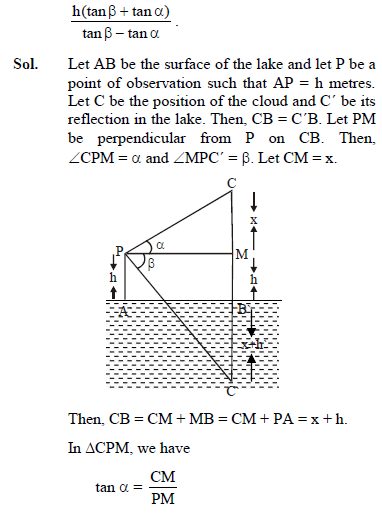
Question 26. The angle of elevation of a cloud from a point 60m above a lake is 30◦ and the angle of depression of the reflection of the cloud in the lake is 60°. Find the height of the cloud from the surface of the lake.
Answer: Let the height of the cloud above the surface of the lake be \( H \) meters.
Since the observation point is 60 m above the lake:
- Height of the cloud above the observation level = \( H - 60 \) meters
- Depth of the reflection below the lake surface is also \( H \) meters (due to properties of reflection).
- Depth of the reflection below the observation level = \( H + 60 \) meters.
Let the horizontal distance from the observation point to the cloud be \( x \) meters.
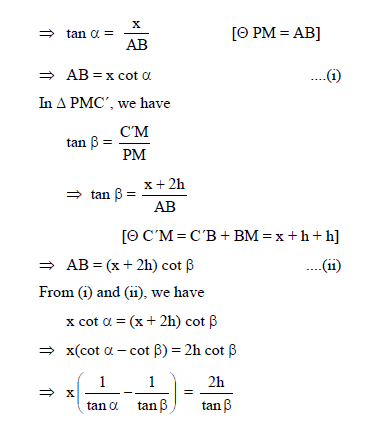
1. **For the angle of elevation of \( 30^\circ \) to the cloud:**
\[ \tan(30^\circ) = \frac{H - 60}{x} \implies x = \sqrt{3}(H - 60) \tag{Equation 1} \]
2. **For the angle of depression of \( 60^\circ \) to the reflection:**
\[ \tan(60^\circ) = \frac{H + 60}{x} \implies x = \frac{H + 60}{\sqrt{3}} \tag{Equation 2} \]
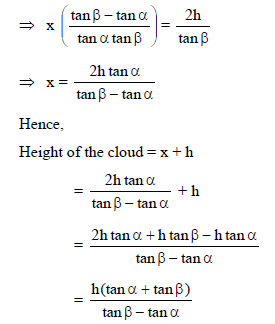
Equating the two expressions for \( x \):
\[ \sqrt{3}(H - 60) = \frac{H + 60}{\sqrt{3}} \]
\[ 3(H - 60) = H + 60 \]
\[ 3H - 180 = H + 60 \]
\[ 2H = 240 \implies H = 120\text{ m} \]
Therefore, the height of the cloud from the surface of the lake is 120 m.
In simple words: We set up equations for both the elevation of the cloud and the depression of its reflection. Equating the horizontal distances reveals that the cloud's altitude is 120 meters above the lake.
Exam Tip: Remember that the height of the cloud above the lake surface is equal to the depth of its reflection below the lake surface; this is the key physical property used to solve this problem.
Question 27. A round balloon of radius r subtends on angle α at the eye of the observer whose angle of elevation of centre is β . Prove that the height of the Centre of the balloon is (r sin β. Cosec α/2)
Answer: Let the center of the balloon be \( C \) and let the observer's eye level be at point \( O \).
The balloon of radius \( r \) subtends an angle \( \alpha \) at the eye \( O \). Let \( T \) be the point of contact of one of the tangents from \( O \) to the balloon.
The line \( OC \) bisects \( \angle \alpha \), so \( \angle TOC = \frac{\alpha}{2} \).
In right-angled \( \Delta OTC \) (where \( \angle OTC = 90^\circ \)):
\[ \sin\left(\frac{\alpha}{2}\right) = \frac{\text{Opposite (CT)}}{\text{Hypotenuse (OC)}} = \frac{r}{OC} \]
\[ OC = \frac{r}{\sin\left(\frac{\alpha}{2}\right)} = r \csc\left(\frac{\alpha}{2}\right) \tag{Equation 1} \]
Now, let \( h \) be the perpendicular height of the center \( C \) of the balloon from the ground.
The angle of elevation of the center \( C \) from \( O \) is \( \beta \).
In the right-angled triangle formed by \( C \), the observer, and the horizontal:
\[ \sin \beta = \frac{h}{OC} \implies h = OC \sin \beta \tag{Equation 2} \]
Substitute Equation 1 into Equation 2:
\[ h = \left[ r \csc\left(\frac{\alpha}{2}\right) \right] \sin \beta = r \sin \beta \csc\left(\frac{\alpha}{2}\right) \]
Hence, proven.
In simple words: The angle subtended by the balloon gives the distance from the observer's eye to the center \( OC = r \csc(\alpha/2) \). Combining this with the angle of elevation \( \beta \) gives the height \( h = r \sin \beta \csc(\alpha/2) \).
Exam Tip: Be sure to draw a neat diagram showing the tangent contacts and how \( \alpha \) is split in half by the line of symmetry \( OC \).
Question 28. . A person standing on the bank of a river observes that the angle of elevation of top of building of an organization working for conservation of wild life. Standing on the opposite bank is 60o. When he moves 40m away from the bank, he finds the angle of elevation to be 30o. Find the height of the building and width of the river.
(a) Why do we need to conserve the wild life?
(b) Suggest some steps that can be taken to conserve wild life.
Answer: Let the height of the building be \( h \) meters and the width of the river be \( w \) meters.
1. **From the opposite bank (elevation of \( 60^\circ \)):**
\[ \tan(60^\circ) = \frac{h}{w} \implies \sqrt{3} = \frac{h}{w} \implies h = \sqrt{3}w \tag{Equation 1} \]
2. **When moving 40 m away (elevation of \( 30^\circ \)):**
The new distance is \( w + 40 \).
\[ \tan(30^\circ) = \frac{h}{w + 40} \implies \frac{1}{\sqrt{3}} = \frac{\sqrt{3}w}{w + 40} \]
\[ w + 40 = 3w \implies 2w = 40 \implies w = 20\text{ m} \]
Substitute \( w = 20 \) into Equation 1:
\[ h = 20\sqrt{3}\text{ m} \approx 34.64\text{ m} \]
Therefore, the height of the building is \( 20\sqrt{3}\text{ m} \) (approximately 34.64 m) and the width of the river is 20 m.
(a) We need to conserve wildlife to maintain ecological balance, support biodiversity, ensure food chain stability, and preserve the natural habitats that are essential for life on Earth.
(b) Steps to conserve wildlife include establishing protected reserves and sanctuaries, enforcing strict laws against illegal poaching, reducing habitat destruction, and raising environmental awareness.
In simple words: Setting up equations for the bank and a point 40 meters further back gives a river width of 20 meters and a building height of \( 20\sqrt{3} \) meters. Conserving wildlife is critical for maintaining balance on our planet.
Exam Tip: In value-based questions, make sure to write brief and thoughtful answers for sub-parts (a) and (b) to secure full marks.
Free study material for Mathematics
CBSE Class 10 Mathematics Worksheets for Chapter 09 Some Applications of Trigonometry
Daily Practice Questions for Class 10 Mathematics
Explore reliable practice questions for Chapter 09 Some Applications of Trigonometry tailored for Class 10 Mathematics learners. Use these structured worksheets to evaluate exam preparedness and strengthen problem-solving skills throughout the 2026 academic session.
Detailed Answers for Class 10 Mathematics Chapter 09 Some Applications of Trigonometry
Designed around the official curriculum for Class 10 Mathematics, these practice sheets guarantee standard compliance. Reviewing step-by-step solutions after completion sharpens your accuracy and clarifies complex sub-topics within Chapter 09 Some Applications of Trigonometry.
Complete Your Chapter Revision
Wrap up your chapter revision by testing your knowledge against standard objective question formats. Explore our full library of free, up-to-date printable assignments to maximize your academic results in upcoming CBSE evaluations.
FAQs
You can download the latest chapter-wise printable worksheets for Class 10 Mathematics Chapter 09 Some Applications of Trigonometry for free from StudiesToday.com. These have been made as per the latest CBSE curriculum for this academic year.
Yes, Class 10 Mathematics worksheets for Chapter 09 Some Applications of Trigonometry focus on activity-based learning and also competency-style questions. This helps students to apply theoretical knowledge to practical scenarios.
Yes, we have provided solved worksheets for Class 10 Mathematics Chapter 09 Some Applications of Trigonometry to help students verify their answers instantly.
Yes, our Class 10 Mathematics test sheets are mobile-friendly PDFs and can be printed by teachers for classroom.
For Chapter 09 Some Applications of Trigonometry, regular practice with our worksheets will improve question-handling speed and help students understand all technical terms and diagrams.